What Size Winch Do You Need? Calculator + Layer-Pull Chart
Last updated on October 15th, 2026 at 10:51 pm
Multiply your vehicle's GVWR by 1.5. That's WARN's minimum recommended winch capacity, so a Jeep with a 5,400 lb GVWR needs at least 8,100 lb of rated pull (WARN's own example is a 5,000 lb Wrangler Rubicon at 7,500 lb). Then check the catch most guides skip: a winch is rated on the first layer of rope on the drum, and pull drops as more rope is wound on. By WARN's published numbers, a VR EVO 10 pulls 10,000 lb on layer 1 and 5,370 lb on layer 5. Use the calculator below to see where your weight, slope and rope layer land.
Winch size calculator: weight, slope, surface and drum layer
Winch size calculator for a recovery winch on a truck, Jeep or SUV.
More free tools: see all our off-road calculators for tire size, regear, air-down pressure, winch size and more.
How it works: the 1.5× baseline is WARN's rule. The modeled pull is a force balance, weight × (sin of the slope + rolling resistance × cos of the slope), using the Engineering ToolBox rolling resistance coefficients for a car tire (0.04 to 0.08 on solid sand, loose worn gravel and medium-hard soil; 0.2 to 0.4 on loose sand). Pull ratings by layer come from the WARN VR EVO tables in the next section. It's an estimate: it does not model mud suction, buried axles or a frame resting on the ground, which is why WARN's 1.5× rule sits well above it. A 15° slope is roughly a 27% grade.
Why a 10,000 lb winch doesn't always pull 10,000 lb
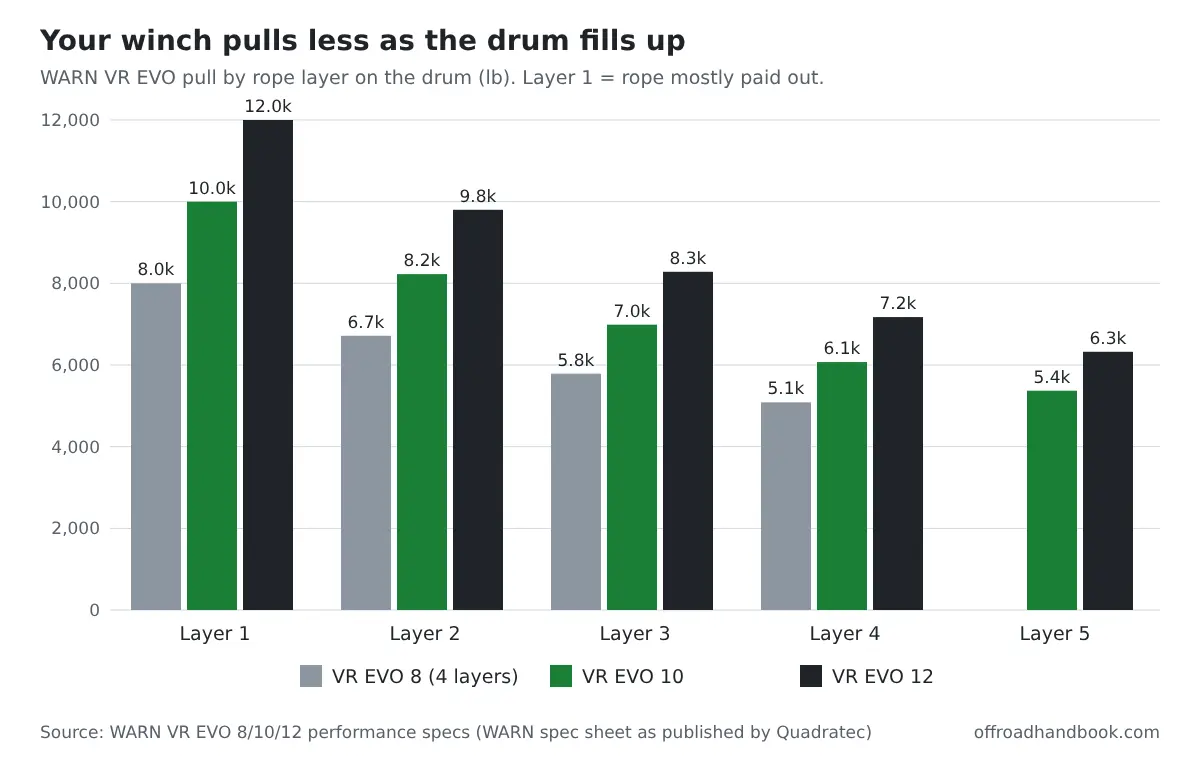
WARN says it plainly in its winching guide: "The maximum pulling capacity occurs on the first layer of winch rope on the drum. As the layers increase, the pulling power decreases." Layer 1 means most of the rope is paid out. On a short pull, most of the rope stays on the drum, so you pull at the top layer's rating, not the number on the box.
| Winch | Rated (layer 1) | Layer 2 | Layer 3 | Layer 4 | Layer 5 | Last layer vs. rated | Line speed, no load / at rated pull | Current at rated pull |
|---|---|---|---|---|---|---|---|---|
| VR EVO 8 | 8,000 lb | 6,716 | 5,788 | 5,085 | none | 64% | 24.8 / 6.0 ft/min | 298 amps |
| VR EVO 10 | 10,000 lb | 8,226 | 6,987 | 6,072 | 5,370 | 54% | 27.1 / 5.2 ft/min | 358 amps |
| VR EVO 12 | 12,000 lb | 9,801 | 8,283 | 7,173 | 6,324 | 53% | 26.2 / 4.0 ft/min | 396 amps |
Two things stand out. Even the biggest model keeps only about half its rated pull by the top layer. And a bigger winch pulls slower and draws more current at full load: the VR EVO 12 slows to 4.0 ft/min at 12,000 lb and draws 396 amps.
What the 1.5× rule looks like at each drum layer
WARN's rule compares your target against the winch's rated pull. Since the rating is a layer 1 figure, here's a stricter reading: for a given GVWR, the highest drum layer at which each VR EVO still delivers 1.5× that weight. This is our analysis of WARN's table, not a WARN requirement.
| GVWR | 1.5× target | VR EVO 8 | VR EVO 10 | VR EVO 12 |
|---|---|---|---|---|
| 4,500 lb | 6,750 lb | Layer 1 | Layer 3 | Layer 4 |
| 5,000 lb | 7,500 lb | Layer 1 | Layer 2 | Layer 3 |
| 5,400 lb | 8,100 lb | Below target | Layer 2 | Layer 3 |
| 6,000 lb | 9,000 lb | Below target | Layer 1 | Layer 2 |
| 6,500 lb | 9,750 lb | Below target | Layer 1 | Layer 2 |
| 7,000 lb | 10,500 lb | Below target | Below target | Layer 1 |
Read the 5,400 lb row. That's the GVWR Quadratec uses in its Jeep winch example. A VR EVO 10 holds 8,100 lb only through layer 2, and the VR EVO 12 through layer 3. If you expect short pulls with most of the rope on the drum, that's a reason to step up a size, which WARN also says you can always do. The same Quadratec guide lists 9,000 to 9,500 lb as common for two-door Wranglers and 10,000 lb for the Wrangler Unlimited, 4xe and Gladiator, with 12,000 lb for heavily equipped Jeeps.
How to stay on the lower layers
- Pull rope out past what you think you need before you hook up, so you start closer to layer 1.
- Use a snatch block for a double line. WARN says it "decreases the number of layers of winch rope on the drum, and increases pulling power." It also slows the pull, and every part in the system has to be rated for the load (Quadratec).
- Keep at least 10 wraps of synthetic rope (5 of steel) on the drum. WARN says never run less, because the rope could come off the drum (WARN).
How much pull do you actually need on a slope?
Gravity and ground resistance set a floor. For a 5,400 lb rig, the chart shows the modeled pull from level ground to a 40° slope. On firm ground it's about 430 lb on the flat and 3,800 lb at 40°. On loose sand it runs from roughly 1,100 to 2,200 lb on the flat and up to 5,100 lb at 40°.
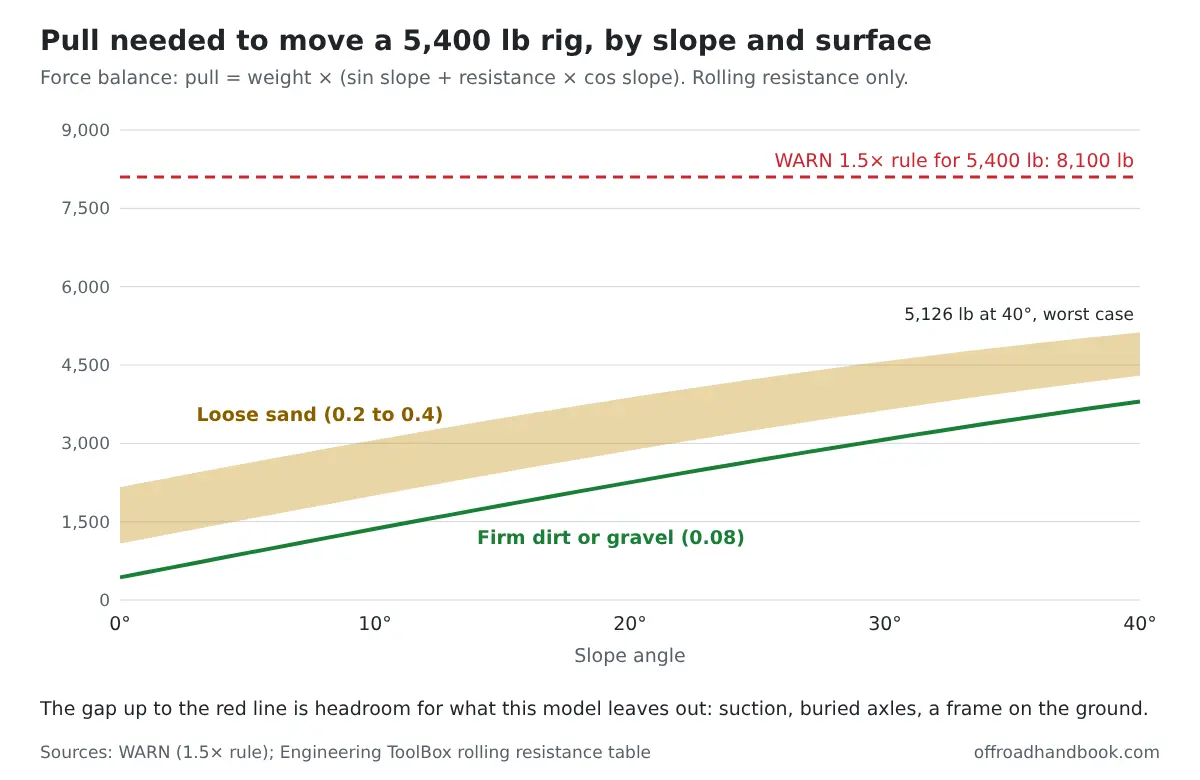
Notice how far the red 1.5× line sits above the worst-case curve. That gap is your margin for the things a clean formula can't see. Quadratec lists them: buried tires in mud, sand or snow, grounded axles or differentials, immobilized wheels, angled pulls and surface suction. So don't size to the curve. Use it to understand why 1.5× exists, and to spot when a pull will be hard on the winch: a heavy rig, a steep slope, loose sand and a nearly full drum all stack up.
ATV and UTV winch size
WARN gives ranges instead of a formula for powersports: 2,500 to 3,500 lb for ATVs, 3,500 to 4,500 lb for two-seat UTVs and 4,500 to 5,500 lb for four-seat UTVs. WARN's winching guide still tells you to take the gross weight of what you intend to pull, multiply by 1.5 and not exceed the rating of the winch or rope.
Setup limits that matter as much as the number
- Battery: WARN lists 650 CCA minimum for winching on the VR EVO line, and the tables above show draws of 298 to 396 amps at full load (spec).
- Heat: "The longer the pull, the more heat that is created. Prolonged winching without cooling the winch motor will damage the motor." Pause on long pulls (WARN).
- Never use a winch or its rope for towing. WARN warns that shock loads can damage, overload and break the rope.
- Wear heavy leather gloves, lay a damper over the rope midway to the anchor, and tell bystanders where not to stand.
- Anchor to something that can take the load. With a snatch block the anchor sees about twice the line load.
Before you rig anything, try the cheap fixes: clear the tires and air down (see our off-road tire pressure guide), and agree on signals with your spotter (off-road spotting signals). If you have a second vehicle, our guide to kinetic ropes, snatch straps and tow straps covers sizing a recovery strap. For building out a trail rig, see our beginner checklist for preparing a Jeep and best Jeep mods for beginners.
Winch size FAQ
Should I use GVWR or curb weight to size a winch?
Use GVWR. WARN says you want the gross vehicle weight rating, not curb weight, and notes it's usually on the sticker in the driver's door jamb.
Is a 9,500 lb winch enough for a Wrangler?
Quadratec lists 9,000 to 9,500 lb as common for two-door Wranglers and moderately equipped four-doors, and 10,000 lb for the Unlimited, 4xe and Gladiator. Use the 1.5× rule on your own GVWR, then check the layer table above for how much of that pull you keep on short pulls.
What does "layer" mean on a winch?
A layer is one level of rope wound across the drum. Layer 1 is when most of the rope is paid out and only a single level remains on the drum. Layer 5 on a VR EVO 10 or 12 is a nearly full drum. Pull is highest on layer 1.
Does a snatch block really double the pull?
Roughly, in theory. Two lines share the load, so each carries about half. Real pulleys lose a little to friction, the pull is slower, and every component and anchor point must be rated for the load. WARN says a snatch block increases pulling power and reduces the layers on the drum.
Sources
- WARN: How to Choose the Right Winch (1.5× GVWR rule, powersports ranges)
- WARN: Basic Guide to Winching (layers, minimum wraps, snatch block, safety, heat)
- Quadratec: WARN VR EVO series (WARN performance specs by layer, speed, current, battery)
- Quadratec: What size winch do I need for my Jeep (GVWR example, ranges, recovery factors)
- Engineering ToolBox: rolling resistance coefficients

I'm Suryashankar Dasgupta, the founder of Off-Road Handbook. I've been off-roading for years in the USA, including California and Texas, and have ridden mountain and desert terrain abroad. I've also driven a Jeep Compass for more than seven years, so I know the day-to-day side of Jeep ownership first-hand, from the Uconnect screen to the warning lights. Every guide here is researched from manufacturer owner's manuals, NHTSA recall and service-bulletin records and other trusted sources, checked against them before it is published, and corrected when we find a mistake. You can read how we work in our editorial policy: https://offroadhandbook.com/editorial-policy/
Like our off-road guides? Add Off-Road Handbook as a Google Preferred Source so our latest Jeep, ATV, UTV, trail, recovery, and off-road troubleshooting articles can appear more often in your Google Search experience.
Add us as a Preferred Source