How Long to Air Up 35s? Air Compressor Fill-Time Calculator
This post contains Amazon affiliate links. As an Amazon Associate I earn from qualifying purchases, at no extra cost to you.
A typical 2-CFM portable compressor needs about 3 to 4 minutes per 35x12.50 tire to go from 15 back to 35 PSI, so plan on roughly 12 to 17 minutes for all four. A twin-motor unit such as ARB's CKMTP12 cuts that to about 5 minutes. Pick a compressor by its flow at 30 PSI, not the bigger 0 PSI number on the box, and make sure its run-time rating covers all four tires.
The calculator below does the math for your exact tire size, pressures and compressor. Under it are the fill times VIAIR actually publishes, a spec table for nine popular 12-volt units, and the duty-cycle and wiring checks that decide whether a compressor finishes the job or quits halfway.
Air-Up Time Calculator for Your Tires and Compressor
Pick a compressor, enter your tire size from the sidewall and the pressures you run, and it estimates the time per tire and for the set. Not sure of your tire's real height? The tire size calculator converts metric sizes to inches.
How it works: the tool treats the tire's air space as a ring (tire height and wheel diameter, times width), takes 90% of that, and adds up the free air each PSI needs (tire volume × pressure change ÷ 14.7). It divides that air by the compressor's published flow at each pressure on the way up. Results are estimates at the makers' test conditions (VIAIR tests at 13.8 volts); expect longer times with the engine off or a tired battery.
I checked this formula against the 29 fill times VIAIR publishes for its 88P, 300P, 400P, 450P and two EF compressors on 31- to 37-inch tires, and with the 90% factor it lands within about 11% of every one. VIAIR names the wheel size only for the EF tests (15-inch), so I assumed 15-inch wheels for the rest.
Published Fill Times: VIAIR's Numbers for 31s to 37s
VIAIR publishes the most detailed fill times of the big brands: per tire size, with the exact pressure range. ARB publishes none, and Smittybilt lists a 5.6 CFM maximum output for its 2781 with no pressure attached. Here are VIAIR's numbers side by side, pulled from each product page.
| Compressor | Tire | Trail refill (PSI range) | From flat (PSI range) |
|---|---|---|---|
| VIAIR 88P | 31 x 10.5 | 2:05 (15–30) | 3:50 (0–30) |
| VIAIR 88P | 33 x 12.5 | — | 5:45 (0–30) |
| VIAIR 300P | 31 x 10.5 | 2:00 (15–30) | 3:25 (0–30) |
| VIAIR 300P | 33 x 12.5 | 2:45 (15–30) | 5:00 (0–30) |
| VIAIR 400P | 33 x 12.5 | 2:05 (15–30) | 4:20 (0–30) |
| VIAIR 400P | 35 x 12.5 | 2:45 (15–30) | 5:20 (0–30) |
| VIAIR 450P-Automatic | 33 x 12.5 | 2:50 (15–30) | 5:30 (0–30) |
| VIAIR 450P-Automatic | 35 x 12.5 | 3:30 (15–30) | 6:55 (0–30) |
| VIAIR 450P-Automatic | 37 x 12.5 | 4:09 (15–30) | 7:56 (0–30) |
| VIAIR 400P EF | 35 x 12.5 R15 | 4:56 (10–40) | 6:25 (0–40) |
| VIAIR 400P EF | 37 x 12.5 R15 | 5:30 (10–40) | 7:15 (0–40) |
| VIAIR 450P EF | 35 x 12.5 R15 | 5:54 (10–40) | 7:41 (0–40) |
| VIAIR 450P EF | 37 x 12.5 R15 | 6:41 (10–40) | 8:50 (0–40) |
Two things jump out. First, the 100%-duty 450P-Automatic is slower per tire than the 33%-duty 400P: it trades flow for the ability to run all day. Second, going from 0 PSI takes about twice as long as a normal trail refill, so a bead you just reseated costs real time.
VIAIR prints the 88P's 33-inch trail refill as "15 to 40 PSI", which doesn't match its other tests, so I left that cell blank rather than guess.
Why the CFM on the Box Isn't What Fills Your Tire
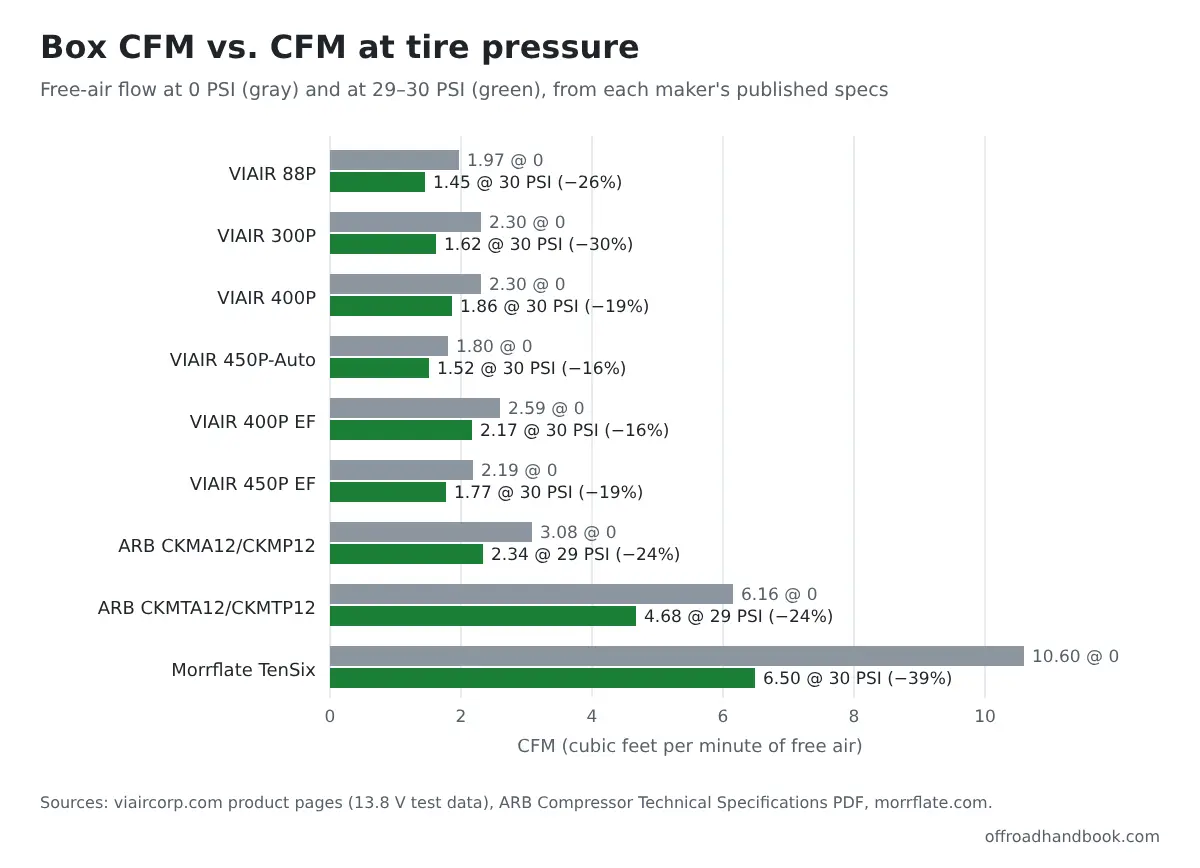
The headline CFM is measured at 0 PSI, pumping into open air. Your tire pushes back, and flow drops as pressure climbs. At 30 PSI the compressors in the chart lose between 16% and 39% of their box rating.
That's why the 30 PSI number is the one to compare. ARB and Morrflate print it right on the spec sheet; VIAIR publishes a full flow table from 0 to 150 PSI. If a maker gives only one CFM figure with no pressure, assume it's the 0 PSI best case.
| Compressor | CFM at 0 PSI | CFM at 30 PSI | Max PSI | Duty cycle / run rating | Max amps |
|---|---|---|---|---|---|
| VIAIR 88P | 1.97 | 1.45 | 120 | 25 min at 30 PSI | 20 |
| VIAIR 300P | 2.30 | 1.62 | 150 | 33% at 100 PSI; 30 min at 30 PSI | 30 |
| VIAIR 400P | 2.30 | 1.86 | 150 | 33% at 100 PSI; about 40 min at 30 PSI | 30 |
| VIAIR 450P-Automatic | 1.80 | 1.52 | 150 | 100% at 100 PSI | 23 |
| VIAIR 400P EF | 2.59 | 2.17 | 150 | 100% at 40 PSI; 33% at 100 PSI | 30 |
| VIAIR 450P EF | 2.19 | 1.77 | 150 | 100% at 100 PSI | 23 |
| ARB CKMA12 / CKMP12 | 3.08 | 2.34 (29 PSI) | 100 | 50% (30 on / 30 off) | 32 |
| ARB CKMTA12 / CKMTP12 | 6.16 | 4.68 (29 PSI) | 150 | 100% | 68.6 |
| Morrflate TenSix | 10.6 | 6.5 | 125 | 80% at 0 PSI (45 on / 10 off) | ~50 running, 90 peak |
Notice that max PSI says nothing about speed. ARB's single-motor CKMA12 tops out at 100 PSI, yet at 29 PSI it moves more air than any VIAIR in the table. For airing up off-road tires, the flow column matters far more than the pressure ceiling.
How Much Compressor Do 33s, 35s and 37s Need?
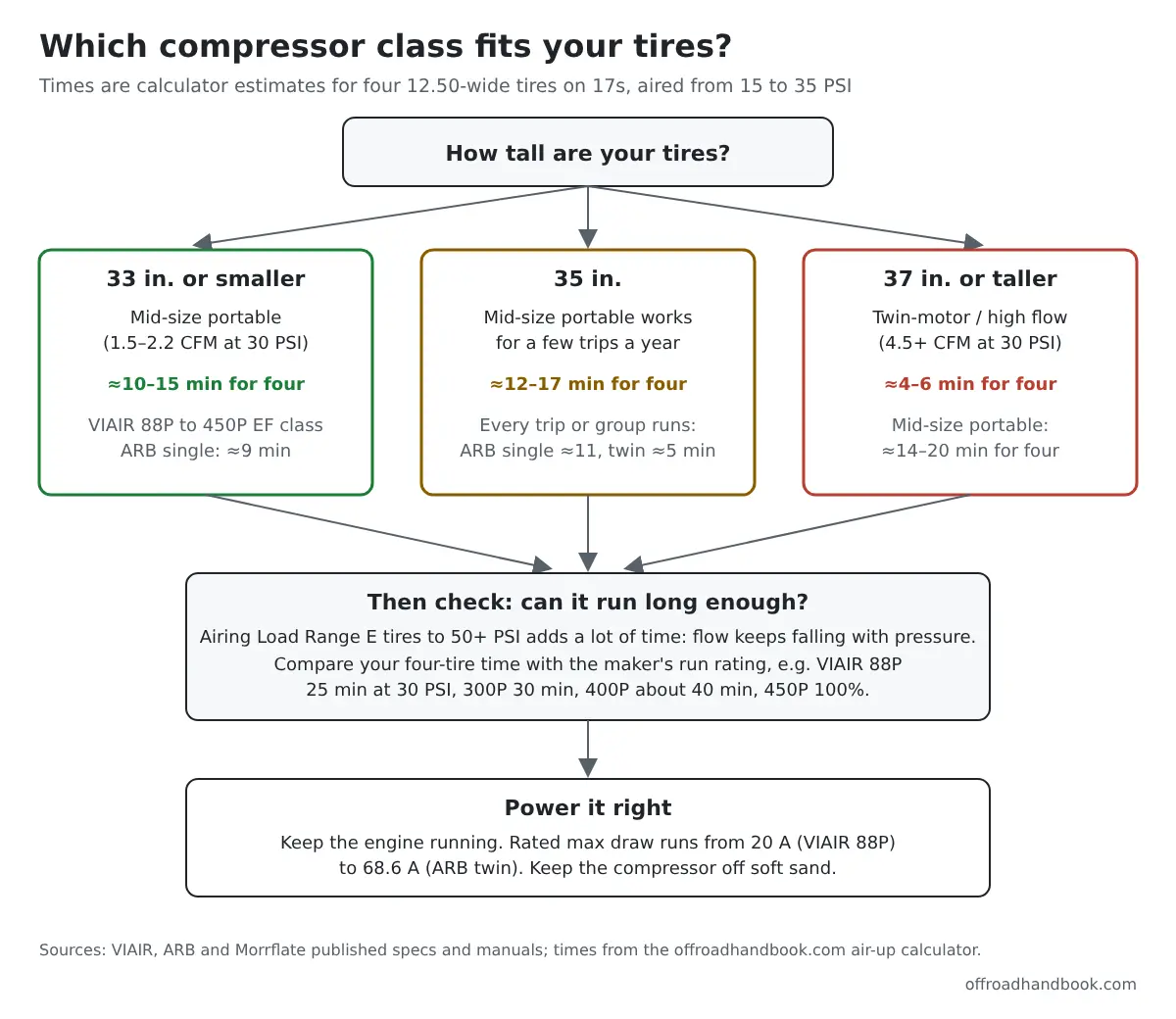
Tire volume grows quickly with height. By the calculator's estimate, a 33x12.50R17 holds about 4.1 cubic feet of air, a 35 about 4.8 and a 37 about 5.5. Bringing one 35 from 15 to 35 PSI takes roughly 6.5 cubic feet of free air, and the compressor has to deliver that against rising back-pressure.
Here's what that means for a full set, using each compressor's published flow curve.
| Compressor | Four 33x12.50R17 | Four 35x12.50R17 | Four 37x12.50R17 |
|---|---|---|---|
| VIAIR 88P | 15 | 17 | 20 |
| VIAIR 300P | 13 | 15 | 18 |
| VIAIR 400P | 12 | 14 | 16 |
| VIAIR 450P-Automatic | 14 | 17 | 19 |
| VIAIR 400P EF | 10 | 12 | 14 |
| VIAIR 450P EF | 12 | 14 | 17 |
| ARB CKMA12 / CKMP12 | 9 | 11 | 12 |
| ARB CKMTA12 / CKMTP12 | 5 | 5 | 6 |
| Morrflate TenSix | 3 | 4 | 4 |
A sensible way to read the table: on 33s, any of the mid-size portables is fine for a few trail days a year. On 35s they still work, but 14 to 17 minutes of airing up gets old if you run every weekend or wait on friends. On 37s and up, a twin-motor or high-flow unit pays for itself in time.
Morrflate says its TenSix PSI Pro airs four 35s from 10 to 40 PSI in about 5 minutes with its four-tire hose kit. The calculator puts that job at about 6 minutes on 17-inch wheels, so the claim is in the right range.
Load Range E Tires and Duty Cycle: Can It Finish the Job?
Duty cycle is how long a compressor may run before it needs to cool. VIAIR's manual says exceeding the duty cycle or pressure rating will damage the compressor, and if the thermal overload trips it suggests letting the unit cool for about 30 minutes before restarting.
Normal trail refills rarely hit those limits. Even the small 88P, rated for 25 minutes at 30 PSI, finishes four 37s from 15 to 35 PSI in about 20 minutes. Heavy tires at high pressure are where it gets tight.
Load Range E tires on a loaded truck can need 50 PSI or more, and flow keeps falling as pressure rises. Taking four 35s from 20 to 50 PSI is about 28 minutes on an 88P, longer than its rating, and about 22 minutes on a 400P. Check what pressure your load range really needs before you size the compressor.
Rule of thumb from the numbers above: if your four-tire time is close to the compressor's run rating, buy the next size up or a 100%-duty model.
Power and Setup on the Trail
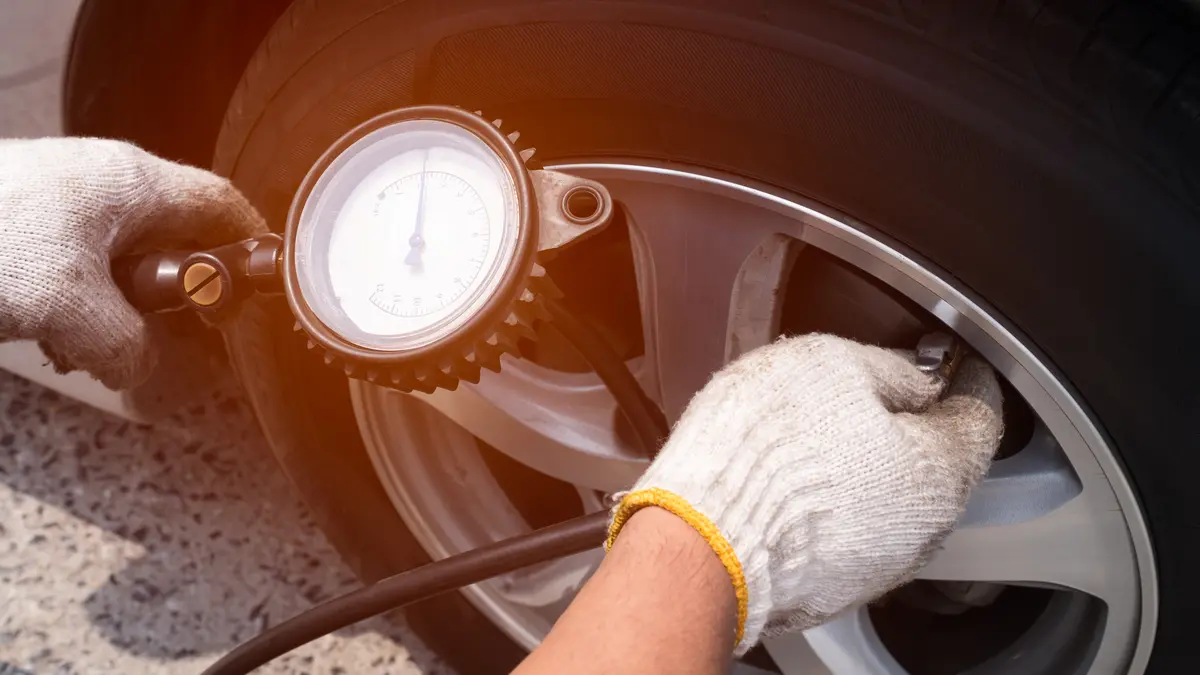
These compressors pull serious current, from 20 A for a VIAIR 88P to 68.6 A for ARB's twin. VIAIR's 400P manual says the engine must be running while you use it, to keep from draining the battery, and that the compressor performs better that way.
- Connect a portable straight to the battery. VIAIR's 400P, for example, uses battery clamps, and its manual has you check the switch is off before you clip on.
- Keep the compressor out of soft sand. VIAIR warns that vibration lets it sink and suck in grit, so set it on a mat, the tailgate or a hard spot.
- Onboard units need wiring sized for their draw. ARB lists 25.2 A under load for the CKMA12 and 50.4 A for the CKMTA12; follow the maker's fuse and wire chart.
- A four-tire manifold doesn't create air. It saves the walk between valves, but the same compressor still has to supply the same total volume.
If you aired down for sand or rocks, the air-down PSI calculator gives a starting pressure by terrain, which also tells you how far you'll have to pump back up. Carry a plug kit too: a compressor is what turns a plugged trail flat into a drivable tire, and it's needed if you ever have to reseat a bead.
Which Compressor to Buy
Base the choice on your tire size and how often you air down, then check the price on Amazon:
- 33s to 35s, a few trips a year: the VIAIR 400P has the best 30 PSI flow of the classic VIAIR portables (1.86 CFM) and about 40 minutes of continuous run time at 30 PSI.
- Long sessions or LR E pressures: the VIAIR 450P-Automatic is slower per tire, but its 100% duty cycle rating suits long sessions and high pressures.
- 35s every trip, 37s and up, or group runs: the twin-motor ARB CKMTP12 flows 4.68 CFM at 29 PSI, about two and a half times a 400P, at 100% duty. Plan for its 68.6 A draw.
FAQ
Is a 150 PSI compressor faster than a 100 PSI one?
Not necessarily. Max pressure is a ceiling, not a speed. ARB's CKMA12 stops at 100 PSI but flows 2.34 CFM at 29 PSI, more than a 150 PSI VIAIR 400P (1.86 CFM at 30 PSI). Compare flow at 30 PSI.
How much air does a 35-inch tire hold?
By the ring-volume estimate this page uses, a 35x12.50R17 holds about 4.8 cubic feet. Refilling it from 15 to 35 PSI takes roughly 6.5 cubic feet of free air.
Can I air up all four tires at once to save time?
A four-tire hose kit saves walking and hose swaps, but total fill time with the same compressor stays about the same because the flow is shared. It helps most with high-flow units like the Morrflate TenSix.
Why does my compressor take longer than the box says?
Box CFM is usually the 0 PSI figure, and VIAIR measures its tables at a 13.8-volt supply. A real tire pushes back, and VIAIR notes its compressors perform better with the engine running, so a battery-only fill will be slower.

I'm Suryashankar Dasgupta, the founder of Off-Road Handbook. I've been off-roading for years in the USA, including California and Texas, and have ridden mountain and desert terrain abroad. I've also driven a Jeep Compass for more than seven years, so I know the day-to-day side of Jeep ownership first-hand, from the Uconnect screen to the warning lights. Every guide here is researched from manufacturer owner's manuals, NHTSA recall and service-bulletin records and other trusted sources, checked against them before it is published, and corrected when we find a mistake. You can read how we work in our editorial policy: https://offroadhandbook.com/editorial-policy/
Like our off-road guides? Add Off-Road Handbook as a Google Preferred Source so our latest Jeep, ATV, UTV, trail, recovery, and off-road troubleshooting articles can appear more often in your Google Search experience.
Add us as a Preferred Source