When to Change Jeep Wrangler Transfer Case Fluid (and What Type)
This post contains Amazon affiliate links. As an Amazon Associate I earn from qualifying purchases, at no extra cost to you.
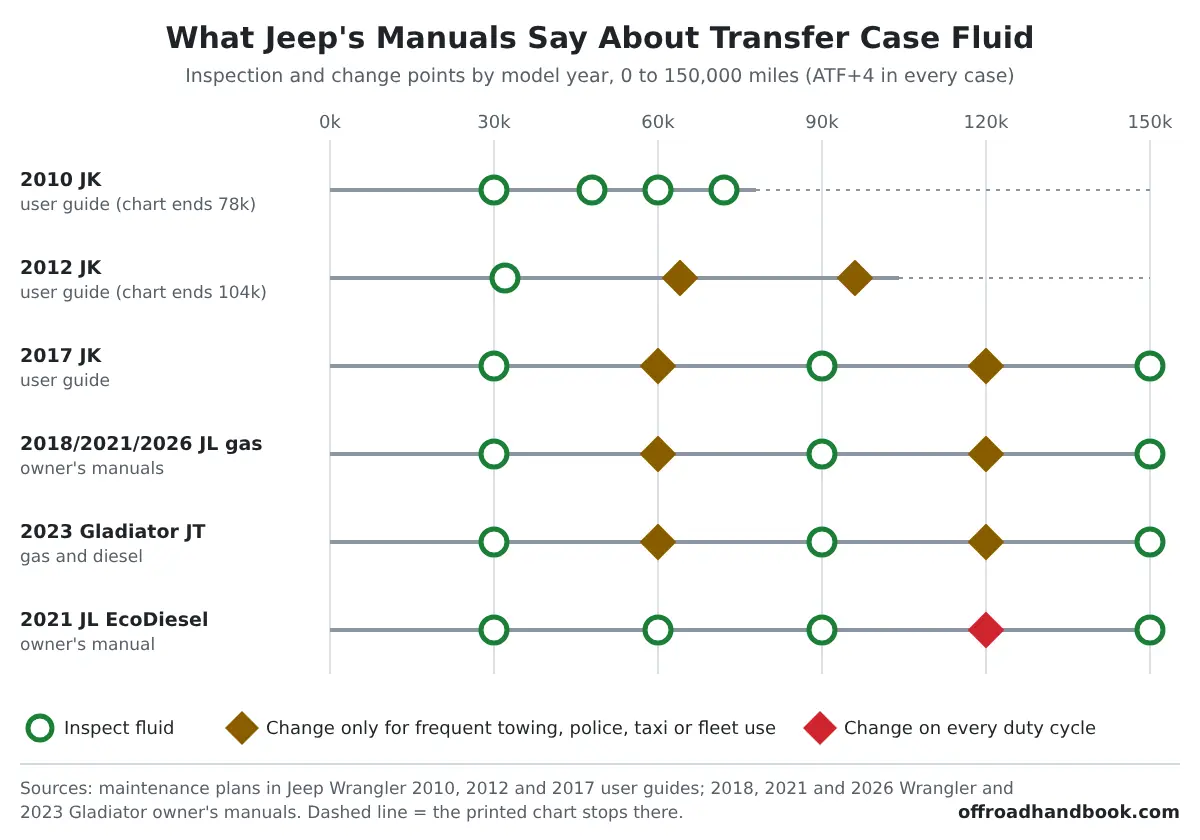
Every Wrangler JK, JL and Gladiator JT manual we checked calls for Mopar ATF+4 in the transfer case. On recent models in normal use, Jeep only asks you to inspect it at 30,000, 90,000 and 150,000 miles. The 60,000- and 120,000-mile changes are for frequent towing or fleet duty, and the 2021 JL EcoDiesel gets a change at 120,000 miles regardless.
There's one exception that overrides the calendar: water. If you've crossed water deeper than the bottom of the differentials, pull the fill plug and look. Milky fluid gets drained now, not at the next service.
Jeep's transfer case fluid schedule, manual by manual
We pulled the maintenance plans and fluids tables from seven Jeep documents, from a 2010 JK user guide to the 2026 JL owner's manual. The fluid never changes. The schedule changes a little, and the diesel is the odd one out.
| Manual | Transfer case fluid | Inspect at | Change at |
|---|---|---|---|
| 2010 Wrangler JK (user guide) | Mopar ATF+4 | 30k, 48k, 60k, 72k miles | Not listed (chart ends at 78k) |
| 2012 Wrangler JK (user guide) | Mopar ATF+4 | 32k miles | 64k and 96k, only for police, taxi, fleet or frequent towing (chart ends at 104k) |
| 2017 Wrangler JK (user guide) | Mopar ATF+4 | 30k, 90k, 150k | 60k and 120k, only for police, taxi, fleet or frequent towing |
| 2018, 2021 and 2026 Wrangler JL, gas | Mopar ATF+4 | 30k, 90k, 150k | 60k and 120k, only for police, taxi, fleet or frequent towing |
| 2021 Wrangler JL, 3.0L EcoDiesel | Mopar ATF+4 | 30k, 60k, 90k, 150k | 120k on every duty cycle |
| 2023 Gladiator JT, gas and diesel | Mopar ATF+4 | 30k, 90k, 150k | 60k and 120k, only for police, taxi, fleet or frequent towing |
If your model year isn't listed, your own manual's maintenance plan wins. The years we checked line up closely, so the nearest row is a fair starting point.
One detail surprises a lot of owners: "off-road" is not a trigger for a transfer case change in any of these plans. Jeep lists off-road use as a reason to change the axle fluid and the manual transmission fluid sooner, but not the transfer case.
Is your transfer case fluid due? Service checker
Pick the manual schedule closest to your Jeep, enter your miles and tick what applies. The checker reads the same table as above and tells you whether a change point has passed since your last fluid change.
How it works: a change is "due" when one of the manual's change points falls between your last change and today's odometer. Towing and fleet change points only count if you tick that box. The result is a schedule reminder, not a diagnosis; a leak, a whine or fluid that looks wrong overrides it.
Why "change it every 60,000 miles" isn't quite what Jeep says
Plenty of how-to pages say the JL manual calls for a check every 30,000 miles and a change every 60,000. That's a misread. The 30,000-mile mark is the first of three inspections, and the 60,000/120,000-mile change sits on a line that starts "if using your vehicle for any of the following: police, taxi, fleet, or frequent trailer towing."
So a gas Wrangler that never tows has no scheduled transfer case fluid change through 150,000 miles. That doesn't mean a change is a waste. It means the choice is yours, and that the people who should be strict about it are the ones who tow, wheel hard or cross water.
Our take: if you wheel regularly, a fluid change around the 60,000-mile mark is cheap insurance for a case that sees heavy 4-Low loads. If you also run the manual transmission, Jeep wants that fluid changed every 30,000 miles for off-road use, and it takes the same ATF+4, so doing both on the same day makes sense.
Towing a camper or a trailer most weekends counts as "frequent trailer towing." If you're near your Wrangler's limit, our Wrangler towing capacity guide by model year shows the factory ratings.
After a water crossing: when to drain it right away
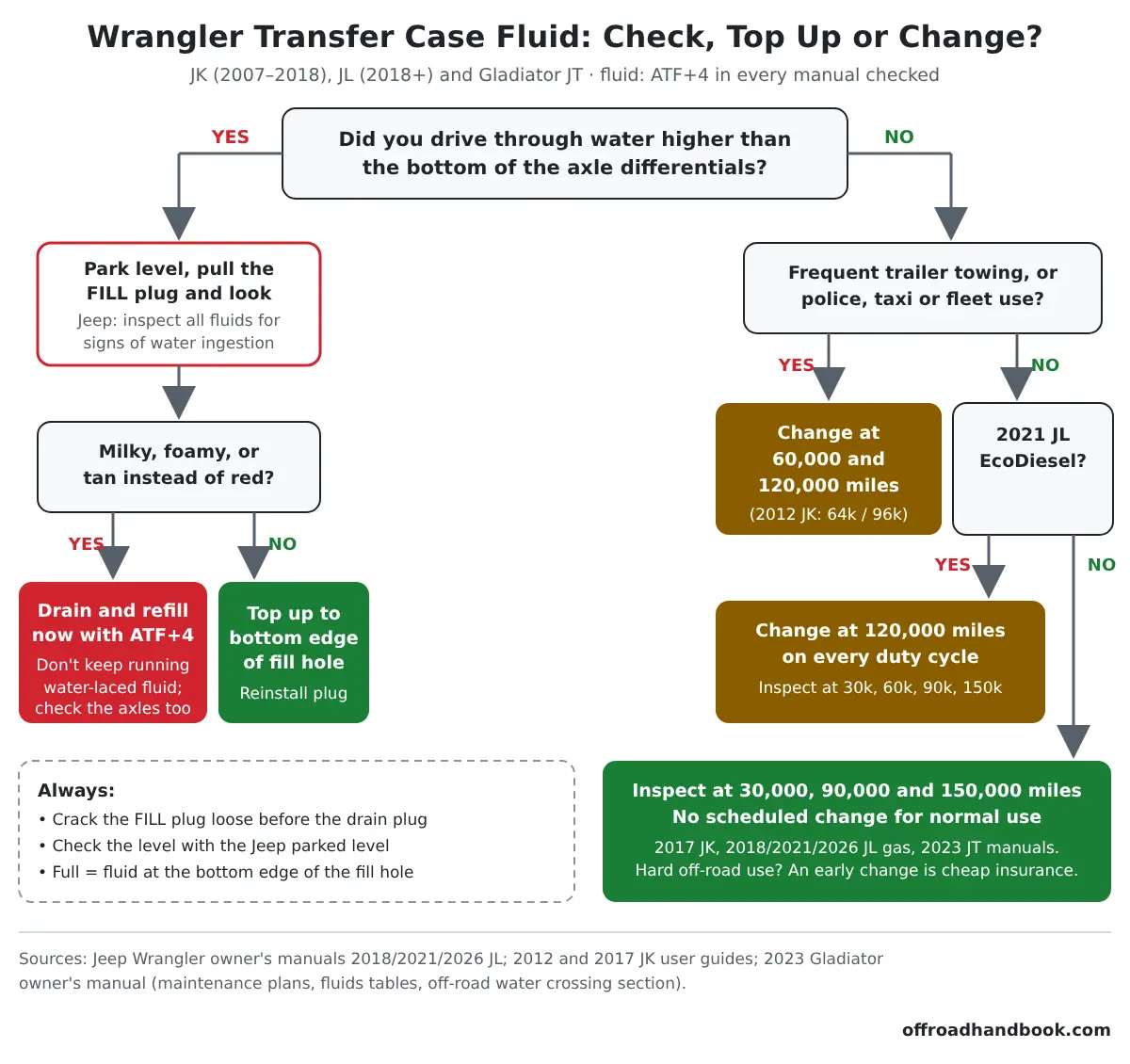
Jeep's off-road section is specific: after crossing any water higher than the bottom of the axle differentials, inspect all of the vehicle fluids for signs of water ingestion. Jeep's caution in the same section lists the transfer case alongside the axles, transmission and engine as places water can get in if you drive too fast or too deep.
Here's how to read what comes out of the fill hole:
- Clear red or slightly darker red: normal ATF+4. Top up to the bottom edge of the fill hole if it's low.
- Pink, milky or foamy: water is mixed in. Drain and refill now. Water-laced fluid lubricates poorly and the chain, bearings and shift parts pay for it.
- Tan sludge or grit on the drain plug: water plus contamination. Drain, refill and recheck soon after; if it comes back the same, have the vent and seals looked at.
Check the axles while you're under there. They take gear oil, not ATF, and Jeep's manuals list off-road use as a reason to change them on a shorter schedule. Our guide to Jeep problems after mud or water covers brakes, bearings and electrical checks after a soaking.
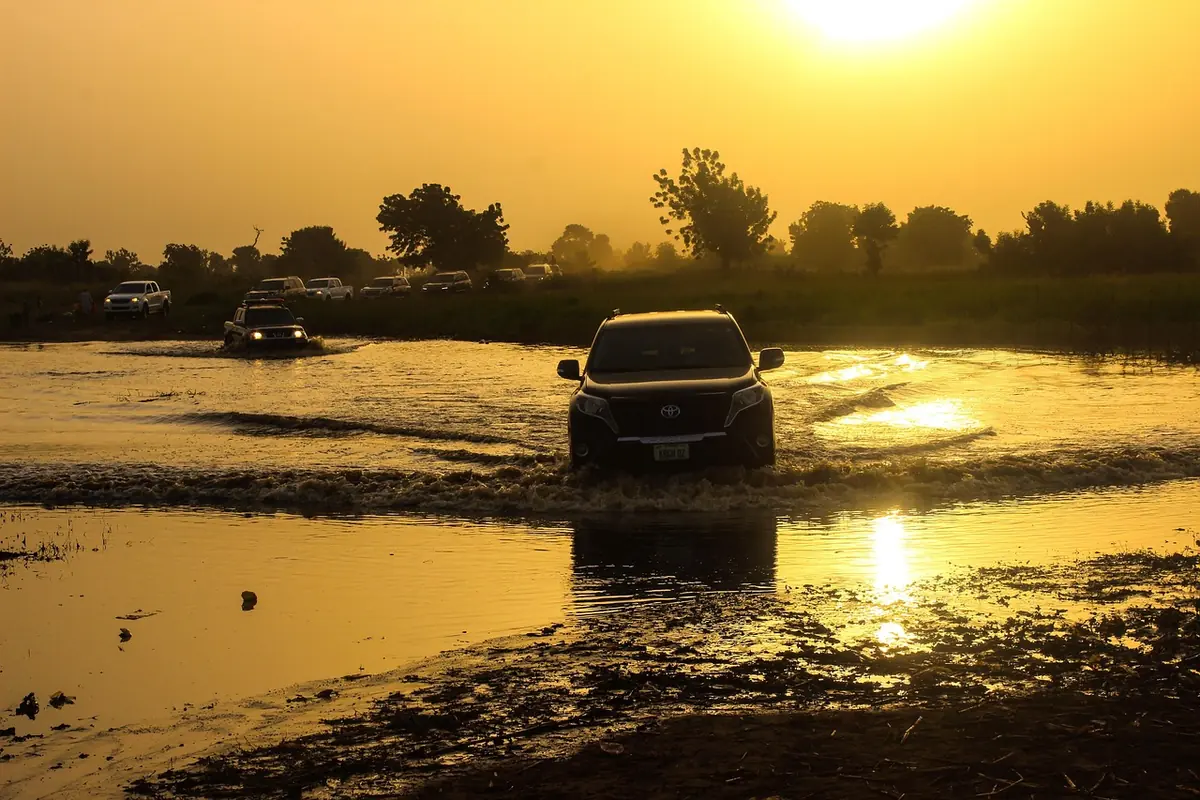
Prevention beats a fluid change. Before the next crossing, our water crossing depth checker compares the water with your Jeep's rated fording depth and intake height.
How much ATF+4 to buy
Jeep's US owner's manuals don't print a transfer case capacity. They give a level instead: with the vehicle level, the fluid should reach the bottom edge of the fill hole. That's the number that matters, because it's how you know the case is full.
For the NV241 family used in the JK, Quadratec's and ExtremeTerrain's capacity charts both list about 2.1 quarts (2.0 liters). We couldn't find a JL or JT figure that two independent sources agree on, so we won't print one. Fill to the hole and you're right regardless.
Buying a six-pack of Mopar ATF+4 quarts (68218057AB) covers the transfer case with spare quarts for top-ups. Check the current price on Amazon.
Don't grab the wrong bottle on a JL. Its 850RE eight-speed automatic takes Mopar ZF 8 & 9 Speed ATF, not ATF+4, according to the 2018 and 2026 manuals.
On a JK, the automatic and the transfer case both took ATF+4. And never put gear oil in the transfer case: the 75W-85 and 75W-140 lubes in the fluids table belong in the axles.
Not sure which case you have? Command-Trac, Rock-Trac and Selec-Trac all take ATF+4 in these manuals, and our Command-Trac vs Rock-Trac vs Selec-Trac guide shows how to tell them apart.
How to drain and refill a Wrangler transfer case
This is a driveway job if you can get under the Jeep safely. Jeep's manual shows the fill hole on the case above the drain hole. Plug sizes and torque values vary by case and year, so take those from a service manual or your dealer rather than a forum post.
You'll need ATF+4, a hand fluid pump that fits quart bottles, an oil drain pan, sockets or hex bits to suit your plugs, rags and wheel chocks.
- Park level and secure it. Flat ground, transmission in Park (or in gear for a manual), parking brake on, wheels chocked. If you lift it, use jack stands rated for the Jeep. Never work under a Jeep held up only by a jack.
- Leave the transfer case in 2H. Neutral is for flat towing and lets the Jeep roll even in Park, so don't leave it there while you work.
- Remove the skid plate if it's in the way. Some owners drain around it; removing it keeps fluid off the plate and gives you room.
- Break the fill plug loose first. If it's seized, you've lost nothing. If you drain first and the fill plug won't budge, the Jeep can't be driven.
- Drain. Pull the drain plug, let it empty, and look at the fluid and any metal on a magnetic plug. Fine paste is normal wear; chunks or flakes are not.
- Reinstall the drain plug. Clean the threads and use a new washer or the thread sealant your service manual calls for.
- Fill until it runs out. Pump ATF+4 into the fill hole until it starts to dribble back out of the hole. That's the bottom-edge level Jeep specifies.
- Reinstall the fill plug and check for leaks. Drive a few miles, shift through 2H, 4H and 4L once, then look for drips.
Stiff shifting on a cold morning is normal: Jeep's manual says you may feel increased shifting effort in cold weather until the transfer case fluid warms up. If it still won't go into 4-Low once warm, see how to shift into 4-Low and what to do when it won't go.
Transfer case fluid FAQ
Can I use Dexron or a "universal" ATF instead of ATF+4?
Jeep's manuals recommend Mopar ATF+4 for the transfer case. Many universal fluids say they meet the ATF+4 spec on the label. If yours does, it's the label claim you're relying on, not Jeep's. When in doubt, use ATF+4.
Is the transfer case fluid "lifetime" on a Wrangler?
Not officially. Jeep schedules inspections at 30,000, 90,000 and 150,000 miles on recent models, and changes for towing and fleet use. A gas Wrangler in normal use has no scheduled change through 150,000 miles, which is where the "lifetime" idea comes from.
How do I check the level without changing the fluid?
Park on level ground and remove the fill plug. Fluid should be right at the bottom edge of the hole. If you can't touch it with a fingertip just inside the hole, add ATF+4 until it starts to run out, then reinstall the plug.
Does the Wrangler 4xe follow the same schedule?
We didn't verify a separate 4xe maintenance plan for this guide, so check the 4xe section of your owner's manual. The fluids table in the 2026 Wrangler manual lists ATF+4 for the transfer case.
Want more numbers for your build? All of our free tools, from tire size to regearing, are on the off-road calculators page.

I'm Suryashankar Dasgupta, the founder of Off-Road Handbook. I've been off-roading for years in the USA, including California and Texas, and have ridden mountain and desert terrain abroad. I've also driven a Jeep Compass for more than seven years, so I know the day-to-day side of Jeep ownership first-hand, from the Uconnect screen to the warning lights. Every guide here is researched from manufacturer owner's manuals, NHTSA recall and service-bulletin records and other trusted sources, checked against them before it is published, and corrected when we find a mistake. You can read how we work in our editorial policy: https://offroadhandbook.com/editorial-policy/
Like our off-road guides? Add Off-Road Handbook as a Google Preferred Source so our latest Jeep, ATV, UTV, trail, recovery, and off-road troubleshooting articles can appear more often in your Google Search experience.
Add us as a Preferred Source