Polaris Sportsman 450 Problems: 7 Common Issues and Fixes
Last updated on October 20th, 2026 at 06:11 pm
This post contains Amazon affiliate links. As an Amazon Associate I earn from qualifying purchases, at no extra cost to you.
The Polaris Sportsman 450 H.O. is a simple, popular utility ATV, and most of its trouble comes from a short list: a weak battery or dirty terminals, a worn or wet drive belt, AWD that is not engaged the way the manual describes, heat from packed mud, and a wiring-harness recall on 2021–2023 machines.
Below, each problem is ordered the way a mechanic checks it, free checks first, with the numbers taken from Polaris’s own Sportsman 450/570 owner’s manual. Anything the manual does not give is marked as a shop job rather than guessed.
Sportsman 450 problems at a glance
| What you see | Check first (free) | Next step | Who fixes it |
|---|---|---|---|
| Hard to shift, or in gear but not moving | Full stop, engine at idle, parking brake off | Inspect belt and clutch | Shop for linkage or clutch |
| Click or no crank | Battery terminals and charge level | Test battery under load, starter circuit | Shop if the battery tests good |
| Hot smell, slipping, burnt belt | Low range for slow or heavy work | Drain the PVT cover, inspect belt | Shop for clutch cleaning |
| Front wheels not pulling | Switch position and engine rpm | Check ADC conditions | Dealer for front drive faults |
| Engine Hot lamp | Stop, let it cool, clear mud from the radiator | Coolant level, leaks | Pressure test at a shop |
| EPS lamp or heavy steering | Battery and connections | Read the fault on the gauge | Dealer |
| Check Engine lamp | Stop riding | Note the code before key-off | Dealer |
Check in this order
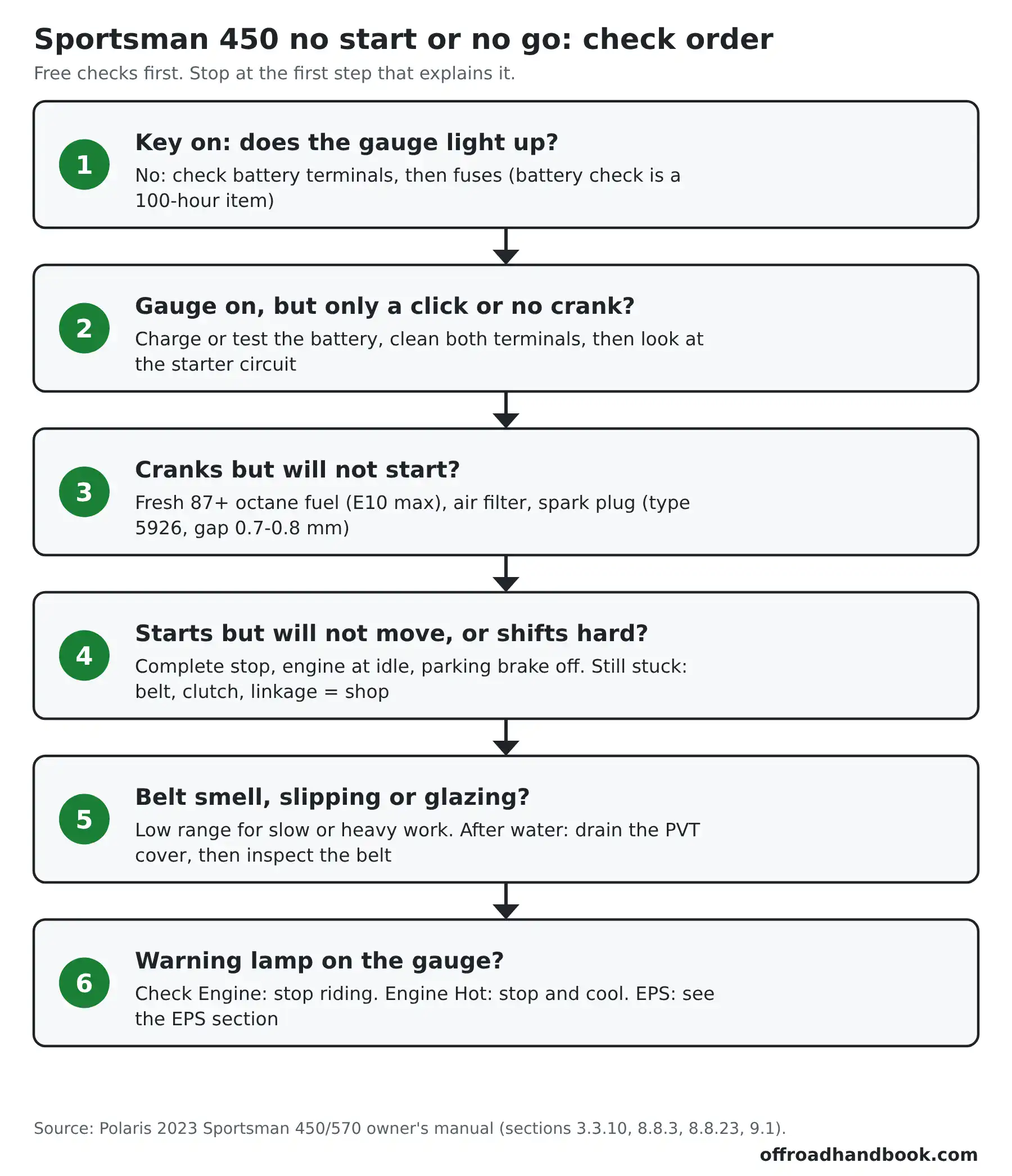
Start at the top and stop at the first step that explains the problem. Steps 1 to 3 cost nothing but a few minutes. Steps 4 and 5 are free until you open the belt cover.
Never ride with the Check Engine lamp on. The manual says not to operate the vehicle when that warning appears, because serious engine damage can follow.
What is your Sportsman doing?
The checker only repeats steps from the manual and the table above. It cannot read codes or inspect the machine, so treat it as an ordered checklist.
1. Hard to shift, or in gear but not moving
The manual is blunt about shifting: brake to a complete stop, move the lever only with the engine at idle, and put the transmission in Park whenever you leave the machine. Shifting above idle or while rolling can damage the transmission.
If it still binds after a full stop at idle, check that the parking brake is fully released. Linkage adjustment and clutch drag are not owner procedures in the sections of the manual reviewed here, so hand those to a Polaris shop.
2. Clicks but will not crank
Battery first. The manual lists a battery check every 100 hours or yearly: check the terminals, clean them and test the battery. Disconnect the negative cable first and connect it last.
A battery can read fine at rest and still fail when the starter loads it. Charge it, test it under load, and only then look at the starter circuit. A battery maintainer keeps one healthy through storage, for example a 12-volt battery maintainer.
3. Belt slipping, smelling hot or breaking
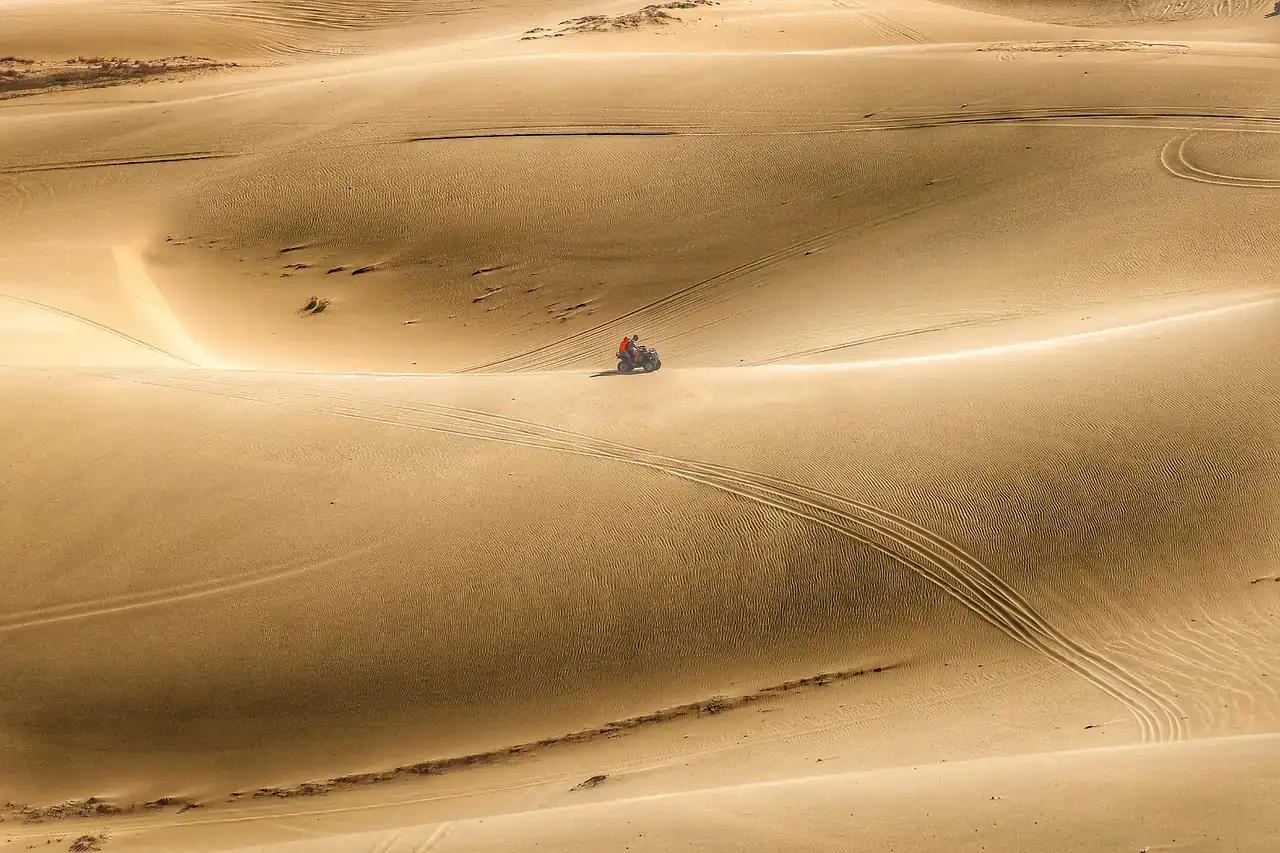
Belt wear is mostly about how the machine is used. Polaris says to use low forward gear when pulling a heavy load and when climbing slowly, and to use low for rough terrain, loading onto a trailer, or riding below 7 mph.
Inspect the drive belt every 100 hours or yearly and replace it as needed. Hard use cuts every interval in half: the manual defines severe use as frequent mud, water or sand immersion, or extended idling.
Water in the clutch cover
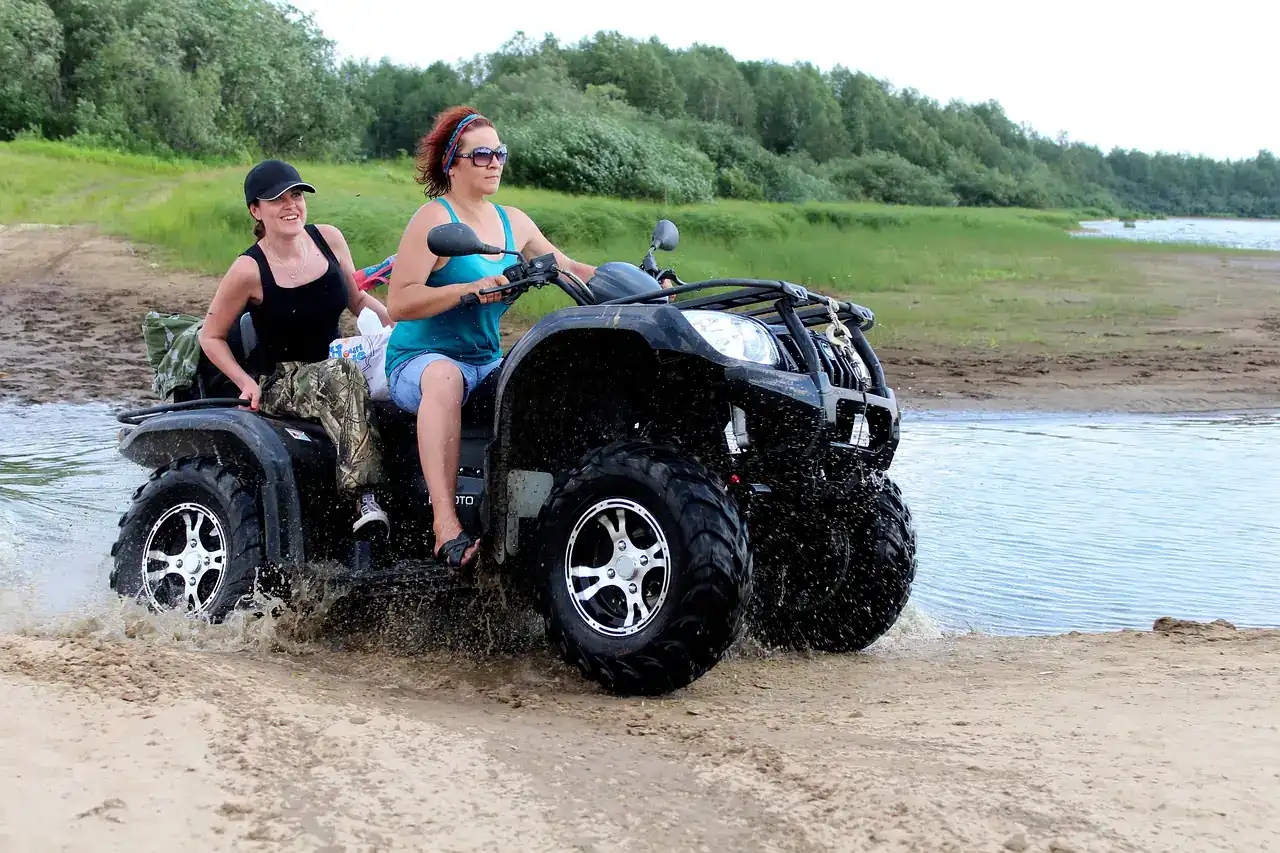
After water gets into the PVT cover, the manual’s drying procedure is simple. Remove the drain plug, let it drain fully, reinstall the plug, then run the engine with varying throttle for 10 to 15 seconds.
Polaris also says never to run in fast-flowing water or water deeper than the vehicle’s floor level. After a crossing, test the brakes by applying them lightly several times at low speed, because wet brakes may stop less effectively.
4. AWD or ADC not engaging
The Sportsman’s demand drive engages when the rear wheels lose traction and releases when they grip again. Polaris says to switch to AWD while the rear wheels have traction or are at rest, not after they are already spinning.
On standard models, AWD only enables below 3000 rpm. California, HD Utility LE and Ultimate Trail models use 3100 rpm. ADC mode needs all four conditions: switch in ADC 4X4, 15 mph or less, throttle closed, and the transmission in gear.
If those conditions are met and the front wheels still do nothing, that is a dealer diagnosis. The manual gives no owner test for the front drive.
5. Overheating and the Engine Hot lamp
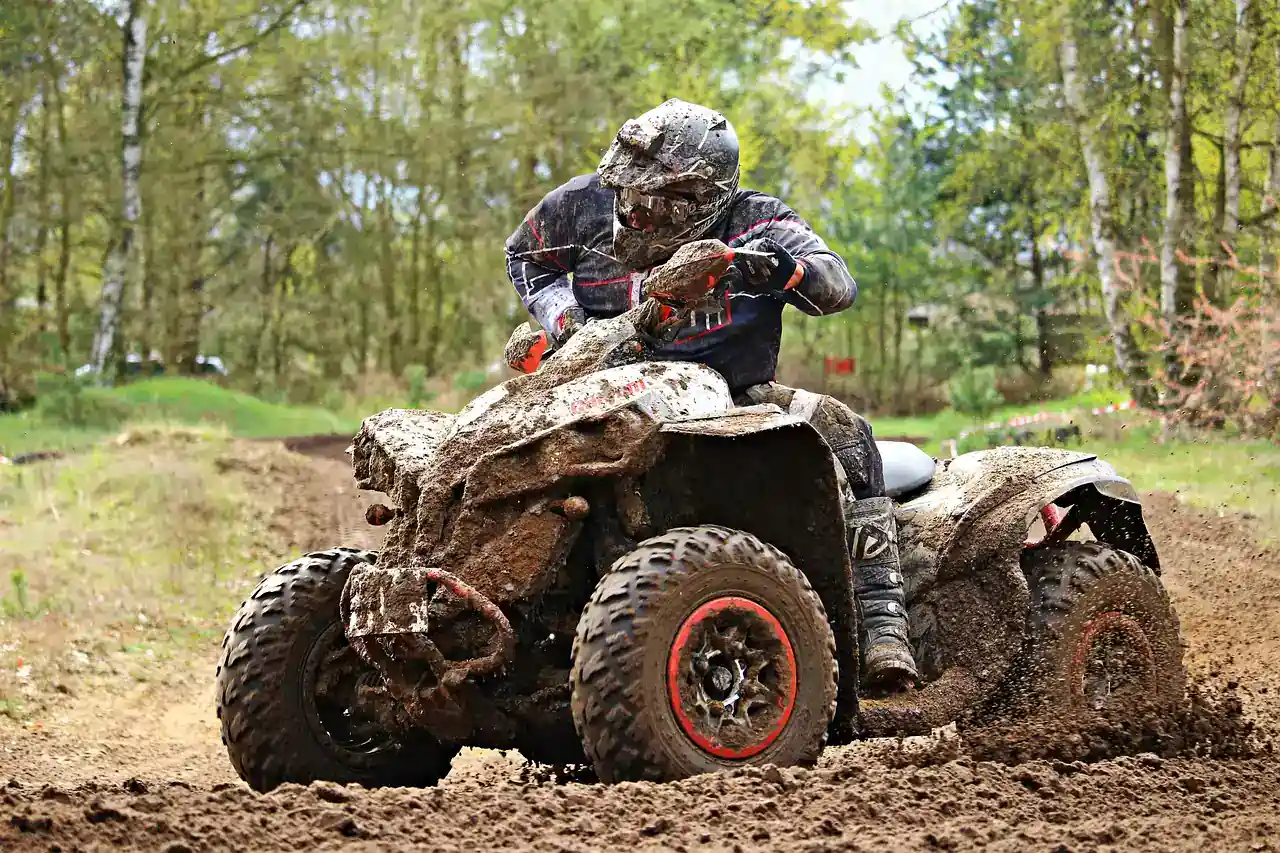
A lit Engine Hot lamp means an overheated engine, and a flashing lamp means a severe case. Stop and let it cool before doing anything else.
Packed mud is the usual first suspect, so wash the radiator gently once it is cool. Then check coolant level. Polaris specifies its 50/50 premix antifreeze, says not to dilute it, and lists a coolant change every 60 months and a cooling-system level check and yearly pressure test.
6. EPS warning or heavy steering
The EPS lamp lights when the system sets a fault. The manual notes that EPS operation is possible with the key on and the engine off for up to 5 minutes.
Check the battery and its connections first, since they are free. Any EPS fault that stays on belongs at a dealer.
7. Check Engine lamp and fault codes
Polaris says not to operate the vehicle with the Check Engine warning on. Codes show on the gauge only if the fault was set during the current ignition cycle.
Turning the ignition off clears saved codes from the gauge. Write the code down before you shut the machine off, then give it to the dealer.
Recall: 2021–2023 wiring harness
Polaris and the CPSC announced recall 23-734 on March 16, 2023, for certain model year 2021–2023 Sportsman 450 and 570 ATVs. A harness can contact the brake line or frame, which can cause loss of front brakes or a fire (CPSC recall notice).
Stop riding an affected machine and call a Polaris dealer; the repair is free. Check your VIN on Polaris’s recall page, since only certain VIN ranges are covered.
Own the bigger Sportsman 570? It shares this harness recall, but it also has its own 2014–2017 fuel-leak recalls and different specs, covered in our Polaris Sportsman 570 problems guide.
Maintenance schedule from the manual
| When | Service |
|---|---|
| First 25 hours / 500 miles | Change engine oil and filter and front gearcase fluid; check transmission fluid |
| Every 100 hours / 1,000 miles or yearly | Replace air filter; check battery; inspect drive belt; check cooling system |
| Every 200 hours / 2,000 miles | Change engine oil and filter, transmission fluid and front gearcase fluid; inspect spark plugs |
| Every 24 months | Change brake fluid (DOT 4) |
| Every 60 months | Change coolant |
Oil is Polaris PS-4 5W-50, 2 quarts. Use unleaded fuel of at least 87 octane with no more than 10% ethanol. Replace brake pads at 0.030 inch.
| Spec | Sportsman 450 H.O. |
|---|---|
| Engine | 499 cc, single cylinder, 4-stroke |
| Spark plug | Type 5926, gap 0.7–0.8 mm |
| Fuel tank | 4.5 gal |
| Tires and pressure | 25x8-12 front, 25x10-12 rear, 7 psi |
| Ground clearance | 11.5 in |
| Hitch towing rating | 1,350 lb |
For the same kind of checks on other machines, see our ATV and UTV troubleshooting guide, the Polaris Ranger 1000 problems guide and the Ranger 700 XP guide.
More free tools are on our off-road calculators page.
FAQ
Battery and terminal problems, drive belt wear or water in the clutch cover, overheating from packed mud, and AWD that was not engaged as the manual describes. 2021–2023 machines also have a wiring-harness recall.
The 2023 manual lists the first change at 25 hours or 500 miles and then every 200 hours or 2,000 miles, at half those intervals for severe use. Use PS-4 5W-50, 2 quarts.
Certain 2021–2023 Sportsman 450 and 570 VINs are covered by CPSC recall 23-734 for a wiring harness that can contact the brake line or frame. Check your VIN with Polaris or a dealer.
Stop completely, let the engine idle and release the parking brake, as the manual requires. If it still binds, linkage or clutch drag needs a Polaris shop.
The manual lists type 5926 with a 0.7–0.8 mm gap, torqued to 15 ft-lb on the 450 engine.

I'm Suryashankar Dasgupta, the founder of Off-Road Handbook. I've been off-roading for years in the USA, including California and Texas, and have ridden mountain and desert terrain abroad. I've also driven a Jeep Compass for more than seven years, so I know the day-to-day side of Jeep ownership first-hand, from the Uconnect screen to the warning lights. Every guide here is researched from manufacturer owner's manuals, NHTSA recall and service-bulletin records and other trusted sources, checked against them before it is published, and corrected when we find a mistake. You can read how we work in our editorial policy: https://offroadhandbook.com/editorial-policy/
Like our off-road guides? Add Off-Road Handbook as a Google Preferred Source so our latest Jeep, ATV, UTV, trail, recovery, and off-road troubleshooting articles can appear more often in your Google Search experience.
Add us as a Preferred Source