Can-Am Maverick X3 Problems: Belt Overheat, PPS Fault, Limp Home
Last updated on October 26th, 2026 at 08:46 pm
This post contains Amazon affiliate links. As an Amazon Associate I earn from qualifying purchases, at no extra cost to you.
Most Can-Am Maverick X3 problems come back to the CVT drive belt and what overheats it: riding in high range when BRP says to use low, holding wide-open throttle in heat, sand or mud, and water getting into the CVT. Almost everything else shows up as a gauge message that points straight at the cause.
So read the message first (LOW GEAR, BELT OVERHEAT, LIMP HOME, PPS FAULT), then work through the table and check order below. Everything here comes from BRP's own Maverick X3 operator's guides and CPSC recall records, not forum guesses, and we flag model-year differences.
The 8 most common Maverick X3 problems at a glance
| Problem | What you notice | Most likely cause (per BRP) | First fix |
|---|---|---|---|
| 1. Belt slipping or failing | Burnt-rubber smell, weak take-off, then no drive | High range used where low is required; long wide-open throttle | Shift to LOW for slow, heavy or wet work; replace belt and clean CVT if it failed |
| 2. LOW GEAR or BELT OVERHEAT message | Torque cut, warning light, buzzer | Too slow in HIGH, or belt area above 167°F for over 1 minute | Stop, shift to LOW, slow down, let it cool below 158°F |
| 3. Engine revs, car won't move | RPM climbs, no motion, often right after water | Water in the CVT, or a broken belt | Engine off, drain the CVT; inspect the belt |
| 4. Overheating / torque limitation | High temp reading, power fades | Mud-packed radiator fins, low coolant, fan or fan fuse | Let it cool, clean the fins, check fan fuse and coolant |
| 5. LIMP HOME or TPS FAULT | Check engine light, reduced power | Stored critical fault; throttle body fault | Ride out gently, get the codes read soon |
| 6. Pedal does nothing (PPS FAULT) | Accelerator partly or fully dead | Failed pedal position sensor(s) | Hold the override switch to limp out; see a dealer |
| 7. Won't crank or won't start | No crank, or cranks without firing | D.E.S.S. key, not in PARK/brake not pressed, fuse, battery, flooded engine | Clean and reseat the key, press the brake, check fuses; use drowned mode if flooded |
| 8. Stuck at about 12 mph | ENGINE LIMITATION ENGAGED FASTEN SEAT BELT | Driver's seat belt not buckled | Buckle the driver's belt |
Notice how many rows point back to the belt. The X3's turbo three-cylinder makes a lot of torque through a rubber belt, and BRP's guide says plainly that the main reason the belt slips is being in high range when it should be in low.
That's good news for your wallet. Several of the "problems" owners pay a shop to chase are really range choice, heat management or a message the gauge already explained.
What to check first when an X3 loses power or won't move
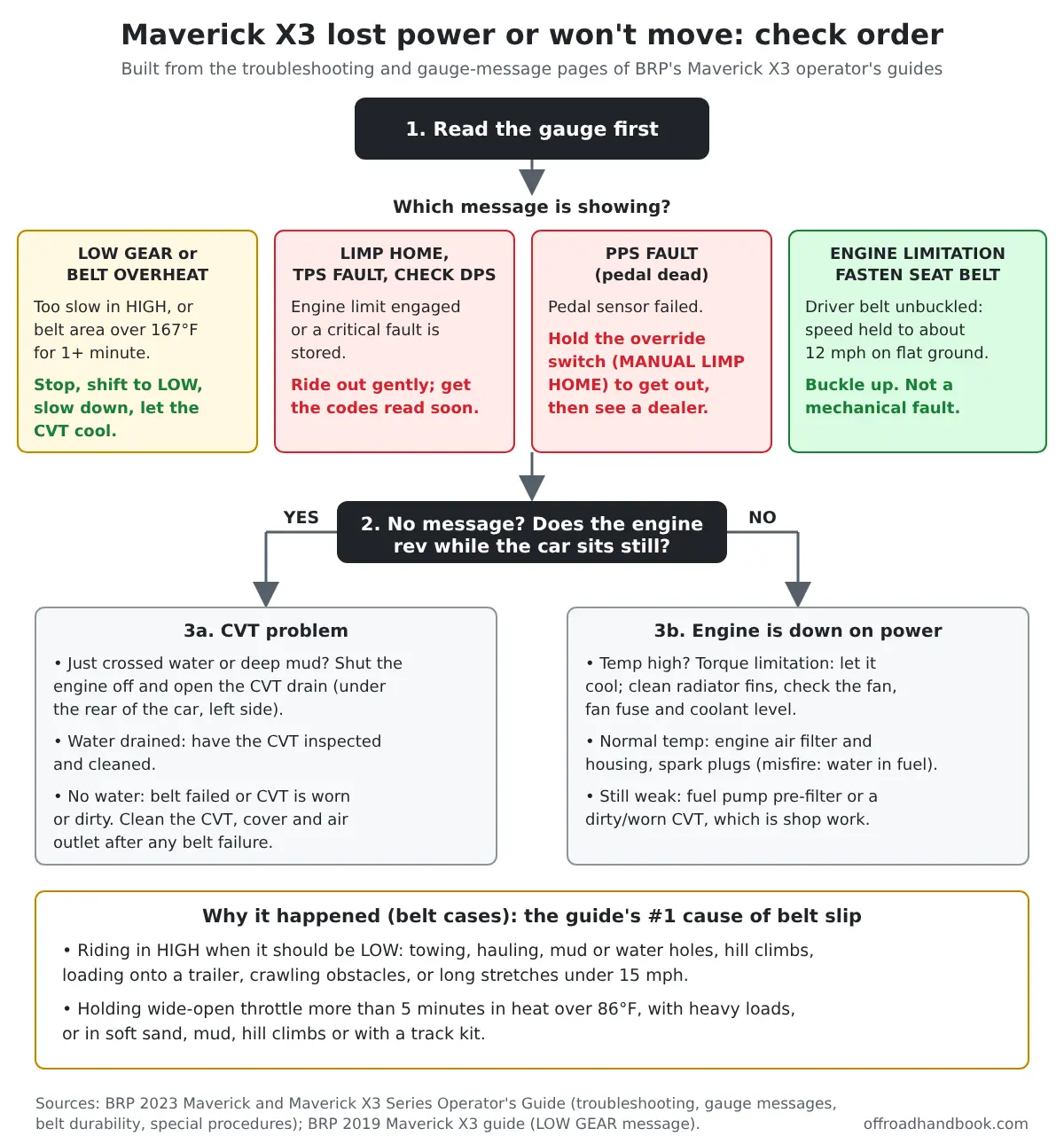
Step one is always the multifunction gauge. BRP's guide pairs each abnormal condition with a message, so a LOW GEAR warning and a PPS FAULT lead to completely different fixes even though both feel like "it lost power."
No message? Then the split is simple. If the engine revs and the car sits still, the problem is in the CVT. If the car moves but feels flat, look at heat, air, spark and fuel in that order.
Maverick X3 problem checker
Pick the symptom and tick what was going on when it happened. The checker returns the likely causes and first steps in the order BRP's guide lists them.
The checker only re-orders BRP's published troubleshooting steps and adds the guide's belt rules when your answers match them. It can't read fault codes, so anything with a CHECK ENGINE light still needs a scan.
1. Belt slipping, glazing or snapping
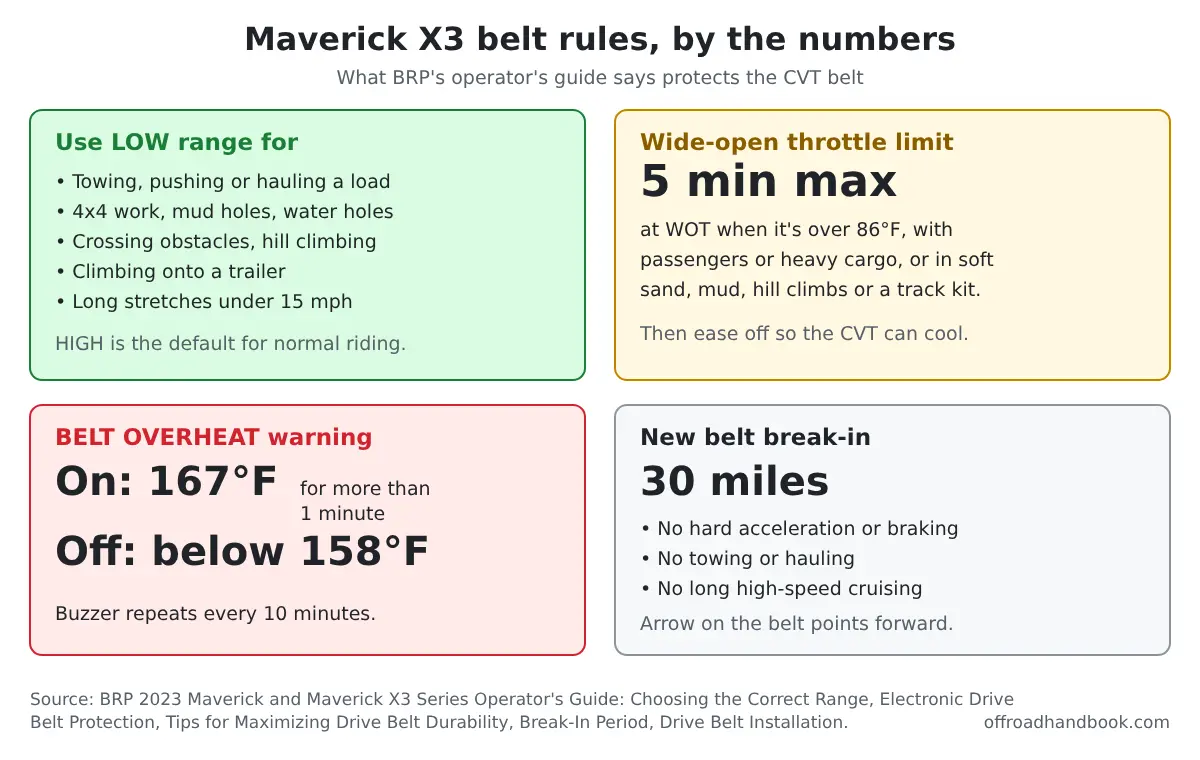
Belt trouble is the complaint you'll hear most about the X3, and BRP's guide is blunt about why: the belt slips when the gearbox is in high range and should be in low. Slip creates heat, heat glazes the belt, and a glazed belt slips more until it lets go.
BRP wants low range for pulling, pushing, hauling, 4x4 work, mud and water holes, crossing obstacles, climbing onto a trailer and hill climbing. It also recommends low for long stretches under 15 mph, which covers a lot of tight Midwest and Southeast woods trails.
The second belt killer is sustained wide-open throttle. When it's above 86°F, when you're carrying passengers or heavy cargo, or when you're in soft sand, mud, hill climbs or running a track kit, BRP says not to hold WOT for more than five minutes. Think long dune pulls at Glamis or the Little Sahara in Utah on a summer afternoon.
A fresh belt also needs a 30-mile break-in with no hard acceleration or braking, no towing and no long high-speed cruising. Install it with the printed arrow pointing toward the front of the vehicle, viewed from the top.
If a belt does fail, don't just drop in a new one. The guide says the CVT, cover and air outlet must be cleaned after a belt failure, because leftover belt debris chews up the replacement. Carry a spare that matches the BRP part number for your engine (search Can-Am Maverick X3 drive belts on Amazon and confirm fitment against your model before buying).
2. LOW GEAR or BELT OVERHEAT on the gauge
These two messages are the X3 protecting its own belt. On models where electronic drive belt protection is available and activated, riding too slowly in high range during the jobs above triggers the engine torque limiter and scrolls LOW GEAR. The guide says you must then shift to low.
The 2023 guide adds BELT OVERHEAT: it comes on with a telltale light when the temperature near the belt stays above 167°F for more than a minute, and a buzzer sounds once every 10 minutes. It turns off when the temperature drops below 158°F. The fix is the same: shift to low and slow down.
The 2019 X3 guide describes the LOW GEAR message but not BELT OVERHEAT, so an older car may only show LOW GEAR. Check the gauge-message table in your own model year's guide.
You can temporarily bypass belt protection with the override switch when the situation won't let you shift to low. BRP's warning is clear, though: don't use the override switch on a slope steep enough to risk a tipover. Brake, shift to reverse and back down slowly instead of turning around.
3. Engine revs but the X3 won't move
If the engine accelerates but the car stays put, BRP's first suspect is water in the CVT, with a dirty, worn or failed belt second. This usually happens right after a creek crossing, a deep puddle or a pressure wash.
- Stop the engine right away. Revving with water in the CVT damages it.
- Find the CVT drain under the rear of the vehicle on the left-hand side and let the water out.
- Have the CVT inspected and cleaned, as the guide directs.
- If no water came out, open the CVT cover and check the belt.
Before the next crossing, check the depth against your machine with our water crossing depth checker and use low range, which BRP lists for water holes. If the X3 was ever submerged, the guide says never start the engine and to transport it to a dealer; our hydrolock guide explains why.
4. Overheating and torque limitation
When coolant temperature climbs too high, the X3 gradually limits engine torque to protect itself. That feels like a power fade, and the fix starts with letting the engine cool down.
BRP's overheating list is short: low coolant, a cooling fan that's jammed or not running (check its fuse), and dirty radiator fins. Mud-packed fins are the classic cause after a wet ride, so clean them before you blame the thermostat or water pump.
The cooling system holds 1.82 US gallons of extended-life 50/50 ethylene glycol coolant, or a coolant designed for aluminum engines. BRP's schedule replaces it every 5 years or 8,000 miles.
5. LIMP HOME, TPS FAULT and the check engine light
LIMP HOME means a critical fault that needs diagnosis as soon as possible: an engine limitation is engaged or engine behavior is modified. TPS FAULT is a throttle body fault, and the guide says it's generally followed by LIMP HOME.
CHECK ENGINE on its own flags active or past faults that need attention but with no engine limit. CHECK DPS means the power steering isn't working properly, and CHECK SMART-LOK means the front differential system has a fault. All three end the same way in the guide: see a dealer or a qualified shop.
| Gauge message | What it means | What to do |
|---|---|---|
| D.E.S.S. KEY NOT RECOGNIZED | Key needs cleaning | Clean the key and reseat it on the post |
| BAD KEY | Wrong D.E.S.S. key for this vehicle | Use the key programmed to this X3 |
| CHECK ENGINE | Active or past faults, no engine limit | Get codes read at the next chance |
| LIMP HOME | Critical fault, engine limited | Ride out gently; diagnose as soon as possible |
| TPS FAULT | Throttle body fault | Usually followed by LIMP HOME; diagnose |
| BRAKE SWITCH FAULT | Brake signal fault | Have the switch and wiring checked |
| CHECK DPS | Power steering not working properly | See a dealer |
| PPS FAULT | Pedal position sensor fault | Use the override switch to limp home |
| MANUAL LIMP HOME | Override switch is driving the throttle | Ride only far enough to get out |
| FUEL SENSOR FAULT | Fuel sender reading out of range | Don't trust the fuel gauge; have it checked |
| CHECK SMART-LOK | Smart-Lok differential not working properly | See a dealer |
| LOW GEAR | Belt protection active in high range | Stop and shift to LOW |
| BELT OVERHEAT | Belt area too hot (above 167°F for over 1 minute) | Shift to LOW, reduce speed |
| ENGINE LIMITATION ENGAGED FASTEN SEAT BELT | Driver's belt unbuckled; about 12 mph limit | Buckle up |
If your X3 has Smart-Shox and the shock icon blinks fast with the malfunction light on, the system has defaulted to full stiff at one or both ends. BRP says it stays rideable; switch to Sport+ so front and rear match, then book a dealer visit.
6. Dead accelerator pedal (PPS FAULT)
The X3's accelerator pedal talks to the engine through electronic position sensors, so a failed sensor can leave the pedal partly or completely dead. The gauge shows PPS FAULT with the check engine light.
The way out is the override switch above the D.E.S.S. post. Pressing and holding it either restores pedal response or raises engine speed enough to move the vehicle, depending on the failure; the gauge shows MANUAL LIMP HOME. Let go and the engine drops back to idle. Use it to get off the trail, then get the sensors checked.
7. Won't crank or won't start
A no-crank X3 is often just a lockout. The engine won't turn if the D.E.S.S. key isn't seated on its post, if the shift lever isn't in PARK and the brake isn't pressed, or if you press the accelerator 20% or more while starting.
After that, BRP's order is fuses, a weak battery or loose connections, then the start button and starter solenoid. Waking the electrical system over and over, or running accessories with the engine off, drains the battery. To jump it, connect red to the battery positive and black to the chassis; a compact lithium jump starter earns its space in the glove box.
If it cranks but won't fire, pull a spark plug. A wet plug means a flooded engine, and the X3 has a drowned mode: hold the accelerator fully down and crank for 10 seconds, release, then start normally. A dry plug points to fuel (tank level, fuel pump fuse, pump pre-filter), and no spark points to the ignition fuse or plugs.
Two turbo habits from the guide help here too. Don't hold the start button longer than 10 seconds, and after the engine starts, wait about 10 seconds so oil reaches the engine and turbo before you drive off.
8. Stuck at about 12 mph
This one catches new owners and rental riders. If the driver's seat belt isn't fastened when the shift lever leaves PARK, the X3 limits speed to roughly 12 mph on flat ground and shows ENGINE LIMITATION ENGAGED FASTEN SEAT BELT.
BRP also lists an unbuckled belt as the first cause of "engine lacks acceleration or power." There's no reminder for the passenger's belt, so the driver has to check that one by eye.
Maverick X3 recalls: what's actually on record
Plenty of problem lists mention vague X3 "fire" or "fuel tank" recalls. As of October 2026, BRP's US safety-recall page lists one recall on the Maverick X3 vehicle itself, from 2016. Two more covered accessories sold for it.
| Date | What's covered | Hazard | Remedy |
|---|---|---|---|
| Nov 22, 2016 (CPSC 17-714) | 2017 Maverick X3 STD, XDS and XRS, about 2,380 units | Rack and pinion may have the wrong amount of grease; steering can lock | Free dealer repair |
| Sep 2, 2020 (CPSC 20-174) | IMMI SubZero 4-point and Click6 6-point harnesses marked Can-Am, sold as accessories (Maverick and Maverick X3 listed) | Missing stitching at an attachment point | Stop using; dealer inspection and free replacement |
| Dec 16, 2020 (CPSC 21-054) | Can-Am screw jack sold as an accessory for the Maverick X3, about 650 units | Jack can collapse; crush hazard | Stop using; full refund |
Not every vehicle in a model year is included in a recall, so confirm your VIN. BRP says any authorized dealer will check it for open recalls at no charge, or you can call BRP at 1-888-272-9222.
Maintenance that prevents most X3 problems
BRP's schedule runs on calendar time, engine hours or miles, whichever comes first. It switches to a tighter "severe duty" schedule if you repeatedly haul more than 75% of the rated capacity or run at high speed for long periods.
| Item | Regular duty | Severe duty |
|---|---|---|
| Engine oil and filter | Replace every year, 100 hours or 2,000 miles | Replace every 6 months, 50 hours or 1,000 miles |
| Engine air filter | Inspect, clean or replace every year, 100 hours or 2,000 miles | Inspect and clean every 6 months, 50 hours or 1,000 miles; replace every year, 100 hours or 2,000 miles |
| CVT components | Inspect, clean, lubricate every year, 100 hours or 2,000 miles | Same |
| Gearbox oil | Replace at 2,000 and 4,000 miles, then every 2 years, 200 hours or 4,000 miles | Replace at 1,000 and 2,000 miles, then every year, 100 hours or 2,000 miles |
| Front differential oil | Replace every 2 years, 200 hours or 4,000 miles | Replace every year, 100 hours or 2,000 miles |
| Spark plugs | Replace every 2 years, 200 hours or 4,000 miles | Same |
| Coolant | Replace every 5 years or 8,000 miles | Same |
| Brake fluid | Replace every 2 years | Same |
Dust is the hidden belt and engine killer. BRP says both the engine and CVT air filters need more frequent service on dry sand, dirt and gravel, in mud or snow, and even more often when you ride in a group and eat the dust of the car ahead.
After deep mud or water, the guide's post-ride care is worth doing every time: rinse the car, clean the CVT air filters, drain and clean the CVT compartment, clean the radiator, and check the fuel tank, gearbox and differential vent hoses for water.
Check the oil the dry-sump way
The Rotax 900 ACE turbo is a dry-sump engine, so the dipstick only reads right when you follow BRP's method: engine at operating temperature, vehicle level, idle at least 20 seconds, shut off, then unscrew the dipstick, wipe it, screw it all the way back in and read it.
Capacity with the filter is 3.7 US quarts. BRP recommends XPS 5W-40 synthetic blend for general use, 0W-40 synthetic for cold weather and 10W-50 synthetic for heat; any substitute must meet API SN or JASO MA2.
Fuel matters on a turbo engine too. BRP specifies premium unleaded with at least 91 AKI and no more than 10% ethanol, so skip E15 at the pump. After a hard ride, let the engine idle 20 to 30 seconds before shutting down so the turbo can cool.
Tires are the last piece. If you air down for sand or rocks, use our off-road tire pressure calculator as a guide, but never go below the minimum on your X3's tire pressure label, which varies by package and tire size.
What most X3 problem lists get wrong
Many top-ranking X3 "problems" pages are parts-store blogs. They go straight to radius rods, knuckles and alternator upgrades, with no sources and no mention of the gauge messages that tell you what's actually wrong.
Others list recalls that don't exist for the X3 or tell you to search NHTSA, which doesn't handle off-highway vehicles; side-by-side recalls go through the CPSC. And almost none mention that BRP's own top cause of belt slip is range choice, which costs nothing to fix.
Heavy racing and big jumps do wear suspension parts faster, and owners do upgrade them. That's real, but it's wear from use, not a defect BRP has documented, so have a shop inspect the parts before you buy anything.
If you also ride other Can-Ams, see our guides to Can-Am Maverick Sport problems, Can-Am Commander problems and Can-Am Defender problems, or compare with Polaris RZR XP 1000 problems. Our ATV and UTV troubleshooting guide covers bogging and no-start problems across brands.
Maverick X3 problems FAQ
Why does my Maverick X3 keep burning belts?
Usually because it's in high range during slow, heavy work, or because of long wide-open throttle in heat, sand or mud. BRP's guide names high range as the main cause of belt slip. Also check for water in the CVT, skipped break-in on a new belt, and leftover debris from an earlier failure.
How do I get my X3 out of limp mode?
LIMP HOME means the engine computer has stored a critical fault, so the fix is finding that fault with a scan tool. If the message is PPS FAULT instead, holding the override switch lets you drive out in MANUAL LIMP HOME mode until the pedal sensors are repaired.
Is it safe to keep riding with BELT OVERHEAT on?
Only after you shift to low range and slow down. The warning means the belt area has been above 167°F for over a minute, and it clears below 158°F. Riding on in high range at speed is how belts fail.
Does the Maverick X3 have open recalls?
The only vehicle recall on BRP's US list for the X3 is the 2017 steering rack recall. Accessory recalls covered certain Can-Am-marked IMMI harnesses and a Can-Am screw jack. Have a dealer run your VIN to be sure.
Sources: BRP 2023 Maverick and Maverick X3 Series Operator's Guide; BRP 2019 Maverick and Maverick X3 Series Operator's Guide; CPSC recall 17-714; CPSC recall 20-174; CPSC recall 21-054; Can-Am Off-Road US safety recalls. Featured photo: Olivie Zemanova on Unsplash.

I'm Suryashankar Dasgupta, the founder of Off-Road Handbook. I've been off-roading for years in the USA, including California and Texas, and have ridden mountain and desert terrain abroad. I've also driven a Jeep Compass for more than seven years, so I know the day-to-day side of Jeep ownership first-hand, from the Uconnect screen to the warning lights. Every guide here is researched from manufacturer owner's manuals, NHTSA recall and service-bulletin records and other trusted sources, checked against them before it is published, and corrected when we find a mistake. You can read how we work in our editorial policy: https://offroadhandbook.com/editorial-policy/
Like our off-road guides? Add Off-Road Handbook as a Google Preferred Source so our latest Jeep, ATV, UTV, trail, recovery, and off-road troubleshooting articles can appear more often in your Google Search experience.
Add us as a Preferred Source