Polaris Sportsman 570 Problems: Wet PVT, AWD and Fault Codes
Last updated on October 26th, 2026 at 08:46 pm
This post contains Amazon affiliate links. As an Amazon Associate I earn from qualifying purchases, at no extra cost to you.
Polaris's own Sportsman 570 owner's manual points to a short list of problems: a drive belt that slips or burns because the ATV was worked in high range, water in the PVT (belt) housing, AWD that seems "dead" because of how the switch works, overheating from a mud-packed radiator, and simple no-start causes like a weak battery or stale fuel.
When a warning lamp comes on, the gauge will show you the exact fault code, as long as you read it before you turn the key off.
Everything below comes from Polaris's own 2026 Sportsman 570 owner's manual and the 2022 edition, plus the CPSC recall records. Start with the table, then jump to your symptom.
The 8 most common Sportsman 570 problems at a glance
| Problem | What you notice | Most likely cause (per Polaris) | First fix |
|---|---|---|---|
| 1. Belt slipping or burning | Burnt-rubber smell, weak take-off, belt wears fast | High range at low speed, towing, loading or plowing in high, cold belt | Use LOW under 7 mph and for heavy work; inspect the belt |
| 2. Water in the PVT | Engine revs, ATV crawls, right after water or a wash | Water in the belt housing | Pull the PVT drain plug and run the drying steps |
| 3. AWD won't engage | No front drive, or AWD feels like it never kicks in | Switch pressed at high rpm; AWD only drives the front when the rears slip | Release throttle; AWD engages below 3,100 rpm |
| 4. Overheating | Engine Hot lamp, power drops | Mud in radiator screen and core, low coolant | Stop, cool down, clean the screen and core, check coolant |
| 5. Won't turn over | Click or nothing at the starter button | Low battery, loose battery or solenoid connections, fuse | Recharge to 12.8 V, tighten connections, check fuses |
| 6. Cranks but won't start | Turns over, never fires | No fuel, water in fuel, old fuel, fouled plug | Fresh 87+ octane fuel, new NGK MR7F plug |
| 7. Runs rough or loses power | Misfire, backfire, stalling, bogging | Plug, air filter or pre-filter, kinked fuel vent line, bad fuel | Clean or replace the filter, check plug gap and vent line |
| 8. Warning lamp or fault code | Check engine, EPS or Brake Failure lamp | Stored fault (SPN/FMI), brake problem, recall item | Read the code; check brakes; run your VIN for recalls |
Notice that half the list is about the drivetrain, not the engine. The 567 cc single-cylinder engine is a simple design, and the manual's troubleshooting chart spends more space on belt wear than on anything else.
That's good news. Many "problems" owners pay a shop to chase are really range choice, water in the clutch cover, or a code the gauge already explained.
What to check first when a Sportsman 570 acts up
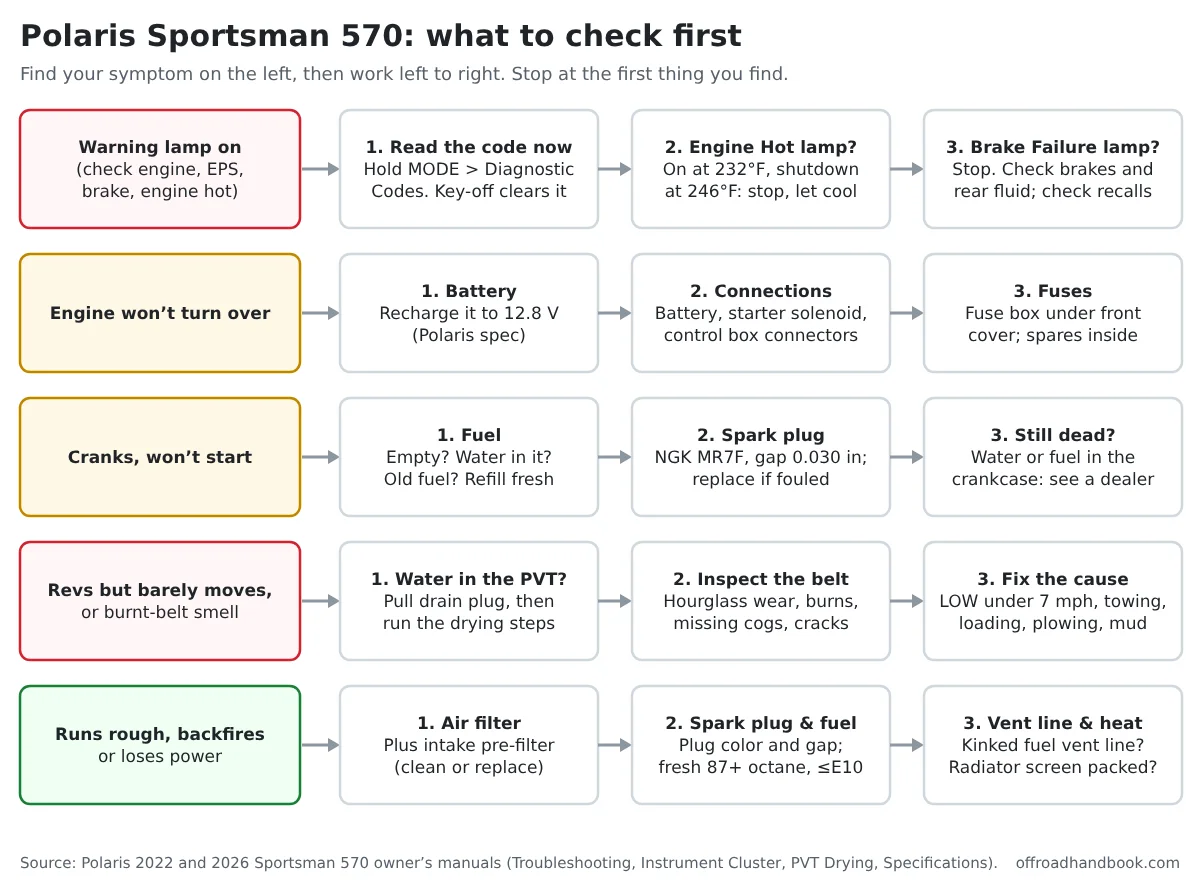
Find your symptom in the left column and work across. The order puts the cheap, quick checks first, which is also how the Polaris troubleshooting tables are arranged.
One rule applies to every row: if a warning lamp is on, read the code before you shut the key off. Polaris says turning off the ignition clears saved codes from the gauge.
1. Belt slipping, burning or wearing out fast
This is the big one. The Sportsman 570 uses a rubber drive belt between two clutches (Polaris calls it the PVT), and heat is what kills it. Polaris says low range keeps the air inside the clutch cover much cooler and "greatly extends" belt life.
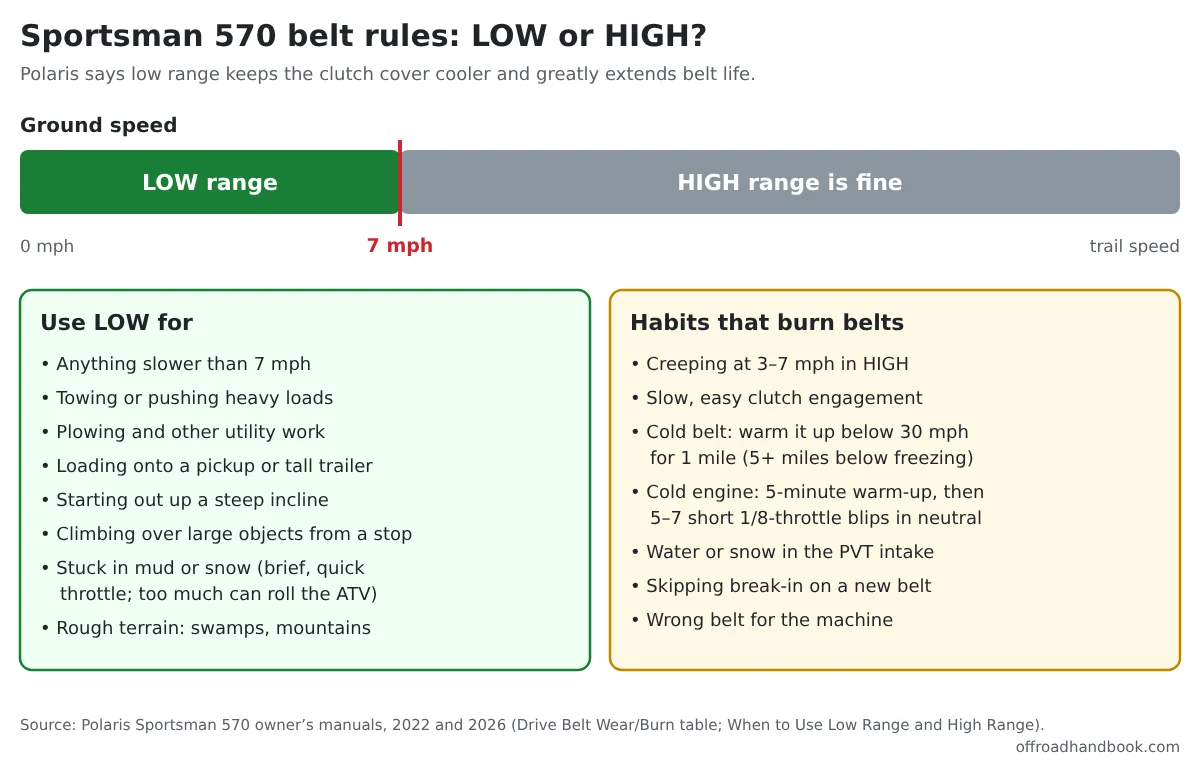
The manual's cut-off is simple: under 7 mph, use low. Towing heavy loads, plowing, loading onto a truck or tall trailer, starting up a steep hill and crawling over big objects all call for low range too, whatever the speed.
The worst habit is creeping along at 3 to 7 mph in high. The clutch never fully grabs the belt, so it slips and cooks. Slow, gentle throttle when pulling away does the same thing in a smaller dose.
Cold weather and new belts
Polaris also blames cold belts. Before working the machine, warm the belt by riding below 30 mph for about 1 mile, or 5 miles or more when it's below freezing. In low temperatures, warm the engine for at least 5 minutes, then give 5 to 7 short blips to about ⅛ throttle in neutral.
A new belt needs a break-in: slower speeds, light loads, no hard acceleration. If a belt fails, Polaris says to clean all the debris out of the PVT intake and outlet duct and the clutches before fitting the new one, or the new belt is at risk too.
How to inspect the belt
With the outer PVT cover off, Polaris says to look for "hourglassing" (a worn, narrowed spot on both sides, caused by the clutch spinning against a belt that isn't moving), loose cords, missing cogs, cracks, thin spots and burn marks. Compare the width with a new belt and replace it if anything is off.
Belt part numbers vary by model year and clutch type (EBS or non-EBS), so match it to your VIN. You can compare Sportsman 570 drive belts on Amazon, but confirm the part number with your dealer or the parts fiche first.
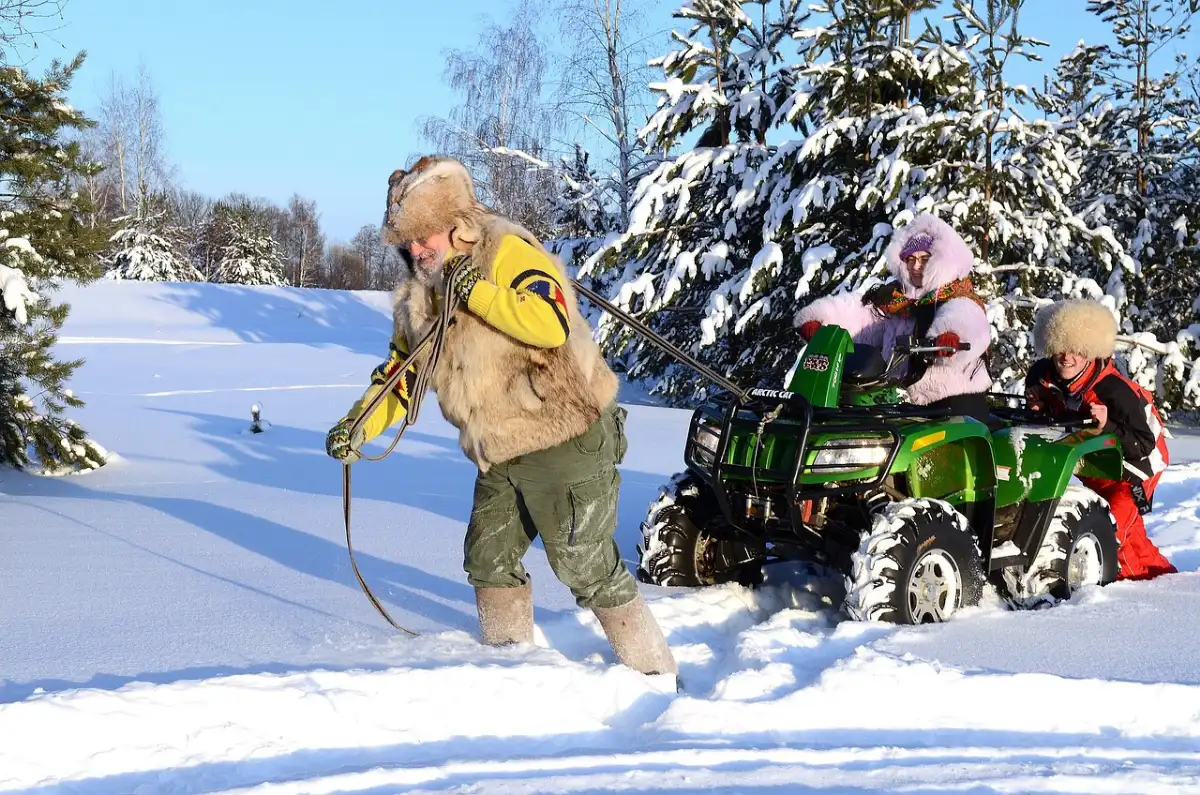
Stuck in mud or snow? Shift to low and use quick, brief throttle to engage the clutch rather than a long slow squeeze. Polaris adds a warning: too much throttle can cause loss of control and a rollover. If it still won't move, get help instead of spinning the belt; our guide to kinetic ropes, snatch straps and tow straps explains which recovery strap fits which job.
2. Water in the PVT: revs but barely moves after a crossing
If the engine revs and the ATV barely moves right after a creek crossing, deep puddle or a pressure wash, suspect water in the belt housing. A wet belt slips on the clutch sheaves. Polaris specifically says to avoid spraying water at the intake pre-filters when washing.
Here's the PVT drying procedure from the owner's manual:
- Park on level ground.
- Remove the PVT drain plug, let the water drain completely, then reinstall the plug.
- Start the engine and put the transmission in PARK (P).
- Apply varying throttle for 10 to 15 seconds to blow out moisture and air-dry the belt and clutches. Don't hold wide-open throttle for more than 5 seconds.
- Let the engine settle to idle, then shift to LOW.
- Test for belt slip. If it still slips, repeat. Polaris says the vehicle then needs dealer service as soon as possible.
If it keeps happening, the manual says to check the clutch cover seals. And if water got past the air box too, stop: cranking an engine with water in the cylinder can bend parts. Our hydrolock guide covers what to do before you hit the starter.
3. AWD won't engage (or seems to do nothing)
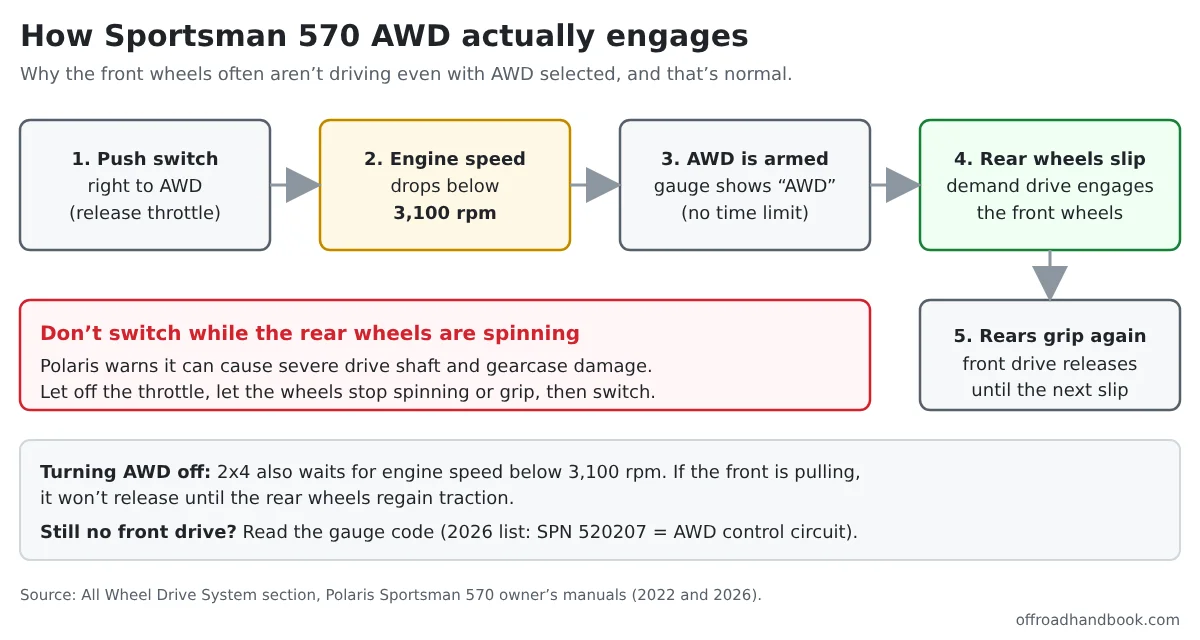
A lot of "my AWD is broken" posts are really about how the system works. On the Sportsman 570, the AWD switch arms the front drive, and the demand drive unit only engages when the rear wheels lose traction. On dry ground with good grip, it's normal for the front to be idle.
Two rules from the manual explain most of the rest:
- Engine speed: AWD engages, and 2x4 disengages, only when engine speed drops below 3,100 rpm. Hit the switch at high revs and nothing changes until you ease off.
- Don't switch while the rears spin: Polaris warns that engaging AWD (or ADC) with the rear wheels spinning can cause severe drive shaft and gearcase damage. Release the throttle first, then switch.
If AWD is engaged, the gauge shows "AWD." It stays armed until you turn it off, and if you switch off while the front is pulling, it won't release until the rears get traction back. On models with TURF mode, don't use it on hills, loose ground, snow, sand or water crossings; Polaris says to use AWD or ADC there.
Still nothing? Check the gauge for a code. SPN 520207 is the All Wheel Drive Control Circuit in the 2026 code list. Also check the front gearcase fluid: it takes about 9 oz of Polaris Demand Drive Fluid, and Polaris says other fluids can make it work improperly.
4. Overheating and the Engine Hot lamp
Polaris sets clear numbers here. The Engine Hot lamp comes on at 111°C (about 232°F). If it flashes, the overheating is severe, and the engine shuts down at 119°C (about 246°F).
The manual's fix for an overheated engine is: clean the radiator screen and core, clean the engine exterior, and check the coolant level. Mud and grass packed into the radiator is the usual culprit after a wet trail day.
- Stop and let the engine cool down.
- Never open the radiator pressure cap hot. Polaris warns escaping steam can burn you.
- Clean the radiator screen and fins. Keep a pressure washer 2 ft away and under 3,000 psi; Polaris says high pressure can damage the fins.
- Check the coolant level in the recovery bottle (and the radiator if the bottle ran dry). The system holds about 2.7 qt of 50/50 coolant.
- If the lamp returns on a clean, full system, read the code. SPN 110 is the engine temperature sensor, and SPN 1071 is the fan relay circuit.
5. Engine won't turn over
If you press the starter and get a click or nothing, the manual lists four causes in order: low battery voltage, loose battery connections, loose starter solenoid connections, and loose electronic control box connections.
Recharge the battery first (Polaris uses 12.8 volts as its recharge target), then check that the terminals are tight and clean. Polaris's cleaning recipe is one tablespoon of baking soda in a cup of water, a rinse, then a coat of dielectric grease. A digital multimeter makes the voltage check quick.
If the battery is fine, check the fuses. On the 2026 model they sit under the front cover below the work light pod, and spares are in the fuse box. Find what blew the fuse before you replace it.
6. Cranks but won't start
If it spins over but won't fire, the Polaris chart starts with fuel: out of fuel, water in the fuel, or old or non-recommended fuel. The manual calls for unleaded with at least 87 octane and no more than 10% ethanol, so E15 and E85 are out.
Next is the spark plug. The 2022 and 2026 manuals list an NGK MR7F gapped at 0.030 in (0.7 to 0.8 mm), torqued to 9 ft-lbs. If it still won't start with good fuel, a good plug and a charged battery, Polaris lists water or fuel in the crankcase and mechanical failure as dealer jobs.
7. Runs rough, backfires, stalls or loses power
These symptoms share the same short list in the manual. Work through it in this order:
- Spark plug: fouled, wrong gap or wrong heat range. A gray, tan or light-brown tip is normal; a white tip points to overheating, and a black, oily tip is wet fouling.
- Air filter and intake pre-filter: a clogged filter chokes power. The 2022 manual says to clean the pre-filter with soapy water or replace it.
- Fuel: water in the fuel, low-octane or old fuel, or a kinked or plugged fuel vent line (Polaris lists it under engine stops or loses power).
- Connections: loose ignition connections and low battery voltage can cause misfires.
- Heat: an overheated engine also loses power (see problem 4).
Engine pinging or knocking has its own two-line entry: poor-quality or low-octane fuel, or a wrong plug gap or heat range. If none of this fixes it, a misfire code (SPN 65590 or 65591) or an oxygen sensor code will narrow it down.
8. Check engine, EPS or Brake Failure lamp: how to read the code
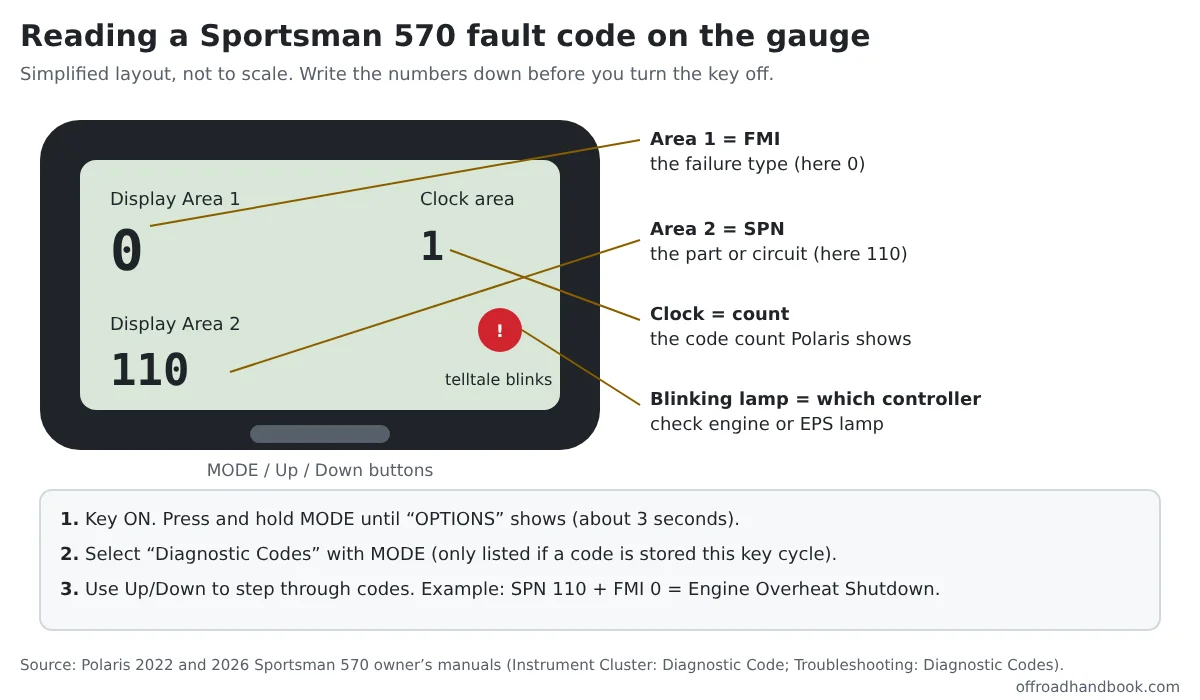
The Sportsman 570 gauge shows fault codes as two numbers. The SPN tells you which part or circuit, and the FMI tells you what kind of failure. Here's the procedure from the 2022 and 2026 manuals:
- With the key ON, press and hold MODE until "OPTIONS" appears (about 3 seconds).
- Press MODE to select "Diagnostic Codes." It only shows up if a code was set or is active this key cycle.
- Use the Up/Down buttons to scroll. Display area 1 shows the FMI, display area 2 shows the SPN, and the clock area shows the count.
- Watch the warning lamps: the check engine or EPS lamp blinks to show which controller set the code.
- Write everything down before turning the key off, because that clears the saved codes from the gauge.
Polaris is blunt about the check engine lamp: don't operate the vehicle while it's on, because serious engine damage could result.
The EPS lamp means a power steering fault, and the Brake Failure lamp means the system detected a stuck brake while the throttle was applied, or the rear brake fluid is low. Stop and check the brakes before riding further.
Sportsman 570 fault code lookup tool
Type the SPN and FMI from your gauge. The tool looks them up in the diagnostic code list printed in the 2026 Sportsman 570 owner's manual and adds the first step Polaris gives for that system.
The code names and failure types are copied from the Polaris diagnostic code table; the "first step" lines summarize the manual's advice for that system. This is a lookup aid, not a scan tool, and older model years may not use every code.
A few SPNs worth knowing by heart: 110 is engine temperature, 100 is engine oil pressure, 168 is system power, 597 is the brake switch, and 51 and 520198 are the two throttle position sensors.
Sportsman 570 recalls by model year
Before you chase any problem on a used 570, run the VIN. We found three CPSC recalls that name Sportsman 570 models, and one of them reaches the 2021 to 2023 machines that many owners assume are recall-free.
| CPSC recall | Announced | Models covered | Hazard | Remedy |
|---|---|---|---|---|
| 17-061 | Dec 29, 2016 | 2014 Touring 570 EFI; 2015–2016 Touring 570, Touring 570 EPS and SP, X2 570 EPS; 2017 6x6 570 EPS (about 9,900 units) | Air intake duct can contact the fuel rail and cause a fuel leak (fire hazard) | Free repair |
| 17-190 | Jul 19, 2017 | All 2014 Sportsman 570 EFI, 570 EPS and Touring 570 EFI (about 25,600 units) | Fuel can leak into the headlight pod (fire hazard) | Free repair |
| 23-734 | Mar 16, 2023 | Certain 2021–2023 Sportsman 450 and 570 (about 80,000 in the U.S.) | Wiring harness can rub the brake line or frame: loss of front brakes and/or fire | Stop riding; free dealer repair |
Check your VIN on the Polaris off-road recall lookup or call Polaris at 800-765-2747. The VIN is stamped on the left rear of the frame. For the 2021 to 2023 recall, CPSC lists five fires and three damaged-wire reports, two of them with lost front brakes, so don't ride an unrepaired machine.
Sportsman 570 service specs that fix half these problems
| Item | Spec (2022 and 2026 manuals) |
|---|---|
| Engine oil | Polaris PS-4 5W-50 (or PS-4 Extreme 0W-50 on 2026), 2 qt |
| Transmission | Polaris AGL, 32 oz |
| Front gearcase (demand drive) | Polaris Demand Drive Fluid, about 9 oz |
| Coolant | Polaris 50/50 premix, 2.7 qt |
| Fuel | Unleaded, 87 octane minimum, no more than 10% ethanol; tank 4.5 gal |
| Spark plug | NGK MR7F, 0.030 in gap, 9 ft-lbs |
| Idle speed | 1,200 ± 50 rpm |
| Tire pressure | 7 psi front and rear |
| Engine Hot lamp / shutdown | 232°F / 246°F (111°C / 119°C) |
| AWD engages / disengages | Below 3,100 rpm |
Polaris says engine oil problems are a seizure risk, and the 570 only holds 2 qt, so check it often. Polaris PS-4 5W-50 and Polaris AGL gearcase lubricant are both on Amazon; check the current price there.
The 7 psi tire spec matters more than it looks: it's low enough that a few psi either way changes handling. Our off-road tire pressure calculator explains how pressure changes the contact patch and what to run for each kind of terrain.
Sportsman 570 FAQ
Is the Polaris Sportsman 570 reliable?
Most problems in Polaris's own troubleshooting chart are maintenance and riding-habit issues (belt heat, water, filters, battery). The fuel leak recalls on 2014 to 2017 machines and the 2021 to 2023 wiring harness recall are the documented defects, and all three have free repairs. Run the VIN before you buy a used one.
Why does my Sportsman 570 smell like burning rubber?
That's almost always the drive belt slipping. Polaris lists creeping at 3 to 7 mph in high range, towing or plowing in high, slow clutch engagement, cold belts and water in the PVT as the causes. Shift to low, let it cool, and inspect the belt.
How do I clear the check engine light on a Sportsman 570?
Turning the key off clears saved codes from the gauge, but the lamp comes back if the fault is still there. Read and write down the SPN and FMI first, fix the cause, and have a dealer check anything you can't identify.
Why won't my Sportsman 570 go into AWD?
AWD only engages below 3,100 rpm, so ease off the throttle after you press the switch. Once armed, the front drive only works when the rear wheels slip. If the gauge doesn't show "AWD" or there's a code like SPN 520207, see a dealer.
For other machines, our Sportsman 450 problems guide covers the smaller sibling, and the general ATV and UTV troubleshooting guide covers bogging, no-starts and belts across brands.

I'm Suryashankar Dasgupta, the founder of Off-Road Handbook. I've been off-roading for years in the USA, including California and Texas, and have ridden mountain and desert terrain abroad. I've also driven a Jeep Compass for more than seven years, so I know the day-to-day side of Jeep ownership first-hand, from the Uconnect screen to the warning lights. Every guide here is researched from manufacturer owner's manuals, NHTSA recall and service-bulletin records and other trusted sources, checked against them before it is published, and corrected when we find a mistake. You can read how we work in our editorial policy: https://offroadhandbook.com/editorial-policy/
Like our off-road guides? Add Off-Road Handbook as a Google Preferred Source so our latest Jeep, ATV, UTV, trail, recovery, and off-road troubleshooting articles can appear more often in your Google Search experience.
Add us as a Preferred Source