How Deep Can You Ford? Water Crossing Depth Checker
Last updated on October 18th, 2026 at 09:37 am
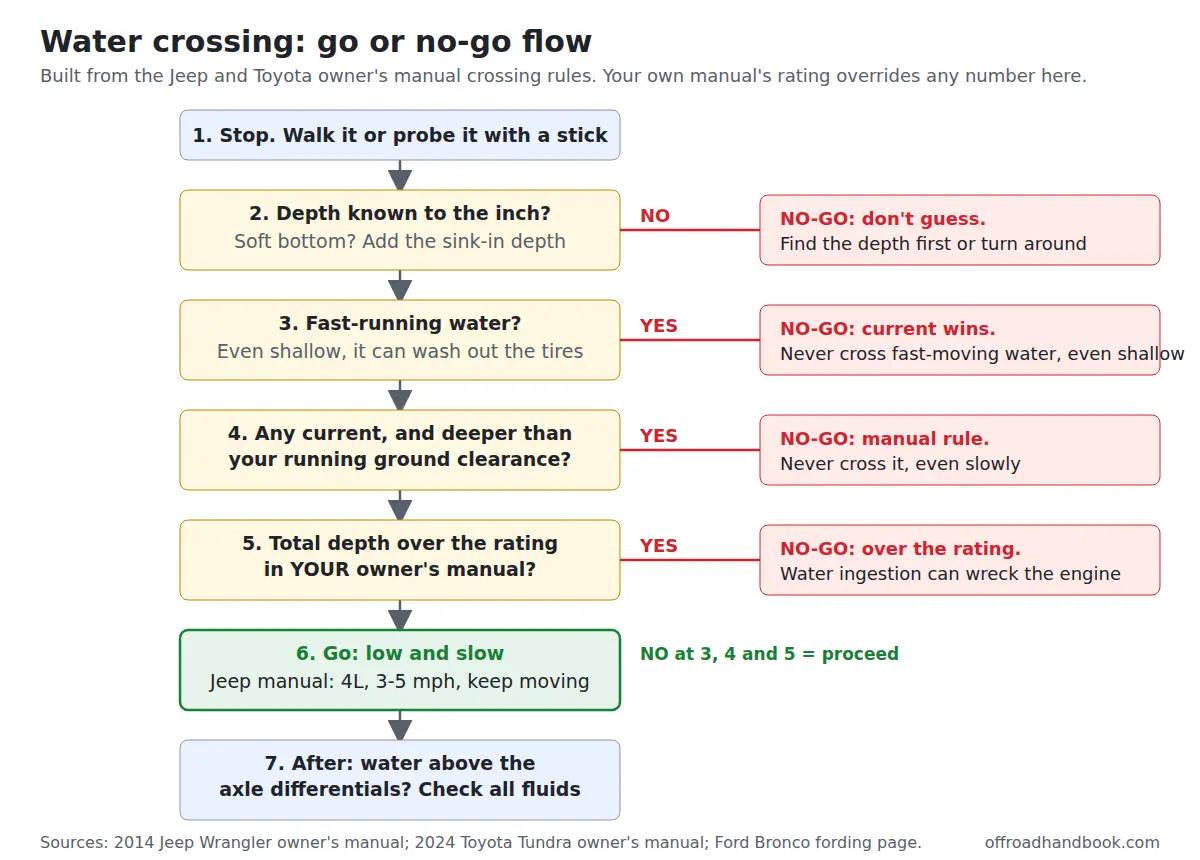
Your vehicle's fording rating is a ceiling, not a safe target. It assumes still water, a firm bottom you've measured, and a crawl (Jeep's 2014 Wrangler manual says 30 inches at no more than 5 mph; the 2023 JL manual keeps the 5 mph limit and says to check the depth first). Add the depth your tires sink into a soft bottom. In moving water, Jeep's manual says never cross anything deeper than your running ground clearance, and never cross fast-running water at all. If the total is over the number in your owner's manual, don't go.
Water crossing go/no-go checker
Enter what you measured on foot. The checker applies the rules from the owner's manuals in the table below. It's an estimate, not a guarantee, so your own manual's rating always wins.
More free tools: see all our off-road calculators for tire size, regear, air-down pressure, winch size and more.
How it works: effective depth = measured depth + sink-in. Fast-running water is a no-go. Flowing water deeper than running ground clearance is a no-go (Jeep manual). Anything over your rating is a no-go. A "go" still means low and slow. The fluid-check note appears when the water is above your lowest axle/diff height, the trigger in Jeep's manual.
What the owner's manuals actually say about water crossings
Most spec lists give one number and stop. The manuals attach conditions to that number, and the conditions differ by vehicle.
| Vehicle (source) | Stated depth | Speed and conditions | Flowing water | After the crossing |
|---|---|---|---|---|
| Jeep Wrangler (2014 owner's manual, pp. 240-242) | 30 in. | No more than 5 mph. Use 4L and 1st or Drive at 3-5 mph, light throttle, keep moving. Don't stop or shut off unless you've ingested water. | Never cross fast-running water. Never cross flowing water deeper than running ground clearance. | If water went above the bottom of the axle differentials, inspect all fluids for water. Check the radiator for mud. |
| Ford Bronco (Ford Bronco page, Ford support article) | Up to 33.5 in. (Base through Badlands); Raptor up to 37 in. | Reduce speed as depth increases. First gear or Drive, slow constant speed, light throttle. Never stop or shut off in deep water unless water was ingested. | Never cross a deep, fast-flowing body of water. | Not covered in that article. Check your owner's manual. |
| Toyota Tundra (2024 owner's manual) | About 28 in., only on trucks with the electronically modulated air suspension | Over about 20 in.: HI height mode, then manual mode, 18 mph or less. If equipped, press the Stop & Start cancel switch. | Check depth and bottom firmness first. Drive slowly and avoid deep water. | Water can wash grease from wheel bearings and enter the differentials, transmission and transfer case. After a puddle, tap the brakes to confirm they work. |
Notice what's different. Jeep ties its number to a 5 mph crawl. Toyota ties its number to a specific suspension and a ride-height mode. Ford's page gives a headline depth, and its support article keeps repeating "reduce speed as depth increases." None of them treat the number as something to aim for.
Go or no-go: the decision flow
Why the fording rating isn't the safe depth
- The rating assumes you know the real depth. Jeep's own site tells owners not to attempt fording unless the depth is known and consistent with the rating in the owner's manual. Murky water hides it, and the manual notes puddles and flooded areas often hide obstacles.
- Soft bottoms add depth. Jeep's manual says that on soft bottoms the vehicle sinks in, effectively raising the water level on the vehicle. That's why the checker has a sink-in box. Measure with a stick, then add how far you expect to settle.
- Current changes the rules. Jeep's manual says even very shallow fast water can wash the dirt out from around your tires, and you should never cross flowing water deeper than the vehicle's running ground clearance. The National Weather Service says it takes just 12 inches of rushing water to carry away most cars, and 2 feet can carry away SUVs and trucks.
- The number can depend on equipment and speed. Toyota's Tundra figure applies only with air suspension, in HI mode, at 18 mph or less. Jeep's applies at 5 mph or less.
To check your own clearance honestly, see how to check whether your ground clearance is enough. For the low-range part of the Jeep procedure, here's how to shift into 4-Low. Wet-season trails in South Florida work the same way; our Miami off-roading guide covers the permit and water-level rules at Big Cypress.
How to cross when the checker says go
- Get out and walk it or probe it with a stick. Check depth, approach angle, current and bottom, and look for hidden obstacles.
- If the water is murky or muddy, Jeep's manual suggests hooking up tow straps before you enter, which makes a recovery faster and cleaner. Here's how to pick the right strap or rope.
- Shift into first gear or Drive. Jeep's manual specifies the transfer case in 4L.
- Go at a slow, constant 3 to 5 mph with light throttle. Don't try to accelerate through.
- In a stream, cross at an angle heading slightly upstream (Jeep's manual).
- Keep moving. Don't stop or shut the vehicle off in deep water unless you've ingested water.
What to do if the engine stalls in the water
Don't crank it. Jeep's manual says that if the engine stalls, don't attempt to restart it until you've determined whether it ingested water. Water doesn't compress, so cranking an engine that has swallowed water can bend connecting rods and turn a wet engine into a dead one. Get the vehicle out of the water by winching or towing, then pull the dipstick and look at the air intake for water. Milky or cloudy oil means water got in. Call for a tow rather than turning the key. Our full hydrolock guide covers pulling the plugs and when to tow.
After the crossing: what to check
- Fluids. Jeep's manual says that after crossing water higher than the bottom of the axle differentials, inspect all vehicle fluids for signs of water ingestion. Milky or cloudy fluid is the warning sign.
- Brakes. Toyota says to lightly press the brake pedal after a puddle to confirm the brakes work. Jeep warns abrasive material in the brakes can cause wear or unpredictable braking, so have them checked and cleaned after dirty conditions.
- Radiator. Muddy water can reduce cooling by depositing debris on the radiator, and Jeep says to inspect and clean it.
- Wheel bearings and driveline. Toyota notes water can wash grease from wheel bearings and enter the differentials, transmission and transfer case.
If something sounds off afterward, our guides to Jeep problems after mud or water and grinding noises after a water crossing walk through the likely causes. For the cleanup itself, see how to clean your Jeep after off-roading.
FAQ
Is the fording rating the same as a safe depth?
No. It's a manufacturer ceiling that comes with conditions: a known depth, a slow speed, and for some vehicles specific equipment. Jeep ties 30 inches to 5 mph or less, and Toyota ties 28 inches to air suspension.
Does a snorkel raise my fording rating?
A snorkel or breather relocation moves vulnerable air paths higher, but Quadratec notes these don't make windshield-deep fording safe. Axles, transmission, transfer case and electronics are still exposed, so your manual's rating is the number to respect.
How deep can I go in moving water?
Per Jeep's manual, no deeper than your running ground clearance, and never in fast-running water. Rating doesn't matter once there's a real current.
Can I use the checker for my Tacoma, 4Runner or Ram?
Yes, if you type the depth rating from your own manual. This guide only quotes the manuals linked in the table, so look up your vehicle's own conditions.
Sources: 2014 Jeep Wrangler owner's manual; 2024 Toyota Tundra owner's manual; Ford Bronco and Ford off-road safety article; Jeep Wrangler page; National Weather Service flood safety; Quadratec fording guide.
Related guides

I'm Suryashankar Dasgupta, the founder of Off-Road Handbook. I've been off-roading for years in the USA, including California and Texas, and have ridden mountain and desert terrain abroad. I've also driven a Jeep Compass for more than seven years, so I know the day-to-day side of Jeep ownership first-hand, from the Uconnect screen to the warning lights. Every guide here is researched from manufacturer owner's manuals, NHTSA recall and service-bulletin records and other trusted sources, checked against them before it is published, and corrected when we find a mistake. You can read how we work in our editorial policy: https://offroadhandbook.com/editorial-policy/
Like our off-road guides? Add Off-Road Handbook as a Google Preferred Source so our latest Jeep, ATV, UTV, trail, recovery, and off-road troubleshooting articles can appear more often in your Google Search experience.
Add us as a Preferred Source