How to Shift Into 4-Low (and What to Do When It Won't Go)
Last updated on October 26th, 2026 at 07:52 pm
To shift into 4-low (4L), slow to a crawl or stop, put the transmission in Neutral (or push the clutch in), then move the transfer case lever or switch to 4L. Do it with the truck rolling no faster than about 3 mph, never with the transmission in gear, and never with one axle spinning. If it refuses, rolling the vehicle a few feet usually lines up the gears. The exact order varies by vehicle, so here is what three real owner's manuals say.
What 4L actually does (and when to use it)
4L is a low-range gear set inside the transfer case. It multiplies engine torque and slows the wheels for the same engine rpm. Ram's manual notes that in 4L the engine turns roughly three times faster than in 2H or 4H at the same road speed, and Jeep's Wrangler manual puts that at about four times for Rubicon models, which have the 4:1 Rock-Trac case. That is why it is for crawling, not cruising. Our Command-Trac vs Rock-Trac vs Selec-Trac comparison shows which Wrangler cases have 2.72:1 or 4:1 low range.
Use it for slow, technical ground: rock ledges, steep climbs and descents, deep sand or mud where you need torque without wheelspin, and pulling a stuck vehicle or a trailer up a ramp. For gravel roads, snow-covered highways and washboard, 4H is the right setting. Our guide to using 4H on the highway covers where that line sits, and which gear to run once you are in 4L covers the transmission side.
The 5-step method that works on most 4x4s
- Stop on level, firm ground, or roll slowly in a straight line. Wheels should be turning at the same speed front and rear. Wrangler manuals note the transfer case has no synchronizer, so the front and rear driveshaft speeds must match for the shift to happen.
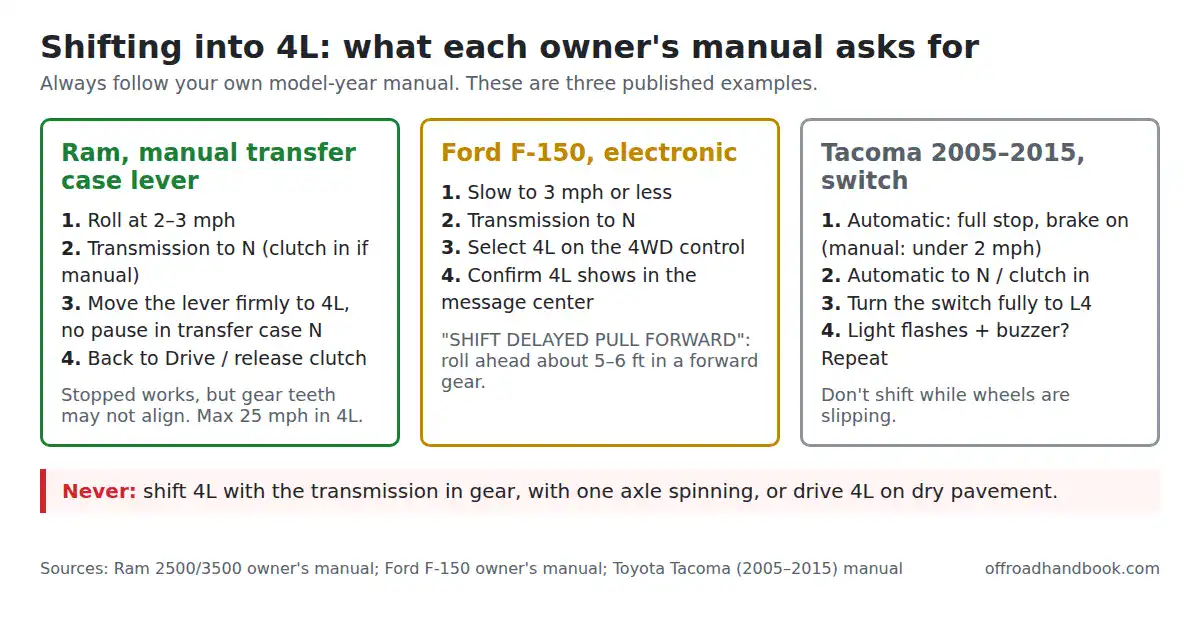
- Slow to the speed your manual allows. Ram's manual-shift procedure says 2 to 3 mph. Ford says 3 mph or less. Toyota's older Tacoma manual says a full stop for automatics, and under 2 mph for manuals.
- Shift the transmission to Neutral, or push the clutch in on a manual.
- Shift the transfer case. On a lever, move it firmly and don't pause in the transfer case's own neutral. On a switch or button, select 4L and hold it until the indicator stops flashing and stays on.
- Check the dash for a steady 4L indicator, then put the transmission back in gear (or release the clutch) and ease off the brake slowly.
Differences by vehicle
Ram and Jeep-style manual levers. Ram's manual says to roll at 2 to 3 mph, shift the transmission to Neutral, then move the transfer case lever firmly to the position you want without pausing in neutral. Shifting while completely stopped is possible, but the manual warns the mating clutch teeth may not be aligned, which makes it harder. Don't try it with the transmission in gear. Source: Ram manually shifted transfer case section. Wrangler owners should read their own manual, but the hardware logic is the same.
Ford F-150 (electronic). Ford's manual says to bring the truck to 3 mph or less, put the transmission in Neutral, then move the 4WD control to 4L. You can move between 2H and 4H at any forward speed, but 4L is the one with conditions. If the message center shows SHIFT DELAYED PULL FORWARD, the gear teeth are blocked: put the transmission in a forward gear and roll about 5 feet so the transfer case can finish. Source: Ford F-150 owner's manual, 4WD shifting. The F-150 also has an automatic mode, which we cover in can you leave an F-150 in 4A.
Toyota Tacoma (2005 to 2015). On an automatic, stop completely with the brake on, shift to N, then turn the 4WD switch fully to L4. On a manual, you can be under 2 mph with the clutch held in. The manual also warns against shifting from H2 to H4 while wheels are slipping, and says to use H2 on dry hard roads because 4WD on dry pavement can cause seizure or oil leaks. Newer Tacomas and 4Runners differ, so confirm for your year. Source: Tacoma (2005 to 2015) owner's manual text.
It won't go into 4L: causes and fixes
| What you see | Likely cause | What to try |
|---|---|---|
| Grinding or a hard stop at the lever | Shifting too fast, or transmission still in gear | Stop, confirm Neutral, try again smoothly |
| Indicator flashes and never settles | Gear teeth blocked, or one axle spinning | Roll a few feet in a forward gear (Ford's SHIFT DELAYED message says about 5 ft), then retry in Neutral |
| Lever won't move at all | Stopped with teeth aligned tooth-to-tooth | Rock the vehicle slightly while holding light pressure on the lever |
| Works on pavement but not off-road | One wheel slipping, so axles are unequal | Move to firm, flat ground and shift there |
| Engine revs very high in 4L | Normal: about 3x (4x on Rubicon) rpm at the same speed | Slow down; Ram's manual caps 4L at 25 mph |
If none of that works, don't force it. Repeated failures can point to a bad shift motor, low transfer case fluid or a worn fork, which needs a shop. Also note that shaking after you do get into 4WD is a different problem; see why a truck shakes in 4-wheel drive.
Getting out of 4L
Reverse the procedure. Toyota's manual uses the same stop, Neutral and switch sequence for L4 back to H4, and Ram's manual says the same slow roll and Neutral for either direction. Do it as soon as the trail lets you go faster than a walking pace. Don't leave it in 4L on dry pavement; Ram's manual says driveline damage can result. When you're back on pavement, move to 2H, and if you aired down, air back up using our tire pressure guide by terrain.
Safety note: Neutral disconnects the drivetrain from the wheels. Set the parking brake before you leave the vehicle in Neutral, especially on a slope. Never leave any vehicle unattended in Neutral on a slope.
FAQ
Can I shift into 4L while moving?
Only at walking pace. Ram's manual says 2 to 3 mph, Ford says 3 mph or less. Anything faster risks damaging the transfer case.
Do I need to be in Neutral?
On the manuals cited here, yes. Neutral frees the transmission output so the transfer case gears can mesh.
How fast can I drive in 4L?
Ram's manual says not to exceed 25 mph. Practically, you'll want to be far below that.
Is 4L the same as a locked differential?
No. 4L multiplies torque; a locker forces both wheels on an axle to turn together. Many trail setups use both. See what a diff lock is and whether you need one.
Related guides
- Can a 2WD Vehicle Drive Forest Service Roads? What You Need
- 4WD vs AWD vs 4A: What Each Setting Does and When to Use It

I'm Suryashankar Dasgupta, the founder of Off-Road Handbook. I've been off-roading for years in the USA, including California and Texas, and have ridden mountain and desert terrain abroad. I've also driven a Jeep Compass for more than seven years, so I know the day-to-day side of Jeep ownership first-hand, from the Uconnect screen to the warning lights. Every guide here is researched from manufacturer owner's manuals, NHTSA recall and service-bulletin records and other trusted sources, checked against them before it is published, and corrected when we find a mistake. You can read how we work in our editorial policy: https://offroadhandbook.com/editorial-policy/
Like our off-road guides? Add Off-Road Handbook as a Google Preferred Source so our latest Jeep, ATV, UTV, trail, recovery, and off-road troubleshooting articles can appear more often in your Google Search experience.
Add us as a Preferred Source