Hydrolock: What to Do If Water Gets Into Your Engine Off-Road
Last updated on October 17th, 2026 at 12:32 pm
Hydrolock (hydrostatic lock) happens when water gets into a cylinder, and because water does not compress, the piston cannot finish its stroke. If your engine stalls or dies in water, do not turn the key or press the start button. Cranking a water-filled engine is what bends connecting rods. Get the vehicle out of the water, find out whether water reached the air intake, and have the cylinders cleared before any restart attempt.
The Jeep Wrangler owner's manual says it plainly: if the engine stalls, do not attempt to restart it, and determine first whether it has ingested water.
What hydrolock is and why it destroys engines
An engine is built to compress air. When liquid fills a cylinder, the piston still tries to travel up on the compression stroke and something has to give. Common failures include bent connecting rods, damaged pistons, bearing damage, and in bad cases a cracked block or head (see the Hydrolock overview). Liquid fuel can do the same on an ATV when a stuck petcock floods the engine, as covered in our Suzuki Eiger 400 problems guide.
Diesels are more vulnerable. Their higher compression ratios leave a smaller combustion chamber, so less liquid is needed to lock the engine, and strong starters and high torque make damage more likely. If a gas engine was idling or at low load when it stalled, it may stop without internal damage, but you cannot tell that by cranking it.
Signs of water ingestion
- The engine dies or surges as you cross, often with a sudden loss of power.
- It cranks slowly, stops abruptly, or will not turn at all, and sometimes you hear a thud or knock.
- Water or steam coming out of the exhaust.
- Milky or foamy oil on the dipstick, or an oil level that is higher than before the crossing.
- Water visible in the air box, intake tube, or air filter housing.
What to do right now: step by step
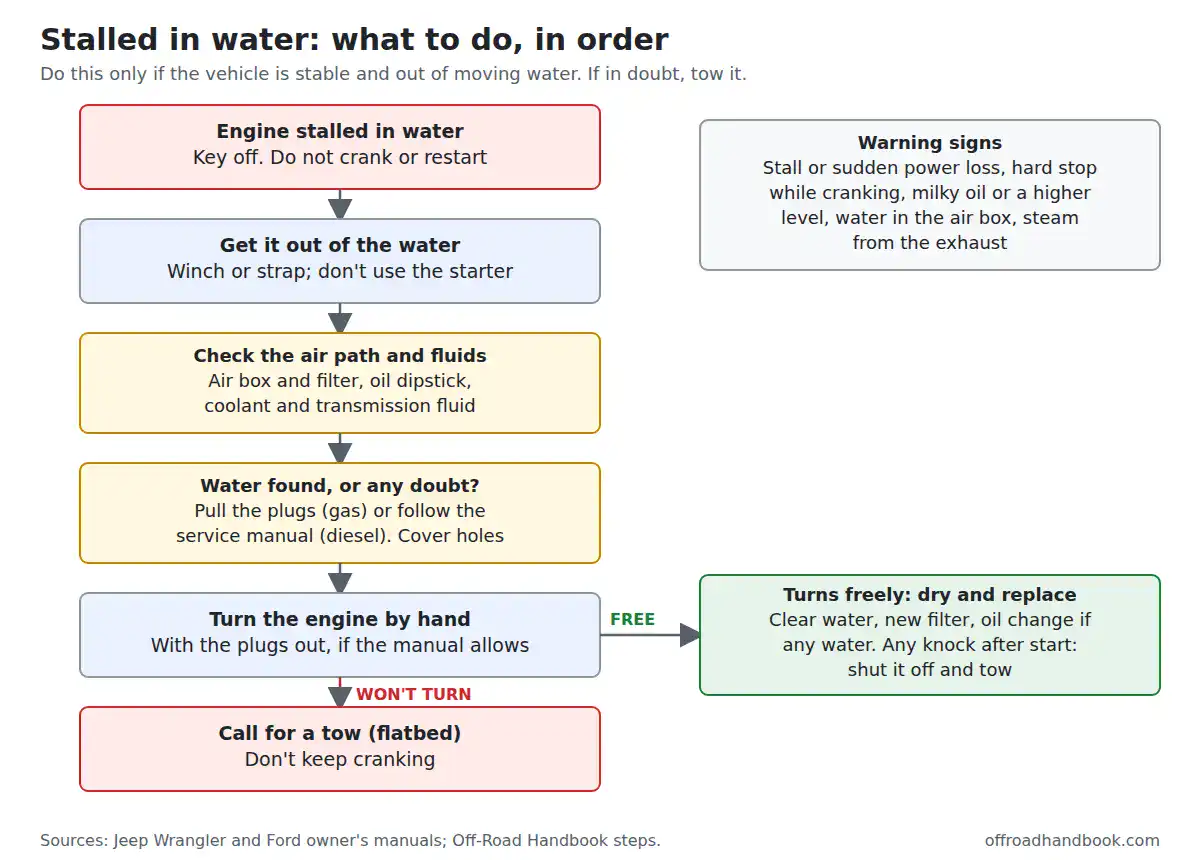
- Stop and keep the key off. If the engine stalled, do not crank it to see whether it starts. Take the vehicle out of gear and, if you must move it, push or winch it out rather than start it.
- Get it onto dry, level ground. Recover it by winch or strap (see kinetic rope vs snatch strap vs tow strap for the right gear). Do not try to drive out on the starter.
- Check the air path. Open the air box, pull the air filter, and look inside the intake tube. A wet filter or standing water downstream of it means water went toward the engine. With a snorkel, check the snorkel head, the joints, and the air box seal.
- Check the oil. Pull the dipstick. Milky oil or a rising level points to water in the crankcase. Check coolant and transmission fluid too, as water can enter several places.
- Disable fuel and spark, then pull the plugs. On a gas engine, remove the spark plugs (and coil packs if they sit on top). On a diesel, glow plugs or injectors are removed instead, following the factory service manual for your engine. Cover the holes with a rag, since water can shoot out.
- Rotate the engine by hand. With the plugs out, turn the crankshaft with a breaker bar and socket on the crank pulley bolt, if your service manual allows it. Water should spit from the plug holes. If the engine will not turn by hand even with the plugs out, stop and call for a tow.
- Dry, replace, and recheck. Dry the cylinders and plug wells, replace the air filter, and change the oil and filter if there is any sign of water. Refit the plugs, then try a start. Listen for knocking and watch for rough running. Any knock means shut it off.
Safety note: Do this only if you are comfortable with it and the vehicle is safe, stable, and not in moving water. A mistake can cost you an engine, and a flooded engine bay with a battery attached is an electrical hazard. If in doubt, tow it.
Symptom, meaning and action: the water-crossing table
This table is compiled from the manufacturer guidance and technical sources listed below. It is a starting point, not a replacement for your service manual.
| Symptom after a water crossing | What it likely means | What to do now | What not to do |
|---|---|---|---|
| Engine stalls mid-crossing | Possible water in the intake, or wet ignition or sensors. Hydrolock risk is real. | Key off, get the vehicle out of the water, check the air box and filter, then oil. | Do not restart or crank it. The Wrangler manual says not to restart a stalled engine until you know whether it ingested water. |
| Engine cranks, then stops hard or will not turn | Probable hydrostatic lock with water in one or more cylinders. | Stop. Pull the plugs (or injectors/glow plugs on a diesel) and turn it by hand. Tow if it will not turn. | Do not keep cranking, and do not use a jump or tow start. |
| Wet air filter or water in the intake tube | Water reached or neared the engine. Intake depth was exceeded. | Replace the filter, dry the tube, check the oil, and clear the cylinders before starting. | Do not just dry the filter and start it. |
| Milky or foamy oil, or oil level up | Water in the crankcase, from the intake, a failed seal, or the breather. | Do not run it. Drain the oil, find the entry point, and refill. Have it inspected. | Do not drive it to the trailhead exit on contaminated oil. |
| Runs but misfires, rough idle, or knocks | Wet ignition parts or a bent rod. A steady knock is a bad sign. | Shut it off. Check coils, plugs, and connectors for water. A knock means a shop inspection. | Do not rev it to clear it out. |
| Grinding or whining after the crossing | Often a wet brake, bearing, or axle problem rather than the engine. | See grinding noise after a water crossing. | Do not keep driving on suspect bearings. |
| Brakes weak, shaking, ABS light, odd smells | Wet or muddy brakes and sensors. | See problems after mud or water. Dry brakes with light pedal pressure at low speed. | Do not assume brakes are back to normal. |
| Temperature gauge climbing after the crossing | Mud or debris in the radiator or a bent fan, not necessarily water in the engine. | See why a Jeep overheats. Shut down, let it cool, and check coolant. | Do not open a hot cap. |
Sources: Jeep Wrangler owner's manual, Driving Through Water; Ford owner's manual, Driving Through Water; Hydrolock; Toyota Tundra owner's manual.
When to call a tow
- The engine will not turn by hand with the plugs out.
- You hear knocking, tapping, or clunking after clearing the cylinders.
- There is water in the oil and you cannot find or fix the entry point.
- It is a diesel, or a modern engine with a complex intake, and you are unsure how to remove the injectors or coils safely.
- The water is moving, rising, or deep enough to reach the cabin or electronics.
Flatbed transport is the safer choice. Check your manual before flat-towing, since driven wheels can turn the engine over in some drivetrains.
Insurance and warranty
Do not assume water damage is covered. Manufacturers set wading limits in the owner's manual, and damage from exceeding them is generally treated as misuse. The Ford manual warns that driving through deep water above the recommended level can cause vehicle damage. Read your warranty booklet and your insurance policy before you ford anything, and ask your insurer whether comprehensive coverage includes engine water damage from driving into water.
Keep records. Photos of the water depth, the vehicle, and the tow receipt help any claim, and a shop report on the cause helps both claims and warranty conversations.
How to prevent it: check your intake height
- Know the rated depth. Jeep's 2014 Wrangler manual gives 30 inches at no more than 5 mph. The 2023 Wrangler JL manual drops the number but still says not to exceed 5 mph, to check the depth before entering and to check all fluids afterward. Ford's manual for trucks says never to drive through water higher than the bottom of the hubs. Toyota's 2024 Tundra manual says about 28 inches, and only with air suspension. Use your own manual.
- Find the air intake opening. Measure from the ground to the lowest opening of the intake, with the vehicle loaded. Stay well below it, as water level and bow wave change.
- Walk the crossing. Check depth, bottom, and exit before driving. For a depth worksheet, see how deep you can ford.
- Go slow and steady. A bow wave pushes the water in front of the vehicle higher than the surrounding water, and speed can force it into the engine bay. Do not stop in the water.
- Consider a snorkel. It raises the intake, but the maximum depth is then set by the snorkel head, and the axle and transfer case breathers, and electrics still need protection (see vehicle snorkel).
- Check fluids afterward. The Jeep manual says to inspect all vehicle fluids after crossing water higher than the bottom of the axle differentials.
Wading research from SAE, such as paper 2016-28-0072 and paper 2017-01-1327, studies water entering the air intake and engine bay from splash and bow waves, which is why a depth below the intake is not a guarantee.
FAQ
Can a hydrolocked engine be saved?
Sometimes. If the engine was at low speed and was not cranked, clearing the water and changing the oil can be enough. If a rod is bent, the engine needs a rebuild or replacement.
Can I restart after the water drains out?
Only after the cylinders are cleared, the air filter and oil are dealt with, and the engine turns freely by hand. A knock on startup means shut it off.
Does a snorkel stop hydrolock?
It raises the intake, so it helps up to the snorkel height. If water reaches the snorkel head, it goes straight into the engine.
Is it hydrolock if the engine just stalls?
Not necessarily. Wet ignition parts and sensors can also stall an engine. Until you have checked, treat it as possible hydrolock and do not crank.
Sources
- 2023 Jeep Wrangler JL owner's manual: Driving Through Water
- Ford owner's manual: Driving Through Water
- 2023 Jeep Wrangler JL owner's manual: Driving Through Water
- 2024 Toyota Tundra owner's manual
- Wikipedia: Hydrolock
- Wikipedia: Vehicle snorkel
- SAE 2016-28-0072: Passenger Car Water Wading Evaluation Using CFD Simulation
- SAE 2017-01-1327: Water Ingress Analysis and Splash Protection for Vehicle Wading
- Quadratec: How to properly ford water

I'm Suryashankar Dasgupta, the founder of Off-Road Handbook. I've been off-roading for years in the USA, including California and Texas, and have ridden mountain and desert terrain abroad. I've also driven a Jeep Compass for more than seven years, so I know the day-to-day side of Jeep ownership first-hand, from the Uconnect screen to the warning lights. Every guide here is researched from manufacturer owner's manuals, NHTSA recall and service-bulletin records and other trusted sources, checked against them before it is published, and corrected when we find a mistake. You can read how we work in our editorial policy: https://offroadhandbook.com/editorial-policy/
Like our off-road guides? Add Off-Road Handbook as a Google Preferred Source so our latest Jeep, ATV, UTV, trail, recovery, and off-road troubleshooting articles can appear more often in your Google Search experience.
Add us as a Preferred Source