Tire Load Index Chart: Can Your Tires Carry the Truck?
Last updated on October 18th, 2026 at 10:58 am
This post contains Amazon affiliate links. As an Amazon Associate I earn from qualifying purchases, at no extra cost to you.
The load index is a code, not a weight. A 126 means the tire can carry 3,748 lb at its maximum inflation pressure, and you look the number up in a chart.
Federal rule FMVSS 120 says the maximum load ratings of the tires on an axle, added together, must not be less than that axle's gross axle weight rating (GAWR) on the door-jamb label. So the check is simple: tires on the axle x load per tire must be at least the GAWR. Never go below the load index your truck came with.
The tool below does that math for you. If you are changing sizes, pair it with the tire size calculator so you check both load and speedometer error.
Tire Load Index Checker: Do Your Tires Meet the Axle Rating?
How it works: the per-tire figure comes from the load index chart below, which is the same at maximum pressure in the Pirelli and Tires Plus charts. The pass/fail test is the FMVSS 120 axle rule. The 10% derate for P-metric tires on light trucks follows tirepressure.com's load/inflation guidance. These are estimates: your tire maker's load and inflation table for your exact size is the final word.
How to Check Your Tires in Three Steps
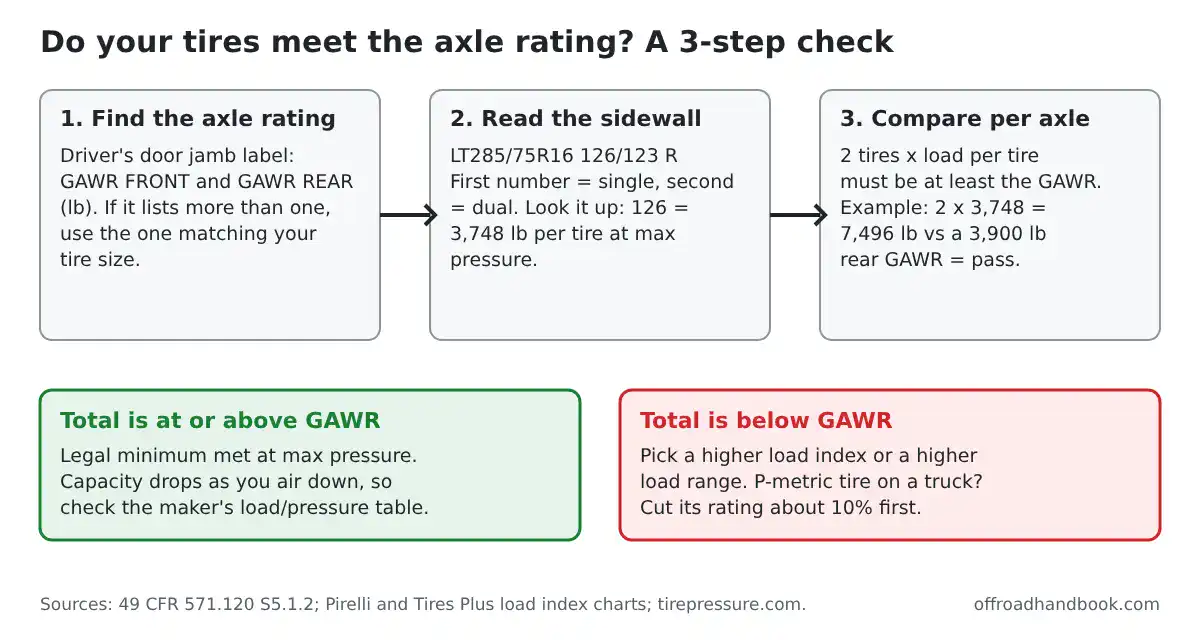
- Find the GAWR. It is on the vehicle certification label, usually on the driver's door jamb. FMVSS 120 compares tire ratings to the GAWR "as specified on the vehicle's certification label". If the label lists more than one GAWR, the rule uses the one that matches your tire size.
- Read the sidewall. In LT285/75R16 126/123 R, the load index is 126/123 and the letter is the speed symbol. On light truck tires the first number is the single-wheel rating and the second is the dual rating.
- Compare. Look up the index below, multiply by the number of tires on the axle and compare with the GAWR.
Tire Load Index Chart (75 to 130)
Values are pounds per tire at the tire's maximum inflation pressure. The two-tire and four-tire columns are simple multiples for checking an axle. Two independent charts agree on every row from 75 to 130.
Show the full load index chart
| Load index | One tire (lb) | Two tires (lb) | Four tires (lb) |
|---|---|---|---|
| 75 | 852 | 1,704 | 3,408 |
| 76 | 882 | 1,764 | 3,528 |
| 77 | 908 | 1,816 | 3,632 |
| 78 | 937 | 1,874 | 3,748 |
| 79 | 963 | 1,926 | 3,852 |
| 80 | 992 | 1,984 | 3,968 |
| 81 | 1,019 | 2,038 | 4,076 |
| 82 | 1,047 | 2,094 | 4,188 |
| 83 | 1,074 | 2,148 | 4,296 |
| 84 | 1,102 | 2,204 | 4,408 |
| 85 | 1,135 | 2,270 | 4,540 |
| 86 | 1,168 | 2,336 | 4,672 |
| 87 | 1,201 | 2,402 | 4,804 |
| 88 | 1,235 | 2,470 | 4,940 |
| 89 | 1,279 | 2,558 | 5,116 |
| 90 | 1,323 | 2,646 | 5,292 |
| 91 | 1,356 | 2,712 | 5,424 |
| 92 | 1,389 | 2,778 | 5,556 |
| 93 | 1,433 | 2,866 | 5,732 |
| 94 | 1,477 | 2,954 | 5,908 |
| 95 | 1,521 | 3,042 | 6,084 |
| 96 | 1,565 | 3,130 | 6,260 |
| 97 | 1,609 | 3,218 | 6,436 |
| 98 | 1,653 | 3,306 | 6,612 |
| 99 | 1,709 | 3,418 | 6,836 |
| 100 | 1,764 | 3,528 | 7,056 |
| 101 | 1,819 | 3,638 | 7,276 |
| 102 | 1,874 | 3,748 | 7,496 |
| 103 | 1,929 | 3,858 | 7,716 |
| 104 | 1,984 | 3,968 | 7,936 |
| 105 | 2,039 | 4,078 | 8,156 |
| 106 | 2,094 | 4,188 | 8,376 |
| 107 | 2,149 | 4,298 | 8,596 |
| 108 | 2,205 | 4,410 | 8,820 |
| 109 | 2,271 | 4,542 | 9,084 |
| 110 | 2,337 | 4,674 | 9,348 |
| 111 | 2,403 | 4,806 | 9,612 |
| 112 | 2,469 | 4,938 | 9,876 |
| 113 | 2,535 | 5,070 | 10,140 |
| 114 | 2,601 | 5,202 | 10,404 |
| 115 | 2,679 | 5,358 | 10,716 |
| 116 | 2,756 | 5,512 | 11,024 |
| 117 | 2,833 | 5,666 | 11,332 |
| 118 | 2,910 | 5,820 | 11,640 |
| 119 | 2,998 | 5,996 | 11,992 |
| 120 | 3,086 | 6,172 | 12,344 |
| 121 | 3,197 | 6,394 | 12,788 |
| 122 | 3,307 | 6,614 | 13,228 |
| 123 | 3,417 | 6,834 | 13,668 |
| 124 | 3,527 | 7,054 | 14,108 |
| 125 | 3,638 | 7,276 | 14,552 |
| 126 | 3,748 | 7,496 | 14,992 |
| 127 | 3,858 | 7,716 | 15,432 |
| 128 | 3,968 | 7,936 | 15,872 |
| 129 | 4,079 | 8,158 | 16,316 |
| 130 | 4,189 | 8,378 | 16,756 |
Why the Same Load Index Does Not Always Mean the Same Capacity
Three things catch off-roaders out, and most charts skip all three.
1. LT and P-metric are not equal. At 35 psi, tirepressure.com lists about 1,709 lb for a P215/70R16, about 1,653 lb for the same size in a plain metric tire and about 1,340 lb for an LT215/70R16 in single use.
Its guidance is to buy replacements with at least 10% more capacity when you move a P-metric tire onto a light truck, SUV or van, and the tool above applies that derate. Our Load Range C vs D vs E guide covers the LT side.
2. Pressure changes capacity. The chart numbers are for maximum pressure. As tirepressure.com puts it, an underinflated tire cannot support as much weight as a properly inflated one.
That matters when you air down for the trail: you are trading capacity for traction, so a loaded rig needs more pressure than an empty one. See our off-road tire pressure guide for terrain starting points, and use a real gauge (tire pressure gauges on Amazon; check the current price) instead of guessing.
3. Dual rating is lower. The second number on an LT tire is for dual rear wheels. tirepressure.com says dual assemblies carry about 9% less per tire than the single rating, which is why the tool asks you to enter the second number for duals.
Speed Symbol Chart: What the Letter After the Load Index Means
The letter is the speed symbol. Continental describes it as the maximum speed the tire can safely maintain under its specified load. Check it against how fast you actually drive, especially when towing.
| Speed symbol | Top rated speed (mph) |
|---|---|
| Q | 99 |
| R | 106 |
| S | 112 |
| T | 118 |
| U | 124 |
| H | 130 |
| V | 149 |
| W | 168 |
| Y | 186 |
What to Do If the Numbers Don't Work
- Total below GAWR: pick a size or tire with a higher load index, usually a higher load range.
- Going to bigger tires: a taller tire does not automatically carry more. Check the maker's load/pressure table for the new size; our mud tire size guide and bigger-tire fitment article help with the size side.
- Replacing one tire: match the others and the original load index. NHTSA has noted that replacements with a lower load index reduce the payload your vehicle can carry.
- Towing or hauling heavy: the GAWR is a floor, not a plan. Stay within your owner's manual limits and your tire maker's data.
For a quick speedometer and gearing check after any tire change, the regear calculator and the rest of our free off-road calculators are one click away.
Tire Load Index FAQ
Is the tire load index the weight in pounds?
No. It is a code. You look it up in a chart; 100 is 1,764 lb and 126 is 3,748 lb per tire at maximum pressure.
Can I use a tire with a higher load index than stock?
Yes. A higher load index means a higher load capacity at maximum pressure, and it is the safe direction. Dropping below the original is the problem.
What does 126/123 mean on a tire?
126 is the load index for single use and 123 is for dual rear wheels.
Where do I find my GAWR?
On the vehicle certification label, usually on the driver's door jamb. It lists a front and a rear axle rating in pounds.
Sources: 49 CFR 571.120 (FMVSS 120); Pirelli load index; Tires Plus load index chart; Continental speed index; tirepressure.com load/inflation guidance.

I'm Suryashankar Dasgupta, the founder of Off-Road Handbook. I've been off-roading for years in the USA, including California and Texas, and have ridden mountain and desert terrain abroad. I've also driven a Jeep Compass for more than seven years, so I know the day-to-day side of Jeep ownership first-hand, from the Uconnect screen to the warning lights. Every guide here is researched from manufacturer owner's manuals, NHTSA recall and service-bulletin records and other trusted sources, checked against them before it is published, and corrected when we find a mistake. You can read how we work in our editorial policy: https://offroadhandbook.com/editorial-policy/
Like our off-road guides? Add Off-Road Handbook as a Google Preferred Source so our latest Jeep, ATV, UTV, trail, recovery, and off-road troubleshooting articles can appear more often in your Google Search experience.
Add us as a Preferred Source