Tire Size Calculator: Diameter, Speedometer Error, Clearance
Last updated on October 29th, 2026 at 07:40 pm
Going from a 245/75R17 (about 31.5 in tall) to a 35x12.50R17 makes the tire about 11% taller. At an indicated 60 mph you are really doing about 66.7 mph, your odometer under-counts by the same 11%, the axles sit about 1.8 in higher, and your gearing feels about 11% taller. Type your current and new sizes into the calculator below to see the numbers for your own swap.
Tire size calculator: diameter, speedometer, clearance and gearing
Tire size calculator: compare your current tire with a new size.
Metric (265/70R17, LT285/70R17) or flotation (33x12.50R17, 35x12.5-17).
More free tools: see all our off-road calculators for tire size, regear, air-down pressure, winch size and more.
Watch this on Instagram: @off_road_handbook
How it works: for a metric size like 265/70R17, the first number is the tread width in millimeters, the second is the sidewall height as a percentage of that width, and the last is the wheel diameter in inches. Overall diameter = wheel diameter + 2 × (width × aspect ratio ÷ 100 ÷ 25.4). A flotation size like 35x12.50R17 already gives the overall diameter (35 in) and width (12.5 in) in inches. Speed and odometer error scale directly with diameter, because a taller tire covers more ground per turn. Read more about the sidewall numbers in our guide on how to read mud tire sizes.
Common upsizes from a 31.5-inch stock tire
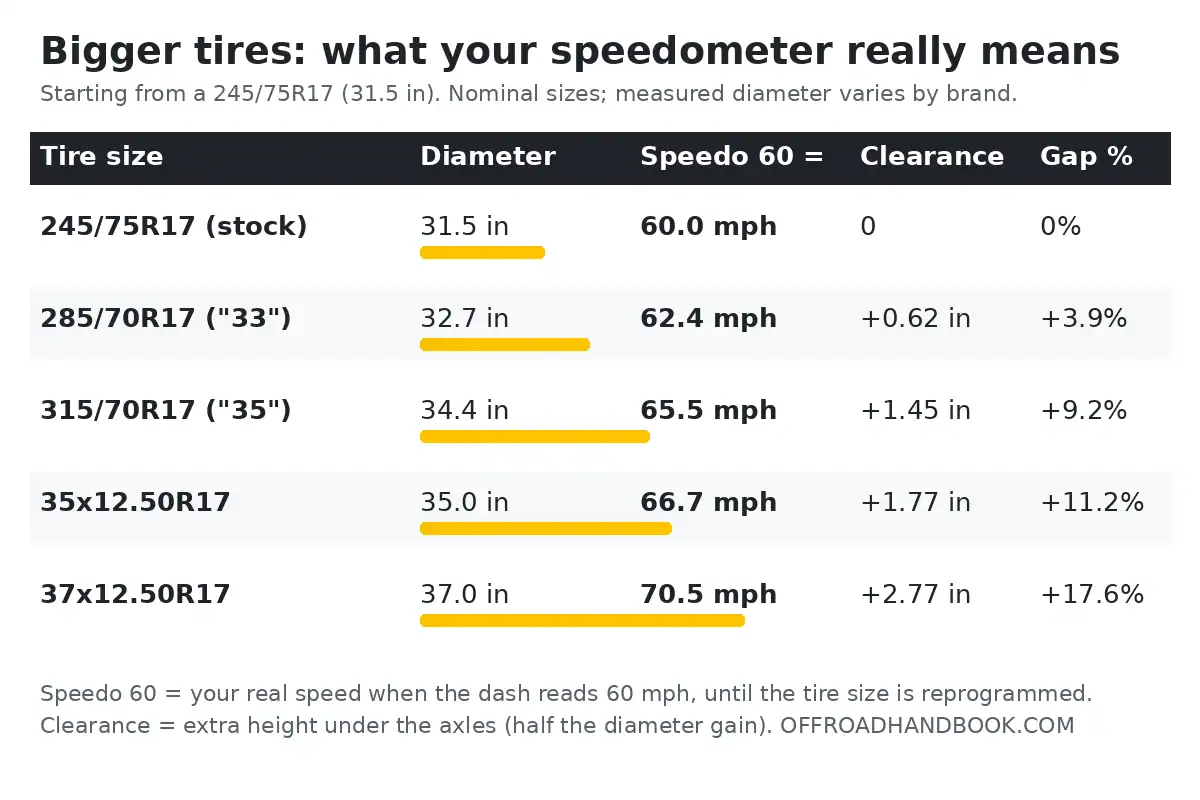
A few things stand out. A "35" in metric sizing (315/70R17) is really about 34.4 in, not 35, so check the calculated diameter rather than the nickname. And a 37 is almost 18% taller than a 31.5 in tire: at an indicated 60 mph you are doing about 70.5 mph.
What changes when you fit bigger tires
Speedometer and odometer
Your speedometer and odometer are set up for the factory tire size. With taller tires they read low by the same percentage the diameter grew. On many newer trucks and Jeeps the tire size is stored in a vehicle module and can be reprogrammed by a dealer or with a scan tool that supports it; check your owner’s manual or dealer for your model. Until then, use the real speed from the calculator, or a GPS speed app, to stay legal.
Gearing and acceleration
A taller tire acts like a taller (numerically lower) axle ratio. Enter your axle ratio in the calculator to see the effective ratio with the new tires, and the ratio you would need to get your original gearing back. The heavier the tire and the bigger the jump, the more you will notice slower acceleration and more downshifting on hills. Our regear calculator shows the closest common ratio and your highway RPM.
Ground clearance
Only half of the diameter gain shows up as clearance under the axles and differentials, because the tire grows both up and down from the hub. Going from 31.5 in to 35 in adds about 1.8 in under the diffs. Body and frame clearance only change if you lift the suspension.
Fitment, load and pressure
- Fitment: bigger tires can rub on fenders, control arms or the frame at full lock or full flex. Wheel width and backspacing matter as much as diameter. See what fits on a Grand Cherokee without a lift for a model-specific example.
- Load rating: the new tire must carry at least the load your vehicle’s door placard calls for. Compare load ranges in Load Range C vs D vs E.
- Pressure: a different size and load range can need a different pressure than the door sticker. Use the tire maker’s load tables, and our off-road tire pressure guide for airing down on the trail.
FAQ
Is a 315/70R17 the same as a 35-inch tire?
Not quite. By the numbers a 315/70R17 is about 34.4 in tall, which is why it is often called a "35" but sits about half an inch shorter than a 35x12.50R17.
How much does a bigger tire throw off the speedometer?
By the same percentage as the diameter change. An 11% taller tire makes an indicated 60 mph about 66.7 mph in reality.
Why does the real tire measure smaller than the size says?
The sidewall size is nominal. Actual mounted diameter varies by brand, tread design, wheel width and inflation, and a loaded tire is shorter than an unloaded one. Use the tire maker’s published overall diameter when it matters.

I'm Suryashankar Dasgupta, the founder of Off-Road Handbook. I've been off-roading for years in the USA, including California and Texas, and have ridden mountain and desert terrain abroad. I've also driven a Jeep Compass for more than seven years, so I know the day-to-day side of Jeep ownership first-hand, from the Uconnect screen to the warning lights. Every guide here is researched from manufacturer owner's manuals, NHTSA recall and service-bulletin records and other trusted sources, checked against them before it is published, and corrected when we find a mistake. You can read how we work in our editorial policy: https://offroadhandbook.com/editorial-policy/
Like our off-road guides? Add Off-Road Handbook as a Google Preferred Source so our latest Jeep, ATV, UTV, trail, recovery, and off-road troubleshooting articles can appear more often in your Google Search experience.
Add us as a Preferred Source