Speedometer Off After Bigger Tires? How to Recalibrate It
This post contains Amazon affiliate links. As an Amazon Associate I earn from qualifying purchases, at no extra cost to you.
Bigger tires make your speedometer read low, and the fix is to tell the vehicle the tire's real height. Measure the mounted tire from the ground to the top of the tread, then enter that number with the tool your vehicle accepts. If you regeared too, enter the new axle ratio in the same session.
That tool is an OBD-II module on a JL Wrangler or Gladiator, a handheld programmer on a JK, an in-line calibrator on a Tacoma, or a new driven gear on an older truck with a speedometer cable. The calculator below shows how far off you are now and what to enter.
Speedometer error and recalibration calculator
Stock size, inches (33) or metric (285/70R17)
Measured height in inches is best (34.1)
The math is simple. A tire's revolutions per mile equal 63,360 inches divided by its circumference (pi times diameter), which works out to 20,168 divided by the diameter in inches. The vehicle counts revolutions, so true speed equals the displayed speed times the new diameter divided by the diameter it's programmed for.
The axle-ratio fields matter on vehicles that read speed from the driveline rather than the wheels. That's the reason the JL/JT and Tacoma calibration tools below ask for the ratio. Metric sizes are converted from the nominal numbers, so treat those results as estimates and use a tape measure for the final figure.
How to recalibrate, by vehicle
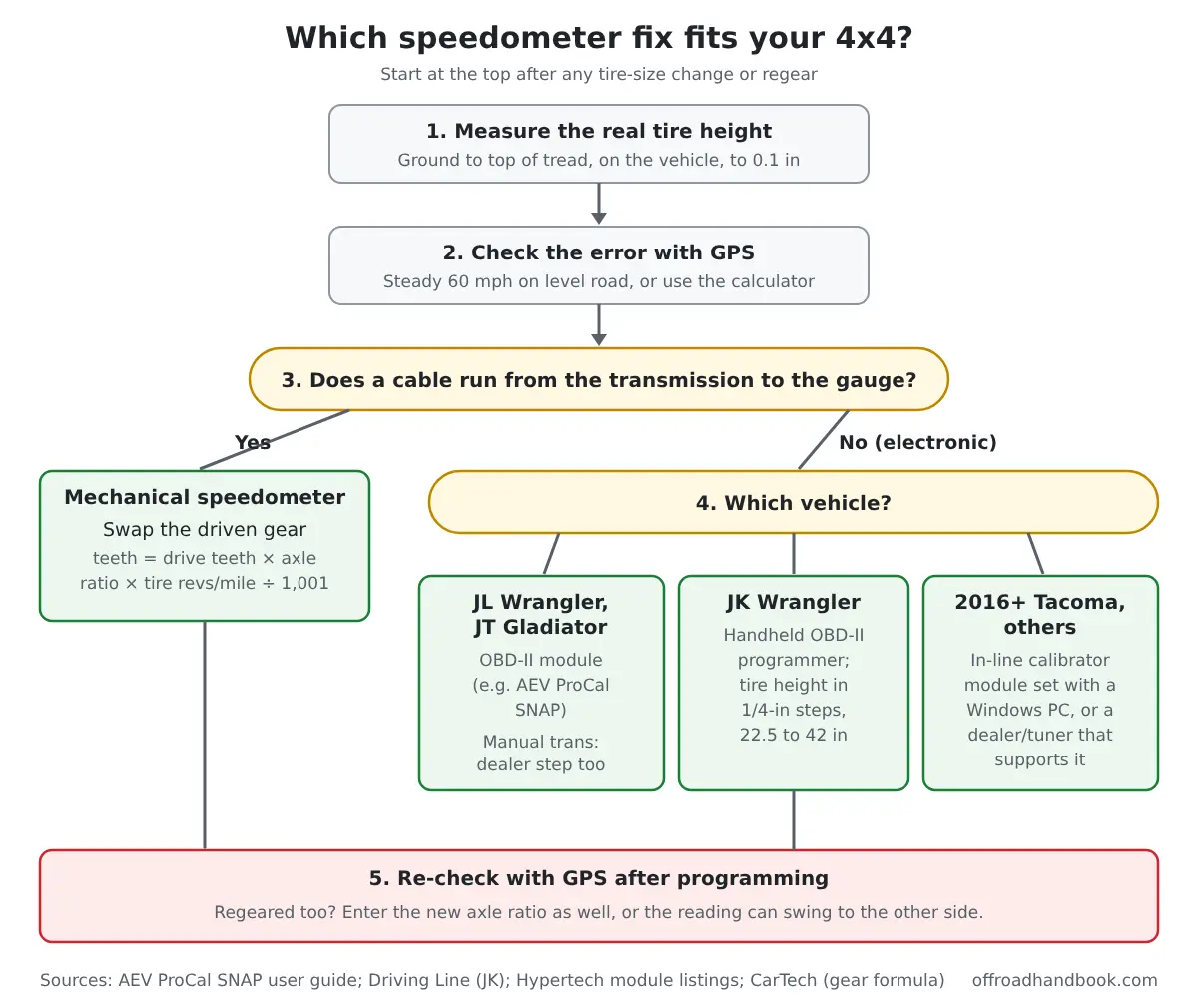
There's no single button for this. Some vehicles accept a new tire size through the OBD-II port, some need a module spliced into the gauge harness, and anything with a cable-driven speedometer needs a different plastic gear in the transmission or transfer case.
The table sums up what each common off-road platform takes and the catch with each. I built it from AEV's ProCal SNAP user guide and product page, Driving Line's JK walkthrough and Hypertech's Tacoma module listing; I left the Ford Bronco out because the one Bronco calibrator listing I found described a different truck in its fitment notes.
| Vehicle | Common route | What you enter | Watch out for |
|---|---|---|---|
| 2018+ Wrangler JL, Gladiator JT | OBD-II module such as the AEV ProCal SNAP for JL/JT (needs AEV's harness) | Measured tire height to 0.1 in (up to 42 in); axle ratio and transfer case ratio only if changed; TPMS warning threshold 28–50 psi | Manual transmissions need extra dealer programming; 4xe: don't enter a ratio above 4.50; some MY2025–26 builds need a dealer DASM update first |
| 2007–2018 Wrangler JK | Handheld OBD-II programmer (Driving Line used a JKS J-Cal) | Measured tire height in ¼-in steps, 22.50 to 42 in; gear ratio after a regear | Enter the measured height, not the sidewall size |
| 2016-and-later Tacoma | Hypertech in-line calibrator module (part 730123), set up with a Windows PC | New tire height and rear gear ratio | Listings disagree on the last covered year (2021 or 2023); earlier Tacomas use different part numbers |
| 2019–2024 Ram HD 2500/3500 | AEV Ram ProCal SNAP | Tire size; TPMS accepts only 35, 45, 50, 60, 65, 80 or 95 psi | AEV says to run the pressure on the tire's sidewall, not lower |
| Older trucks and Jeeps with a speedometer cable | Swap the driven gear | Nothing to program: pick the tooth count with the formula below | Gears come in whole teeth, so expect a small leftover error |
Driving something not listed, like an F-150, Silverado or 4Runner? Check whether a dealer, a handheld tuner or an in-line module supports a tire-size setting for your exact year before you buy anything. Hypertech sells several in-line speedometer calibrators that are vehicle-specific, so match the part number to your truck.
Step 1: measure the real tire height
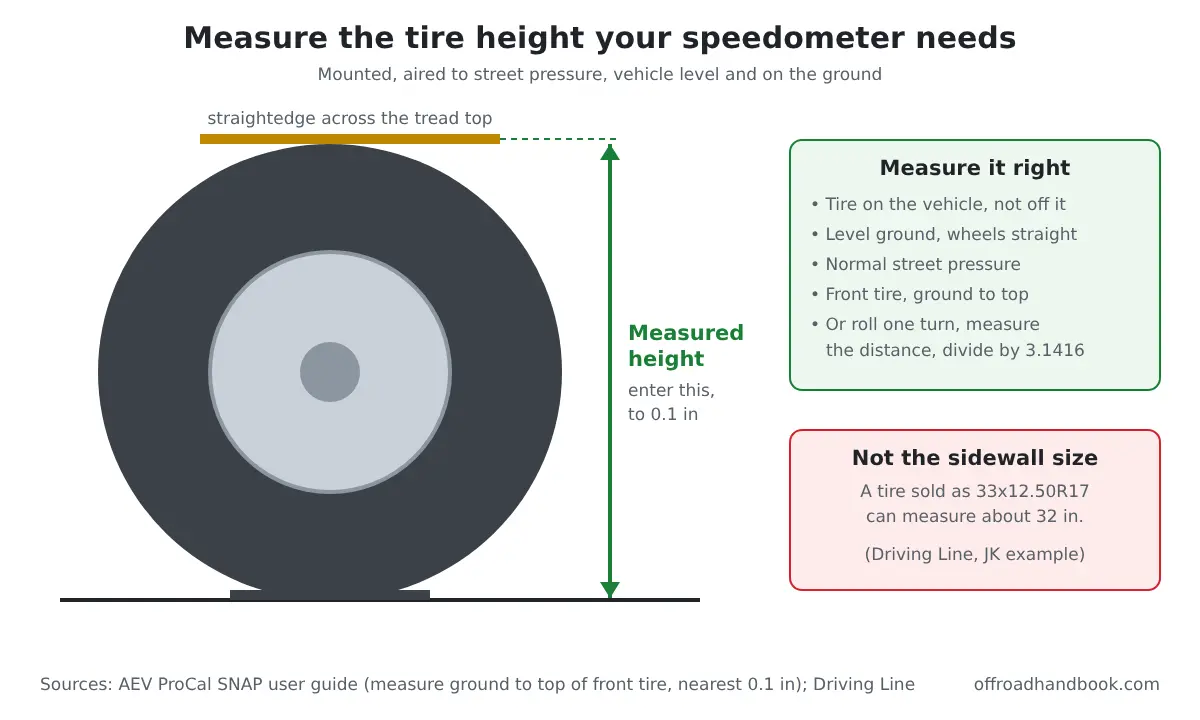
This is where most recalibrations go wrong. The size on the sidewall is a name, not a measurement. Driving Line's example is a tire sold as a 33x12.50R17 that measures closer to 32 inches on the Jeep, so 32 is the number to program.
AEV's instructions say the same thing for the JL: use the measured size, not the rated size written on the tire. Here's how to get it.
- Park on level ground with the wheels pointed straight and the tires at your normal street pressure.
- Lay a straightedge (a level or a board) across the top of a front tire's tread.
- Measure from the ground to the bottom of the straightedge, to the nearest 0.1 inch.
- Cross-check if you like: mark the tread and the ground, roll the vehicle forward exactly one turn, measure that distance and divide by 3.1416.
Measure again once the tread wears down. A worn tire is a little shorter than a new one, so the error creeps back slowly over the tire's life.
JL Wrangler and Gladiator: programming with ProCal SNAP
The JL and JT don't have a menu for tire size, so most owners use a plug-in module. AEV's ProCal SNAP is a common one. It plugs into the OBD-II port and reads your input from the stereo's equalizer settings, so you dial in numbers with Bass, Mid and Treble.
Per the AEV user guide, the order is:
- Install AEV's ProCal harness first, then pair the SNAP to the vehicle. Pairing locks the unit to that one Jeep.
- Set the stereo source to AM/FM and dial the value into the equalizer in order Bass, Mid, Treble. A 34.2-inch tire is Bass 3, Mid 4, Treble 2.
- Press the start button twice for RUN, plug in the SNAP and wait for a solid green light.
- Hold the brake and the cruise-control button combination shown in the guide for 3 seconds. Two horn honks mean it's done.
- Shut the Jeep off, unplug the SNAP and repeat for each separate change (axle ratio, transfer case ratio, TPMS).
A few catches are worth knowing before you start. If the red BRAKE light on the dash flashes during programming, let off the brake pedal right away, or you may set warning lights. A later dealer reflash can overwrite your settings, so keep the module in the glovebox.
AEV also warns that certain 2025 and 2026 JL and JT models built on or after March 24, 2025 shipped with a driver-assist module (DASM) calibration that wouldn't accept a new tire size. That caused lane-departure and auto high-beam faults until a dealer update. Manual-transmission Jeeps need extra dealer programming to avoid clutch errors and transmission codes.
JK Wrangler, Tacoma and other trucks
On a JK, a handheld programmer plugs into the OBD-II port under the driver's side of the dash and walks you through prompts. In Driving Line's walkthrough the tool set tire height in quarter-inch steps from 22.50 to 42 inches, and it also took a new gear ratio, which they flag as needed to prevent shifting problems after a regear.
The 2016-and-later Tacoma takes a different approach. Hypertech's in-line module plugs into the factory harness. You connect it to a Windows computer, enter the new tire height or rear gear ratio, then install it. Check the listing for your exact model year before you buy.
Cable speedometers: choosing the driven gear
Older trucks and Jeeps with a speedometer cable have no computer to reprogram. A small drive gear on the output shaft turns a plastic driven gear on the cable. You correct the reading by swapping the driven gear for one with a different tooth count.
The formula used in CarTech's speedometer tech tip is: driven gear teeth = drive gear teeth × axle ratio × tire revolutions per mile ÷ 1,001. Their example, an 8-tooth drive gear with 3.73 gears and 747 revolutions per mile (about a 27-inch tire), works out to 22 teeth.
Now run an off-road example. With a 7-tooth drive gear and 4.10 gears, a 33-inch tire (611 revolutions per mile) needs about 17.5 teeth.
Step up to 35s (576 revolutions per mile) and it drops to about 16.5. Regear that truck to 4.56 with the 35s and you're back up to about 18.4. Gears only come in whole teeth, so round and expect to be a little off.
Count the drive gear's teeth before you order anything. Drive gears vary (CarTech shows 7- and 8-tooth versions in different diameters), and the driven gear you pick has to fit your housing.
Regeared too? Why the axle ratio matters
Bigger tires make the gauge read low. Shorter (numerically higher) gears do the opposite when the vehicle reads speed from the driveline, because the driveshaft spins faster at the same road speed. If you change both and only update one, the error can swing the other way.
Take a vehicle programmed for 33-inch tires and 3.73 gears. After 37s alone, an indicated 60 mph is really about 67.3 mph. After 37s plus 4.88 gears with nothing reprogrammed, the same 60 on the gauge is only about 51.4 mph. Enter both the tire height and the new ratio, and both errors go away.
If you're still choosing gears, the regear calculator for bigger tires shows which ratio restores your stock cruising rpm, and our breakdown of the best gear ratio for 37s on a Wrangler JL covers that build by trim and engine.
Check the result with GPS
Once you've programmed it, have a passenger read a GPS speed app while you hold a steady 60 mph on a flat, straight road. Read it at more than one speed. A small gap is normal, and a percentage error that stays the same at every speed points to a slightly wrong tire height.
Don't forget the odometer. It counts the same wheel or driveline signal, so a gauge that reads 5% low also logs about 5 miles short for every 100 you drive. That affects oil-change intervals and warranty or lease mileage. Hypertech describes its modules as correcting both the speedometer and the odometer.
Here's a typical JL Rubicon upsize. The computer is set for the factory 285/70R17 (32.71 in nominal), and you fit 315/70R17s (34.36 in nominal).
At an indicated 60 mph you're doing about 63.0 mph, and the odometer reads 100 miles for every 105 driven. If the new tires actually measure 34.0 in, it's closer to 62.4 mph. That's why the measured height matters.
To compare other sizes before you buy, the tire size calculator shows diameter, speedometer error and clearance side by side. If you're going to 35s, check wheel offset and backspacing for 35s on a Wrangler or Tacoma too.
What else a wrong tire setting affects
The speedometer is only the part you can see. According to SD Wheel's tire-size guide, a change in tire size can also throw off shift points on vehicles that use wheel-speed data to decide when to shift. It can affect ABS and traction control, sometimes with warning lights, and it skews fuel-economy readouts.
On newer Jeeps, the driver-assist systems use the tire size too, as AEV's 2025–26 DASM note shows. If your new tires run a different pressure, set the TPMS warning threshold in the same session where your tool allows it. While you're at it, confirm your new tires' load capacity with the tire load index chart.
FAQ
How far off is my speedometer with 35-inch tires?
It depends on what the computer is set for. Going from a 33-inch setting to a true 35-inch tire, an indicated 60 mph is about 63.6 mph. From the JL Rubicon's 285/70R17 to a nominal 315/70R17, it's about 63.0 mph. Plug your own numbers into the calculator above.
Can I just enter the size printed on the tire?
You can, but it's usually a little off. Both AEV and Driving Line say to enter the measured height. A tire sold as a 33 can measure about 32 inches mounted.
Does recalibrating fix the odometer too?
Yes. The odometer counts the same signal, so correcting the tire size corrects both. Mileage driven before the fix stays recorded as it was.
Do I need to recalibrate after a regear if I kept my tires?
On vehicles whose calibration tools ask for an axle ratio, like the JL/JT and the Tacoma, yes. Enter the new ratio, or both the speedometer and shift behavior can be off.
Sources
- AEV ProCal SNAP user guide (AEV30348): measuring tire height, equalizer entry, axle, transfer case and TPMS limits
- AEV ProCal SNAP product page: 42-inch limit, manual-transmission and 2025–26 DASM notes
- Driving Line: How to properly calibrate your JK for taller tires
- ExtremeTerrain: Hypertech 730123 Tacoma in-line speedometer calibrator
- CarTech: speedometer gear calculations
- SD Wheel: why your speedometer is off after changing tire size

I'm Suryashankar Dasgupta, the founder of Off-Road Handbook. I've been off-roading for years in the USA, including California and Texas, and have ridden mountain and desert terrain abroad. I've also driven a Jeep Compass for more than seven years, so I know the day-to-day side of Jeep ownership first-hand, from the Uconnect screen to the warning lights. Every guide here is researched from manufacturer owner's manuals, NHTSA recall and service-bulletin records and other trusted sources, checked against them before it is published, and corrected when we find a mistake. You can read how we work in our editorial policy: https://offroadhandbook.com/editorial-policy/
Like our off-road guides? Add Off-Road Handbook as a Google Preferred Source so our latest Jeep, ATV, UTV, trail, recovery, and off-road troubleshooting articles can appear more often in your Google Search experience.
Add us as a Preferred Source