How to Use a Snatch Block (+ Anchor Load Calculator)
This post contains Amazon affiliate links. As an Amazon Associate I earn from qualifying purchases, at no extra cost to you.
A snatch block does one of two jobs. In a double-line pull it lets your winch put about twice its rope tension on the stuck vehicle, at half the line speed. In a redirect it turns the rope so you can use an anchor that isn't straight ahead.
Either way, you hang the block from a tree strap or another rated anchor with a shackle, run the rope over the sheave and close the side plate. The part most how-to pages leave out is the load: the block, shackle and strap can carry close to double the rope's tension, so they need ratings to match.
Double line, redirect or triple line: what each rig does
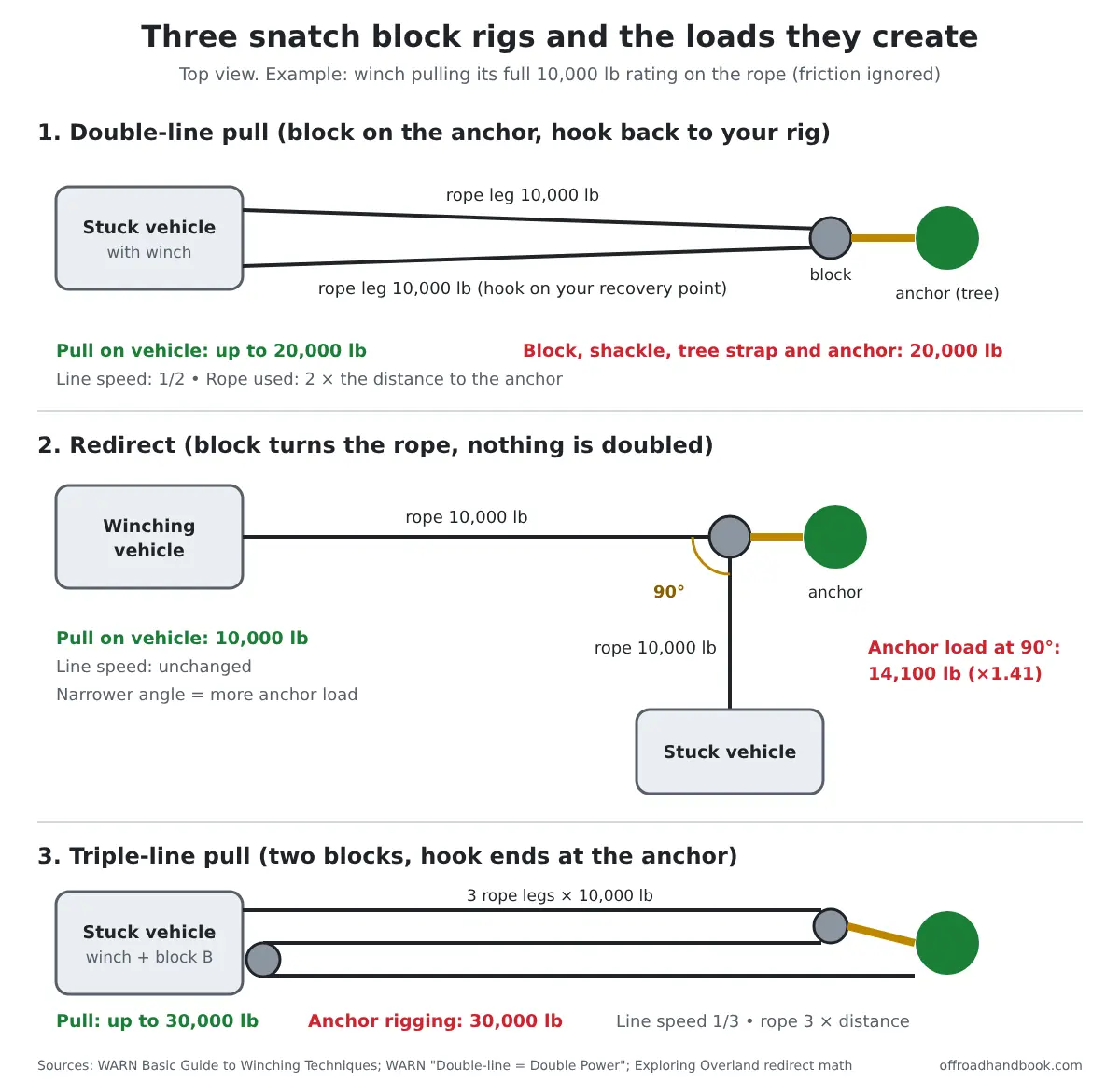
Every rig comes back to one idea. Each length of rope running between the winch, the blocks and the anchor carries the same tension the winch is pulling. Count the rope legs that end on the stuck vehicle and you have the pull on it. Count the legs tied to the anchor and you have what the anchor has to hold.
WARN's own example is a 2,500 lb ATV winch rigged double-line to "pull 5,000 lbs," with the warning that "you've cut your rope length and line speed in half" (WARN). A redirect is different. Only one leg reaches the stuck vehicle, so its pull and speed stay the same, but the anchor still sees most of both legs (Exploring Overland).
| Rig (10,000 lb winch at full rated pull) | Max pull on stuck vehicle | Load on block and anchor rigging | Line speed | Rope needed |
|---|---|---|---|---|
| Single line, straight to the anchor | 10,000 lb | 10,000 lb (strap and shackle) | Full | 1 × distance |
| Double line, block on the anchor, hook back to your rig | 20,000 lb | 20,000 lb | ½ | 2 × distance |
| Redirect at 90° between the rope legs | 10,000 lb | 14,100 lb | Full | Winch to block + block to vehicle |
| Redirect at 30° (rope nearly doubles back) | 10,000 lb | 19,300 lb | Full | Winch to block + block to vehicle |
| Triple line, two blocks, hook ends at the anchor | 30,000 lb | 20,000 lb per block, 30,000 lb on the anchor | ⅓ | 3 × distance |
Those maximums only happen when the winch is pulling its full rating on the first layer of rope. In a real pull the winch only makes as much tension as it takes to move the vehicle, and its pull drops on each outer layer of rope on the drum.
That's why the table uses the worst case. Size your gear for what the winch can do, not for what you hope the pull will need. If you're still choosing a winch, our winch size calculator with layer-by-layer pull figures shows how much pull you keep as the drum fills up.
Snatch Block Load Calculator
Enter your winch's rated line pull and how you plan to rig the block. The calculator gives you the most pull the stuck vehicle can get, the load on the block and anchor, the minimum rating every anchor part needs, and whether you have enough rope.
How it works: a double line puts two rope legs on the vehicle and the anchor (2 × pull), a triple line puts three, and a redirect loads the anchor by 2 × pull × cos(angle ÷ 2). Results ignore pulley friction and assume the winch reaches its full rated pull, so treat them as estimates.
The "minimum working load limit" line is what to compare against the rating stamped on the block, the shackle and the tree strap. If a part only lists a breaking strength, don't read that number as its working load. More on that below.
How to rig a double-line pull, step by step
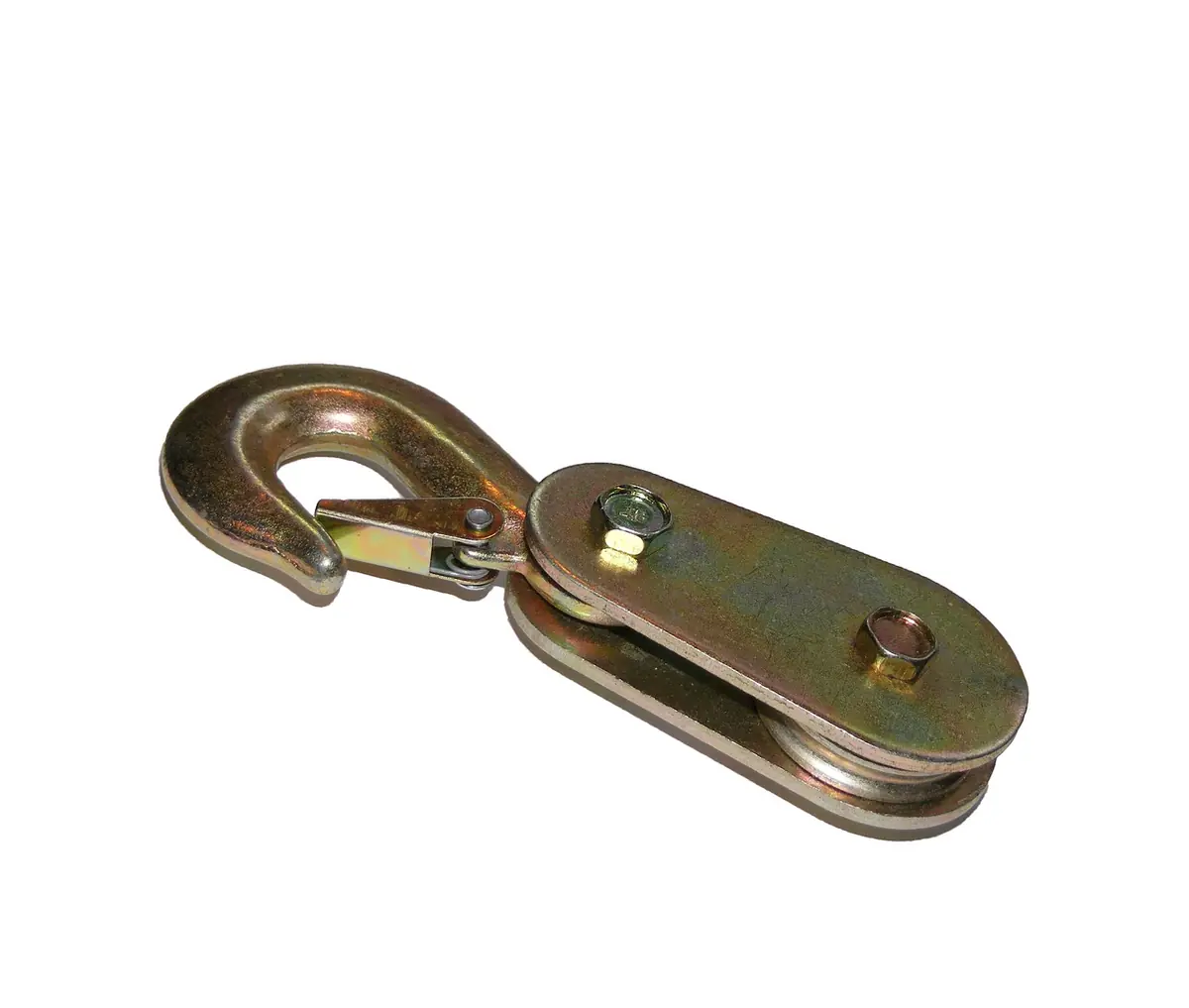
The double-line pull is the rig you'll use most. It doubles the force on the stuck vehicle, and it keeps more rope off the drum, so the winch works on a lower, stronger layer. These steps follow WARN's Basic Guide to Winching Techniques.
- Gloves on, clutch out. Put on heavy leather gloves, disengage the winch clutch and free-spool the rope. Hold the hook by its strap, not by the hook itself.
- Pick the anchor. Use a solid tree, stump, rock or a parked vehicle as close to straight ahead as you can get. Because a double line uses twice the rope, an anchor half as far away still gets most of the rope off the drum.
- Wrap a tree strap, low. Wrap a tree trunk protector around the base of the anchor. WARN says to hook as low as possible, and warns that chains "will damage or kill trees."
- Hang the block. Join both eyes of the strap with a shackle and put the block on that shackle. WARN says to tighten a screw-pin shackle and then back it off half a turn.
- Lay the rope in and close the plate. Swing the side plate open, lay the rope over the sheave, close the plate and make sure it's secure.
- Bring the hook home. Walk the rope back to a frame-mounted recovery point on your vehicle and shackle the hook there. Never hook the rope back onto itself.
- Lock the clutch and take up the slack. Spool in slowly until the rope is tight, then check that the block, strap and shackles are seated and that the rope is winding evenly on the drum.
- Damper and clear zone. Lay a heavy blanket or a recovery damper over the rope midway between the winch and the anchor. Move everyone away from the rope and the snatch block, and out from in front of and behind the vehicles.
- Pull slowly. Winch steadily, and let the driver add a little throttle to help if the vehicle can drive. Stop if the rope starts piling up at one end of the drum.
If someone is spotting for you, agree on hand signals before anyone touches the remote. Our guide to off-road spotting signals covers the basic set, and WARN adds one rule worth repeating: if the winch operator can't see both of the spotter's hands, don't run the winch.
To pull a second vehicle double-line, flip the layout. Put the block on the stuck vehicle's recovery point and bring the hook back to your own front recovery point. That's the setup in WARN's photo of a ditched Jeep Cherokee.
How to rig a redirect without overloading the anchor
Use a redirect when the only good anchor is off to one side, or when you need the stuck vehicle to move in a direction your winch isn't facing. It also keeps the rope coming in straight through the fairlead. WARN warns that side pulls stack rope up at one end of the drum, and that the pile can grow big enough to damage the winch.
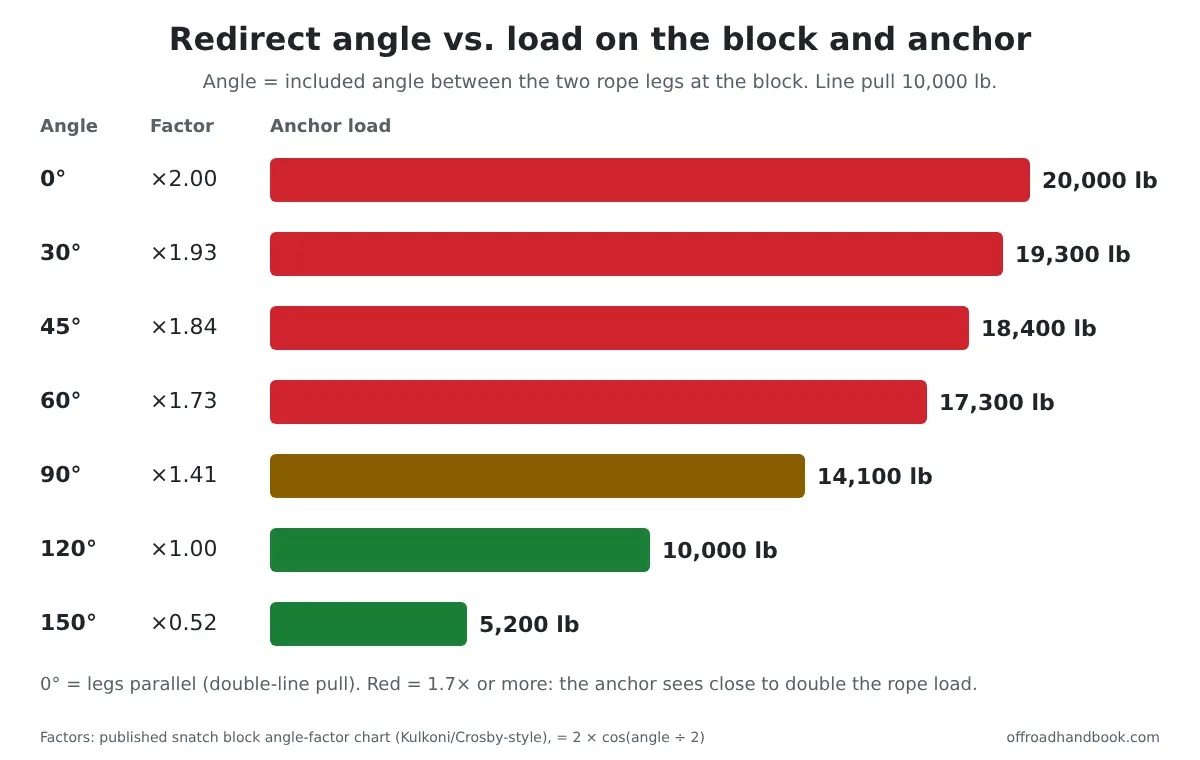
The angle that matters is the one between the rope coming in from the winch and the rope going out to the stuck vehicle, measured at the block. At 0° the legs run side by side, like a double line, and the anchor carries twice the rope tension. At 120° it carries exactly the tension. Past that it carries less.
The trap is the "simple" redirect where the stuck vehicle sits nearly beside your rig. Exploring Overland works through a 4,000 lb pull at 90° (5,656 lb on the anchor) and points out that with the vehicles side by side the anchor nears 8,000 lb, even though the stuck vehicle only gets 4,000.
| Angle between rope legs | Factor | 5,000 lb winch | 8,000 lb winch | 10,000 lb winch | 12,000 lb winch |
|---|---|---|---|---|---|
| 0° (legs parallel) | 2.00 | 10,000 lb | 16,000 lb | 20,000 lb | 24,000 lb |
| 30° | 1.93 | 9,600 lb | 15,400 lb | 19,300 lb | 23,200 lb |
| 45° | 1.84 | 9,200 lb | 14,700 lb | 18,400 lb | 22,100 lb |
| 60° | 1.73 | 8,600 lb | 13,800 lb | 17,300 lb | 20,800 lb |
| 90° | 1.41 | 7,000 lb | 11,300 lb | 14,100 lb | 16,900 lb |
| 120° | 1.00 | 5,000 lb | 8,000 lb | 10,000 lb | 12,000 lb |
| 150° | 0.52 | 2,600 lb | 4,200 lb | 5,200 lb | 6,200 lb |
I took the factors in this table from the published chart in the Kulkoni rigging catalog and checked each one against Exploring Overland's 2 × cos(half-angle) formula. A Firehouse extrication article prints the same factors, but its worked example contradicts its own chart, so I didn't use it.
You can't measure angles precisely on the trail, and you don't have to. A rough rule is enough: if the rope makes a sharp, hairpin-like turn at the block, rate everything at the anchor for double the winch's pull. If the rope only bends a little, the anchor sees far less.
What rating do the block, shackle and tree strap need?
Rate every part at the anchor for twice your winch's rated line pull. That's the double-line load, and it's also the worst case for a tight redirect. US Cargo Control gives the same rule for the block: choose one rated at twice the winch's pull.
Watch which number a listing gives you. Some list a working load limit (WLL), some just say "capacity," and many tree straps only list breaking strength. A breaking strength is not a working load. When a maker doesn't say which number it is, assume it's the higher, less useful one and ask them before you count on it.
- Winches up to 9,000 lb: the WARN 93195 Epic Snatch Block is listed at 18,000 lb capacity and takes both wire and synthetic rope. Check the current price on Amazon.
- 10,000 to 11,000 lb winches with synthetic rope: the Factor 55 Rope Retention Pulley lists a 22,000 lb WLL. It's for synthetic rope up to ½ inch only, used with an uncoated soft shackle.
- 12,000 lb winches: the WARN 15640 Heavy Duty Snatch Block lists a 24,000 lb maximum capacity. Its listing doesn't say whether it takes synthetic rope, so confirm that with WARN if you run synthetic.
- Tree strap: the WARN 92096 Epic Tree Trunk Protector (4 in. × 8 ft) is rated at 30,000 lb. A wide strap spreads the load over more bark than a thin one.
The shackle joining the strap to the block carries the full anchor load too, so its stamped WLL has to clear the same number. In a triple-line pull, the recovery point holding the second block carries twice the rope tension. Make sure it's a frame-mounted, rated point, not a tie-down loop.
Wire rope or synthetic: check the sheave first
Not every block takes both kinds of rope. WARN's Epic blocks are listed for wire and synthetic. Factor 55's pulley is synthetic-only. ARB's 20,000 lb snatch block listing says plainly that it is "not for synthetic rope."
US Cargo Control adds that the sheave should match the rope diameter. Before you buy, check three things on the maker's page: the rope type, the largest rope diameter it accepts, and whether the rating is a WLL or a breaking strength.
Choosing an anchor when the vehicle is buried
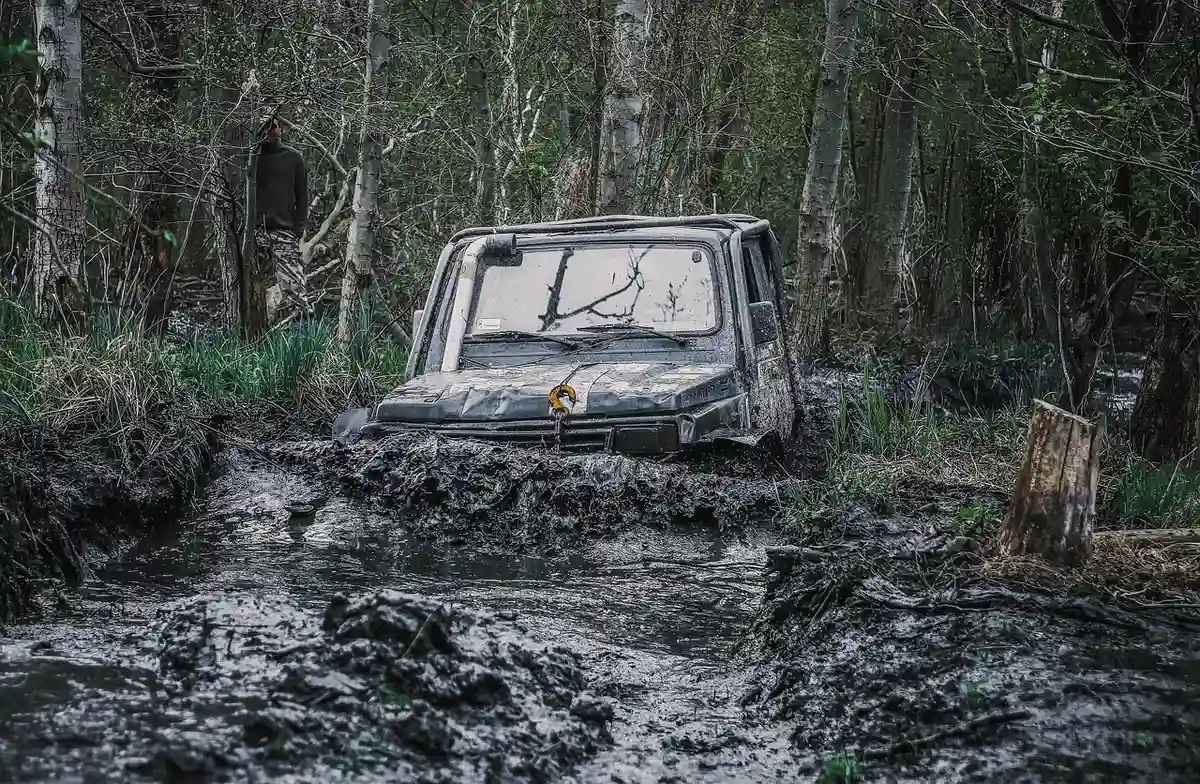
A vehicle buried to the bumpers takes a lot more pull to move than the same vehicle on firm ground, which is exactly when the double line earns its keep. It also means the anchor is about to carry the biggest load of the day, so choose it carefully.
WARN lists trees, stumps and rocks as natural anchors. With no natural anchor, a second vehicle can be one: WARN says to set its parking brake and block its wheels. A dead or shallow-rooted tree, a loose boulder or a small sapling can let go under a double-line load.
Before you rig anything, try the cheap fixes. Dig out the tires and drop the pressure. Our air-down pressure calculator gives a starting PSI for mud. If you have a second vehicle and a clear straight line, a kinetic pull may be faster. See kinetic rope vs snatch strap vs tow strap for which strap to use.
Snatch block mistakes that make a pull dangerous
- Rating the block for the winch, not double the winch. An 8,000 lb block on a 10,000 lb winch is overloaded in a double-line pull as soon as the winch pulls more than 4,000 lb.
- Ignoring the redirect angle. A tight redirect loads the anchor almost as much as a double line, even though the stuck vehicle only gets single-line pull.
- Using a recovery strap in the winch line. WARN says never to use one in a winching operation, because it stretches, stores energy "and could react like a rubber band" if the rigging fails.
- Standing near the block. WARN's no-people zones include anywhere near the rope or the snatch block, as well as in front of and behind the vehicles.
- Jerking the rope. WARN warns that shock loads "can momentarily far exceed" the winch and rope ratings. Take up slack slowly before the real pull.
- Too few wraps on the drum. A double line uses twice as much rope. WARN's guide says never winch with fewer than 5 wraps of wire rope on the drum, so check your manual for the synthetic-rope minimum.
Safety note: winching loads are far higher than they feel. A rope, shackle or anchor that fails under several tons can seriously injure or kill. Use rated, undamaged gear, keep everyone clear, and if the anchor or rigging looks marginal, stop and rethink the pull.
Snatch block FAQ
Does a snatch block really double my winch's pull?
Almost. In a double-line pull, two rope legs each carry the winch's tension, so the vehicle gets close to twice the winch's pull. The block's friction takes a little of that. The winch itself isn't any stronger, and WARN notes the line speed drops by half.
Do I need a snatch block if I have a 12,000 lb winch?
Yes. A bigger winch doesn't fix a side anchor, a short anchor distance or a drum full of rope. A double line also lets the winch work on a lower layer and at lower tension, and WARN says it helps cut heat buildup and amp draw.
Does a redirect slow the winch down?
No. Only the rope between the block and the stuck vehicle gets shorter, so line speed and pull stay the same as a single-line pull. What goes up is the load on the anchor.
How much rope does a double-line pull use?
About twice the distance from your winch to the block, plus the wraps that have to stay on the drum. A triple line uses about three times the distance. Run the numbers in the calculator above before you walk the rope out.
Sources
- WARN: Basic Guide to Winching Techniques (rigging steps, anchors, tree trunk protectors, no-people zones, minimum wraps, side pulls)
- WARN: Double-line = Double Power (double-line pull, line speed and rope length cut in half)
- Exploring Overland: The simple redirected winch pull (redirect anchor-load formula and examples)
- Kulkoni rigging catalog: snatch block angle factors
- US Cargo Control: How to use a snatch block (block rated at twice the winch pull, sheave matched to rope)

I'm Suryashankar Dasgupta, the founder of Off-Road Handbook. I've been off-roading for years in the USA, including California and Texas, and have ridden mountain and desert terrain abroad. I've also driven a Jeep Compass for more than seven years, so I know the day-to-day side of Jeep ownership first-hand, from the Uconnect screen to the warning lights. Every guide here is researched from manufacturer owner's manuals, NHTSA recall and service-bulletin records and other trusted sources, checked against them before it is published, and corrected when we find a mistake. You can read how we work in our editorial policy: https://offroadhandbook.com/editorial-policy/
Like our off-road guides? Add Off-Road Handbook as a Google Preferred Source so our latest Jeep, ATV, UTV, trail, recovery, and off-road troubleshooting articles can appear more often in your Google Search experience.
Add us as a Preferred Source