How Much Extra Fuel to Carry Off-Road (+ Jerry Can Calculator)
This post contains Amazon affiliate links. As an Amazon Associate I earn from qualifying purchases, at no extra cost to you.
Carry enough extra fuel to cover your longest stretch between reliable gas stations at your real trail MPG, and still arrive with the reserve you planned. In numbers: divide that stretch by your MPG, subtract the usable part of your tank, and divide what's left by your can size. For most stock Wranglers, Gladiators, Tacomas and 4Runners, the EPA rating promises 300 to 450 miles a tank, but rough roads, bigger tires and a loaded roof cut that hard.
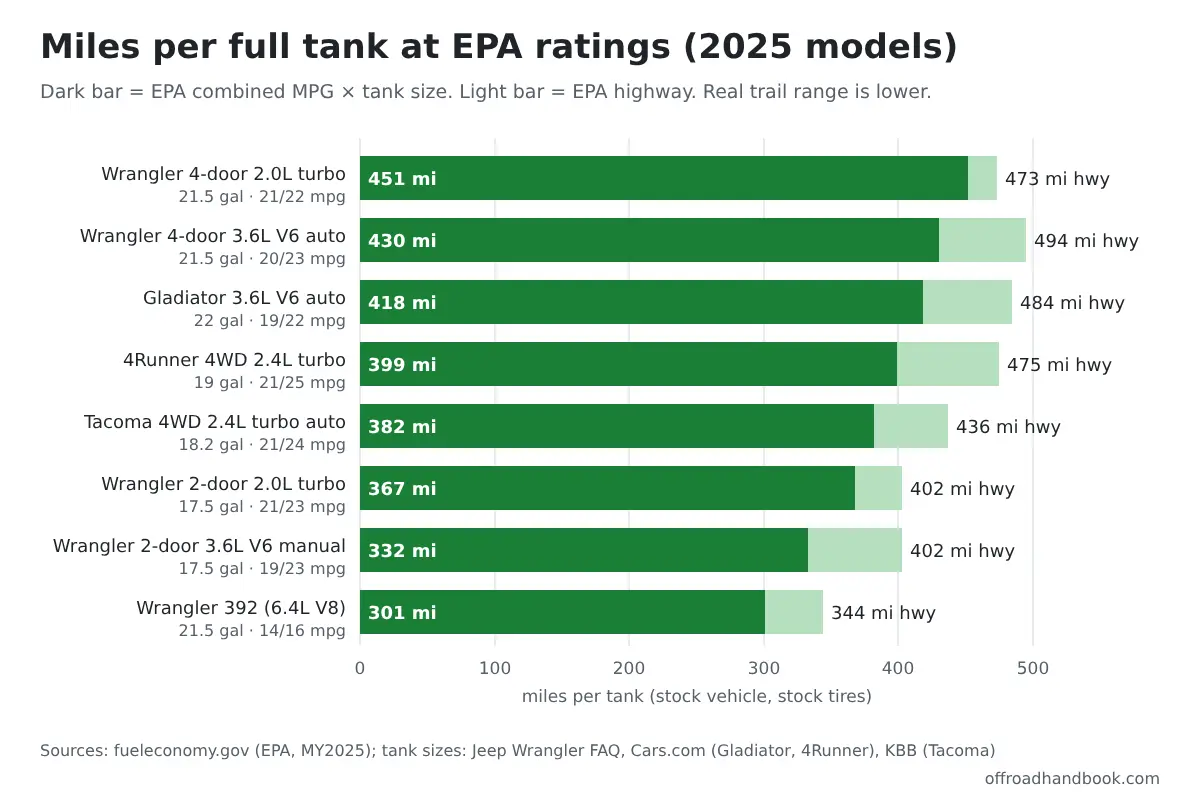
The table shows what a full tank buys at EPA ratings. The calculator after it turns your own MPG and route into a can count and the weight you'll add.
Range per Tank for Popular US 4x4s
| 2025 model | Fuel tank | EPA MPG (combined / highway) | Miles per tank, combined | Miles per tank, highway |
|---|---|---|---|---|
| Jeep Wrangler 4-door, 2.0L turbo, auto | 21.5 gal | 21 / 22 | 451 | 473 |
| Jeep Wrangler 4-door, 3.6L V6, auto | 21.5 gal | 20 / 23 | 430 | 494 |
| Jeep Wrangler 4-door 392, 6.4L V8 | 21.5 gal | 14 / 16 | 301 | 344 |
| Jeep Wrangler 2-door, 2.0L turbo, auto | 17.5 gal | 21 / 23 | 367 | 402 |
| Jeep Wrangler 2-door, 3.6L V6, manual | 17.5 gal | 19 / 23 | 332 | 402 |
| Jeep Gladiator, 3.6L V6, auto | 22 gal | 19 / 22 | 418 | 484 |
| Toyota Tacoma 4WD, 2.4L turbo, auto | 18.2 gal | 21 / 24 | 382 | 436 |
| Toyota 4Runner 4WD, 2.4L turbo | 19 gal | 21 / 25 | 399 | 475 |
I pulled each MPG figure from the EPA's fueleconomy.gov database for the 2025 model year and paired it with the published tank size for that body style. The Ford Bronco isn't in the table on purpose: Ford's website lists 16.9 and 20.8 gallons for the 2-door and 4-door, while copies of the owner's manual quoted online list larger figures, so check the capacities page in your own manual.
Two more details worth knowing. The 6th-gen 4Runner (2025 on) carries 19 gallons, not the 23 gallons of the 2024 5th-gen truck, and some spec sites still show 23 for the new one. The Wrangler 392 also wants premium fuel, which can be scarce at small rural stations.
Jerry Can Calculator: Extra Fuel for Your Longest Stretch
Pick a vehicle to prefill its tank and EPA combined MPG, then swap in your own trail MPG if you have it. Enter real map miles for the stretch, not odometer miles.
Fills tank size and EPA combined MPG (2025)
Best: your own fill-up to fill-up number
Your safety margin; 25% = a quarter tank
Fill both only if your MPG came from an uncorrected odometer
Enter your numbers and press Calculate.
How it works: real MPG = your MPG × (current tire diameter ÷ stock diameter) when both are entered. Extra gallons = stretch ÷ real MPG − tank × (1 − reserve). Cans are rounded up, and weight uses 6.17 lb per gallon for gasoline and 7.05 lb for diesel from the EPA's AP-42 conversion table. Results are estimates; the fuel you carry is only as good as the MPG you enter.
Can fuel goes into the plan with no reserve held back, because the reserve already sits in your main tank. If the trail has a fuel stop halfway, run the calculator for each leg and pack for the longer one.
Why Your Trail MPG Is the Number That Matters
EPA ratings come from lab cycles with a stock vehicle on stock tires. Trail miles mean low gears, wheel spin, idling at obstacles and, on a lot of rigs, a heavier and taller build. The government's own fuel economy site lists several of the things that pile on during an overland trip:
- Weight: an extra 100 pounds could reduce MPG by about 1%.
- Roof cargo: a large rooftop cargo box can cut fuel economy by around 10% to 25% at 65 to 75 mph. Rear-mounted boxes and trays cost much less.
- Speed: gas mileage usually drops quickly above 50 mph, which matters on the highway run to the trailhead.
Those figures are from fueleconomy.gov's driving and cargo tips. They explain why a Wrangler that sees 20 mpg on the commute can come back from a loaded weekend far lower, and why the only number you should trust is one you measured.
How to measure it on your next trip
- Fill the tank until the pump clicks off and reset a trip meter.
- Drive the kind of route you're planning for: dirt, low range, loaded the way you'll travel.
- Refill at the first station, note the gallons, and divide trip miles by gallons.
- Do it on two or three trips and plan on the worst result, not the average.
Bigger tires make your MPG look worse than it is
Here's the step most fuel calculators skip. If you went up a tire size and never recalibrated, your odometer counts fewer miles than you actually drove. A 35-inch tire on a computer set for 32.8-inch tires covers about 6.7% more ground per turn, so your hand-figured MPG reads about 6.7% low.
That error is on the safe side, since you'd pack a little more fuel than needed. It also means your trip meter can't be trusted to tell you how far you've gone against a map. Enter both tire diameters in the calculator above, check yours with the tire size and speedometer error calculator, or fix the root cause with this guide to recalibrating your speedometer after bigger tires.
What the Extra Fuel Weighs, and Where It Can Ride
Fuel is heavy. At the EPA's 6.17 lb per gallon, one 5-gallon can of gasoline holds about 31 lb of fuel; diesel at 7.05 lb per gallon puts about 35 lb in the same can. The can and its mount come on top of that.
| Full 5-gallon cans | Gallons | Gasoline weight | Diesel weight |
|---|---|---|---|
| 1 | 5 | 31 lb | 35 lb |
| 2 | 10 | 62 lb | 71 lb |
| 3 | 15 | 93 lb | 106 lb |
| 4 | 20 | 123 lb | 141 lb |
Every pound of it comes out of the same payload as passengers, water and bumpers. Run your loaded build through the 4x4 payload calculator before you add a second can.
Roof racks have their own limit while moving. Ford, for example, rates the 2025 Bronco's roof at 110 lb dynamic in its 2025 technical specifications. Four full gas cans would eat more than that on their own. If you already run a tent or box up top, the rooftop tent weight limit calculator shows how much dynamic capacity is left.
Down low and at the back is usually the better spot, and it's the one fueleconomy.gov says costs far less MPG than the roof. For the can itself, a spill-proof 5-gallon container such as the Scepter 5-gallon SmartControl gas can is a common choice; diesel users can look at the yellow Scepter SmartControl diesel can. Mount it with a jerry can mount rated for a full can, and check the current price on Amazon.
Filling Cans Without a Static Fire
Never fill a jerry can while it sits in the truck bed or the cargo area. NIOSH has documented fires that ignited on their own when people filled gas cans in pickups with plastic bed liners or in carpeted cars. The liner or carpet keeps the static charge from draining to ground, and the spark jumps to the pump nozzle.
NIOSH's hazard bulletin gives three steps that apply to metal and plastic cans alike:
- Take the can out of the vehicle and set it on the ground, a safe distance away.
- Touch the can with the pump nozzle before you remove the cap.
- Keep the nozzle in contact with the can's opening the whole time you fill.
Then cap it tight and put it back on its mount before you drive away. On a long trip, pour can fuel into the tank at your first chance instead of carrying a full tank and full cans for the whole leg.
Plan the Stretch Before You Count the Cans
The calculator is only as good as the distance you feed it. Measure the stretch on a map from the last station you trust to the next one, and confirm that station's hours, since small-town pumps can close early or run out. If part of the route is a national forest road, read the Motor Vehicle Use Map first so you aren't counting miles on a road that's closed to your vehicle or for the season.
Worked example: a Wrangler 4-door 3.6L that measured 14 mpg on dirt, a 300-mile stretch and a quarter-tank reserve. The tank gives 16.1 usable gallons, or 225 miles. The trip needs 21.4 gallons, so you're 5.3 gallons short: two 5-gallon cans, about 62 lb of gasoline. At EPA's 20 mpg the same trip would have needed none, which is exactly the trap.
FAQ
How far can a Jeep Wrangler go on a full tank?
At EPA combined ratings, a 2025 Wrangler 4-door covers about 430 to 451 miles with the 3.6L V6 or 2.0L turbo, and a 2-door about 332 to 367 miles. The 392 V8 manages about 301. Off-road and loaded, plan on your measured MPG instead.
How much does a 5-gallon jerry can of gas weigh?
The gasoline alone weighs about 31 lb, using the EPA's 6.17 lb per gallon. Diesel is about 35 lb. Add the weight of the empty can, which varies by material and brand.
Can I fill a gas can in my truck bed?
No. NIOSH warns that static buildup has ignited fires when cans were filled in beds with plastic liners and in carpeted cars. Set the can on the ground, touch it with the nozzle first, and keep contact while filling.
How many jerry cans do I need for overlanding?
It depends on your longest fuel gap, not the trip length. Divide that gap by your trail MPG, subtract the usable part of your tank after your reserve, and divide by can size. Run the numbers in the calculator above for each leg.
For more planning tools, from gearing to approach angles, see the full list of free off-road calculators.

I'm Suryashankar Dasgupta, the founder of Off-Road Handbook. I've been off-roading for years in the USA, including California and Texas, and have ridden mountain and desert terrain abroad. I've also driven a Jeep Compass for more than seven years, so I know the day-to-day side of Jeep ownership first-hand, from the Uconnect screen to the warning lights. Every guide here is researched from manufacturer owner's manuals, NHTSA recall and service-bulletin records and other trusted sources, checked against them before it is published, and corrected when we find a mistake. You can read how we work in our editorial policy: https://offroadhandbook.com/editorial-policy/
Like our off-road guides? Add Off-Road Handbook as a Google Preferred Source so our latest Jeep, ATV, UTV, trail, recovery, and off-road troubleshooting articles can appear more often in your Google Search experience.
Add us as a Preferred Source