How to Drive on Sand Dunes: PSI, Flags and Getting Unstuck
This post contains Amazon affiliate links. As an Amazon Associate I earn from qualifying purchases, at no extra cost to you.
To drive on sand dunes, air your tires down to about 12–15 PSI before you leave firm ground, lock in 4WD, switch traction control off and keep a steady, light throttle so the tires never dig. Climb and descend dune faces straight, angle into every crest so you can see the far side, and stop the moment you feel the vehicle bog.
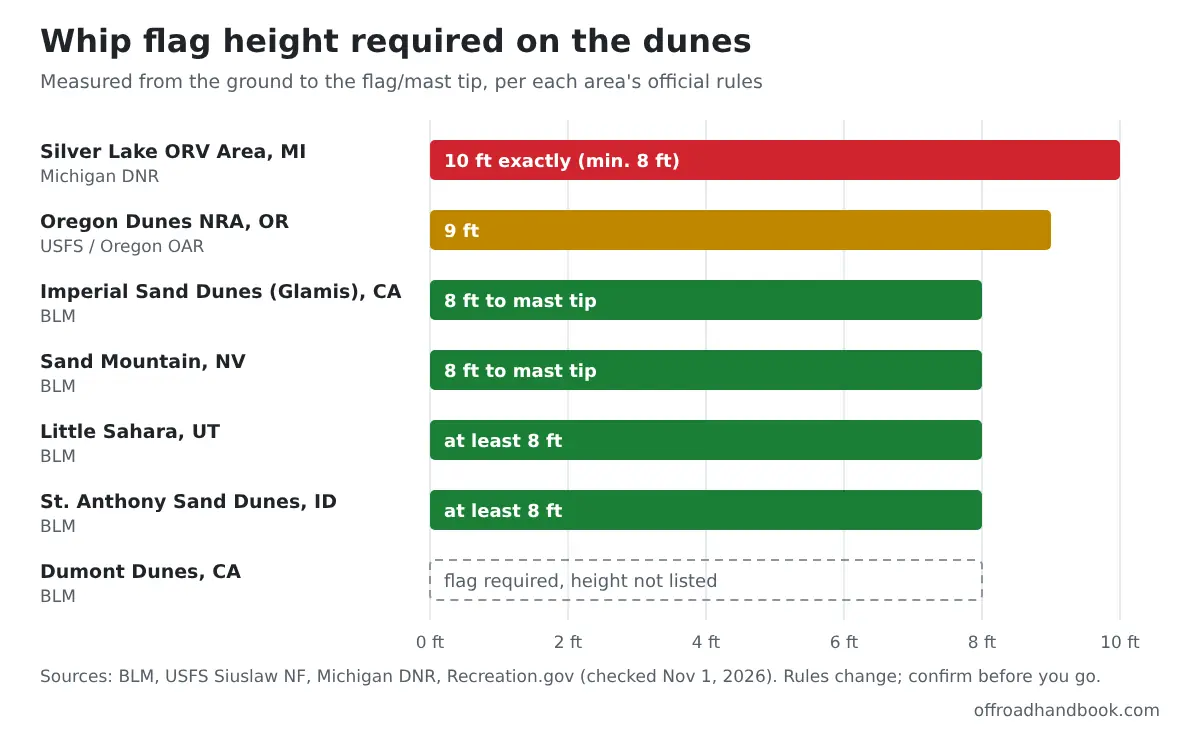
The part beach-driving guides skip: every major US dune area requires a whip flag, and the height isn't the same everywhere. It's 8 ft at Glamis, 9 ft on the Oregon Dunes and exactly 10 ft at Michigan's Silver Lake. The table and calculator below cover seven areas.
Dune-ready settings at a glance
| Setting | What to do | Why |
|---|---|---|
| Tire pressure | 12–15 PSI on standard wheels; Silver Lake caps it at 15 PSI | A longer, flatter footprint floats instead of digging |
| Drivetrain | 4WD engaged before the sand; low range for slow, deep sand on hot days | All four tires pulling means less slip at each one |
| Traction control | Off, if your vehicle allows it | Michigan DNR lists it in its dune driving rules |
| Throttle | Steady and light; no wheelspin, no hard braking | Spinning tires dig holes; hard braking piles sand in front of the tires |
| Line | Straight up and down faces; angle into crests | Side slopes can tip you; a blind crest hides the drop and other drivers |
| Flag | Whip flag at the height the area requires (8–10 ft) | A vehicle behind a crest is invisible without it |
Air down before the soft sand, not after you're stuck
Tire pressure does more in sand than any other setting. Dropping pressure stretches the tread's footprint so the tire rides on top of soft sand instead of cutting into it.
The Michigan DNR puts a number on it for Silver Lake: maximum 15 PSI, with 12–15 PSI highly recommended. That matches the 12–15 PSI sand range in our air-down PSI calculator by terrain, which also explains how vehicle weight and beadlock wheels move the number.
Air down at the staging area, before your first soft patch. Once a tire has dug in, you're airing down from inside a hole, and that's a much harder start.
What your owner's manual may say instead
Some owner's manuals push the other way. Ford's sand guidance in the 2015 F-150 owner's manual says to "avoid reducing the tire pressures," shift to a lower gear and drive steadily instead.
That advice is written for a stock vehicle crossing a sandy stretch, not for a dune park. Silver Lake won't let you on the sand above 15 PSI, so if you're not willing to air down, that vehicle isn't headed for those dunes.
Low pressure has limits either way. Don't drop below about 12 PSI on standard wheels, keep speeds low, avoid sharp turns that can roll a bead, and air back up before pavement.
4H or 4L in sand, and why traction control goes off
Engage 4WD before you need it. Michigan's dune rules tell drivers to make sure four-wheel drive is engaged, and spreading the pull over four tires means each one slips less.
For open, rolling sand where you can carry some speed, 4H usually works. For slow work in deep sand, especially on a hot day, use low range. Ford's manual says to use a low gear when driving slowly in deep sand in high outside temperatures because "low gear operation will maximize the engine and transmission cooling capability."
If you're not sure which modes your Jeep has or how they differ, our guide to Command-Trac, Rock-Trac and Selec-Trac 4x4 modes breaks down 2H, 4H AUTO, 4H and 4L by surface.
Traction control is the other switch. Michigan's rules say to turn it off if your vehicle has it. Traction control treats wheelspin as a fault and cuts power or brakes the spinning wheel, and in soft sand that can stop your momentum at the worst moment.
Some vehicles only let you switch it partly off, or turn it back on above a set speed. Check your owner's manual for how your system works.
How to climb, crest and come down a dune
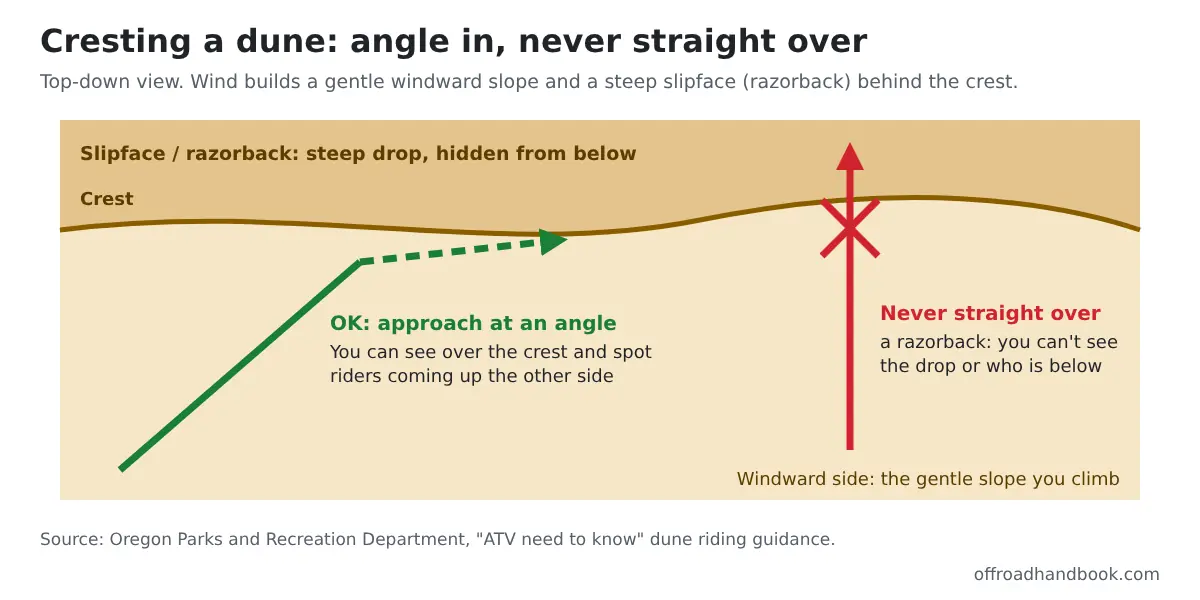
Wind builds most dunes with a long, gentle windward slope and a steep slipface on the downwind side. From the bottom, the slipface is hidden behind the crest, and so is anyone on it.
Oregon's state parks department sums up the two rules that matter: approach a dune crest at an angle so you can scan the terrain and look for other riders, and don't cross straight over a razorback.
- Climb straight. Point the nose straight up the face and keep a steady throttle. Ford's guidance is to drive steadily and avoid excessive wheel slip.
- Don't side-hill. Driving across a steep sand face lets the downhill tires sink and the vehicle slide or tip.
- Ease off before the top. Arrive at the crest at a walking pace and at an angle, so you can see the drop and any traffic before you commit.
- If a climb fails, back straight down. Don't try to turn around on the face. Ford's manual notes you "may be able to back out the way you came."
- Come down straight, in a low gear. Let engine braking hold your speed and keep the steering straight; turning across the slope on the way down can roll you.
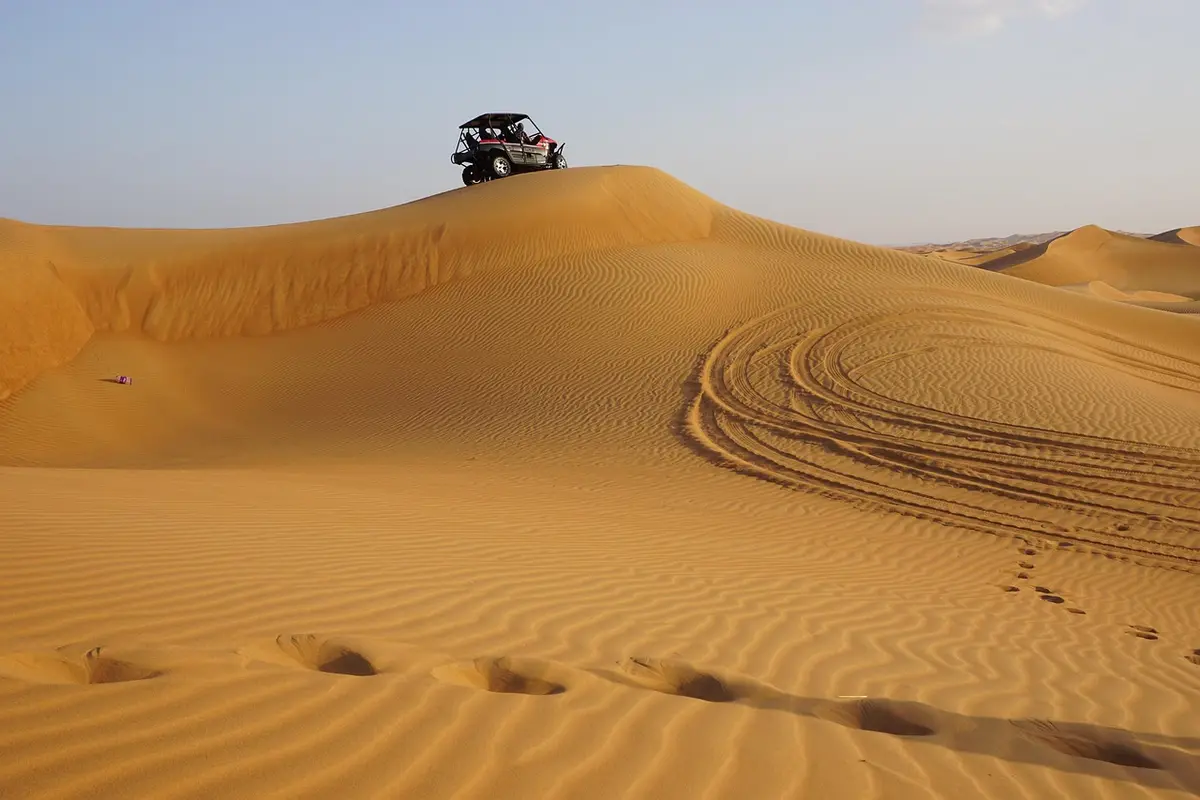
Keep away from vegetation and posted closures, too. The dune areas below all set boundaries on where you can drive, whether that is open sand, marked routes or the area inside orange boundary markers.
One more habit worth building: never stop just below a crest on the far side. That's exactly where a vehicle coming over the top can't see you.
Whip flag and permit rules at 7 US dune areas
A whip flag isn't decoration. When the BLM adopted its Sand Mountain rules, it explained in the Federal Register notice that any vehicle on the dunes may be hidden by the crest of a dune, and whip flags make it visible to other drivers and pedestrians.
The catch for anyone who travels: an 8 ft whip that's legal at Glamis is a foot short on the Oregon Dunes and two feet short at Silver Lake. Flag size, color and mounting position differ too.
| Dune area | Flag height | Flag size and color | Other rules worth knowing |
|---|---|---|---|
| Imperial Sand Dunes (Glamis), CA – BLM | Mast reaches 8 ft from the ground to the tip | 6 x 12 in, red or orange, within 10 in of the mast tip | Permit required for street-legal vehicles driven to the site; OHVs need California registration (green or red sticker) or a nonresident permit; 96 dBA sound limit (1986 and newer) |
| Dumont Dunes, CA – BLM | Required; height not listed | Not listed | Green sticker or license plate displayed; approved muffler and spark arrester; 15 mph within 50 ft of a campsite, animal or pedestrian |
| Oregon Dunes NRA, OR – USFS | 9 ft above the ground | 8 x 12 in, red or orange | 93 dBA sound limit; lights on at dawn, dusk and in limited visibility; riders under 18 need a helmet; trucks, cars and motorhomes need a fire extinguisher |
| Little Sahara, UT – BLM | At least 8 ft above level ground | Red or orange (size not listed) | Utah law requires helmets for all riders under 18 |
| Sand Mountain, NV – BLM | Mast reaches 8 ft to the tip, vehicle stopped | 6 x 12 in, solid red or orange, within 10 in of the tip | 25 mph on maintained roads, 15 mph in camping areas; driving without the flag is a listed violation |
| St. Anthony Sand Dunes, ID – BLM | Whip mast at least 8 ft above level ground | "Brightly colored" (size not listed) | Annual OHV sticker; open sand or designated routes only; helmets for riders under 18 (Idaho law) |
| Silver Lake ORV Area, MI – Michigan DNR | Exactly 10 ft from the ground; never below 8 ft | At least 5 x 10 in, solid orange (no mesh); front-most point on vehicles that require seat belts | ORV license, trail permit and Recreation Passport; 15 PSI maximum; 4WD engaged; traction control off; 94 dB limit; lights on from 30 minutes after sunset |
I built this table on November 1, 2026 from each agency's own page, linked in the first column. Dumont's BLM page says flags are required but gives no height or size, so I left those cells blank rather than borrow a number from another area.
Crowds raise the stakes. The BLM says Little Sahara welcomes over 20,000 visitors every Easter weekend, and on busy dunes an unflagged vehicle behind a crest is far more likely to meet someone coming the other way.
Whip flag length calculator
The rules measure height from the ground, not from wherever the whip is mounted. A whip on a rear tire carrier or a bed-rail mount starts several feet up, so the whip you need is shorter than the rule's number. Measure from level ground to your mount, then pick the area.
The math is simple: required height from the table minus your mount height equals the whip length. It doesn't account for a whip bending back while you drive; Silver Lake's rule covers that with a 10 ft standing height that must never drop below 8 ft. Round up when you shop, never down.
For Glamis and Sand Mountain, remember that the flag itself has to sit within 10 inches of the tip. A flag zip-tied halfway down the whip doesn't count. If you need a whip, a whip with an orange safety flag is the starting point; check the length, flag size and color against your area's row before you buy.
Stuck in sand: the recovery order that works
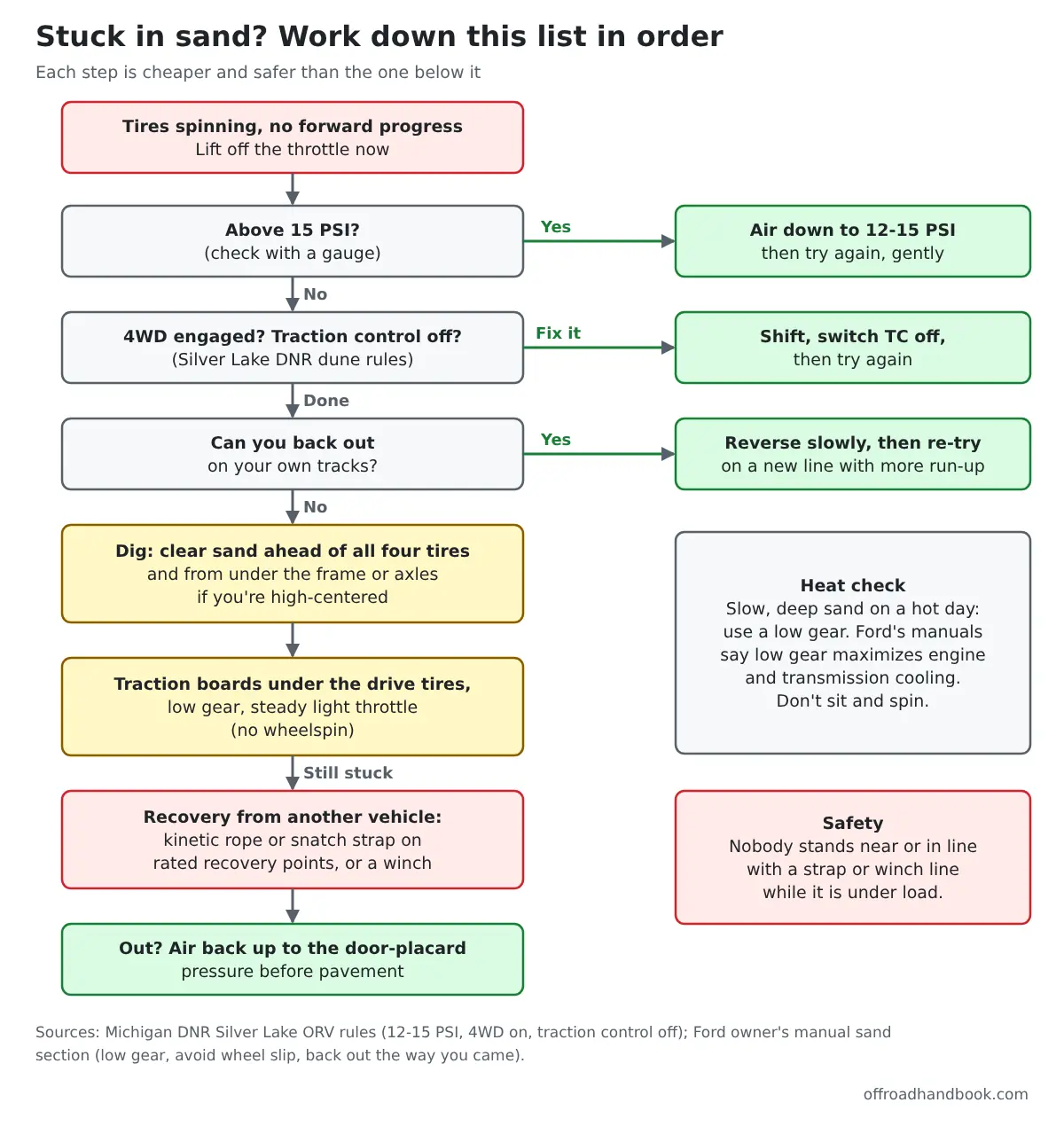
The first move decides how bad it gets. The instant the tires spin and the vehicle stops moving forward, lift off the throttle. Every extra second of wheelspin digs the hole deeper and sinks the axles toward the sand.
- Check pressure. If you're above 15 PSI, air down to the 12–15 PSI range and try again gently.
- Check the drivetrain. Make sure 4WD is engaged and traction control is off, then try again in a low gear.
- Back out. Reverse slowly along your own tracks, which are already packed, and take a fresh run at a different line.
- Dig. Clear sand from in front of all four tires. If the frame, skid plate or axles are resting on sand, dig that out too, or the tires have nothing to push against.
- Use traction boards. Wedge them tight against the front of the drive tires and drive out in a low gear with light, steady throttle.
- Get a pull. If you're still stuck, a second vehicle with a kinetic recovery rope or snatch strap on rated recovery points, or a winch, finishes the job.
For step six, our comparison of a kinetic rope vs snatch strap vs tow strap explains which one fits a sand recovery and why a tow strap is the wrong tool for a jerk pull. If you're winching, the winch size calculator shows how much pull you lose as rope stacks on the drum.
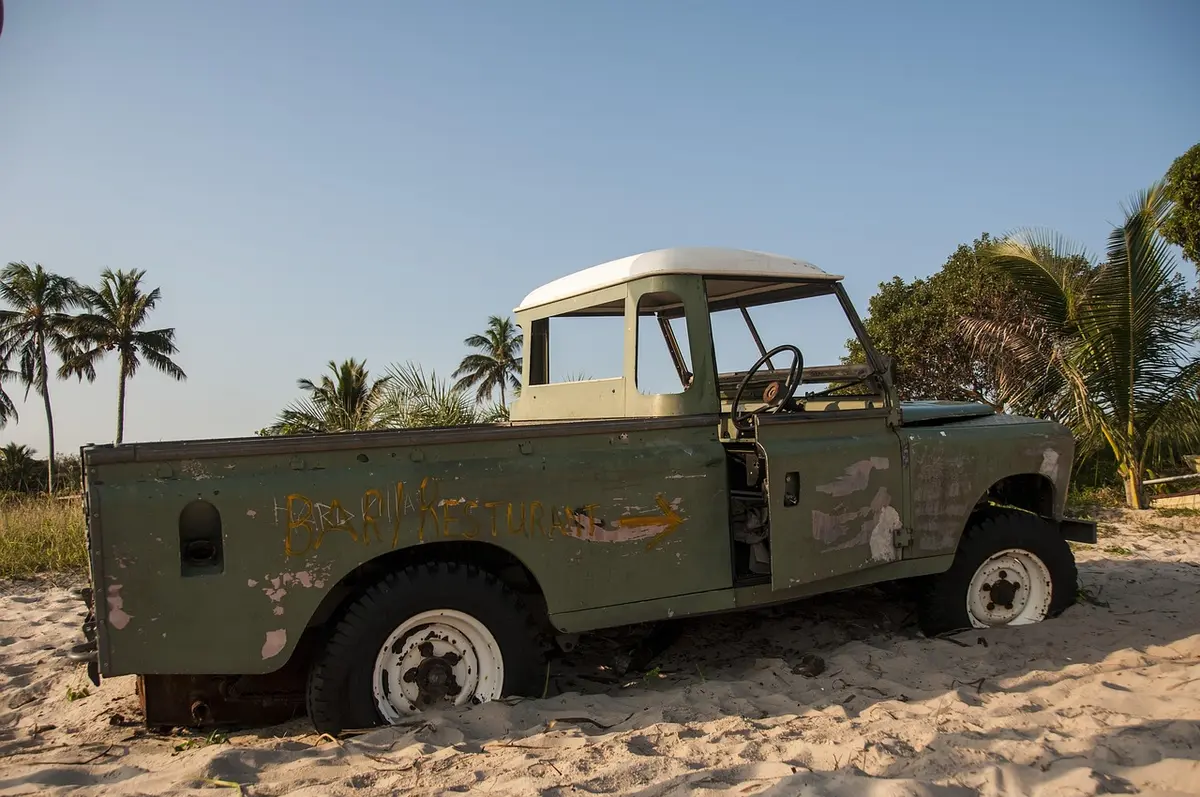
Keep everyone clear of any strap or winch line while it's under load, and never hook to a tow ball. And on a hot day, don't sit there spinning: Ford's manual warns that slow, deep-sand driving in high temperatures calls for a low gear to keep the engine and transmission cool.
What to bring for a day on the dunes
Sand punishes the driver who left something at home. This short list covers airing down, getting unstuck and staying legal:
- Tire gauge and deflators. A set of off-road tire deflators takes all four tires to the same pressure much faster than a valve tool.
- An air compressor to get back to road pressure before pavement.
- A long-handled shovel for digging out tires and the frame.
- Traction boards. A pair of recovery traction boards is often the difference between a five-minute stop and waiting for help.
- A kinetic rope or snatch strap and rated shackles, plus a partner vehicle when you can.
- A whip flag at your dune area's height, and a fire extinguisher (required for trucks and cars on the Oregon Dunes).
- Water and sun protection for everyone aboard.
Check the current price on Amazon for any of the linked gear before you buy.
After the dunes: air up and rinse
Air back up to the pressure on your door placard before you drive on pavement. Four big tires take a while to refill from 12–15 PSI, and our air compressor fill-time calculator shows how long your compressor will need.
Sand packs into wheels, brakes and suspension joints. Rinse the underside, wheel wells and brakes the same day; our step-by-step guide to cleaning your Jeep after off-roading covers the order. Beach sand adds salt, so rinse even sooner after a coastal run.
Sand driving FAQ
What PSI should I run on sand dunes?
Start at 12–15 PSI on standard wheels. Michigan's Silver Lake requires 15 PSI or less and recommends 12–15. Heavier vehicles sit at the top of that range; beadlock wheels can go lower. Don't go under about 12 PSI without beadlocks.
Do I need a whip flag on a Jeep or truck at the dunes?
Yes, at every area in the table above. The rules cover all vehicles on the sand, not just ATVs and UTVs; Imperial Sand Dunes applies it even to motorcycles. Height runs from 8 ft (Glamis, Sand Mountain, Little Sahara, St. Anthony) to 9 ft (Oregon Dunes) and exactly 10 ft (Silver Lake).
Should I use 4H or 4L in sand?
4H works for open sand where you can keep moving at a steady pace. Switch to 4L for slow, deep or steep sand, and on hot days: Ford's manual says low gear gives the engine and transmission the most cooling.
Why turn off traction control in sand?
Traction control cuts engine power or brakes a spinning wheel, and in soft sand that can kill your momentum mid-climb. Michigan's dune rules tell drivers to turn it off where the vehicle allows it.
Can I drive the dunes at night?
Where night riding is allowed, lights are mandatory. Imperial Sand Dunes requires a headlight and a taillight with at least one red light; Silver Lake requires headlights, taillights and brake lights from 30 minutes after sunset; the Oregon Dunes require lights at dawn, dusk and in limited visibility.

I'm Suryashankar Dasgupta, the founder of Off-Road Handbook. I've been off-roading for years in the USA, including California and Texas, and have ridden mountain and desert terrain abroad. I've also driven a Jeep Compass for more than seven years, so I know the day-to-day side of Jeep ownership first-hand, from the Uconnect screen to the warning lights. Every guide here is researched from manufacturer owner's manuals, NHTSA recall and service-bulletin records and other trusted sources, checked against them before it is published, and corrected when we find a mistake. You can read how we work in our editorial policy: https://offroadhandbook.com/editorial-policy/
Like our off-road guides? Add Off-Road Handbook as a Google Preferred Source so our latest Jeep, ATV, UTV, trail, recovery, and off-road troubleshooting articles can appear more often in your Google Search experience.
Add us as a Preferred Source