Honda FourTrax 300 4x4: Top Speed, Specs, Problems, Buying Tips
Last updated on October 25th, 2026 at 10:50 am
Honda never published a top speed for the FourTrax 300 4x4 (TRX300FW). The usual figure of about 45 mph is an owner-reported estimate. Honda’s gear ratios make it believable: top gear with the stock 24-inch rear tire reaches 45 mph at roughly 7,300 rpm. Honda built this 282 cc shaft-drive 4x4 from 1988 to 2000, and the specs and fixes below come from its manuals.
How fast is a Honda FourTrax 300 4x4?
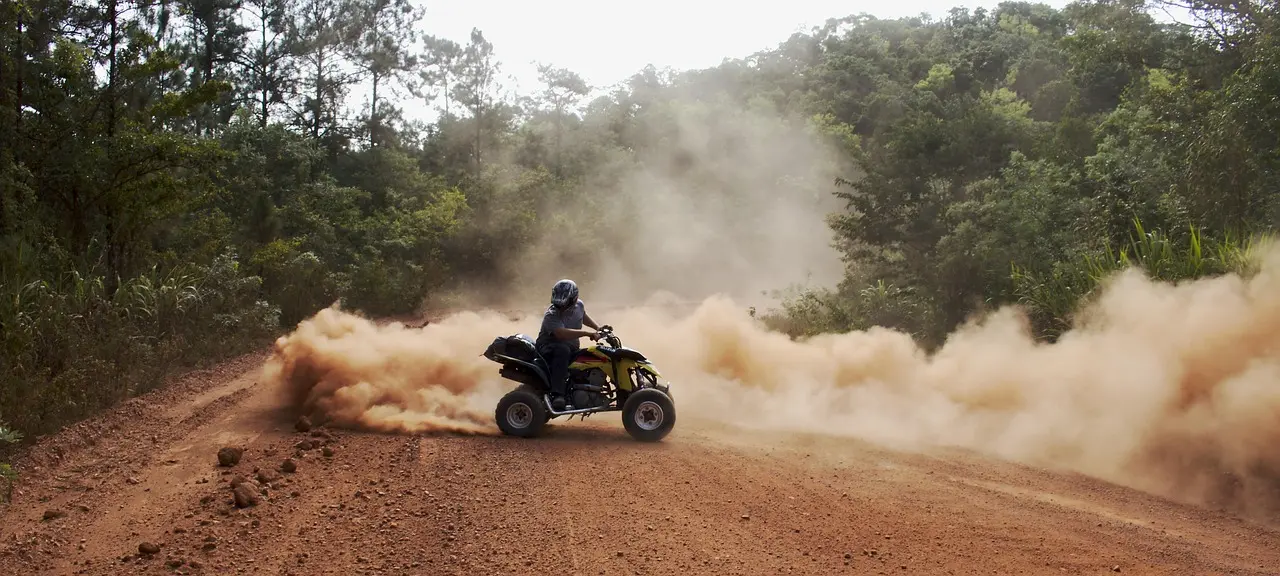
Owners usually report about 45 mph on flat, firm ground. A few claim the low 50s on pavement or downhill, and the same threads note that the 4x4 is slower than the 2WD (see the ATVConnection top-speed thread). Treat all of it as an estimate: nobody ran these quads on a calibrated test, and speedometers on 30-year-old machines drift.
Honda’s spec pages list no top speed or rev limit. That is typical for a utility quad geared for work, with a super-low first gear and a 4x4 drivetrain that adds weight. The 4x4 is roughly 35 to 45 lb heavier than the 2WD in every model year, which costs it some speed and acceleration.
Real top speed depends on load, grade, tire size, altitude, carburetor condition and valve adjustment. A tired engine with clogged jets or tight valves can fall well short of 45 mph, and the troubleshooting section below covers those causes.
Honda FourTrax 300 4x4 specs
| Spec | TRX300FW 4x4 | TRX300 2x4 (where different) |
|---|---|---|
| Model years | 1988 to 2000 | Same |
| Engine | 281.7 cc air-cooled four-stroke, single cylinder inclined 20 degrees, chain-driven overhead camshaft | Same |
| Bore x stroke, compression | 74.0 x 65.5 mm (2.91 x 2.58 in), 9.0:1 | Same |
| Carburetor | Vacuum piston (VE), 32 mm bore | Same |
| Ignition | DC-CDI, 13 degrees BTDC at idle, full advance 31 degrees at 4,500 rpm | Same |
| Transmission | Five forward gears (S/L-1-2-3-4) plus reverse, wet multi-plate automatic centrifugal clutch, left-foot shift | Same |
| Final drive | Shaft. Rear final reduction 1.462 x 3.889, front 5.554 (4x4 only) | Rear shaft drive only |
| Fuel tank | 12.5 L (3.3 US gal), including 2.5 L (0.7 US gal) reserve | Same |
| Engine oil | 2.5 L (2.6 US qt) at disassembly, 2.2 L (2.3 US qt) after draining, SAE 10W-40 | Same |
| Front tires and pressure | AT 23 x 8-11 at 4.4 psi (30 kPa) | AT 23 x 8-11 at 2.9 psi (20 kPa) |
| Rear tires and pressure | AT 24 x 9-11 at 2.9 psi (20 kPa), 3.6 psi (25 kPa) with cargo | AT 25 x 12-9 (1989-1991) or AT 25 x 11-9 (after 1991) at 2.9 psi |
| Front brake | Hydraulic, dual leading shoe | Hydraulic, leading/trailing shoe |
| Rear brake | Cable-operated, leading/trailing shoe | Same |
| Axle travel | 130 mm (5.1 in) front and rear | Same |
| Ground clearance | 160 mm (6.3 in) | Same |
| Dry weight | 215 kg (474 lb) in 1988, 230 kg (507 lb) 1989-1990, 236 kg (520 lb) 1991-1992, 239 kg (527 lb) after 1992 | 199 kg (439 lb), 211.5 kg (466 lb), 216 kg (476 lb), 221 kg (487 lb) |
| Length x width x height (after 1992) | 1,910 x 1,110 x 1,085 mm (75.2 x 43.7 x 42.7 in) | 1,910 x 1,115 x 1,088 mm (75.2 x 43.9 x 42.8 in) |
| Wheelbase, seat height (after 1992) | 1,238 mm (48.7 in), 780 mm (30.7 in) | 1,239 mm (48.8 in), 783 mm (30.8 in) |
| Spark plug | NGK DPR8EA-9 or Denso X24EPR-U9, gap 0.8-0.9 mm (0.031-0.035 in) | Same |
| Battery | 12 V, 12 Ah | Same |
| Towing limit | 385 kg (850 lb) including trailer and cargo, 14 kg (30 lb) tongue weight | Not listed in the sources checked |
Honda changed small details through the run, so match the figures to your model year. The carburetor identification number, jetting and idle speed (1,500 rpm through 1990, 1,400 rpm after) also changed between years.
The 2WD TRX300 and the sport TRX300EX are different machines. For the sport quad, see the separate guide to the Honda 300EX top speed and specs.
Gearing and speed by gear
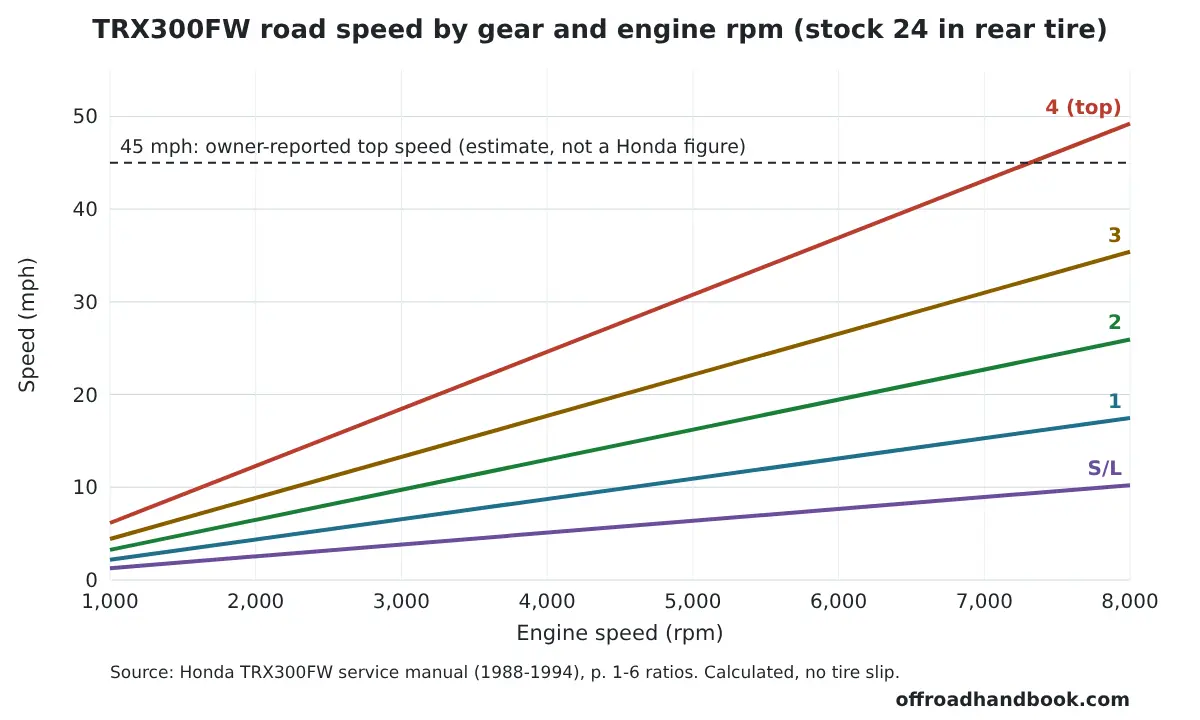
The FourTrax 300 has a primary reduction of 2.407, then five forward ratios from a super-low S/L (4.083) to a fourth gear of 0.848. Rear final reduction is 1.462 x 3.889. Multiply those and divide into engine rpm, and you get the wheel speed.
The chart uses the stock 24-inch rear tire and ignores tire slip and squat, so a loaded quad on soft ground will read lower. The dashed line marks the owner-reported 45 mph, which top gear crosses at about 7,300 rpm.
| Gear | Honda ratio | 3,000 rpm | 4,500 rpm | 6,000 rpm | 7,000 rpm |
|---|---|---|---|---|---|
| S/L | 4.083 (49/12) | 3.8 mph | 5.8 mph | 7.7 mph | 8.9 mph |
| 1 | 2.389 (43/18) | 6.6 mph | 9.8 mph | 13.1 mph | 15.3 mph |
| 2 | 1.609 (37/23) | 9.7 mph | 14.6 mph | 19.5 mph | 22.7 mph |
| 3 | 1.179 (33/28) | 13.3 mph | 19.9 mph | 26.6 mph | 31.0 mph |
| 4 | 0.848 (28/33) | 18.5 mph | 27.7 mph | 36.9 mph | 43.1 mph |
Full spark advance arrives at 4,500 rpm, so that is where the engine is fully into its power band. Gearing alone says top gear needs about 8,100 rpm for 50 mph, which is why 50-plus claims deserve doubt.
The front axle is geared slightly differently from the rear (front final 5.554 against 5.686 overall in the rear, with 23-inch front tires). By the numbers, the front wheels cover about 2 percent less ground per engine revolution, and the front differential has to absorb that difference.
FourTrax 300 speed calculator
Based on the gear ratios and final reductions in Honda’s TRX300FW service manual (page 1-6); speed = rpm / (primary x gear x rear final) x tire circumference. It models the rear drive only.
Use it two ways: enter an rpm to see the speed in any gear, or enter a target speed to see the rpm it takes. If your answer for 45 mph in top gear is far above 7,300 rpm on a stock tire, the quad is probably not making full power.
A measured check beats the math. Mark off a measured mile on a flat, safe, private road, time it at a steady throttle, and compare it with the calculator. Do not chase top speed on public roads, because ATVs are built for off-road use only.
Tire size and speed on a shaft-drive quad
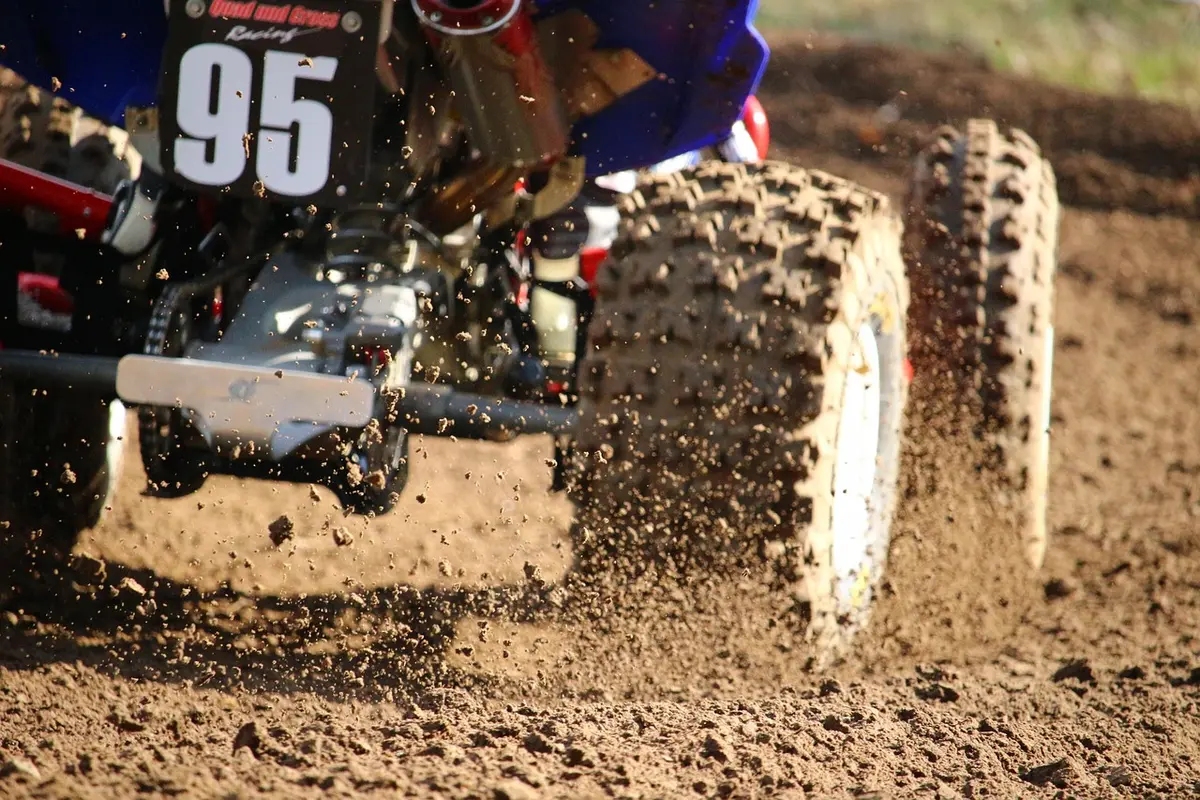
A shaft-drive FourTrax has no chain and no sprockets, so there is no sprocket swap to change gearing. The final drive ratios sit inside the gear cases. Tire height is the only easy way to shift the speed per rpm.
Honda specifies AT 23 x 8-11 front and AT 24 x 9-11 rear on the 4x4, at very low pressures: 4.4 psi front and 2.9 psi rear (3.6 psi with cargo). Taller tires raise speed per rpm but load the engine and the drivetrain harder, and the quad was not designed for them.
Going from 24 to 26 inches adds about 8 percent to the calculated speed at the same rpm, with the same drop in pulling force at the wheel. To compare any tire swap, use the tire size calculator, and the guide to reading ATV tire sizes explains the numbers on the sidewall.
Common FourTrax 300 problems and fixes
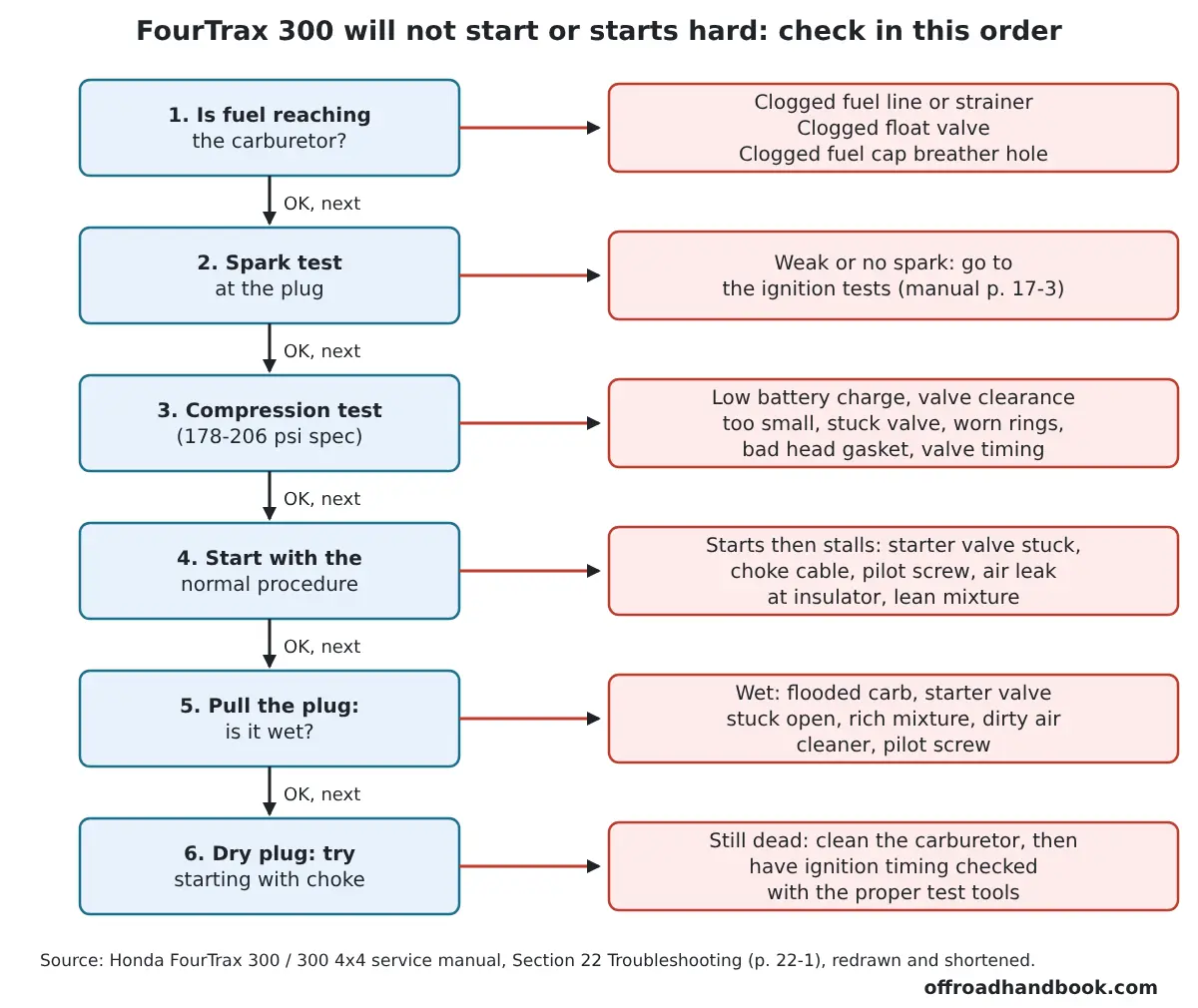
Honda’s service manual has a troubleshooting section built around symptoms, and its logic is to check the free and easy things first. The chart above is a shortened version for the most common complaint, and the table below covers the rest.
Most problems on a 25-to-35-year-old quad trace back to the fuel system, valve clearance or brakes and bearings. Do these checks in the order shown, and stop when you find the fault.
| Symptom | Likely causes, in check order | Fix and spec |
|---|---|---|
| Hard start or no start | Fuel flow (line, strainer, float valve, cap breather), then spark, then compression | Clean or replace the clogged part. Plug: NGK DPR8EA-9, gap 0.8-0.9 mm, 13 ft-lb. Compression spec 178-206 psi |
| Starts then dies | Starter (enrichment) valve, choke cable, pilot screw, air leak past carburetor insulator, lean mixture | Reseat the carburetor and replace the insulator O-ring; reset pilot screw to the manual’s setting; clean passages |
| Idles or runs rough at low rpm | Insulator leak, weak spark, pilot screw, valve clearance, ignition timing, clogged carburetor | Valve clearance 0.15 mm (0.006 in) cold, lock nut 12 ft-lb. Clean the carburetor |
| Weak power, slow acceleration | Dragging brake or bad wheel bearing, low tire pressure, slipping clutch, dirty air cleaner or restricted fuel, low compression | Wheels should spin freely when lifted. Set tires to 4.4 psi front, 2.9 psi rear. Clean the air cleaner. Check compression |
| Flat spot at high speed | Restricted fuel flow, valve clearance, ignition module or pulse generator, clogged jets | Clear fuel line, vent hole and valve; adjust valves; clean jets (main jet #125 after 1990) |
| Spongy or long brake lever | Shoe adjustment, air in the hydraulic front system, worn shoes | Front lever free play 25-30 mm; rear lever 15-20 mm. Bleed the front system if free play stays high |
| Pulls to one side or wanders | Tire pressure, bent tie-rod, tie-rod adjustment, wheel bearing play | Equalize pressures first; have alignment and bearings checked |
Hard starting and carburetor trouble
Old fuel varnishes the vacuum-piston carburetor, and a clogged fuel cap vent can starve the engine on a hot day. Run the chart from step one: fuel line, strainer, float valve and cap breather cost nothing to check.
If the plug is wet, think flooded carburetor, a stuck starter valve or a dirty air cleaner. If the engine starts and dies, check the choke cable and look for an air leak past the carburetor insulator, which Honda lists as the first thing to check for poor low-speed running.
Valve clearance and compression
Honda calls for a valve clearance check at the first service and then every 30 operating days, at 0.15 mm (0.006 in) cold for both valves. The valve adjusting lock nut torque is 12 ft-lb (17 N-m).
A compression gauge reading in the 178-206 psi range (1,250-1,450 kPa) means the rings, valves and head gasket are sealing. A low reading points at valve clearance, a stuck valve, worn rings or a leaking head gasket, and that is a shop job unless you have the manual and tools.
Brakes, bearings and steering
A quad that will not roll freely with the wheels lifted has a dragging brake, a bad wheel bearing, or a fault in the rear final drive or the front differential. Honda’s checklist runs through these before it blames the engine.
Front hydraulic brake free play at the lever tip should be 25-30 mm (1 to 1-¼ in), and Honda says to turn the adjuster up until the shoes lock, then back off three stops. The rear lever should have 15-20 mm (⅝ to ¾ in) of free play. Replace the rear shoes when the indicator plate lines up with the index mark.
Fluids and routine service
Honda lists SAE 10W-40 engine oil, with an oil and filter change in the first week and then every 30 operating days, per the service manual’s maintenance chart. The engine drain bolt torque is 18 ft-lb. Final drive oil is checked yearly and replaced every two years, and the 1999 owner’s manual warns against oils with graphite or molybdenum additives, which can affect clutch operation.
Stop and see a dealer for low compression, grinding from the final drive or front differential, brake fluid leaks, or loose steering. Those faults put you at risk on the trail.
Buying a used FourTrax 300 4x4
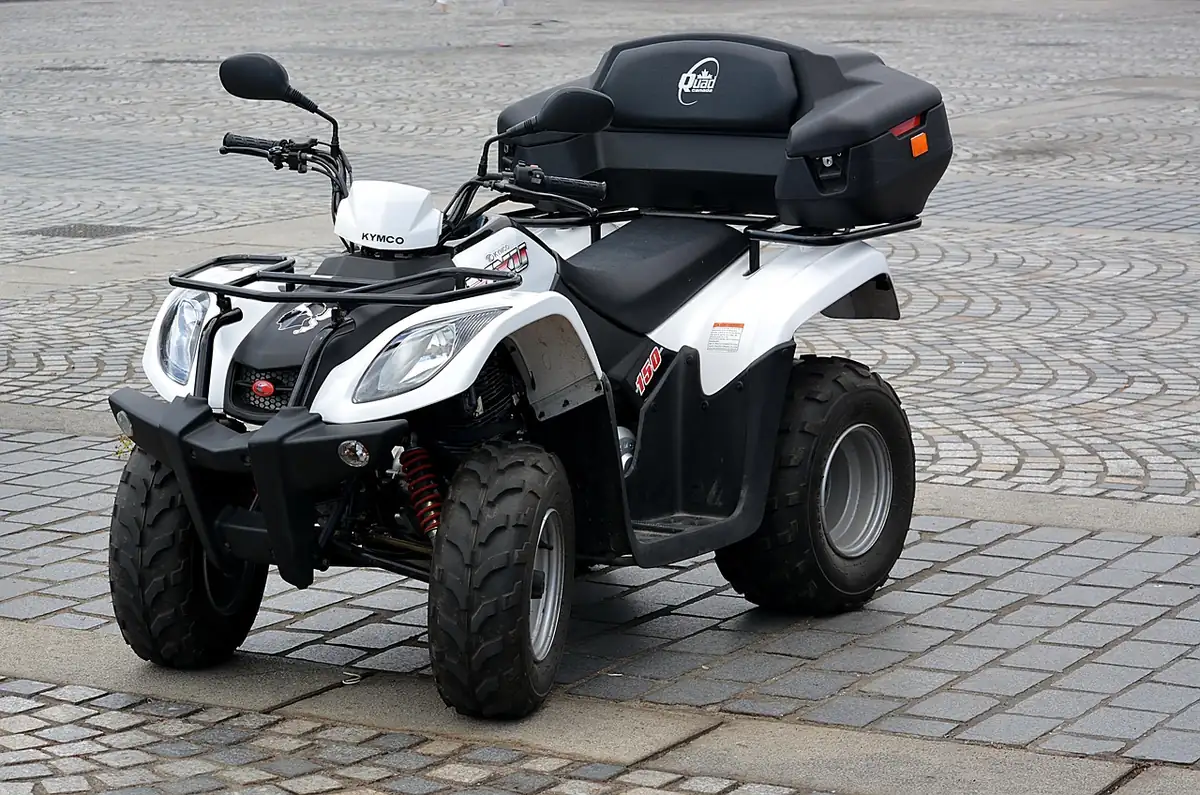
Prices swing with condition and region, and no manufacturer source gives a fair value, so compare several local listings. Use this checklist instead to separate a sound quad from a project.
- Confirm it is a 4x4. The front driving mechanism is a separate TRX300FW section in Honda’s manual, and the 4x4 weighs roughly 35 to 45 lb more than the 2WD.
- Match the frame serial number, stamped on the front of the frame, to the title. The engine number is stamped on the upper side of the right crankcase.
- Start it cold. Hard starting, stalling or heavy smoke points to carburetor, valve or ring problems.
- Run a compression test and look for 178-206 psi.
- Shift through S/L, 1, 2, 3, 4 and reverse. Honda’s pattern is neutral, S/L, 1, 2, 3, 4, with reverse by a separate selector.
- Lift each wheel and spin it. It should turn freely, with no grinding or play.
- Check brake lever free play against the numbers above, and inspect driveshaft boots and gear cases for tears and leaks.
- Look for frame rust and cracked welds, especially on a quad that lived outdoors.
Wear a helmet and eye protection, and keep riders under 16 off adult-size quads. The Consumer Product Safety Commission advises riders younger than 16 to use age-appropriate youth models, never adult ATVs, and to stay off paved roads. For gear, see what to wear for ATV riding.
Shopping the whole 4x4 class? Compare it with the most reliable 4x4 ATVs by recall record and specs.
FAQs
Honda does not publish one. Owners report about 45 mph on flat ground, and the gearing agrees: top gear reaches 45 mph at roughly 7,300 rpm with stock tires.
The TRX300FW 4x4 was built from 1988 to 2000, alongside the TRX300 2WD.
No. It has shaft drive with gear-driven final drives, so there are no sprockets to change. Tire height is the easy way to alter gearing.
AT 23 x 8-11 in front at 4.4 psi and AT 24 x 9-11 in the rear at 2.9 psi (3.6 psi with cargo), per Honda.
Honda calls for SAE 10W-40 engine oil, with a capacity of about 2.5 L (2.6 US qt) at disassembly and 2.2 L after draining.
The 4x4 adds front drive with a front differential, a dual leading shoe front brake, higher front tire pressure and roughly 35 to 45 lb of extra weight.

I'm Suryashankar Dasgupta, the founder of Off-Road Handbook. I've been off-roading for years in the USA, including California and Texas, and have ridden mountain and desert terrain abroad. I've also driven a Jeep Compass for more than seven years, so I know the day-to-day side of Jeep ownership first-hand, from the Uconnect screen to the warning lights. Every guide here is researched from manufacturer owner's manuals, NHTSA recall and service-bulletin records and other trusted sources, checked against them before it is published, and corrected when we find a mistake. You can read how we work in our editorial policy: https://offroadhandbook.com/editorial-policy/
Like our off-road guides? Add Off-Road Handbook as a Google Preferred Source so our latest Jeep, ATV, UTV, trail, recovery, and off-road troubleshooting articles can appear more often in your Google Search experience.
Add us as a Preferred Source