7 Common Honda Rincon 680 Problems and How to Fix Them
Last updated on October 17th, 2026 at 09:22 am
The Honda Rincon 680 is a tough machine, and most of its problems are small ones: a balky electric shift, a front speed sensor fault, water in the display, tired brakes and a radiator packed with mud. There is no drive belt to slip and, since 2006, no carburetor to clean.
Which Rincon you own matters. Honda changed the engine, fuel system and brakes in 2006, so the table below splits the model years before the problem-by-problem fixes.
Honda Rincon 680 problems at a glance
| Symptom | Check first | Likely cause | DIY or dealer |
|---|---|---|---|
| Grinds, rattles or will not shift into reverse or drive | Shift linkage adjustment, then shift-motor gearbox grease | Stiff grease in the shift motor gears; linkage out of adjustment | DIY for grease; dealer if the motor or ECM is suspect |
| Speedometer jumps, engine cuts out, blink code on display | Front speed sensor, wiring and connector | Front speed sensor no-signal (owner-reported code 12) | DIY inspection; replace the sensor if bad |
| Fogged screen or erratic readings | Display housing and seals for water entry | Water in the instrument panel | DIY seal check; replace the unit if damaged |
| Weak brakes, spongy lever, parking brake will not hold | Pad thickness, caliper movement, fluid level | Worn pads, sticking caliper, air in the lines, parking brake adjustment | DIY for pads and adjustment; dealer for hydraulics |
| Seat will not stay latched | Seat tabs and frame tabs | Tabs not seated correctly | DIY, see owner's manual |
| Overheating, fan not running | Radiator and oil cooler fins, coolant level | Mud-clogged cooling stack, failed fan or sensor, low coolant | DIY inspection; dealer if it persists |
| Smoke from the exhaust | Color, and whether it clears when warm | Condensation (normal), rich running, burning oil or coolant | Dealer if it persists |
Where Honda or the CPSC published the fact, it is linked. Where the only evidence is owner reports, the text says so. Always use the Honda service manual for torque values and procedures.
What changed by model year
Honda's 2006 announcement says the Rincon grew from 649cc to 675cc, with the bore going from 100mm to 102mm. It also says Programmed Fuel Injection replaced the carburetor. So a 2003 to 2005 Rincon (TRX650FA) is carbureted, and a 2006 or newer Rincon 680 (TRX680FA) is fuel-injected.
| Detail | 2006 (Honda release) | 2013 (ATV.com listing) | 2023 (Honda spec sheet) |
|---|---|---|---|
| Engine | 675cc, 102mm x 82.6mm (stated bore) | 675cc, 102mm x 82.6mm | 675cc, 102mm x 82.6mm, 9.2:1 compression |
| Fuel system | PGM-FI, 40mm throttle body | Fuel injected, 40mm | PGM-FI, 40mm throttle body |
| Front brakes | Dual 180mm discs | Dual hydraulic discs, 180mm | Dual 180mm discs; rear 151mm disc |
| Fuel tank | Low-fuel light; about 1.1 gal left at E | 4.3 gal incl. 1.2 gal reserve | 4.4 gal incl. 1.2 gal reserve |
| Weight | Not listed | 648 lb wet | 658 lb curb |
| Towing capacity | Not listed | 850 lb | 848 lb |
| Ground clearance | Not listed | 10 in | 9.1 in |
Several small details from Honda's 2006 release matter when you diagnose a fuel-injected Rincon. Idle is set at 1400 rpm, plus or minus 50. The fuel pump sits in a separate aluminum sub tank in front of the engine, between the top shock towers. A rollover sensor cuts engine power if the machine overturns.
The same release says the battery grew from 14 Ah to 18 Ah in 2006. If your Rincon cranks slowly, confirm the battery is the right size for your year before you chase anything else.
What is your Honda Rincon 680 doing?
Based on the symptom table and sections 1 to 7 of this post, which draw on Honda's 2006 Rincon release and owner reports (marked as such). Use the Honda service manual for torque values and procedures.
Recalls that touch the Rincon name
The U.S. Consumer Product Safety Commission lists two Honda recalls that include Rincon models. Both involve the 650-series machines, not the 675cc TRX680FA. We found no CPSC recall for the 680 in the sources we could open, so check any machine by VIN with a Honda dealer.
| Recall | Models | Hazard | Remedy |
|---|---|---|---|
| Nov. 25, 2002 (Alert 03-512) | 2003 TRX650FA Rincon, about 6,000 units | Suspension a-arm and shock bolts may be torqued wrong; a bolt could fall out and the suspension collapse | Stop riding; free dealer repair |
| April 14, 2005 | 2004–2005 FourTrax models including Rincon and Rincon GPScape, about 200,000 units | Steering rods can separate and cause loss of steering control | Repair; Honda (866) 784-1870 |
If you are shopping for a 2003 to 2005 Rincon, run the VIN and confirm both repairs were done. Do not torque suspension bolts yourself on a recalled machine, because CPSC says the repair needs shop equipment and special tools.
1. Electric shift problems: grinding, rattling, no reverse
Shifting trouble is the best-documented Rincon complaint. Owners report that the grease in the shift motor gearbox can get so stiff that the motor cannot finish a shift. The motor and gearbox sit low on the front of the engine.
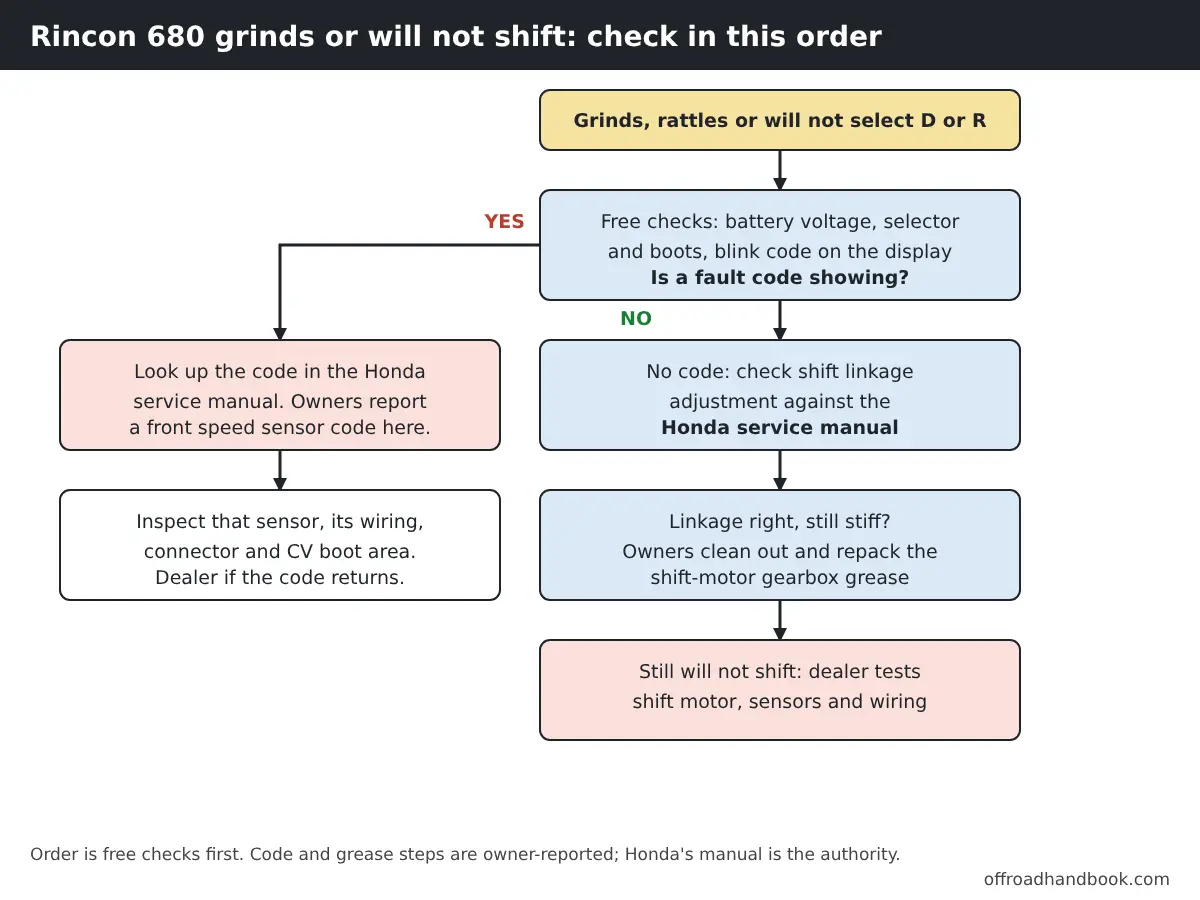
- Look at the shift linkage and boots for damage. Confirm the selector moves freely between D, N and R.
- Check shift linkage adjustment against the Honda service manual.
- If the linkage is right, owners remove the shift motor gearbox (four 10 mm bolts reported), clean out the old grease and repack it with all-temperature lithium grease. See an owner write-up on electronic shift problems and a thread on a Rincon that grinds in reverse.
- If it still will not shift, have a dealer test the shift motor, sensors and wiring.
The grease fix is owner experience, not a Honda procedure. Use the manual for torque values and keep dirt out of the gearbox while it is open.
2. Front speed sensor fault (blink code 12)
The Rincon reads speed sensors to control the electric shift. Owners report that a front speed sensor fault can make the speedometer jump and can cut the engine. The display shows a blink pattern, and one long and two short blinks is reported as code 12, front speed sensor no signal.
That code is owner-reported. Confirm it against the code table in the Honda service manual for your year. A Rincon Riders thread on a speed sensor problem covers a typical case.
- Check that the sensor is mounted securely and its connector is clean and fully seated.
- Inspect the wiring for chafing or cuts. Look at the CV boot area, since torn boots and mud can affect the sensor.
- If the wiring and connector are good, replace the sensor. Confirm the part number for your model year with a Honda dealer.
- Clear the stored code using the procedure in the service manual. The Rincon does not use a standard OBD-II port.
If the engine dies right after a tip-over or roll, that is the rollover sensor Honda added in 2006, not a speed sensor problem. Check your owner's manual for the restart steps.
3. Moisture in the instrument display
Some owners report water getting into the instrument panel and damaging the display, for example in a Rincon Riders thread about a failed instrument panel. It is based on owner reports, not a Honda recall.
- Inspect the housing and any seals for cracks or gaps.
- Check the mounting and wiring connector for water or corrosion.
- Replace damaged seals. If the display or circuit board is damaged, the unit usually needs replacing.
- Avoid pressure washing directly at the instrument panel.
4. Brake problems
Honda lists dual 180mm hydraulic discs up front on the 2006 and later machines, with a single hydraulic disc at the rear (151mm on the 2023 model). Complaints usually come down to worn pads, a sticking caliper, air in the lines, or a parking brake that needs adjustment.
A rear brake lever that does not respond while the foot brake works points to the parking brake cable or its adjustment. See this owner thread on a rear brake problem.
- Check pad thickness against the service limit in the Honda manual and replace worn pads.
- Check that each caliper moves freely and the piston is not seized or corroded.
- Inspect the brake lever and parking brake cable for fraying and adjust the cable.
- Check the fluid level and look for leaks. If the lever feels spongy, bleed the system.
Brakes are a safety system. If you are unsure about any step, have a qualified technician check them before you ride.
5. Seat will not latch
If the seat does not feel secure after you remove it, the tabs on the seat are usually not seated under the frame tabs. Reposition it as your owner's manual describes, push down firmly until it latches, and pull up on it to confirm before you ride.
6. Overheating
Mud packed between the oil cooler and radiator is the first thing to check, since it can look clean from outside. Owners also report overheating from a cooling fan that fails to switch on, often traced to the temperature sensor or a corroded connector. See threads on a fan that will not come on and a Rincon overheating.
- Let the engine cool, then check the coolant level in the reservoir and radiator.
- Wash mud from the radiator fins from the back and front at low pressure. Check between the oil cooler and radiator.
- With the engine hot, confirm the fan switches on. If not, check the fuse, connector and temperature sensor.
- If it still overheats, have a shop pressure-test the cooling system and check the thermostat and water pump.
7. Exhaust smoke
A little white vapor on a cold morning is normal condensation. White smoke that continues once warm can point to coolant entering the engine, black smoke to a rich mixture, and blue smoke to burning oil. Persistent smoke is a job for a technician.
Hard starting and rough idle on a fuel-injected Rincon
There is no carburetor to clean on a 2006 or newer Rincon. Hard starting or a rough idle after long storage is often old fuel, so use fresh fuel with a stabilizer for winter storage.
If symptoms continue, have a shop check fuel pressure, the filter and the injector. Idle should sit at 1400 rpm, plus or minus 50, per Honda's 2006 release. Follow Honda's schedule for transmission and final drive oil changes.
Honda Rincon 680 FAQ
Is the Honda Rincon 680 reliable?
There is no independent reliability data we could verify. We found no CPSC recall for the 675cc model, and the complaints above are mostly maintenance items: shift-motor grease, speed sensor wiring, brakes and a mud-packed cooling system.
What transmission does the Rincon 680 have?
Honda lists an automatic with a hydraulic torque converter, three forward gears and reverse, with push-button electronic shift controls and a multi-plate wet clutch.
Does the Rincon 680 have a drive belt?
No. It uses a torque converter automatic, not a CVT, so there is no drive belt to wear out or slip.
What does code 12 mean on a Honda Rincon?
Owners report one long and two short blinks as a front speed sensor no-signal fault. Check the sensor, wiring and connector first, then confirm the code in the Honda service manual.
Related guides
- ATV and UTV troubleshooting: bogging, no-start, heat and belts
- Honda Foreman 500 gear indicator blinking: causes and fixes
- Honda Big Red UTV problems and fixes
- Off-road tire pressure calculator by terrain

I'm Suryashankar Dasgupta, the founder of Off-Road Handbook. I've been off-roading for years in the USA, including California and Texas, and have ridden mountain and desert terrain abroad. I've also driven a Jeep Compass for more than seven years, so I know the day-to-day side of Jeep ownership first-hand, from the Uconnect screen to the warning lights. Every guide here is researched from manufacturer owner's manuals, NHTSA recall and service-bulletin records and other trusted sources, checked against them before it is published, and corrected when we find a mistake. You can read how we work in our editorial policy: https://offroadhandbook.com/editorial-policy/
Like our off-road guides? Add Off-Road Handbook as a Google Preferred Source so our latest Jeep, ATV, UTV, trail, recovery, and off-road troubleshooting articles can appear more often in your Google Search experience.
Add us as a Preferred Source