Bad Jeep Transmission Symptoms: 10 Signs, Checks and Recalls
Last updated on October 18th, 2026 at 09:38 pm
This post contains Amazon affiliate links. As an Amazon Associate I earn from qualifying purchases, at no extra cost to you.
The signs of a failing Jeep transmission are slipping (engine revs climb but the Jeep does not speed up), a delay or thump when you shift into Drive or Reverse, harsh or missed shifts, limp mode, a burnt smell, red or brown fluid under the Jeep, whining or grinding, and transmission codes. If it slips badly, will not move, grinds or smells burnt, stop driving and tow it, because driving on can turn a repair into a replacement.
Most of these signs have a cheap cause you can rule out in the driveway, and some Jeeps are covered by free recalls. The table lists ten signs with the free check first, and the checker below it narrows things down by symptom.
This guide covers every Jeep. For one model, see our Wrangler automatic shifting guide, Grand Cherokee transmission over temp guide or Grand Cherokee won't move in gear guide.
Bad Jeep transmission symptoms at a glance
| Sign | Likely causes | Free check first | Stop driving? |
|---|---|---|---|
| 1. Slipping: revs rise, speed does not | Low or burnt fluid, worn clutches, solenoid or pressure fault | Fluid level and color; look for leaks | Yes if severe or getting worse |
| 2. Delay when shifting into Drive or Reverse | Low fluid, worn internal seals, range sensor | Fluid level; scan for codes | Not at once, but get it checked soon |
| 3. Harsh or banging shifts | Calibration, worn fluid, solenoid or sensor fault | Codes; ask a dealer about software updates | Not at once |
| 4. Late shifts or stuck in one gear (limp mode) | Speed or range sensor, solenoid, wiring, low voltage | Battery, connectors, then a scan | Drive gently to a safe place and scan it |
| 5. Burning smell | Overheated fluid, a leak onto hot parts | Fluid color and smell once cool | Yes |
| 6. Red or brown fluid under the Jeep | Pan gasket, cooler lines, seals | Find where it re-wets after cleaning | Yes if it is a steady drip or puddle |
| 7. Whine, hum, clunk or grinding | Low fluid, failing pump or torque converter, worn parts, or a driveline fault | Fluid level; mounts, U-joints, bearings | Yes if grinding or a clunk with a change in drive |
| 8. Shudder at steady speed | Torque converter clutch, degraded fluid, or just a tire problem | Fluid condition; tire pressure and balance | Not at once |
| 9. Check engine light with P07xx codes | Transmission sensors, solenoids, ratio faults, or wiring | Write down the codes; inspect connectors | Depends on how it drives |
| 10. Manual: grinding, hard shifts, clutch slipping | Worn clutch, low gear oil, linkage | Pedal feel; gear oil level per the manual | Not at once, but clutch slipping gets worse |
P07xx codes are the transmission block of the standard OBD-II code list, per the OBD-II code format. Some are set by a wiring or connector fault rather than a failed transmission, so inspect the connectors before replacing parts.
Work down the table from the sign you have. The free check comes first on purpose, since paying for a part before checking fluid and connections is the most common waste.
When to stop driving and call a tow
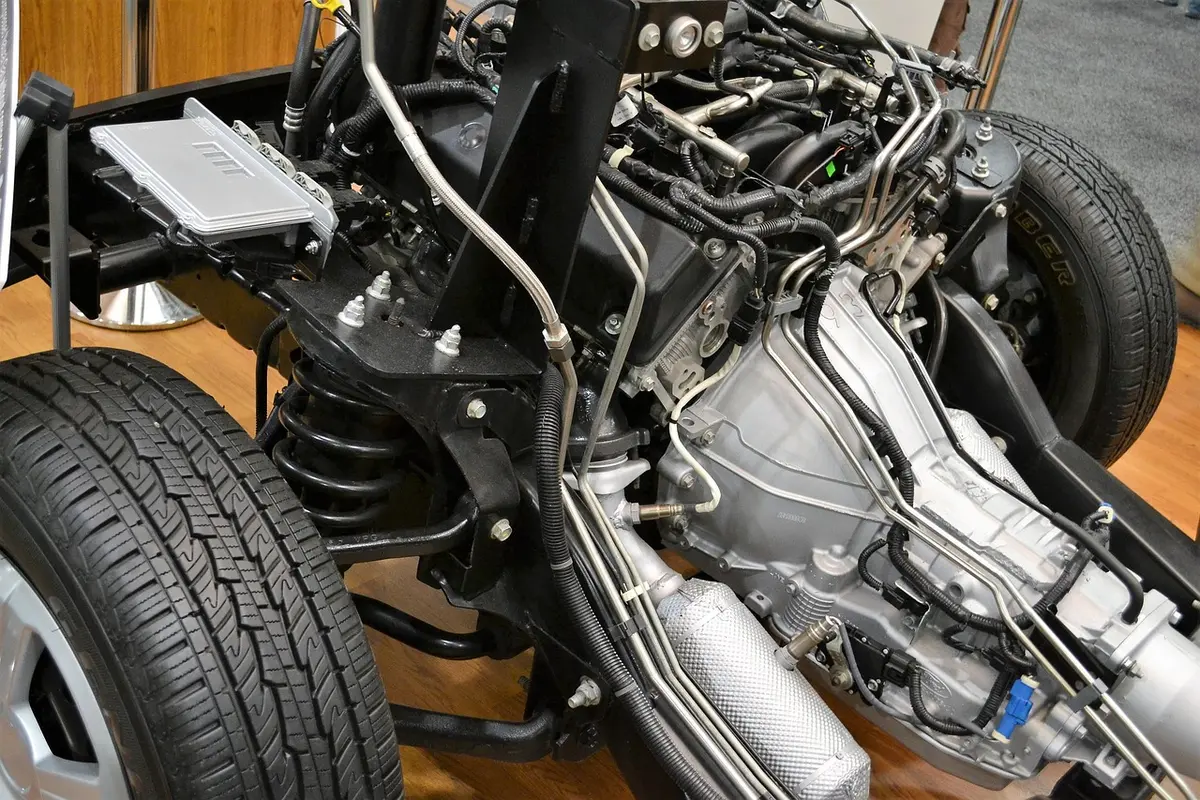
Some signs mean the cost of waiting is higher than the cost of a tow. These are the ones.
- The Jeep will not move in any gear, or loses drive while moving.
- Park will not hold, or the Jeep rolls with the shifter in Park. Set the parking brake and chock the wheels.
- Grinding, or a loud clunk with a change in how it drives.
- A burnt smell or a hot-fluid warning. Pull over and let it cool. Hot fluid reaching hot exhaust parts can start a fire, which is why NHTSA recall 09V436 required a hot-fluid warning on 2007-2008 Wranglers.
- A steady drip or a puddle. Even a slow leak that runs the pan low can cook the clutches.
- Slipping that is getting worse from one drive to the next.
Follow the owner's manual before towing. A transmission that will not turn freely may not be safe to tow with the wheels on the ground.
Check in this order, free checks first
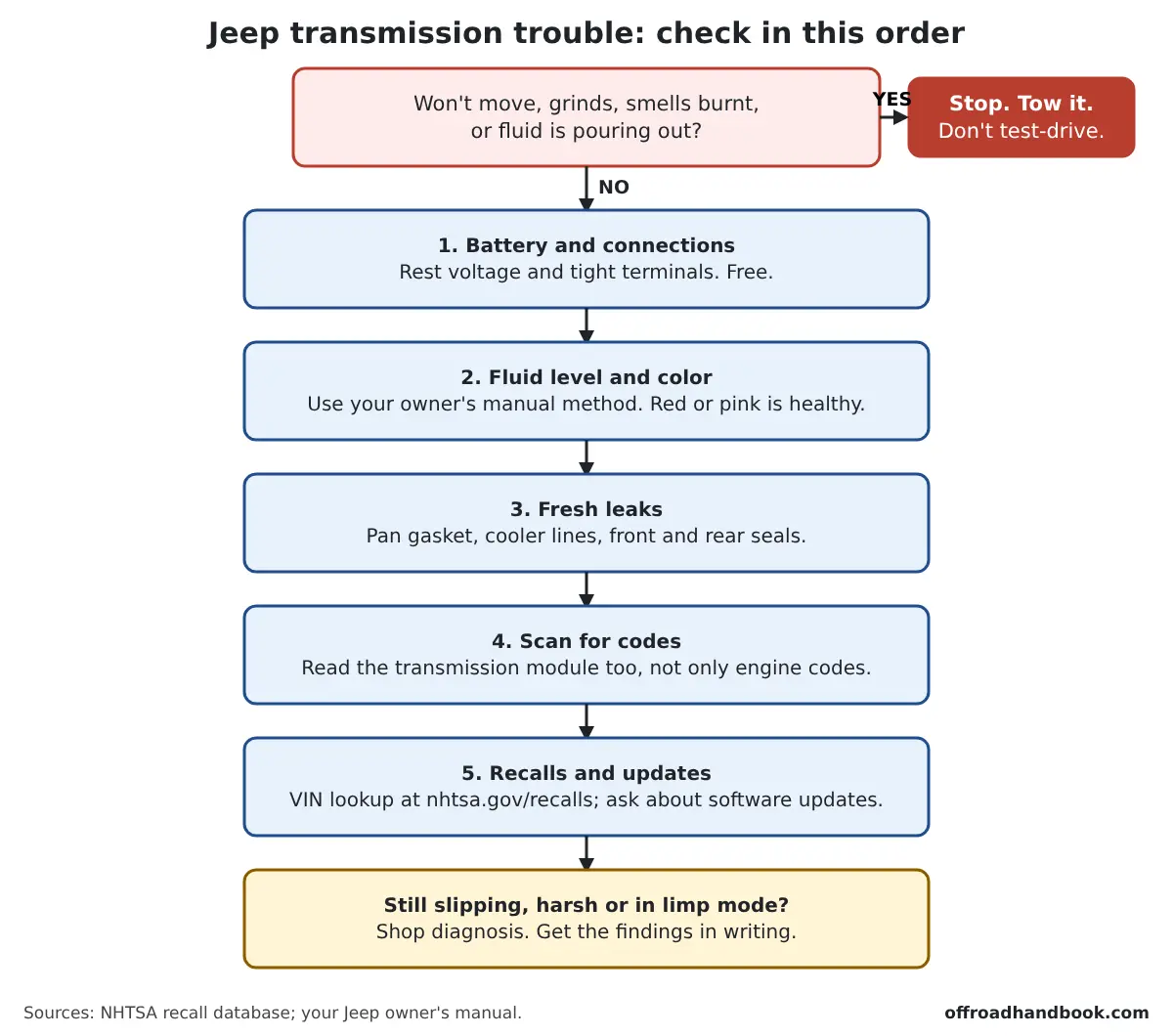
1. Battery and connections
Low voltage and loose or corroded grounds upset control modules, and that can look like a transmission fault. A rested, healthy battery reads about 12.6 V, and anything near 12.4 V or less needs charging. Clean and tighten both terminals first.
2. Fluid level and color
Some Jeeps have a dipstick. Many newer ones are sealed and are checked at a fill plug with the fluid at a set temperature, so use the method in your owner's manual for your exact year.
Healthy automatic transmission fluid is red or pink. Dark brown or black fluid that smells burnt means overheating or worn clutch material. Use only the fluid your manual specifies, because the wrong type can hurt shifting and the transmission.
3. Fresh leaks
Clean the pan and lines, run the engine and watch where it re-wets. The usual spots are the pan gasket, cooler lines and hoses, the front pump seal and the rear output seal. Low fluid from a leak is a common cause of slipping.
4. Scan for codes
A basic engine-code reader may not see the transmission module. Use a scanner that lists transmission codes, and write every code down before you clear anything. A shop or dealer can read the module too. This Amazon search for OBD2 scanners that read transmission codes is one way to shop for a scanner that lists transmission codes. Check the current price on Amazon.
5. Recalls and software updates
Enter your VIN at NHTSA's recall lookup. Recall repairs are free at a dealer, and several Jeep transmission recalls are software updates. Ask the dealer about any other open updates for your VIN while the Jeep is there.
Symptom checker: what is your Jeep doing?
Based on the symptom table, the check order and the NHTSA recall table in this post. It cannot diagnose a fault; a scan and a look at your owner's manual are still needed.
Neither the checker nor the table can replace a scan. They show what to rule out, in what order, before you pay for parts.
Jeep transmission recalls by model year (NHTSA)
These NHTSA campaigns involve the transmission, transfer case or power transfer unit on Jeeps from 2007 to 2023, and all of them can feel like a failing transmission. The remedy is free at a dealer, but the list only matters if your VIN is included, so look it up.
| NHTSA campaign | Vehicles | Problem | Free remedy |
|---|---|---|---|
| 09V436 | 2007-2008 Wrangler automatic (built June 2006 to July 2008) | No transmission fluid temperature warning; boiling fluid can reach hot parts and start a fire | Dealer adds a "HOT OIL" message and chime |
| 12V216 | 2010 Wrangler automatic | Skid plate near the catalytic converter can collect debris that ignites | Dealer replaces the skid plate with a skid bar |
| 13V175 | 2005-2010 Grand Cherokee; 2006-2010 Commander | Transfer case electrical failure can shift it into neutral unintentionally and the Jeep can roll away | Dealer reflashes the final drive controller |
| 16V240 | 2014-2015 Grand Cherokee with the 8-speed and monostable shifter | No adequate warning if the door opens while not in Park | Dealer updates the software |
| 16V249 | 2016 Grand Cherokee built May 2015 to Feb 2016 | Shift interlock solenoid can lose function; transmission may lock in Park or Neutral | Dealer replaces the shifter assembly |
| 16V529 | 2014-2015 Cherokee (and some other Fiat Chrysler models) with the 9-speed | Wire harness crimps; transmission may shift to neutral unexpectedly | Dealer reprograms the PCM and TCM, and replaces the harness if needed |
| 18V280 | 2018 Grand Cherokee and Wrangler (certain units) | Incorrect park lock rod may keep the transmission from holding Park | Dealer installs the correct park lock rod |
| 18V492 | 2019 Cherokee (certain units) | A transmission component may not be welded properly, so the Jeep may stop moving | Dealer replaces the transmission |
| 18V739 | 2019 Cherokee with the 2.4L | Improper transmission calibration may cause a stall | Dealer reflashes the transmission controller |
| 19V447 | 2014 Cherokee with the 3.2L | A stuck clutch may make the software shift to neutral | Dealer updates the transmission software |
| 20V343 and 23V302 | 2014-2017 Cherokee with a two-speed PTU | Worn PTU splines can cause loss of drive and loss of the Park function | Dealer software update that keeps drive and applies the electronic parking brake |
| 21V310 | 2021 Cherokee | Incorrectly cured transmission cooler hose can leak fluid and cause a fire | Dealer inspects and replaces the hose |
A recall can be added at any time. A clean search today does not rule out a new campaign, so check again after a few months.
Know which transmission you have
The check method and fluid differ by transmission. In the JK Wrangler, per Wikipedia: the 3.8L models from 2007 to 2011 used the 4-speed 42RLE automatic, the 3.6L models from 2012 to 2018 used the 5-speed W5A580, and the manual was the 6-speed NSG370.
Confirm yours from the VIN and the owner's manual, or ask a dealer, before you buy fluid or follow a forum procedure. A procedure for one transmission can harm another.
Repair or replace, and what it costs
A fluid service, sensor, solenoid, leak repair or software update is often reasonable. Metal in the pan, burnt clutches or no drive in any gear usually means a rebuild or replacement.
No manufacturer publishes repair prices, and shop prices vary by model and region, so this guide gives no dollar figures it cannot back up. Get a written diagnosis and at least two written estimates, and ask about the warranty on parts and labor. Also check whether a recall (the transmission replacement in 18V492 is free) or your powertrain warranty covers it.
Maintenance that prevents most of it
- Check fluid level and condition on a schedule, and change fluid per your owner's manual. Use the severe-service schedule if you tow, crawl or drive in mud and water.
- Use only the specified fluid.
- Stay inside towing and payload ratings.
- Fix leaks early, and do not ignore a new noise or a change in shifting.
- After a tire or gear change, check the effect on load. Our Regear Calculator shows the engine speed and gearing effect of bigger tires.
Bigger tires and a heavier build raise the load on the transmission, so check gearing first.
FAQs
Slipping, delayed or harsh shifts, a burning smell, red or brown fluid under the Jeep, whining or grinding, limp mode and transmission-related check engine codes.
It is not recommended. Slipping builds heat and wear quickly. If it slips badly, stop driving and have it towed.
Healthy automatic transmission fluid is red or pink. Dark brown or black fluid that smells burnt means it is overheated or worn.
Common causes are low or old fluid, a failing sensor or solenoid, wiring faults, or outdated software. Check the fluid and scan for codes first.
Limp mode is a protective mode in which the control module limits shifting after it detects a fault. Scan for codes, because low voltage and sensor faults can set it off too.
Related guides
- Jeep Wrangler Automatic Transmission Shifting Problems and Fixes
- Bad Throttle Position Sensor on a Jeep: 7 Symptoms and Fixes
- Jeep Grand Cherokee Transmission Over Temp: Causes and Fixes

I'm Suryashankar Dasgupta, the founder of Off-Road Handbook. I've been off-roading for years in the USA, including California and Texas, and have ridden mountain and desert terrain abroad. I've also driven a Jeep Compass for more than seven years, so I know the day-to-day side of Jeep ownership first-hand, from the Uconnect screen to the warning lights. Every guide here is researched from manufacturer owner's manuals, NHTSA recall and service-bulletin records and other trusted sources, checked against them before it is published, and corrected when we find a mistake. You can read how we work in our editorial policy: https://offroadhandbook.com/editorial-policy/
Like our off-road guides? Add Off-Road Handbook as a Google Preferred Source so our latest Jeep, ATV, UTV, trail, recovery, and off-road troubleshooting articles can appear more often in your Google Search experience.
Add us as a Preferred Source