Polaris Ranger 1000 Problems: No-Start, Belt and SPN Code Fixes
Last updated on October 26th, 2026 at 08:46 pm
This post contains Amazon affiliate links. As an Amazon Associate I earn from qualifying purchases, at no extra cost to you.
Most Polaris Ranger 1000 problems come back to a short list: a weak battery or loose connection, stale or watered fuel, a wet or overworked drive belt, a radiator packed with mud, or a front gearcase that stays locked in AWD. Those are the causes Polaris's own owner's manual lists, and most of them can be checked in a driveway with a multimeter and basic hand tools.
Below, each of the 7 problems is set out in the order we'd check it, along with a lookup tool for the SPN/FMI fault codes the gauge shows, and a table of the recalls that name the Ranger 1000 from 2020 to 2024. Run your VIN through the recall list before you start buying parts.
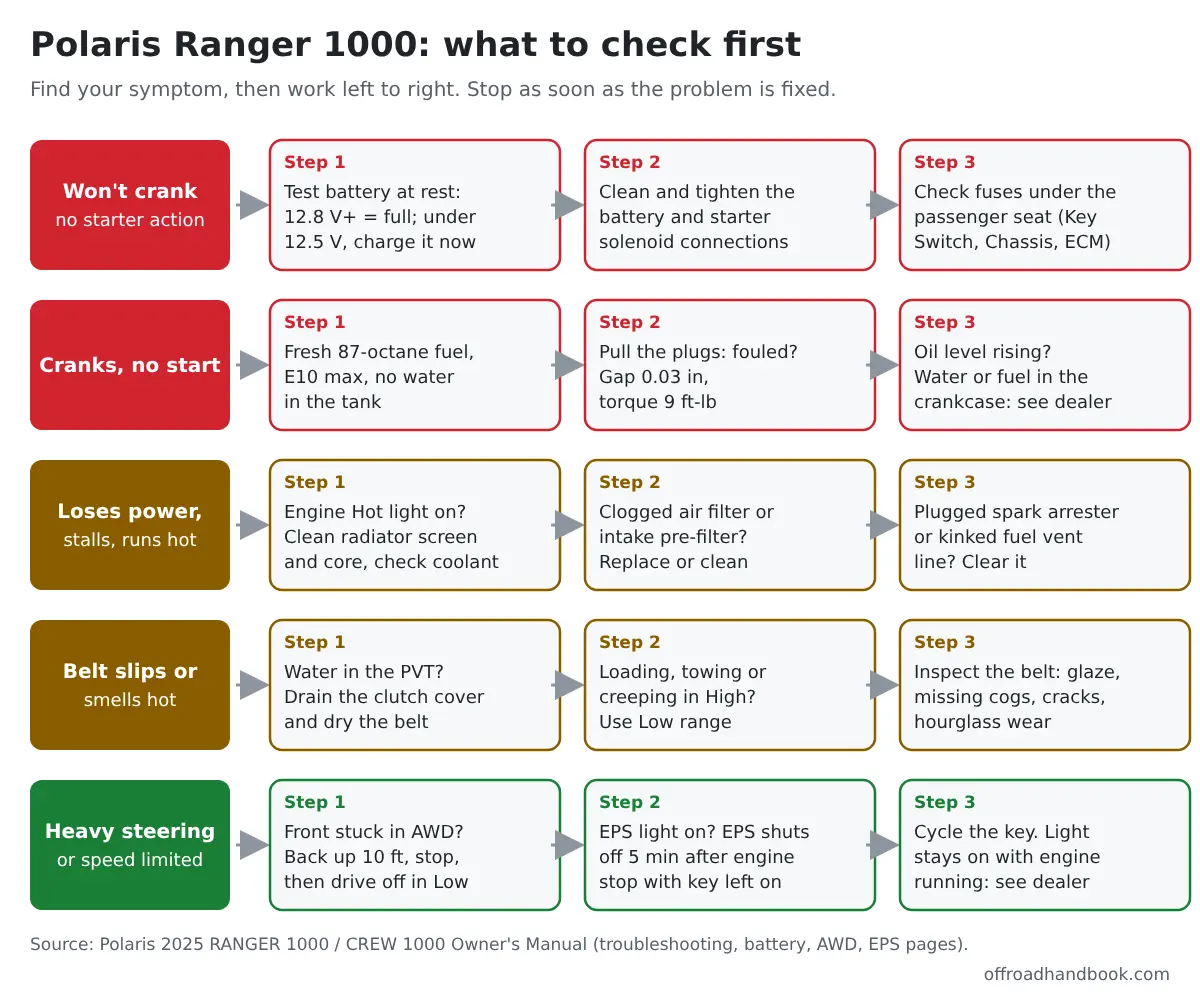
Which Ranger 1000 problem do you have?
This guide covers the gas Ranger 1000 and Ranger Crew 1000 (non-XP) from the 2020 model year on, the years the cited manuals and recalls cover. The Ranger XP 1000 is a different machine with its own manual. All specs below come from the 2025 Ranger 1000 / Crew 1000 owner’s manual on Polaris's publication site unless noted.
One rule before you start: if the vehicle was in a rollover, crash or deep water, Polaris says to have a dealer inspect it before you drive it again. Everything below assumes the machine is otherwise undamaged.
1. Ranger 1000 won't crank (clicks or does nothing)
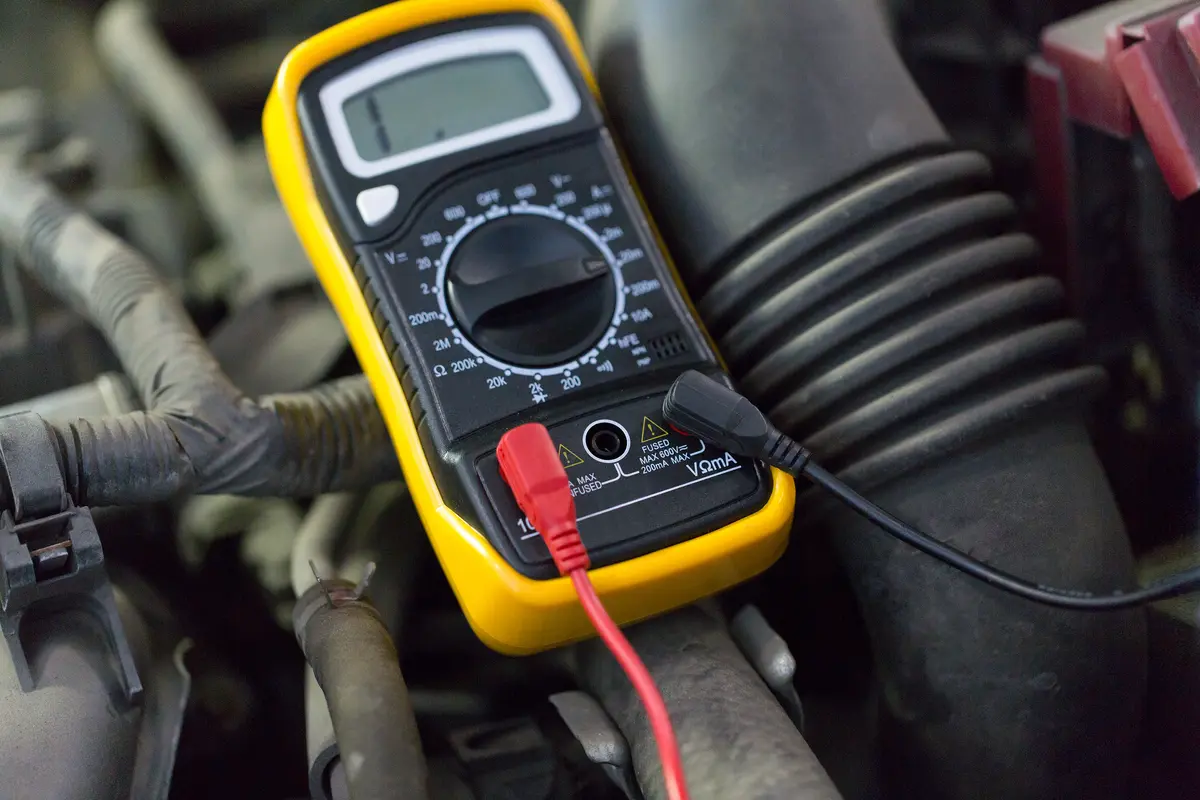
When the starter won't turn the engine, Polaris's troubleshooting table lists only four causes: low battery voltage, loose battery connections, loose starter solenoid connections, and loose electronic control box connections. Start with the battery, because it's the cheapest fix and the most common one.
Put a digital multimeter across the terminals with the key off.
Polaris says a fully charged battery reads 12.8 V or higher, and anything under 12.5 V should be charged right away to avoid sulfation. At 12.0 V or less, the battery is at 0 to 25% and needs at least 20 hours on a charger, per the battery charging chart.
If the battery is good, pull each cable, clean the posts with a wire brush and a baking-soda solution, and coat them with dielectric grease, which is exactly what the manual describes. Then check the starter solenoid and control box plugs for corrosion or a half-seated connector.
Still dead? Check the fuses. The fuse box sits under the passenger seat (the rear passenger seat on a Crew), and spare fuses ride inside it. These are the ratings Polaris lists for the 2025 model:
| Fuse | Circuit | Fuse | Circuit |
|---|---|---|---|
| 20A | Chassis | 15A | Drive |
| 15A | Lights | 30A | EPS |
| 10A | Key switch | 20A | Accessory |
| 10A | Trickle charge | 7.5A | Winch |
| 10A | ECM | 15A | Plug and power |
| 7.5A | Display | 200A | B+ (not serviceable) |
A blown fuse is a symptom, not the fault. Polaris says to find and correct the short circuit that blew it before you install a new one.
If the machine sits for more than two weeks, Polaris recommends a maintainer, specifically the BatteryMINDer 2012-AGM 2-amp charger, which plugs into the dash trickle-charge outlet. On a 4-seat Crew, the rear 12 V socket only has power with the key on, so it can't be used for charging.
2. Ranger 1000 cranks but won't start
If the engine spins at normal speed but won't fire, Polaris's "turns over, fails to start" table points to fuel, spark and voltage, in that order: out of fuel, water in the fuel, old or non-recommended fuel, a fouled or defective spark plug, no spark, water or fuel in the crankcase, low battery voltage, or a mechanical failure.
- Use the right starting routine. Seat belt on, transmission in PARK, foot on the brake, and no throttle. Crank for no more than five seconds, then key off and wait five seconds before the next try (from the manual's starting procedure).
- Check the fuel. Polaris wants fresh 87-octane (R+M/2) unleaded with no more than 10% ethanol, and says E15 and E85 may damage the engine. If the tank sat all winter or took on water, drain it and refill with fresh fuel.
- Pull the spark plugs. A black, damp, oily tip is what Polaris calls wet fouling, usually from oil consumption, the wrong oil or poor fuel. Gap is 0.03 in (0.85 mm) and torque is 9 ft-lb (12 N·m) per the spark plug spec page.
- Check the oil level. A level that rises over time can mean water or fuel collecting in the crankcase, which Polaris says gets worse in cold weather and must be drained. That one goes to the dealer.
- Charge the battery to 12.8 V. A battery can spin the starter and still sag too low for the injectors and ignition, which is why low voltage shows up in this table too.
If the Ranger went under water, don't keep cranking. Read our guide to hydrolock and water in the engine first.
Polaris's own immersion procedure says to dry the air box (and replace a wet filter), remove the plugs, turn the engine over several times on the starter, dry or replace the plugs, then take the machine in for service whether it starts or not.
3. Drive belt slipping, burning or breaking
Polaris gives belt wear and burning its own troubleshooting table, and it's unusually specific. Nearly half of the causes come down to running in high range where Polaris wants low.
- Driving onto a pickup or tall trailer in high range
- Starting out up a steep hill
- Driving at low speed, about 3 to 7 mph, for long stretches
- Towing, pushing or plowing at low speed (Polaris says low range only)
- Easing onto the throttle slowly so the clutch engages gradually
- Cold starts without warming up the belt
- Water or snow in the PVT (the clutch housing)
- A wrong belt, or a new belt that wasn't broken in
The manual is blunt about it: low is the primary driving range for the Ranger, and high is meant for hard-packed surfaces with light loads. Shift to low for rough terrain, hills, trailer loading, heavy towing, anything under 10 mph, mud, and a Crew carrying more than one passenger.
In cold weather, Polaris says to warm the engine for at least five minutes, blip the throttle to about ⅛ in short bursts five to seven times in neutral, then drive under 30 mph for the first mile. Below freezing, stretch that warm-up drive to 5 miles.
How to dry a wet belt
If you crossed water and the belt now slips, Polaris's drying procedure is the fix. The Ranger 1000 manual sends you to it, and it's printed this way in the 2022 Ranger XP 1000 manual:
- Park on a level surface. Remove the drain plug on the outer clutch cover, let the water drain completely, then reinstall the plug.
- Put the transmission in PARK and start the engine.
- Apply varying throttle for 10 to 15 seconds to dry the belt and clutches. Don't hold wide-open throttle for more than five seconds.
- Let it settle to idle, apply the brakes, and shift to low.
- Test for slipping. If it still slips, repeat, and get it serviced as soon as possible.
To keep water out next time, don't point a hose or pressure washer at the PVT intake ducts. Planning a deep crossing? Our water crossing depth checker shows how intake height limits fording depth.
Replacing a burned belt
Inspect the old belt for hourglassing (worn spots on both sides from the clutch spinning while the vehicle stood still), missing cogs, cracks, burn marks or thin spots.
A belt change starts with removing eight fasteners on the outer clutch cover. You don't need to pull the left rear wheel. The clutch spreader tool (Polaris part 2883577) is in the factory tool kit.
Two steps people skip: clean every bit of belt debris out of the clutch ducts, outlet duct screen and engine compartment, and break the new belt in at lighter loads and lower speeds. Polaris warns that leftover debris can cause vehicle damage and loss of control.
On a 2020 or 2021 model, a broken belt is more than a wear item. Those years were recalled because a failing belt could damage the inner clutch cover and fuel line (see the recall table below).
4. Overheating, Engine Hot light or loss of power
The Engine Hot lamp comes on when the engine overheats, and if it flashes, Polaris says a severe overheating condition exists. Shut it down and let it cool. Never open the radiator cap hot. Polaris warns that escaping steam can burn you.
In the "engine stops or loses power" table, the overheating fix is to clean the radiator screen, core and engine exterior, and check that the radiator fan harness is plugged in.
Rinse the radiator with a garden hose, not high pressure. If you do use a pressure washer, Polaris caps it at 3,000 PSI and 2.5 GPM with a 40° nozzle held 2 feet away, and says to keep the stream off the radiator, since high pressure bends the fins.
Then check coolant. Keep the overflow bottle between the min and max marks when cold. If it keeps dropping or runs dry, Polaris says to check the level in the radiator itself, and to suspect a leak. Top up with Polaris Antifreeze 50/50 Premix, undiluted.
Don't mount accessories in front of the radiator or behind the fan, either. Polaris says blocking airflow there can overheat the engine. If the machine bogs instead of overheating, the same table lists a clogged air filter or intake pre-filter, a plugged spark arrester, a kinked fuel vent line, water in the fuel and low battery voltage.
5. Runs rough, misfires, backfires or pings
Rough running, stalling and misfires trace to ignition and fuel in Polaris's troubleshooting table: fouled plugs, worn plug wires, the wrong plug gap or heat range, loose ignition connections, water in the fuel, low battery voltage, the wrong fuel, a clogged air filter or pre-filter, and a plugged spark arrester.
Backfiring adds weak spark, old fuel and incorrectly installed plug wires to that list. Pinging or knocking has just two listed causes: poor-quality or low-octane fuel, and the wrong plug gap or heat range.
The spark arrester is the one owners forget. The manual has you remove it from the tailpipe with the exhaust cold, clear the carbon, check the mesh for holes, and torque the bolt to 8 ft-lb. It's also part of the yearly service.
If you replace the air filter, don't try to clean the old one. Polaris says a filter soaked with fuel or oil must be replaced, and to wipe oil or water out of the airbox before installing the new one.
6. Hard shifting or grinding into gear
The Ranger 1000 gear selector (H, L, N, R, P) is designed to be moved only with the vehicle stopped and the engine at idle. The gear selector page says shifting while moving or above idle can damage the transmission, and the console label says the same thing.
So the first fix is technique. Come to a full stop, let the RPM drop to idle, and then move the lever. If it's still notchy or won't go into a gear, Polaris says maintaining shift linkage adjustment is important, and a dealer can set it.
While you're checking, look at the transmission fluid too. The main gearcase holds 41 fl oz (1,200 ml) of Polaris AGL, and the fill and drain plugs torque to 10 to 14 ft-lb, per the gearcase chart.
7. AWD, speed-limit and heavy steering problems
Several "my Ranger won't go faster" complaints are features, not faults. The helmet/seat belt lamp is a reminder, and Polaris says the vehicle is limited to 15 mph if the seat belt isn't secured. Pressing the brake and throttle together can also limit engine power.
AWD works through the driveline switch. Polaris says the electronics won't enable AWD until the engine is below 3,100 RPM, and switching into AWD while the rear wheels are spinning can severely damage the drive shaft and clutch. Let off the throttle first, then switch.
If the front gearcase stays locked after you switch AWD off, you'll feel heavy steering and some speed restriction. Polaris's unlock procedure: stop, drive in reverse at least 10 feet (3 m), stop, shift into low and drive forward. If it's still locked, see the dealer.
If you have electronic power steering, it shuts itself off 5 minutes after the engine stops if the key is left on, to save the battery, and the EPS light comes on. Turn the key off and on to reset it.
If the light stays on with the engine running, Polaris says the EPS is inoperative and to get it to a dealer soon, since continued use can permanently damage the unit.
Don't use TURF mode (the bottom switch position) on hills, side slopes, gravel, sand, snow, ice or water. It drives one rear wheel only, and Polaris warns it can cause loss of control on loose or sloped ground.
Ranger 1000 fault code lookup (SPN and FMI)
When the check engine or EPS light comes on, the gauge stores a code. Press and hold MODE to open the Options menu, select "Diagnostic Codes," and use the up/down buttons to scroll. Display area 1 shows the FMI, display area 2 shows the SPN, and the clock area shows the count.
Read the code before you shut the machine off. Polaris says turning off the ignition clears saved fault codes from the gauge, so take a phone photo first. The light that blinks while a code is shown tells you which controller set it: check engine or EPS.
Ranger 1000 fault code lookup
Enter the SPN (display area 2) and FMI (display area 1) from your gauge. Leave FMI blank to see every fault for that SPN.
The tool uses the diagnostic code tables in Polaris's 2025 and 2023 Ranger 1000 owner's manuals (86 code combinations). Not every code applies to every vehicle. The plain-English fault descriptions come from Polaris's definitions of open load, short to ground and short to battery. More free tools: see all our off-road calculators.
Two codes deserve special attention. SPN 110 FMI 0 is "Engine Overheat Shutdown," and SPN 110 FMI 16 is "Temperature Too High." Both mean the cooling steps in problem 4 come before anything else. Polaris says not to operate the vehicle with the check engine light on, because serious engine damage could result.
Polaris Ranger 1000 recalls by model year
Recalls are free repairs, and several of them overlap the problems above. This table lists the recalls we found that name the Ranger 1000 or Ranger Crew 1000 (non-XP) in CPSC and Polaris notices:
| Model years | Problem | Risk | Announced |
|---|---|---|---|
| 2020–2021 Ranger 1000 / Crew 1000 (and XP 1000) | Throttle pedal can return to idle slowly or stick down | Crash | March 4, 2021 (CPSC) |
| 2020–2021 Ranger 1000 / Crew 1000 | Drive belt can break and damage the inner clutch cover and fuel line, causing a fuel leak | Fire | March 25, 2021 (CPSC) |
| 2021–2023 Ranger 1000 / Crew 1000 (and XP 1000) | Fuel leak at the fuel pump outlet connector near a hot surface | Fire | August 10, 2023 (CPSC) |
| 2023 Ranger 1000 / Crew 1000 (and XP 1000) | Passenger seat belt buckle bracket not properly welded | Injury | September 28, 2023 (Polaris) |
| 2024 Ranger 1000 / Crew 1000 (and XP 1000, XP Kinetic) | Passenger seat belt anchor can separate from the frame (bad weld) | Injury | December 5, 2024 (CPSC) |
Each recall covers specific VINs, not every machine of that year. Check yours on Polaris's off-road recall lookup or call Polaris at 800-765-2747. On the 2024 seat belt recall, owners were told to stop carrying passengers until a dealer inspection. The 2023 notice said to stop using affected units.
If your 2020 or 2021 throttle pedal feels slow to return, that matches the first recall. Polaris's manual also says to check that the pedal returns normally before every start.
Maintenance that prevents most Ranger 1000 problems
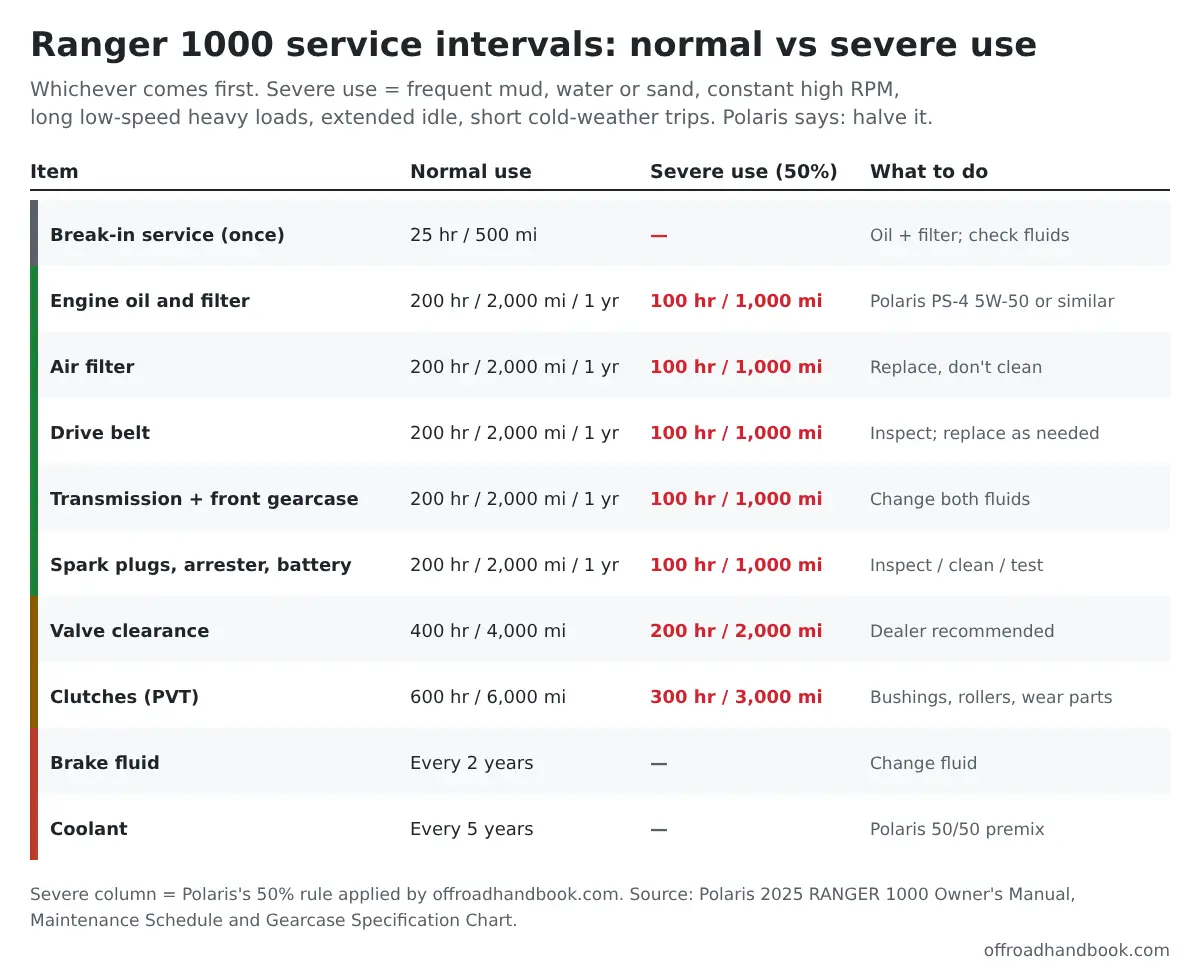
Polaris's maintenance schedule runs at whichever comes first: hours, miles or a year. The catch most owners miss is the severe-use rule. Frequent mud, water or sand, constant high RPM, long low-speed heavy hauling, extended idling or short cold-weather trips mean every interval is cut in half.
A farm Ranger that idles a lot and lives in mud is a severe-use machine. So oil and filter, air filter, belt inspection, gearcase fluids and plugs come due at 100 hours or 1,000 miles, not 200 hours or 2,000 miles.
For oil, Polaris specifies Polaris PS-4 5W-50 4-Cycle Oil or a similar oil, and warns against mixing brands. The front Demand Drive unit takes 10 to 12 fl oz of Demand Drive fluid. Brake fluid is a two-year change, and coolant is drained and replaced every five years.
Respect the load limits, too. Polaris rates the Ranger 1000 at 2,500 lb towed on level ground but only 850 lb on a 15° grade, with a 250 lb tongue limit and a 10 mph towing top speed.
With more than 550 lb of payload, stay under 40 mph. Over 1,050 lb, stay under 25 mph. Sizing a winch for recovery? Try our winch size calculator.
Ranger 1000 problems FAQ
Why won't my Ranger 1000 go faster than 15 mph?
Usually the driver's seat belt isn't latched. Polaris limits the vehicle to 15 mph when the seat belt isn't secured. If the belt is on, check whether you're pressing the brake and throttle together, or whether the front gearcase is stuck in AWD (heavy steering is the clue).
How do I clear a check engine code on a Ranger 1000?
Codes saved on the gauge clear when you turn the ignition off, per Polaris. That doesn't fix the fault, so if the light comes back after a restart, the problem is still active. Write down the SPN and FMI first and look them up in the tool above.
How often should I change the Ranger 1000 drive belt?
Polaris doesn't give a fixed replacement interval. It says to inspect the belt every 200 hours, 2,000 miles or yearly (half that for severe use), and replace it as needed. Glazing, missing cogs, cracks or hourglass wear mean it's time.
Is the Ranger 1000 the same as the Ranger XP 1000?
No. They're separate models with separate owner's manuals, so specs and fault code lists aren't guaranteed to match. Use the manual for your exact model and year, and check Polaris's publication site if you don't have a printed copy.
Related guides
For problems shared by most belt-drive machines, see our ATV and UTV troubleshooting guide. If you also run an older Ranger, our Polaris Ranger 700 XP problems guide covers the older 700 XP, and our Polaris General 1000 problems guide covers the General 1000 and General 4 1000, with a recall checker by model year.

I'm Suryashankar Dasgupta, the founder of Off-Road Handbook. I've been off-roading for years in the USA, including California and Texas, and have ridden mountain and desert terrain abroad. I've also driven a Jeep Compass for more than seven years, so I know the day-to-day side of Jeep ownership first-hand, from the Uconnect screen to the warning lights. Every guide here is researched from manufacturer owner's manuals, NHTSA recall and service-bulletin records and other trusted sources, checked against them before it is published, and corrected when we find a mistake. You can read how we work in our editorial policy: https://offroadhandbook.com/editorial-policy/
Like our off-road guides? Add Off-Road Handbook as a Google Preferred Source so our latest Jeep, ATV, UTV, trail, recovery, and off-road troubleshooting articles can appear more often in your Google Search experience.
Add us as a Preferred Source