Payload Calculator: How Much Can Your Built 4x4 Still Carry?
This post contains Amazon affiliate links. As an Amazon Associate I earn from qualifying purchases, at no extra cost to you.
Your real payload is the occupant-and-cargo limit on the Tire and Loading Information placard in the driver's door opening, minus everything bolted on since the factory. People, gear, water and tongue weight come out of that same number, and so do the bumper, winch, rack and tent. The calculator below shows what's left.
That's the method federal rules make every manufacturer print in the owner's manual (49 CFR 575.6). The catch most payload calculators skip: the placard describes the vehicle as built, so aftermarket parts have to be subtracted first.
4x4 Payload Calculator: Parts, People, Water and Tongue Weight
Enter net weights for added parts, meaning the new part minus whatever stock part came off. The optional last section estimates how much a winch bumper adds to the front axle.
Enter your placard limit and loads, then select Check my payload.
How it works: remaining payload = placard limit − (people + added parts + water × 8.34 lb/gal + gear + tongue weight). Front axle gain = bumper weight × (1 + overhang ÷ wheelbase). Results are estimates. A loaded scale ticket is the final word.
Which door-jamb number is your payload?
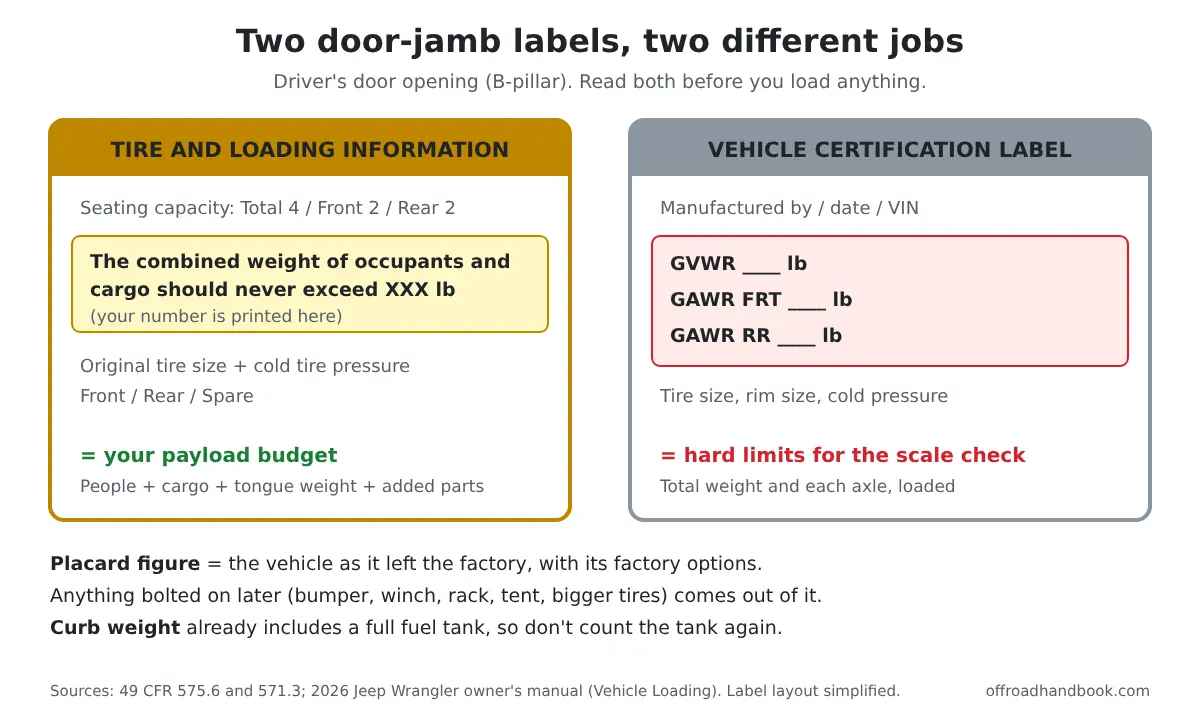
There are two labels in most driver's door openings, and they do different jobs. The Tire and Loading Information placard carries the occupant-and-cargo limit. That's your payload budget for the vehicle as it was built.
The vehicle certification label carries the GVWR (the maximum loaded weight of the whole vehicle) and the front and rear GAWR (the maximum load on each axle). Jeep's 2026 Wrangler owner's manual says total load must be limited so neither the GVWR nor either GAWR is exceeded.
The same manual defines payload as the load the vehicle can carry "including the weight of the driver, all passengers, options and cargo." So the driver counts. Options count too.
Why "GVWR minus curb weight" can mislead
Most calculators online subtract a brochure curb weight from GVWR. That figure may describe a different trim or option package than yours, so it can overstate what your truck can carry. The placard is the figure the manufacturer put on your vehicle, which is why the federal steps start there.
One thing you don't subtract: the fuel in the tank. Federal rules define curb weight as including the "maximum capacity of engine fuel, oil, and coolant" (49 CFR 571.3), and Jeep's manual defines it the same way. Jerry cans on the rack are another story. Those count.
The official steps, corrected for a built rig
The six steps in 49 CFR 575.6 assume a stock vehicle. Here they are with the one step a modified 4x4 needs added (step 2):
- Find the "combined weight of occupants and cargo should never exceed" figure on your placard.
- Subtract the net weight of every part added after the factory: bumpers, winch, sliders, skids, rack, tent, drawers, and any weight gained from bigger tires and wheels.
- Subtract the real weight of the driver and passengers.
- What's left is your cargo and luggage capacity.
- Keep gear, food, water and tools under that figure.
- If you tow, subtract the trailer's tongue weight too. Jeep's manual calls tongue weight part of the load on your vehicle.
The regulation's own example uses five 150 lb passengers. Real adults weigh more. The CDC's latest body measurement data puts the average U.S. man at 199.0 lb and the average woman at 171.8 lb (2021–2023). Two average adults are about 371 lb before anyone packs a bag.
What common overland gear actually weighs
Guessing is where payload math goes wrong, so here are published weights for popular parts. Use your own part's spec sheet when it differs.
| Item | Published weight | Count against payload | Source |
|---|---|---|---|
| Average U.S. adult man / woman | 199.0 lb / 171.8 lb | Full weight, every seat filled | CDC NCHS |
| ARB Bondi Deluxe winch bumper (JL/JT, 3450460) | 143 lb with mounts and fitting kit; about 42 lb of stock parts removed | About 101 lb net | ARB product notes (RubiTrux dealer listing) |
| WARN VR EVO 10-S winch (synthetic rope) | 55.2 lb net (steel-cable VR EVO 10: 74.7 lb) | Full weight | WARN EVO 10 sales sheet |
| Front Runner Extreme Slimline II full roof rack (JL 4-door) | 127.87 lb installed | Full weight | Dometic / Front Runner |
| iKamper Skycamp 3.0 rooftop tent | 165 lb | Full weight | iKamper |
| Dometic CFX3 45 fridge (empty) | 41.23 lb | Plus food and drinks | Dometic |
| Water | 8.34 lb per gallon | Plus the container | USGS |
| MAXTRAX MKII recovery boards | 15 lb per pair | Full weight | Dometic / MAXTRAX |
| Hi-Lift X-Treme 48 in jack | 28 lb | Plus the mount | ExtremeTerrain listing |
I pulled each figure from the maker's spec page or sales sheet. The ARB bumper and the Hi-Lift jack are the exceptions: no manufacturer page I could open listed a weight, so the dealer listings are linked instead.
WARN's sheet also lists a shipping weight about 17 lb above the net weight. Before you trust a number from a store page, make sure it isn't the boxed weight.
Note the bumper row. The new bumper weighs 143 lb, but the stock parts that come off weigh about 42 lb, so the real change is about 101 lb. That's why the calculator asks for net weights. Weigh what comes off on a digital hanging scale before you toss it in the garage.
How fast a typical build eats the budget
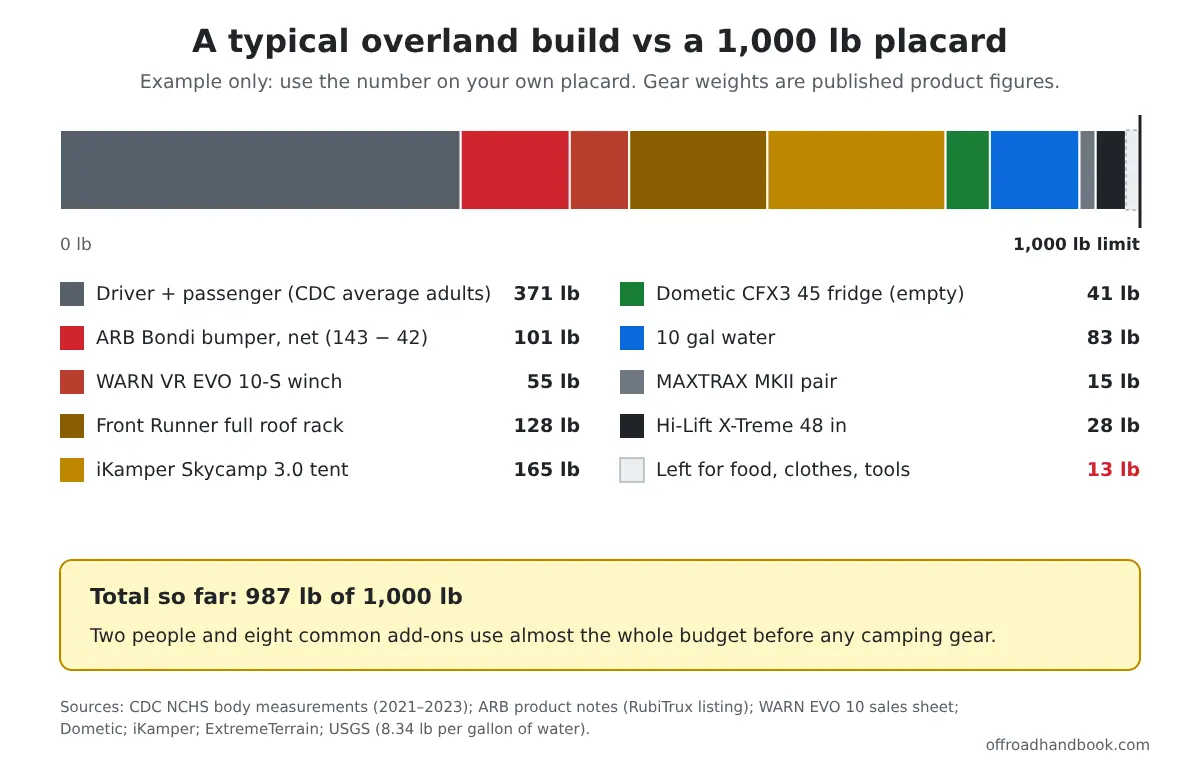
Take a hypothetical 1,000 lb placard (check yours; it varies by model, trim and options). Two average adults use 371 lb. Add the ARB bumper (101 lb net), the WARN winch (55 lb), a full Front Runner rack (128 lb) and an iKamper tent (165 lb).
Then an empty CFX3 45 fridge (41 lb), 10 gallons of water (83 lb), a pair of MAXTRAX (15 lb) and a Hi-Lift (28 lb). Total: 987 lb. There's 13 lb left for food, clothes, a recovery bag, tools and camp chairs.
Nothing in that list is unusual. That's the point. A build that looks normal at the trailhead can be at its limit before the cooler is full, and over it once a third person climbs in.
The front axle can run out before payload does
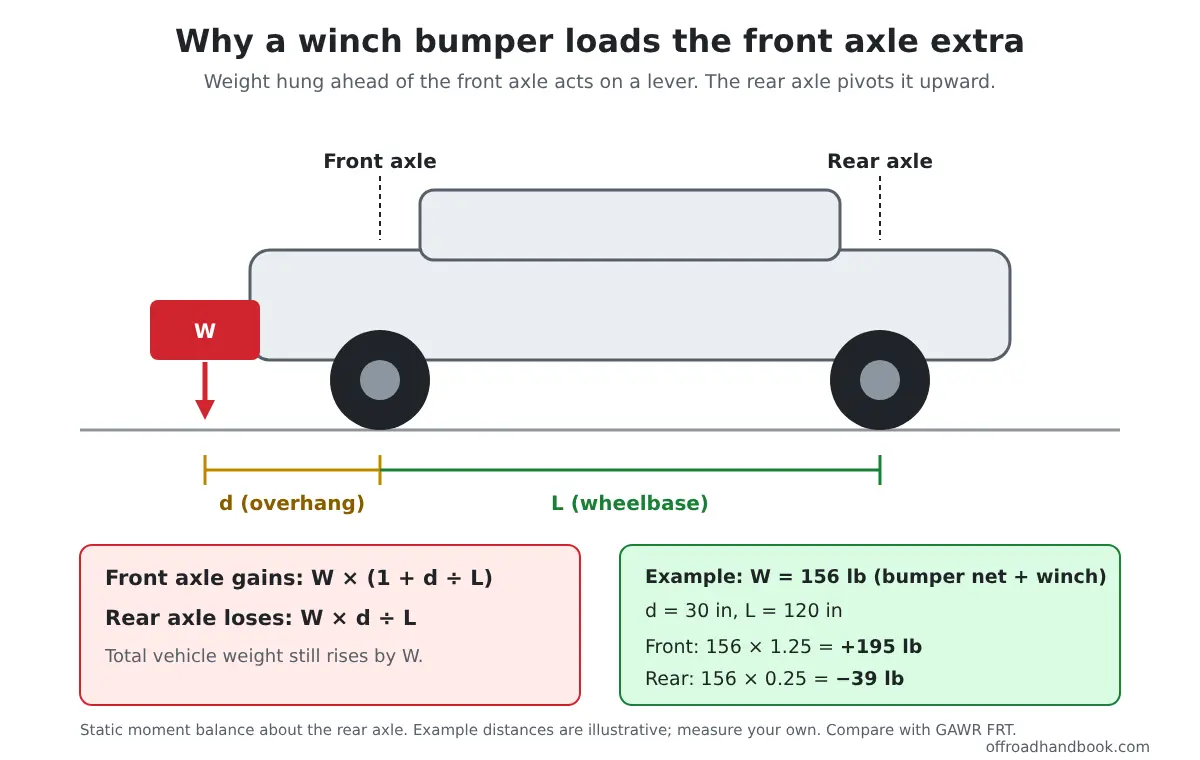
A winch bumper sits out in front of the front axle, so it works like a lever with the rear axle as the pivot. The front axle carries more than the bumper weighs, and the rear axle gets a little lighter.
The math is a simple moment balance. Front axle gain = W × (1 + d ÷ L), and rear axle change = −W × d ÷ L, where d is the distance ahead of the front axle and L is the wheelbase.
Example: a 156 lb bumper and winch (101 + 55 lb) sitting 30 inches ahead of the axle on a 120-inch wheelbase. The front axle picks up about 195 lb, and the rear gets about 39 lb lighter.
Jeep's manual notes that each GAWR is set by the weakest part in that axle system (axle, springs, tires or wheels). It also says heavier parts added for durability "do not necessarily increase the vehicle's GVWR." Stiffer springs don't raise the numbers on the label.
The same lever works in reverse at the back. A swing-out tire carrier with a heavier spare hangs behind the rear axle and loads it the same way.
Still shopping for a winch? Our winch size calculator shows the line pull your rig's weight calls for, so you don't carry more winch than you need.
How to confirm it on a scale
A calculator is only as good as the numbers you feed it. Jeep's manual says the best way to know your actual total weight and the front and rear split is to weigh the vehicle loaded and ready to go on a commercial scale.
- Load the rig exactly as you'll drive it: people, full tank, water, gear, everything on the roof.
- Weigh the whole vehicle and compare it with the GVWR.
- Weigh the front axle and the rear axle separately and compare each with its GAWR.
- If you tow, weigh with the trailer hooked up, or measure tongue weight with a tongue weight scale (check the current price on Amazon).
If any number is over, move weight or remove it. Roof weight deserves its own check, because your roof and rack have a separate dynamic limit. The rooftop tent weight limit calculator covers that part.
Tires, towing and other limits that stack on top
Payload is one limit of several. Jeep's manual says replacement tires must equal the load capacity of the original tire size. If you went to bigger tires, check their load index against your axle ratings with our tire load index chart.
Heavier tires also cost payload. A larger tire and wheel can weigh noticeably more per corner, and a full-size matching spare makes it five. Enter that gain in the calculator. If you're choosing between tire constructions, load range C vs D vs E explains the weight and capacity trade-offs.
Towing adds a third limit. Tongue weight comes out of payload, while the trailer's total weight is limited by the tow rating and GCWR. For Wranglers, the Jeep Wrangler towing capacity guide lists the factory ratings by year and configuration.
Jeep's manual is blunt about why it matters: overloading "can cause a loss of control, poor performance, or damage to brakes, axle, engine, transmission, steering, suspension, chassis structure, or tires." Its tire section adds that overloaded tires can fail and increase your stopping distance.
Payload questions 4x4 owners ask
Does payload include the driver?
Yes. The placard limit covers all occupants plus cargo, and Jeep's manual defines payload as including the driver, all passengers, options and cargo.
Do I count the gas in the tank?
No. Curb weight already includes a full fuel tank under 49 CFR 571.3. Extra fuel in cans, plus the cans and their mounts, does count.
Will a lift or heavy-duty springs raise my payload?
Not on paper. The GVWR and GAWR on the certification label stay the same, and Jeep's manual says heavier suspension parts do not necessarily increase GVWR. The lift kit's own weight also comes out of payload.
Why doesn't the calculator use GVWR minus curb weight?
Because a published curb weight may not match your trim and options, while the placard is the limit the manufacturer put on your vehicle. Starting from the placard is the method federal rules require manufacturers to explain in the owner's manual.
Does trailer tongue weight count against payload?
Yes. The tongue presses down on the hitch just like cargo in the back, and Jeep's manual says to treat it as part of the load on the vehicle.

I'm Suryashankar Dasgupta, the founder of Off-Road Handbook. I've been off-roading for years in the USA, including California and Texas, and have ridden mountain and desert terrain abroad. I've also driven a Jeep Compass for more than seven years, so I know the day-to-day side of Jeep ownership first-hand, from the Uconnect screen to the warning lights. Every guide here is researched from manufacturer owner's manuals, NHTSA recall and service-bulletin records and other trusted sources, checked against them before it is published, and corrected when we find a mistake. You can read how we work in our editorial policy: https://offroadhandbook.com/editorial-policy/
Like our off-road guides? Add Off-Road Handbook as a Google Preferred Source so our latest Jeep, ATV, UTV, trail, recovery, and off-road troubleshooting articles can appear more often in your Google Search experience.
Add us as a Preferred Source