M+S vs 3PMSF: Which All-Terrain Tires Are Really Snow-Rated?
This post contains Amazon affiliate links. As an Amazon Associate I earn from qualifying purchases, at no extra cost to you.
An M+S stamp is common on all-terrain and mud-terrain tires, but that letter code only certifies how open the tread is, not how it grips snow. The three-peak mountain snowflake (3PMSF) is the mark that means a tire passed a standardized snow traction test. Many popular A/Ts now carry it, including the BFGoodrich KO3 and KO2, Falken Wildpeak A/T4W and Toyo Open Country A/T III, while mud-terrains generally don't. Check the sidewall of every tire you own, because some models carry the symbol only in certain sizes.
The table below shows which A/T tires sold in the US carry the snowflake, checked against each maker's own product page. After it comes what the test actually measures, a flowchart for choosing between a 3PMSF A/T, winter tires and chains, and a calculator for how far your pressure falls on a cold morning.
Which all-terrain tires carry the 3PMSF snowflake?
These current A/T lines carry the three-peak mountain snowflake, and their makers list no size exceptions. Warranty figures are the treadwear warranties printed on the same pages. LT sizes often get a lower number, and so do tires that came on the vehicle from the factory.
| Tire | Type | Treadwear warranty | Source |
|---|---|---|---|
| BFGoodrich All-Terrain T/A KO3 | All-terrain | 50,000 mi | Maker page |
| BFGoodrich All-Terrain T/A KO2 | All-terrain (being replaced by the KO3, few sizes left) | 50,000 mi | Maker page |
| BFGoodrich Trail-Terrain T/A | Light all-terrain for SUVs and crossovers | 60,000 mi | Maker page |
| Falken Wildpeak A/T4W | All-terrain | 65,000 mi; 60,000 mi LT | Maker page |
| Toyo Open Country A/T III | All-terrain | 65,000 mi; 50,000 mi LT and flotation | Maker page |
| Goodyear Wrangler DuraTrac RT | Rugged-terrain | 50,000 mi | Maker page |
| Nitto Terra Grappler G3 | All-terrain | 70,000 mi; 55,000 mi LT and flotation | Maker page |
| Cooper Discoverer AT3 4S | All-terrain | 65,000 mi | Maker page |
| General Grabber A/TX | All-terrain, pinned for studs | Up to 60,000 mi | Maker page |
| Yokohama Geolandar A/T G015 | All-terrain | 60,000 mi; 50,000 mi LT and flotation | Maker page |
| Yokohama Geolandar A/T4 | All-terrain | 65,000 mi; 55,000 mi LT | Maker page |
| Nokian Tyres Outpost nAT | All-terrain | 60,000 mi | Maker page |
| Hankook Dynapro AT2 Xtreme | All-terrain (snowflake flagged on every listed size) | Not stated on the product page | Maker page |
| Sumitomo Encounter AT2 | All-terrain | 60,000 mi (headline says up to 65,000) | Maker page |
| Bridgestone Dueler A/T Ascent | All-terrain | 60,000 mi | Discount Tire listing |
I built this table from each brand's own US product page on November 2, 2026. Five tires I originally planned to include were left out. The Falken A/T3W, Cooper AT3 XLT, Bridgestone Revo 3 and General Grabber AT3 no longer have current maker pages, and Goodyear's and Discount Tire's pages disagree on the Wrangler TrailRunner AT.
A model-level claim isn't a promise for every size. Hankook is the only brand above that prints a per-size 3PMSF column. So before you buy, check the size listing, or ask the shop to read you the sidewall of the exact tire.
Only some sizes or versions carry it
These three show why reading the size listing matters. The badge at the top of a product page can cover more than the fine print does.
| Tire | Which sizes carry 3PMSF | Source |
|---|---|---|
| Mickey Thompson Baja Boss A/T | All sizes 12.50 in (315 mm) wide and narrower; wider sizes are excluded | Maker page |
| Goodyear Wrangler All-Terrain Adventure with Kevlar | "Select LT sizes," per Goodyear's own text, even though the page shows a 3PMSF badge | Maker page |
| Goodyear Wrangler Territory AT | The standard version's page shows 3PMSF; the separate Light Truck version's page doesn't | Standard / LT |
The Baja Boss line matters most for lifted Jeeps and trucks. A 37x13.50 is outside Mickey Thompson's snowflake range, but a 35x12.50 is inside it.
Popular off-road tires without the snowflake
Mud-terrains are built around big voids for clearing mud, and none of the popular ones below claims the symbol. Some well-known A/Ts don't carry it either.
| Tire | Type | What the maker's page shows | Source |
|---|---|---|---|
| Michelin LTX A/T2 | All-terrain | Mud & Snow (M+S) badge, no 3PMSF | Maker page |
| Firestone Destination A/T2 | All-terrain | No 3PMSF on the sizes checked | Maker page |
| Nitto Ridge Grappler | Hybrid terrain | No 3PMSF anywhere, including the size table | Maker page |
| BFGoodrich Mud-Terrain T/A KM3 | Mud-terrain | "All-Season" badge only | Maker page |
| Toyo Open Country M/T | Mud-terrain | No snowflake wording | Maker page |
None of this makes those tires useless in snow. It just means they haven't been certified, and that matters if your state's traction rules or your own winter plans call for the symbol.
M+S vs 3PMSF: what each mark actually proves
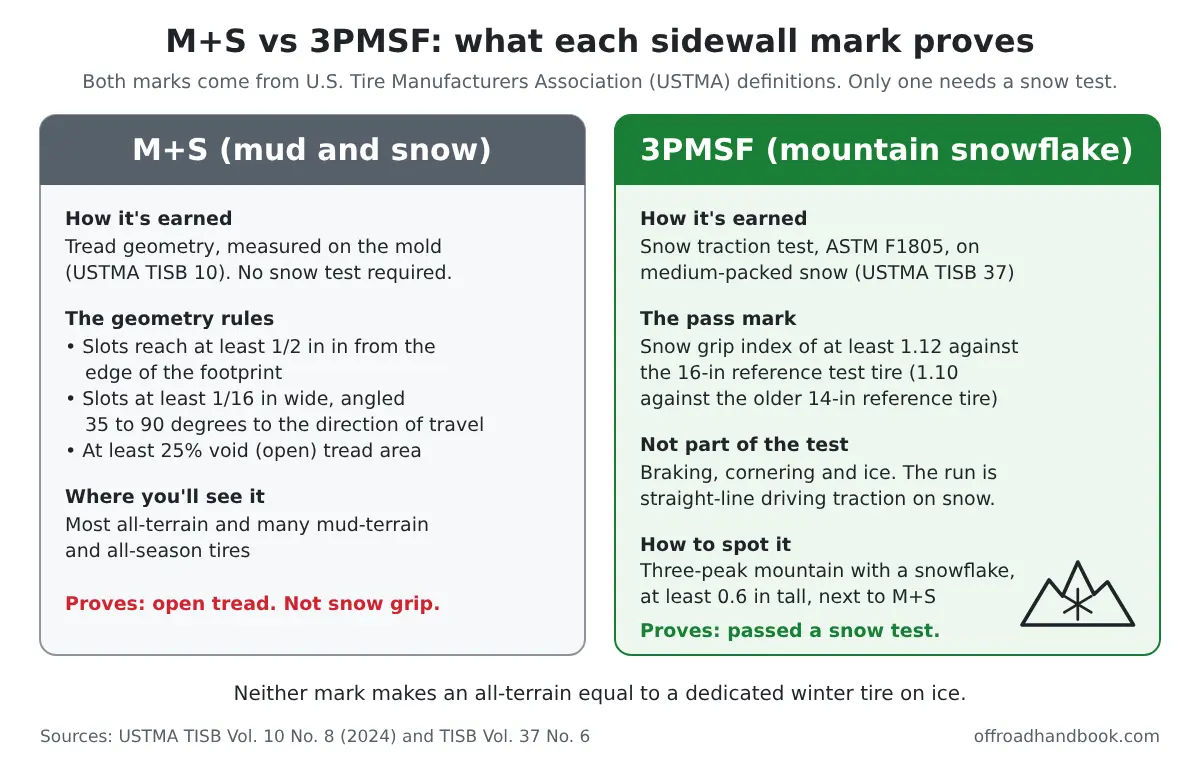
M+S is a tread-shape rule. Under the U.S. Tire Manufacturers Association snow tire definition, the tread needs slots at least 1/16 inch wide reaching at least ½ inch in from the edge of the footprint. They have to be angled 35 to 90 degrees to the direction of travel, and at least 25% of the tread surface has to be open.
All of that is measured on the mold. No snow test is involved, which is why almost every blocky A/T and M/T qualifies.
3PMSF is a performance mark. The USTMA severe-snow definition says the tire must reach a snow grip index of at least 1.12 against the 16-inch Standard Reference Test Tire (or 1.10 against the older 14-inch one). The test is ASTM F1805, run on medium-packed snow.
Put simply, the tire has to deliver at least 12% more snow traction than a reference all-season tire. The snowflake sits next to the M+S marking and must be at least 15 mm (0.6 inch) tall.
What the snow test leaves out
ASTM F1805 measures single-wheel driving traction in a straight line, and the USTMA definition specifies medium-packed snow. Nothing in that definition covers braking distance, cornering, ice or slush. A 3PMSF all-terrain has proved it can pull away on packed snow. It hasn't proved it can stop on a glazed downhill switchback.
That's the gap a dedicated winter tire fills, with its softer cold-weather compound and dense siping. If your winter routes are mostly ice, the snowflake on an A/T isn't enough on its own.
3PMSF all-terrain, winter tires or chains?
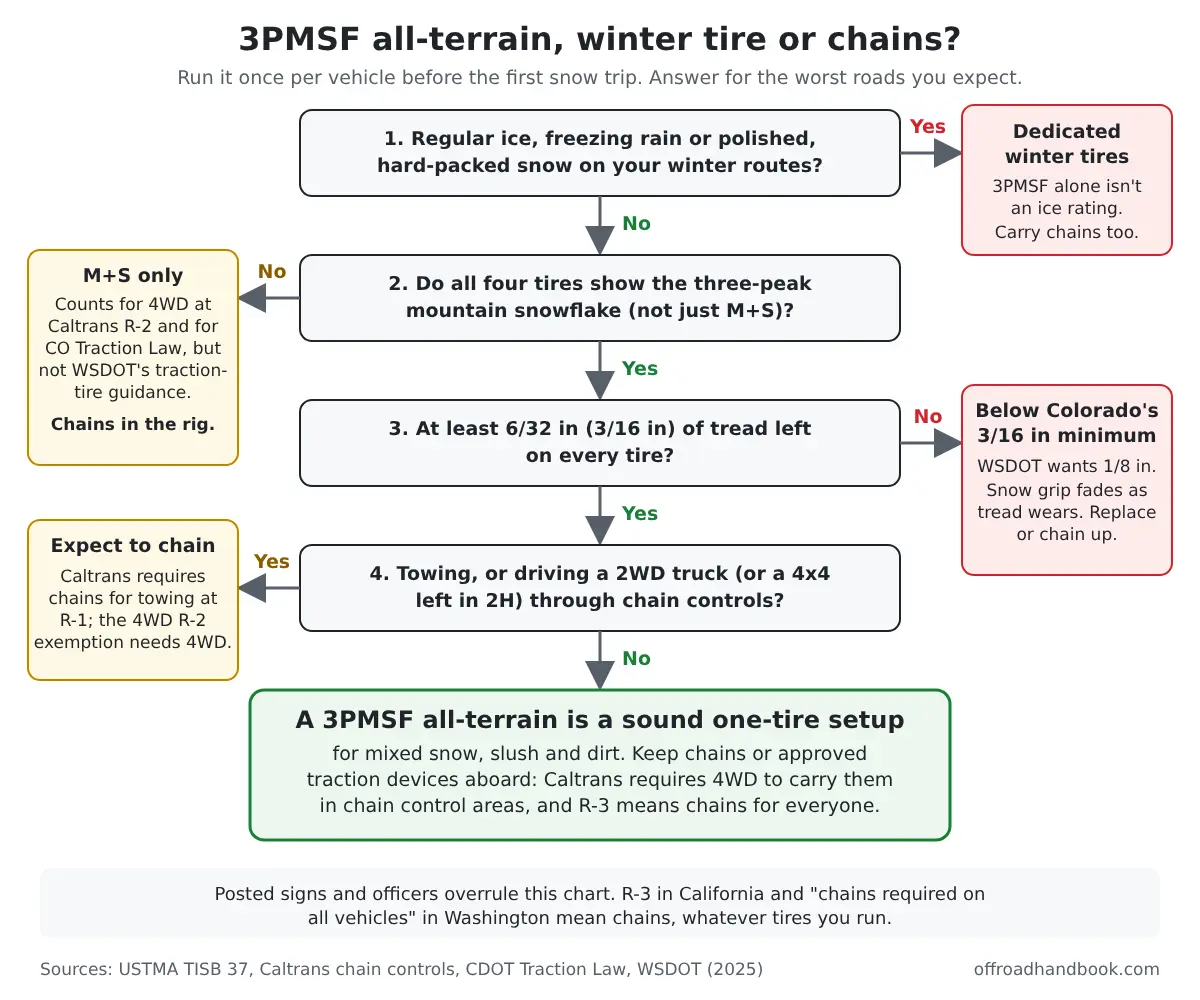
The flowchart encodes four questions, in the order they rule things out. Ice comes first, because no A/T certification covers it. Next is the marking, then tread depth, and last the towing and 2WD cases where state chain rules bite no matter what tires you run.
Tread depth matters because the legal minimums differ. Colorado's Traction Law requires 3/16 inch of tread on tires rated all-weather, M+S or mountain-snowflake. WSDOT's 2025 winter guidance describes approved traction tires as ones with the mountain-snowflake symbol and at least ⅛ inch of tread.
California is looser on the marking. At Caltrans R-2 chain controls, 4WD and AWD vehicles with snow-tread (M+S) tires on all four wheels are exempt from chaining, but they still have to carry traction devices. At R-3, everyone chains. For the full state-by-state rules and a checker, see our guide to 4WD chain laws in CA, CO, OR, WA and UT.
Whichever way the chart sends you, carry a set of tire chains sized for your exact tire and practice fitting them in the driveway first. Check the current price on Amazon, and check your owner's manual for chain clearance on your vehicle.
Cold Tire Pressure Calculator
Winter adds a second tire problem: pressure. Air pressure falls as the air in the tire cools, so tires set in a warm garage read low at a trailhead or ski lot the next morning. Low pressure on an LT tire means more sidewall flex and less load capacity than the placard assumes. Enter what you set and the temperatures below.
Cold tire pressure calculator
The calculator uses the ideal gas law with absolute temperature and absolute pressure: cold psi = (set psi + 14.7) × (low °F + 459.67) ÷ (set °F + 459.67) − 14.7. It assumes the tire's volume stays the same and uses sea-level atmospheric pressure, so treat the result as an estimate and confirm with a gauge.
Worked example: a Wrangler on LT tires set to 38 psi in a 68 °F garage reads about 32.2 psi at 10 °F, a drop of nearly 6 psi. If 38 psi is the door-placard pressure, you'd set about 44.5 psi in the warm garage, or top up outside before leaving.
Airing down for deep snow off the pavement is a different job with its own limits. Our air-down PSI calculator by terrain covers snow, sand and rock, and when to air back up for the highway.
How to check your own tires before the first snow trip
- Find the size and marks on each sidewall. The snowflake is a three-peak mountain outline at least 0.6 inch tall, molded next to the M+S letters. Check all four tires, plus the spare if it will ever go on.
- Measure tread depth in the main grooves with a tread depth gauge. You want at least 6/32 inch (3/16 inch) to meet Colorado's Traction Law. Check the current price on Amazon.
- Read the load range. Winter trips often mean a loaded rig, so make sure the tire's load rating still covers it. Our load range C vs D vs E guide explains the pressures each range needs.
- Set pressure cold, outdoors, the morning you leave, using a digital tire pressure gauge. Never go above the maximum molded on the sidewall.
- If you're buying new tires for winter and changing size at the same time, run the new size through the tire size calculator to check speedometer error and clearance before you order.
FAQ
Are all-terrain tires good in snow?
Many are decent in fresh and packed snow, especially those with the 3PMSF symbol, which proves they passed a packed-snow traction test. None of them is tested on ice, so a dedicated winter tire still stops and turns better on glazed roads.
Is M+S the same as a winter tire?
No. M+S only certifies tread geometry (slot size, angle and at least 25% open tread) under the USTMA definition. No snow test is required, which is why most mud-terrains are marked M+S.
Do mud-terrain tires have the 3PMSF symbol?
The popular mud-terrains we checked, the BFGoodrich KM3 and Toyo Open Country M/T, don't claim it. Check the maker's size listing for any other M/T you're considering.
Does a 3PMSF tire let me skip chains?
Sometimes, never always. Washington's traction-tire guidance and Colorado's Traction Law accept snowflake tires with enough tread, but a California R-3 control or "chains required on all vehicles" in Washington means chains whatever you run.
Can I mix 3PMSF and non-3PMSF tires?
It's best not to. Mixed tires grip differently front to rear, and California's R-2 exemption for 4WD requires snow-tread tires on all four wheels.

I'm Suryashankar Dasgupta, the founder of Off-Road Handbook. I've been off-roading for years in the USA, including California and Texas, and have ridden mountain and desert terrain abroad. I've also driven a Jeep Compass for more than seven years, so I know the day-to-day side of Jeep ownership first-hand, from the Uconnect screen to the warning lights. Every guide here is researched from manufacturer owner's manuals, NHTSA recall and service-bulletin records and other trusted sources, checked against them before it is published, and corrected when we find a mistake. You can read how we work in our editorial policy: https://offroadhandbook.com/editorial-policy/
Like our off-road guides? Add Off-Road Handbook as a Google Preferred Source so our latest Jeep, ATV, UTV, trail, recovery, and off-road troubleshooting articles can appear more often in your Google Search experience.
Add us as a Preferred Source