Soft Shackle or Steel D-Ring? Ratings and When to Use Each
This post contains Amazon affiliate links. As an Amazon Associate I earn from qualifying purchases, at no extra cost to you.
A quality soft shackle matches a ¾-inch steel D-ring at the working-load level, but it isn't stronger at the breaking point. Factor 55's ⅜-inch Extreme Duty soft shackle is rated 8,700 lb working load and 43,500 lb minimum break, while the Crosby ¾-inch screw-pin shackle most Jeeps and trucks carry is 9,500 lb and 57,000 lb.
The soft shackle wins on weight (6.5 oz vs about 2.4 lb) and on what flies if something lets go. Steel wins wherever the connection can be cut, cooked or ground against rock. Use soft for kinetic rope, snatch strap and synthetic winch rope pulls; use steel near heat and sharp edges, and derate it when the pull comes in at an angle.
Soft shackle and D-ring ratings side by side
Every number below comes from the maker's own product page or catalog. Read the WLL and breaking columns separately, because that's where most comparisons go wrong.
| Shackle | Type | Working load limit | Minimum breaking strength | Break ÷ WLL | Weight | Maker's vehicle guidance |
|---|---|---|---|---|---|---|
| Crosby G-209 ¾ in screw-pin anchor (bow) | Steel | 9,500 lb (4-¾ t) | 57,000 lb | 6:1 | 2.36 lb | "Most common for Jeep, truck, SUV" (Factor 55) |
| Crosby G-209 ⅝ in screw-pin anchor (bow) | Steel | 6,500 lb (3-¼ t) | 39,000 lb | 6:1 | 1.37 lb | "Most common for UTV/ATV" (Factor 55) |
| Factor 55 Extreme Duty ⅜ x 10 in | Soft | 8,700 lb | 43,500 lb | 5:1 | 6.5 oz | GVW up to 8,500 lb |
| Factor 55 Standard Duty 7/16 x 10 in | Soft | 7,800 lb | 39,000 lb | 5:1 | 6.3 oz | GVW up to 7,500 lb |
| Factor 55 Standard Duty ½ x 10 in | Soft | 12,000 lb | 60,000 lb | 5:1 | 7 oz | GVW 7,500 to 12,000 lb |
| WARN Spydura ⅜ in | Soft | 5,000 lb (working capacity) | 25,110 lb | About 5:1 | Not listed | Not listed |
| ARB Soft Connect Shackle | Soft | Not published | 14.5 t (about 31,970 lb) | n/a | Not listed | Vehicles up to 3.5 t GVM (about 7,716 lb) |
I built this table from those manufacturer pages on Nov 13, 2026. Some retailers list the WARN Spydura at 29,700 lb, but WARN's own page says 25,110 lb, so that's the figure used here. ARB gets no WLL because ARB only publishes a breaking strength.
One unit note on the steel rows. Crosby's catalog lists the ¾-inch G-209 at 4.75 t. Factor 55, which sells the same Crosby shackle, lists it as 9,500 lb with a 57,000 lb minimum break. The table uses those lower pound figures.
Why "stronger than steel" claims don't hold up
Soft shackles are usually sold on their breaking strength, a big number. Steel shackles are sold on their working load limit, a much smaller one. Put a 43,500 lb soft shackle next to a "4-¾ ton" steel shackle and the soft one looks four times stronger. It isn't.
Compare like with like. At the break, the ¾-inch Crosby (57,000 lb) beats the ⅜-inch Extreme Duty soft shackle (43,500 lb). At the working load, they're close: 9,500 lb vs 8,700 lb. The makers also build in different margins. Crosby uses a 6:1 design factor, and every Factor 55 soft shackle above works out to 5:1.
So the honest claim is "about as strong at the working load, and far lighter." The weight gap is real: 6.5 oz against 2.36 lb is roughly one-sixth the mass. That's what ARB means when it says its Soft Connect Shackle "acts as a fuse," breaking generally before the rated metal parts it's attached to, which keeps flying metal out of the recovery.
Which shackle for which connection
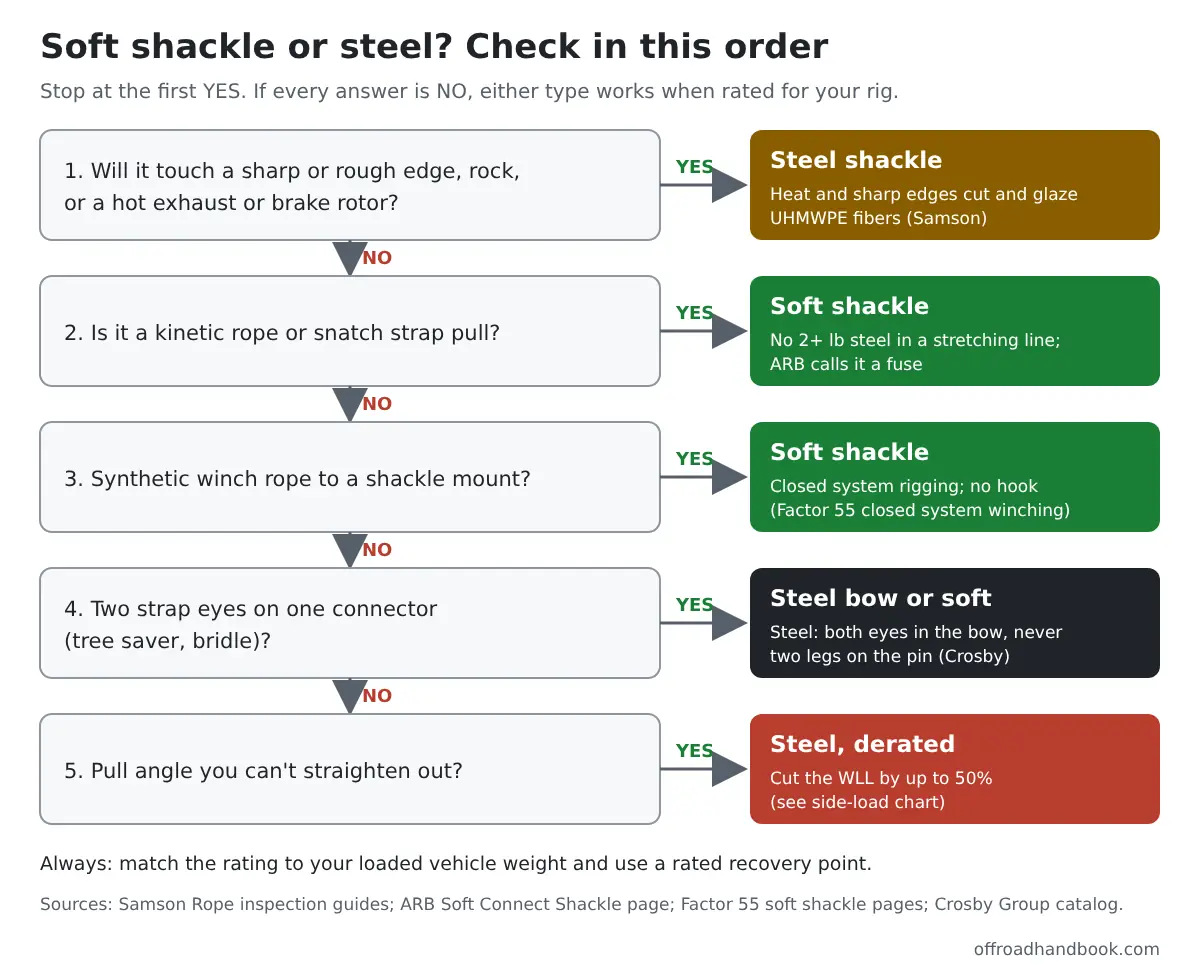
Work through these in order. The first "yes" decides it.
- Sharp edges, rock or heat nearby? Use steel. Samson Rope's inspection guide lists sharp edges and surfaces as the cause of cut strands, and excessive heat as the cause of melted, glazed fibers. A rough-cut bumper tab, a hole without a radius, or a line routed past the exhaust can ruin a soft shackle. Crosby rates its G-209 from -40°F to 400°F.
- Kinetic rope or snatch strap? Use soft. These lines stretch and store energy. If a recovery point or strap fails, you want a 6-ounce rope loop in the line, not a 2-pound forging.
- Synthetic winch rope to a shackle mount? Use soft. Factor 55 lists its soft shackles as compatible with closed-system winching, where every piece of rigging is a closed link.
- Two strap eyes on one connector, like a tree saver or a bridle? Either works. With steel, put both eyes in the bow and the winch line on the pin. Crosby says multiple sling legs should not go on the pin.
- An angle you can't straighten out? Steel, derated. Crosby cuts the working load up to 50% for side loads (chart below). If you can re-anchor to get a straight pull, do that instead.
Whatever you pick, it has to go on a rated recovery point. A shackle is only as good as what it's attached to. Our guide to kinetic ropes, snatch straps and tow straps covers where you can and can't hook up, including the hitch receiver.
How to size a shackle for your rig
Start from your loaded weight, not the curb weight on the window sticker. Factor 55 sizes its soft shackles by gross vehicle weight: ⅜-inch Extreme Duty up to 8,500 lb, 7/16-inch Standard Duty up to 7,500 lb, and ½-inch Standard Duty for 7,500 to 12,000 lb. ARB rates its Soft Connect for vehicles up to 3.5 t GVM, about 7,716 lb.
If you don't know what your built rig weighs with gear, water and passengers, the 4x4 payload calculator will get you close. For steel, Factor 55 calls the ¾-inch Crosby the common size for Jeeps, trucks and SUVs, and the ⅝-inch for UTVs and ATVs.
Check the hole before you buy. Factor 55 notes that a ¾-inch shackle uses a ⅞-inch pin and a ⅝-inch shackle uses a ¾-inch pin. Your bumper tab or receiver mount has to clear that pin, and the bow has to clear the tab's thickness.
Side loading: the steel shackle's weak spot
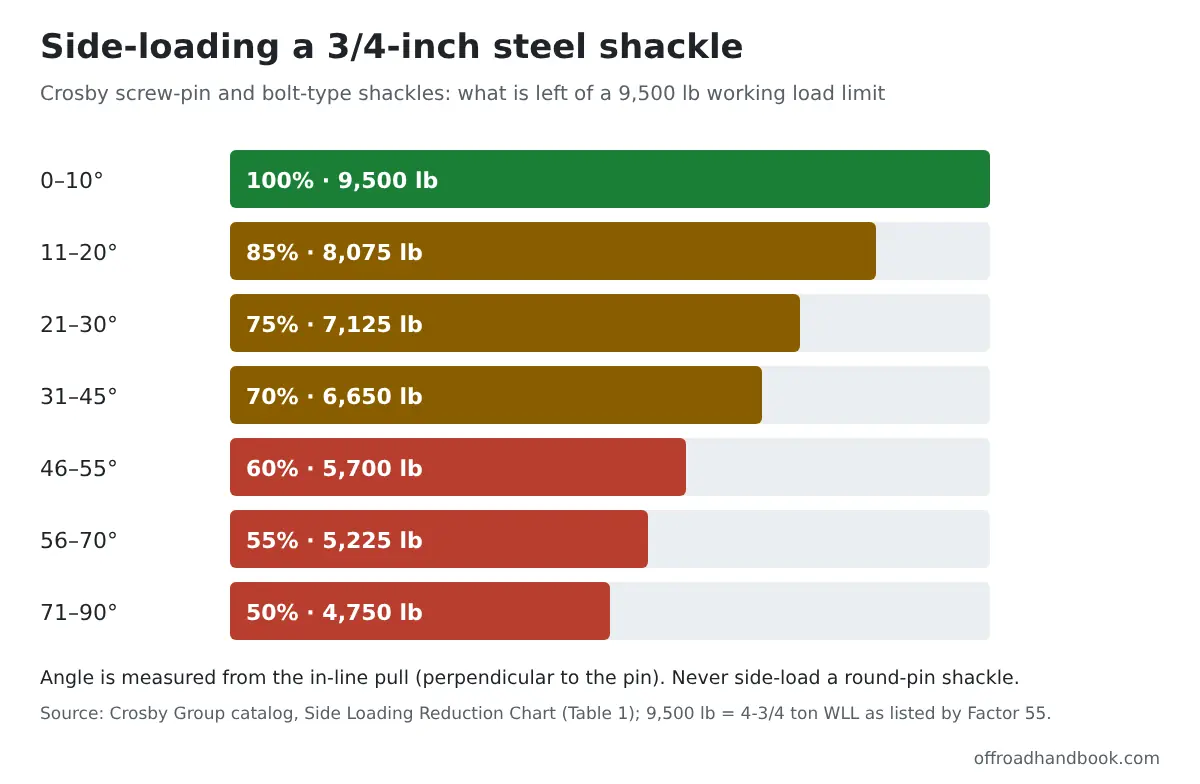
Crosby tested its screw-pin and bolt-type shackles with the load pulled sideways. To keep a proof load of twice the WLL with the load at 90 degrees, the working load had to drop by half. Angles are measured from the in-line pull, which Crosby defines as a load applied perpendicular to the pin.
Here's what Crosby's side-load chart means for a ¾-inch shackle rated at 9,500 lb. Round-pin shackles (the kind held by a cotter pin alone) shouldn't be side-loaded at all.
| Angle of pull off in-line | Crosby adjusted WLL | ¾ in shackle at 9,500 lb |
|---|---|---|
| 0 to 10° | 100% | 9,500 lb |
| 11 to 20° | 85% | 8,075 lb |
| 21 to 30° | 75% | 7,125 lb |
| 31 to 45° | 70% | 6,650 lb |
| 46 to 55° | 60% | 5,700 lb |
| 56 to 70° | 55% | 5,225 lb |
| 71 to 90° | 50% | 4,750 lb |
On the trail, side loads happen when a bumper tab faces forward but the pull comes from off to one side, or when a snatch block redirect leaves the shackle twisted. A 45-degree pull takes a 9,500 lb shackle down to 6,650 lb.
Soft shackle makers don't publish a matching side-load chart, so follow your shackle's own instructions there. For redirects, our snatch block guide and anchor load calculator shows how much load the shackle at the anchor really carries.
Rigging each type the right way
Steel screw-pin shackle
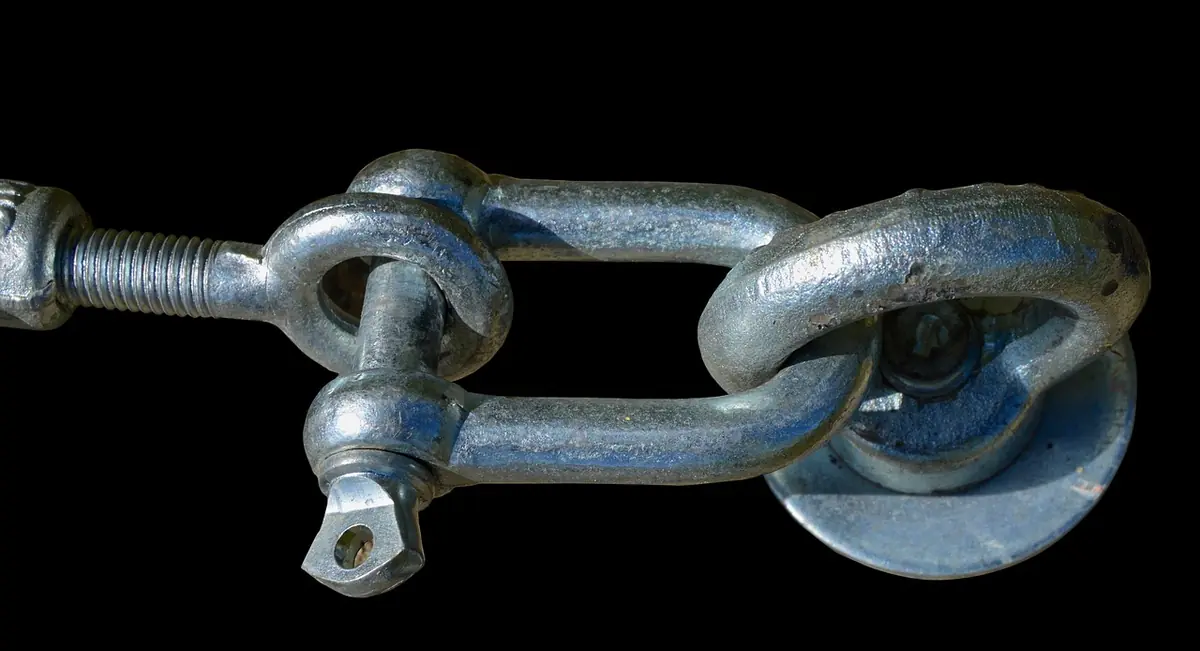
- Thread the pin in until it's fully engaged, and tighten it before each pull. Those are Crosby's own rules for screw-pin shackles.
- Put the strap eye over the bow, not the pin, and keep the load centered in the bow. Crosby warns that pinching or bunching a synthetic sling in a shackle reduces its rated load.
- Never hang two strap legs on the pin. Two eyes go in the bow, and the single line goes on the pin.
- Line the shackle up with the pull. If it can't be lined up, derate it using the chart above.
- If a shackle stays on the truck long-term, Crosby recommends mousing the pin (wiring the collar to the body) so vibration can't back it out.
- Never weld, heat or bend a shackle. The safe-use instructions in Crosby's catalog say that changes its rated load.
Soft shackle
- Open the loop, pass it through the recovery point and the strap eye, then pass the knot through the loop.
- Pull the loop snug around the knot by hand before loading it. ARB describes the loop tightening around its ball-end knot under load, so the knot can't let go.
- Route it clear of sharp edges, hot parts and rock. If the tab edges are rough, switch to steel.
- After a hard pull, check the knot before you pack it away (retirement signs below).
When to retire a soft shackle or a steel D-ring
Soft shackles wear out. Steel mostly doesn't, until it's bent, cracked or overloaded. Inspect both before and after each recovery, and use the table to decide what goes in the trash.
| What you see | Soft shackle | Steel shackle |
|---|---|---|
| Cut strands | Two or more cut strands close together in 12-strand rope means repair or retire, and you can't resplice a shackle on the trail. Retire it. | n/a |
| Melted, glazed, stiff fibers that don't soften when flexed | Caused by heat, shock load or sustained high load. Retire. | n/a |
| Knot shape changed | A crown sunk 1 to 2 rope diameters below the others, or a wall risen past halfway, means the knot shifted under extreme load. Retire. | n/a |
| Worn-through chafe sleeve | Sleeve damage alone doesn't reduce strength. Check the rope underneath. | n/a |
| Distortion or wear | n/a | Distorted or unduly worn body or pin: don't use. |
| Nicks, cracks, grooves, corrosion | n/a | Don't use. |
| Markings unreadable or wrong pin | Rating tag missing: you no longer know what it's rated for. | Markings must be legible and the pin must be the correct type. |
Samson notes that knots adjust under extreme loading, above about 40% of minimum breaking strength. A soft shackle that has stopped a hard kinetic pull deserves a close look at the knot, even if the rope looks clean.
Store soft shackles in a bag, out of the sun. Factor 55 adds extra abrasion and UV protection to its Extreme Duty line, and ARB says its shackle resists short-term UV, which tells you long-term sun exposure is something to avoid.
What to carry
For most Jeeps, mid-size trucks and SUVs under 8,500 lb loaded, a sensible kit is two soft shackles and at least one ¾-inch steel shackle for the jobs a soft one shouldn't do. Check the current price on Amazon for each:
- Factor 55 Extreme Duty Soft Shackle ⅜ x 10 in: 8,700 lb WLL, for vehicles up to 8,500 lb.
- WARN Spydura Soft Shackle ⅜ in (102556): 5,000 lb working capacity, a lighter-duty option.
- Crosby G-209 ¾ in screw-pin anchor shackle: the US-made steel shackle in the table above. Make sure it carries Crosby's markings.
Shackles are one piece of the system. If you're also choosing a winch, the winch size calculator works out the rated pull your rig needs, and every shackle in the line should be rated above that pull.
Soft shackle vs D-ring FAQ
Is a soft shackle stronger than a D-ring?
Not at the break, size for size, in the products compared here. The ⅜-inch Factor 55 Extreme Duty breaks at 43,500 lb minimum, and the ¾-inch Crosby at 57,000 lb. Their working loads are close (8,700 vs 9,500 lb).
What size D-ring do I need for a Jeep Wrangler?
Factor 55 lists the ¾-inch Crosby shackle (9,500 lb WLL) as the common size for Jeeps, trucks and SUVs. Confirm your bumper tab's hole clears its ⅞-inch pin.
Can I use a soft shackle with a kinetic recovery rope?
Yes, and that's where it makes the most sense. ARB calls its soft shackle a fuse that generally breaks before the rated metal parts it's attached to, which keeps heavy metal out of a stretching line.
How long does a soft shackle last?
There's no fixed life. Retire it when you find two or more cut strands close together, glazed or fused fibers, or a knot whose crown has sunk or whose walls have risen, per Samson Rope's inspection guides.
Sources
- The Crosby Group: G-209 screw pin anchor shackles, shackle rigging practice and side loading reduction chart
- Factor 55: soft shackle range and Crosby shackle pages
- WARN: Spydura Soft Shackle 102556
- ARB USA: Soft Connect Shackle ARB2018
- Samson Rope: visual rope inspection guide and Link-It inspection and retirement guide

I'm Suryashankar Dasgupta, the founder of Off-Road Handbook. I've been off-roading for years in the USA, including California and Texas, and have ridden mountain and desert terrain abroad. I've also driven a Jeep Compass for more than seven years, so I know the day-to-day side of Jeep ownership first-hand, from the Uconnect screen to the warning lights. Every guide here is researched from manufacturer owner's manuals, NHTSA recall and service-bulletin records and other trusted sources, checked against them before it is published, and corrected when we find a mistake. You can read how we work in our editorial policy: https://offroadhandbook.com/editorial-policy/
Like our off-road guides? Add Off-Road Handbook as a Google Preferred Source so our latest Jeep, ATV, UTV, trail, recovery, and off-road troubleshooting articles can appear more often in your Google Search experience.
Add us as a Preferred Source