Tire Date Code: How Old Is Too Old, 6 Years or 10?
This post contains Amazon affiliate links. As an Amazon Associate I earn from qualifying purchases, at no extra cost to you.
A tire's age is printed in the last four digits after "DOT" on the sidewall: the first two are the week, the last two the year, so 2619 means the 26th week of 2019. How old is too old depends on whose rule you follow.
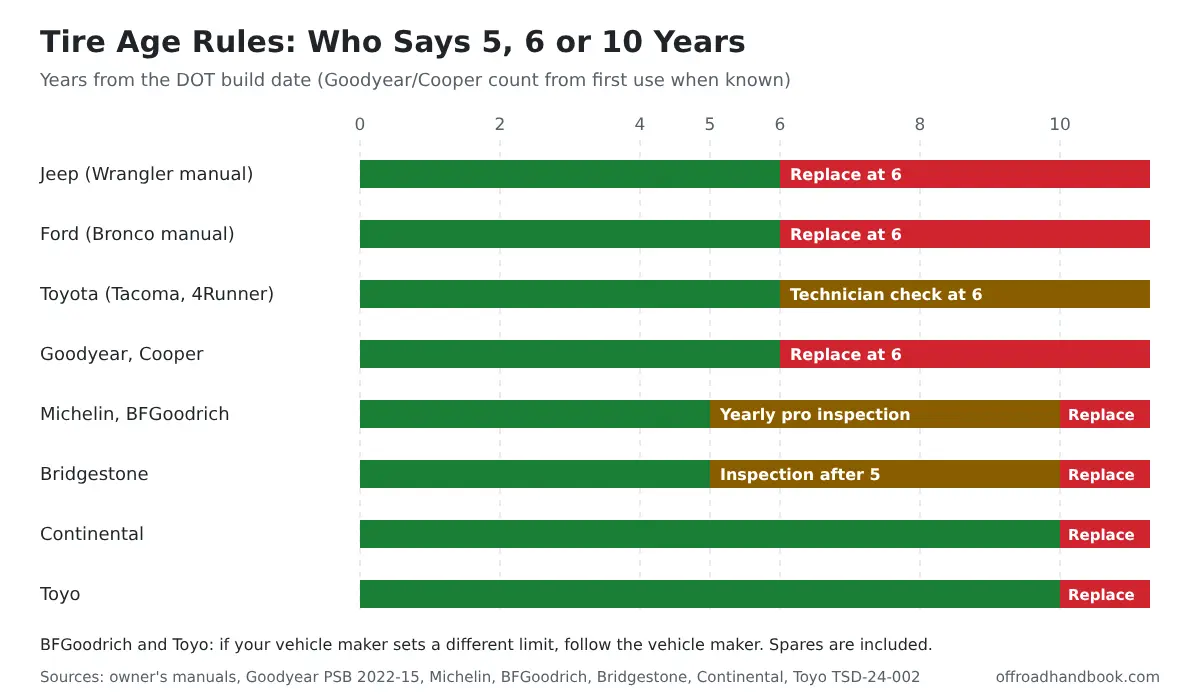
Jeep and Ford owner's manuals say to replace tires, spare included, after six years no matter how much tread is left, and Goodyear and Cooper set the same 6-year limit. Michelin, BFGoodrich, Bridgestone, Continental and Toyo put the hard ceiling at 10 years from the build date.
Type your code into the checker below to get the build week, the tire's exact age and where it stands against each of those rules. The sourced table and the off-road details (rear spares, used rigs, heat) follow.
Tire Age Checker: Enter Your DOT Date Code
Enter the last digits of the DOT code (the date group)
How it works: week 01 is the first full Sunday-to-Saturday week of the year, as defined in the federal tire marking rule, 49 CFR 574.5. The checker dates the tire from that week and compares the age with the limits in the table further down. Goodyear and Cooper count from the day a tire went into service when you know it, so that's the only rule the optional month changes.
How to Find and Read the Date Code
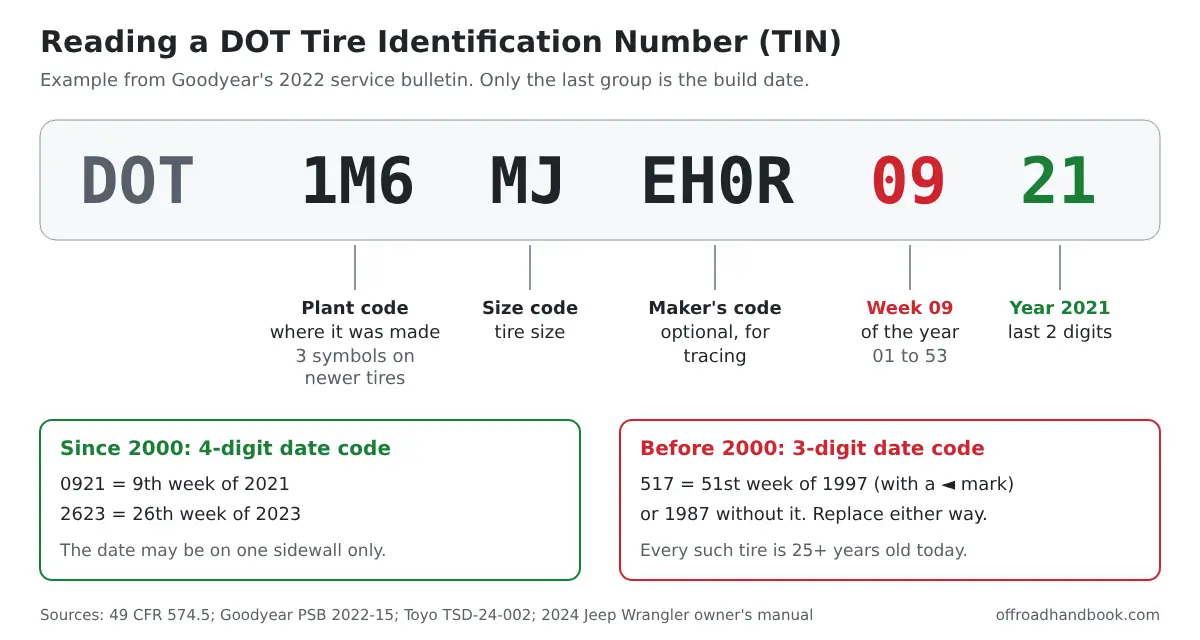
Every road-legal tire sold in the US carries a Tire Identification Number (TIN) that starts with the letters DOT. Goodyear's bulletin describes it as an 11-, 12- or 13-character code that ends with the week and year of manufacture. Only that last group of four digits tells you the age.
- Look on the outboard sidewall first. The federal rule only requires the full TIN on one sidewall. Jeep's 2024 Wrangler manual (page 322) says to check the outboard side of black-sidewall tires as mounted, then the inboard side if it isn't there.
- Find the group of four digits at the end. It often sits inside a small raised oval, separate from the rest of the code.
- Split it in two. First two digits are the week (01 to 53), last two are the year. 0921 is the 9th week of 2021.
- Check all five tires. Tires on the same Jeep or truck aren't always the same age, and the spare is the one most often forgotten.
If you only find a three-digit date, the tire was made before 2000. Back then the year was a single digit, so 517 means week 51 of 1997 if there's a small triangle after the code, or 1987 if there isn't, according to Toyo's service-life bulletin. Either way it's long past every limit below.
Don't be thrown by a longer code on newer tires. A 2015 federal rule moved plant codes from two characters to three, and makers could keep using the old two-character codes until April 13, 2025. The date group at the end works the same way.
The rest of the sidewall (size, load index, speed rating) is covered in our guide to reading every number on a mud tire's sidewall.
6 Years or 10? Tire Age Limits by Maker
There's no single industry number, and that's why the advice you hear goes back and forth. The vehicle makers here say six years (Jeep and Ford) or call for a technician check at six (Toyota). Most big tire makers say 10 years from manufacture, with inspections starting at five. Here is what each one actually publishes.
| Source | What it says about age | Spare tire |
|---|---|---|
| Jeep, 2024 Wrangler JL manual (p. 328) | Replace after six years, regardless of remaining tread | Included by name |
| Ford, 2021 Bronco manual (p. 375) | Replace after six years regardless of tread wear; heat or heavy loads may mean sooner | Replace with the road tires or at six years, even if never used |
| Toyota, Tacoma (p. 532) and 4Runner (p. 433) manuals | Any tire over 6 years old must be checked by a qualified technician | Applies "even if it has seldom or never been used" |
| Goodyear and Cooper, PSB 2022-15 | Replace after 6 years in service; if the in-service date is unknown, 6 years from the DOT date | A mounted spare counts as in service |
| Michelin | Yearly professional inspection after 5 years; replace 10 years after manufacture | Included |
| BFGoodrich | Yearly inspection by a specialist after 5 years in use; replace at 10 years from manufacture; on original-equipment tires, follow the vehicle maker but not past 10 | Included |
| Bridgestone | Inspection is essential after 5 years; replace 10 years after manufacture | Included, "even if it appears new" |
| Continental | Remove tires more than 10 years old from service | Included |
| Toyo, TSD-24-002 (April 2024) | Replace at 10 years from manufacture; follow the vehicle maker where its advice differs | Included |
I built this table from the current owner's manuals for the Wrangler, Bronco, Tacoma and 4Runner and from each tire maker's own FAQ or service bulletin. Goodyear's 6-year rule comes from its November 2022 product service bulletin, which is on file with NHTSA.
Two things stand out. Every source that names a limit includes the spare. And the tire makers' 10-year figure is a ceiling, not a promise: BFGoodrich and Toyo both say most tires need replacing well before then from wear or damage.
Which Limit Applies to Your Tires?
When the rules disagree, go with the stricter one that applies to you. In practice that comes down to three questions.
- Does your owner's manual set an age? If your Wrangler's or Bronco's manual carries a six-year warning, that's your limit, even on aftermarket tires from a brand that says 10. BFGoodrich and Toyo both tell owners to follow the vehicle maker when its advice differs.
- Who made the tire? On a Goodyear, Cooper or other brand in Goodyear's family, the 6-year rule applies no matter what vehicle it's on.
- Do you know when it went into service? Goodyear counts from installation if you have the receipt; everyone else counts from the build date. A tire that sat in a warehouse for a year starts the 10-year clock that much earlier.
Jeep's and Ford's manuals don't say whether "six years" runs from the build date or the install date. Counting from the DOT date is the safe reading, and it's the one the checker uses.
Heat shortens the safe window. Ford's manual warns that hot climates and frequent heavy loading speed up aging and may mean replacing tires sooner. That's worth weighing if your rig lives outside in Arizona or Nevada, or runs heavy with a rooftop tent, drawers and water.
Spare Tires: The Most Overlooked Tire on a 4x4

The spare is where tire age bites off-roaders most. It looks new because it has full tread, but its clock started the week it was built. On a Jeep that came with five matching tires and never rotated the spare in, it's exactly as old as the other four.
Ford's Bronco manual is blunt about it: replace the spare with the road tires or after six years "even if it has not been used," and always replace a spare that's over six years old, whether or not it's part of the rotation. Goodyear treats any spare that's inflated and mounted as in service, whether or not it touches the road.
The simplest fix is a five-tire rotation, so all five age and wear together and you replace them as a set. If you'd rather keep the spare out of rotation, write its date code down and replace it on its own schedule.
Goodyear's storage advice for tires is to keep them away from direct sunlight and ozone, so a spare tire cover sized to your tire is a cheap way to keep the sun off it. Check the current price on Amazon.
One more spare check before a trip: if you went up a size, the old spare may no longer match. Plug both sizes into our tire size calculator to see how far apart the diameters are.
Old-Tire Warning Signs to Check Before a Trail Run
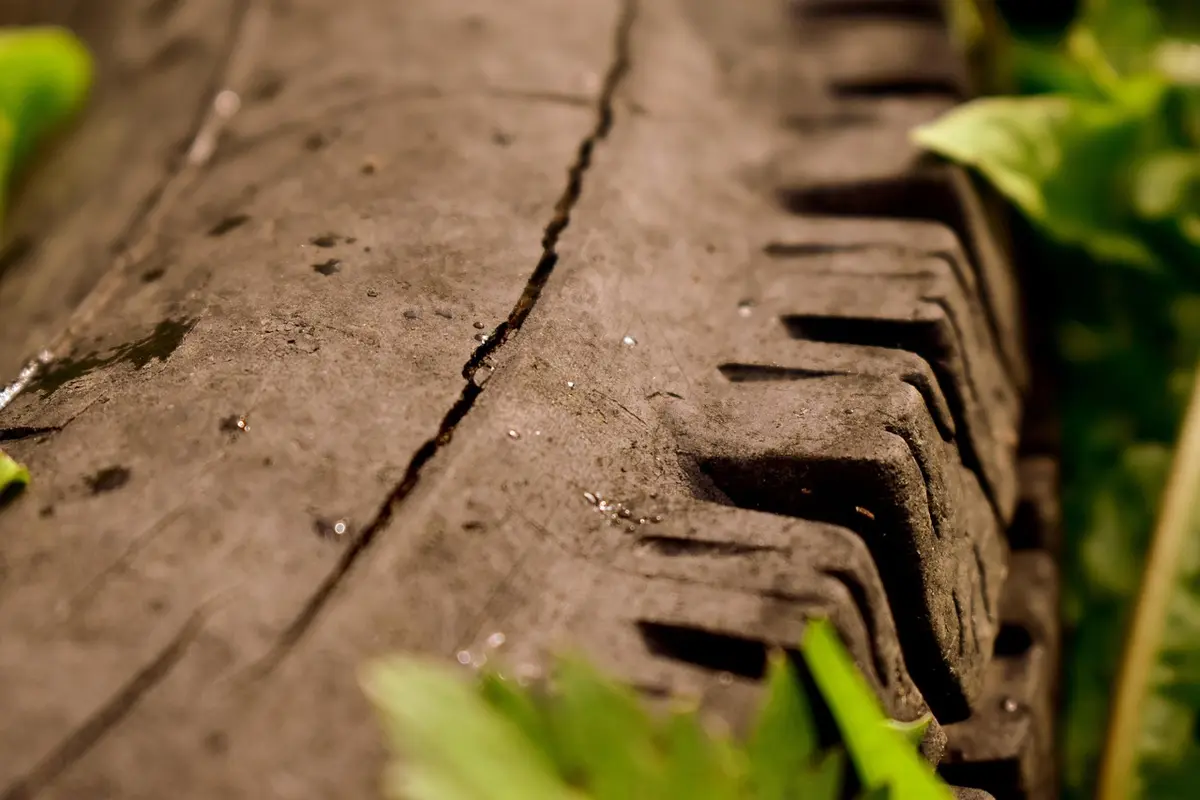
Age limits are the outer edge. A tire can be done at three years if it's damaged, and trail use dishes out more damage than pavement. Toyota's and Toyo's guidance list the same red flags.
- Cracks, cuts or splits in the tread or sidewall, especially any deep enough to show the fabric underneath.
- Bulges or bumps, which can mean a separation inside the tire.
- Tread at 2/32 in. or level with the wear bars anywhere on the tire. Toyo says to replace at that point. A tire tread depth gauge takes the guesswork out (check the current price on Amazon).
- Repeated air loss, new vibration or noise.
- A hard hit. Toyo says a tire that struck something should be taken off the wheel and inspected, because damage may not show on the outside. Think of a rock shelf you dropped off or a ledge that pinched a sidewall.
If a trail puncture is what you're dealing with, our guide on how to plug a flat on the trail, and when you can't covers what's safe to repair. On an aged tire, a sidewall cut is one more reason to retire it.
Buying Tires or a Used 4x4? Check the Dates First
When new tires arrive, read the date codes before they're mounted. Under the 10-year-from-manufacture rules, a tire that's been on a shelf for a while has less life left, so it's reasonable to ask the shop what they have from more recent production.
Used tires are a harder no. Goodyear's bulletin says consumers should never buy or install used tires of any age, because their service, maintenance and storage history is largely unknown.
Shopping for a used Jeep or truck? A set of tires with good tread can still be past six years, which means a new set right after you buy. Read all five codes during the walkaround.
Our used Wrangler inspection checklist covers the rest of the inspection. And if you're replacing tires anyway, confirm the new ones can carry your loaded rig with the tire load index chart.
The TIN has one more use: tire makers use it to contact owners when a tire is recalled, as Ford's manual explains. If you have the full code, you can check for tire recalls on NHTSA's recall lookup.
Tire Age FAQ
Do tires expire if the tread still looks good?
Yes, in the sense that every source above sets an age limit that applies regardless of tread: six years for Jeep, Ford, Goodyear and Cooper, and 10 years for Michelin, BFGoodrich, Bridgestone, Continental and Toyo. Tread depth tells you about wear, not about how much the rubber has aged.
Is there a federal law on how old a tire can be?
The federal rule, 49 CFR 574.5, controls how the date is marked on the tire, not how long it can stay in service. Age limits come from vehicle makers and tire makers, which is why they differ.
I can only find the date code on the inside of the tire. Is that normal?
Yes. The full TIN only has to appear on one sidewall, and Jeep's manual notes the date code may be on one side only. If it's not on the outboard face, look on the inboard side with a flashlight, or check it the next time the wheel is off.
Does a 6-year-old spare that's never been used need replacing?
On a Jeep or Ford, yes: both manuals include the spare in the six-year warning, and Ford says so even if it has never been used. Toyota calls for a technician check at six years, and the 10-year tire makers include spares in their limit too.

I'm Suryashankar Dasgupta, the founder of Off-Road Handbook. I've been off-roading for years in the USA, including California and Texas, and have ridden mountain and desert terrain abroad. I've also driven a Jeep Compass for more than seven years, so I know the day-to-day side of Jeep ownership first-hand, from the Uconnect screen to the warning lights. Every guide here is researched from manufacturer owner's manuals, NHTSA recall and service-bulletin records and other trusted sources, checked against them before it is published, and corrected when we find a mistake. You can read how we work in our editorial policy: https://offroadhandbook.com/editorial-policy/
Like our off-road guides? Add Off-Road Handbook as a Google Preferred Source so our latest Jeep, ATV, UTV, trail, recovery, and off-road troubleshooting articles can appear more often in your Google Search experience.
Add us as a Preferred Source