8 Common Kawasaki Prairie 360 Problems and How to Fix Them
Last updated on October 27th, 2026 at 09:23 am
The most common Kawasaki Prairie 360 problems are a gummed carburetor that causes hard starts and low-rpm sputter, valve clearance that drifts out of spec, a worn drive belt and BELT light, an oil cooler packed with mud, 4WD or front differential control faults, and neglected gear case oil. This 362 cc quad, sold as the KVF360 from 2003 to 2013, is old enough that age and skipped maintenance cause most of it.
One correction matters before you start: Kawasaki's Kawasaki KVF360 service manual, 2003-2013 (sample pages) lists the engine as air-cooled, with an oil cooler and fan switch. There is no radiator or coolant. Advice about coolant airlock or a head gasket blown by low coolant belongs to liquid-cooled quads, not this one.
Symptom, cause, fix at a glance
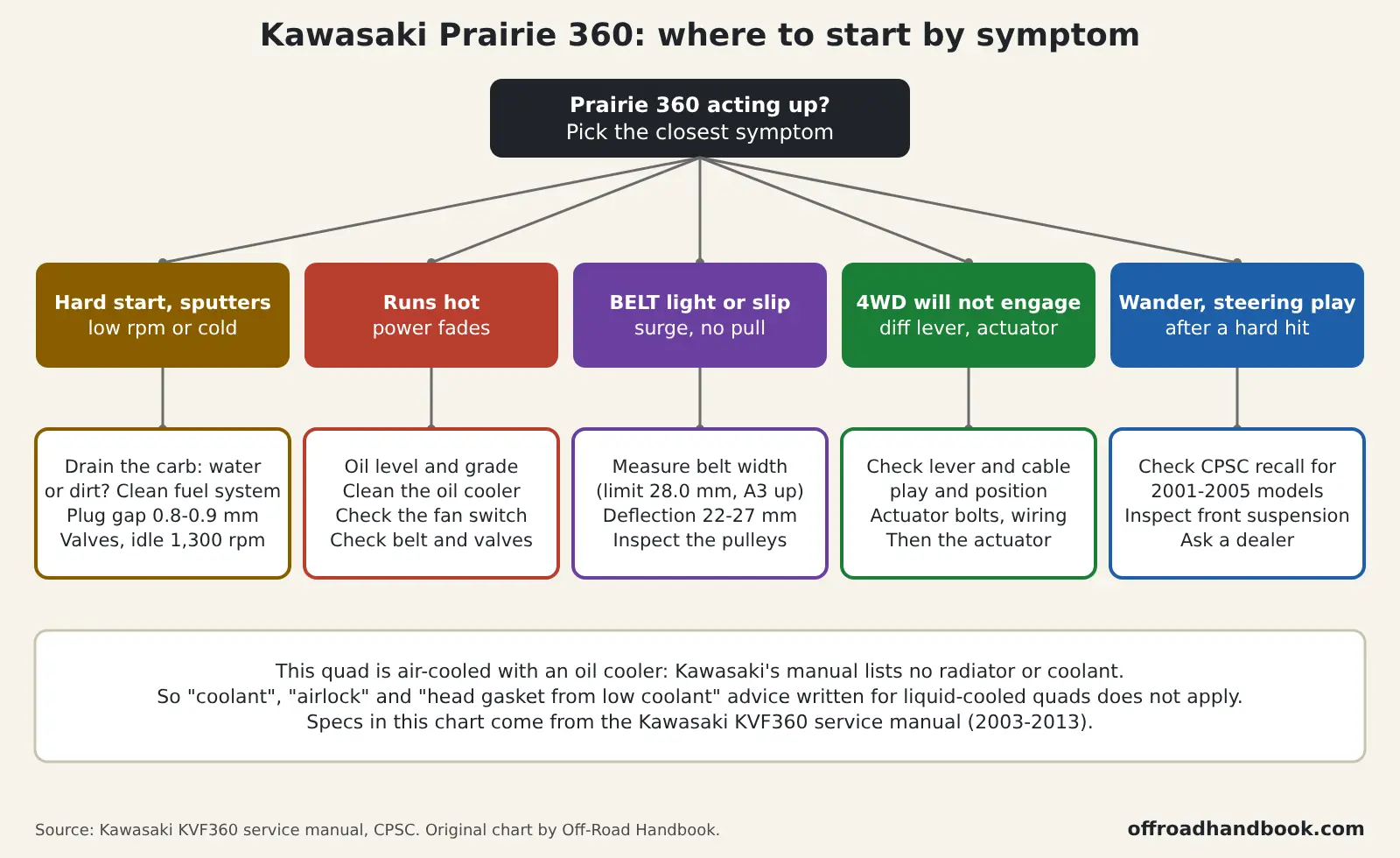
| Symptom | Likely cause | First fix | Section |
|---|---|---|---|
| Hard start, sputter at low rpm | Gummed carburetor, stale fuel, fouled plug | Drain the carb, clean the fuel system, check plug gap | 1 |
| Rough or weak running, ticking | Valve clearance out of spec | Measure and adjust cold | 2 |
| Slip, surge, BELT light | Worn or glazed drive belt, wrong deflection | Measure width and deflection | 3 |
| Hot engine, power fade | Low or wrong oil, clogged oil cooler, fan switch | Check oil, clean the cooler | 4 |
| Flat battery, dim lights | Corroded terminals, weak battery, charging fault | Clean, charge, test | 5 |
| 4WD will not engage | Variable differential lever or cable, actuator | Inspect lever and cable play | 6 |
| Steering wander after a hard hit | Front suspension damage (2001-2005 recall) | Check the CPSC recall | 7 |
| Whine, leak, noise from the shaft drive | Low or wrong gear case oil | Check the fill level and grade | 8 |
Work top to bottom: the early fixes are free or cheap, and they solve most no-start and sputter complaints before parts are needed.
Which problem should you check first?
Pick what the quad is doing and your model code. The checker lists the steps from the sections below in order, free checks first.
The checker only repeats the Kawasaki service manual steps and the CPSC notice already quoted on this page. It cannot inspect the quad, so treat it as a checklist.
The sections below give the reasoning and context for each problem, so read the one that matches your result before buying parts.
Prairie 360 specs worth knowing
| Item | Spec | Source |
|---|---|---|
| Engine | 362 cc, 4-stroke SOHC single, air-cooled | Kawasaki manual |
| Carburetor | Keihin CVK34 | Kawasaki manual |
| Idle speed | 1,300 plus or minus 50 rpm | Kawasaki manual |
| Spark plug | NGK DPR8EA-9, gap 0.8 to 0.9 mm (0.031 to 0.035 in.) | Kawasaki manual |
| Valve clearance, cold | Inlet 0.08 to 0.13 mm; exhaust 0.15 to 0.20 mm | Kawasaki manual |
| Engine oil | SAE 10W-40, API SG to SM with JASO MA; 1.50 L without filter change, 1.74 L with, 2.3 L dry | Kawasaki manual |
| Drive belt width (A3 and later) | 29.7 to 30.3 mm; replace below 28.0 mm | Kawasaki manual |
| Belt deflection | 22 to 27 mm with a firm push, no more than 59 N (13 lb) | Kawasaki manual |
| Front gear case oil | SAE 10W-40, 430 mL | Kawasaki manual |
| Rear gear case oil | Mobil Fluid 424, Kawa Chem Gear and Wet Brake Oil, or Exxon Hydraul 560; 900 mL | Kawasaki manual |
| Oil cooler fan switch torque | 16 N-m (12 ft-lb) | Kawasaki manual |
Check the identification plate on the frame for your model code before using these numbers. Parts and specs differ between model years, so confirm against the manual for your quad.
The 8 problems and how to fix each
1. Hard starting and low-rpm sputter
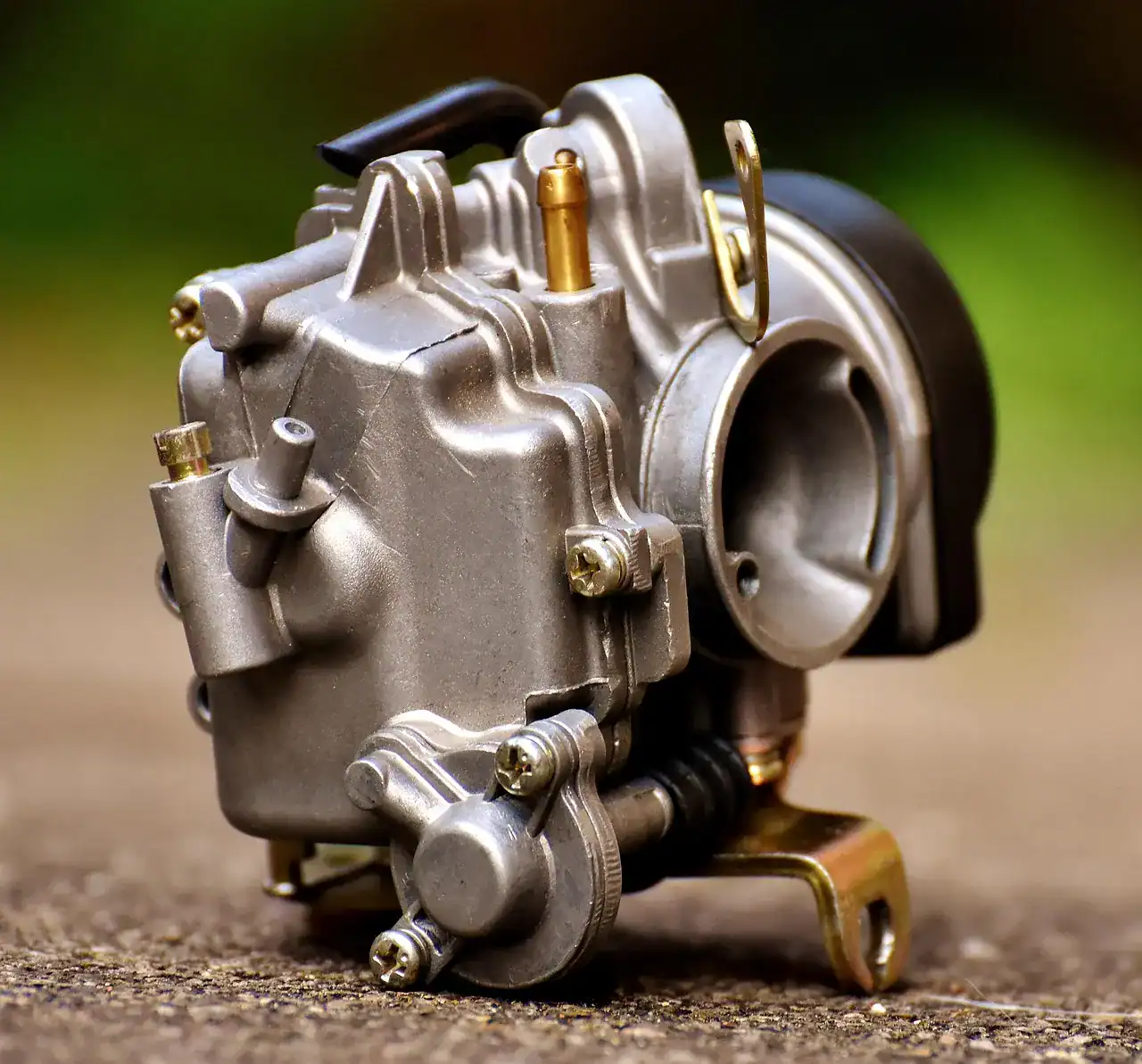
A quad that fires only with the choke, or that sputters at low rpm but pulls cleanly at higher rpm, usually has a gummed carburetor. Fuel left in the bowl varnishes the passages that meter idle fuel.
Kawasaki's fuel system check gives a free first test. Turn the fuel tap off, run the overflow hose into a container, then loosen the carburetor drain plug a few turns and see whether water or dirt comes out. If it does, the manual says to clean the carburetor, tank and fuel hose.
- Replace old fuel and check the battery terminals.
- Pull the plug: it should be NGK DPR8EA-9 gapped 0.8 to 0.9 mm.
- Drain the carburetor as above and look for water or dirt.
- Clean the pilot circuit and check the intake boot for cracks.
- Set idle to 1,300 rpm plus or minus 50 once it runs.
If it still sputters, go to the valves: a clearance out of spec produces the same weak low-rpm running.
2. Valve clearance out of spec
Kawasaki lists valve clearance inspection in its maintenance chart because it drifts with use. Tight valves cause hard starts and burned valves; loose ones tick and lose power.
Measure with the engine cold. The specs are 0.08 to 0.13 mm for the inlet and 0.15 to 0.20 mm for the exhaust. Kawasaki also lists a special adjusting screw holder tool, so a dealer is a fair choice if you do not have it.
3. Drive belt wear and the BELT light
The Prairie 360 has a belt converter and a drive belt failure detection system. Kawasaki's chart calls for inspection every 90 days or 1,100 miles, or when the BELT indicator light comes on at about 100 hours of use.
Kawasaki warns that neglecting the belt can lock the transmission and wheels. Treat a BELT light as an order to inspect, not something to ignore.
- Remove the torque converter cover.
- Measure belt width at several points. Replace it below 28.0 mm (A3 and later).
- Check for cracks, breaks and peeling, and inspect both pulleys whenever the belt is changed.
- Check deflection: 22 to 27 mm with a push of no more than 59 N. Adjust with spacers.
- If the detection system tripped, Kawasaki says the detection switch is damaged and the converter cover must be replaced.
Kawasaki notes that less deflection keeps performance longer as the belt wears. Replace the driven pulley nut when you disturb it, and torque it to 93 N-m (69 ft-lb) with the holder tool.
4. Overheating on an air-cooled, oil-cooled engine
Because the engine has no radiator, heat is carried by the oil and the oil cooler. Kawasaki's chart lists oil cooler cleaning and the oil cooler fan switch. That makes the checks simple:
- Check the oil level and use SAE 10W-40 with JASO MA.
- Clean mud and debris from the oil cooler fins, and clean it more often when you ride in mud or dust.
- Confirm the fan switch connector is clean and tight; its mounting torque is 16 N-m (12 ft-lb).
- Check the belt, since a slipping belt makes heat too.
We could not open a Kawasaki figure for the fan switch's turn-on temperature, so we do not list one. Heavy slow work in hot weather also raises oil temperature; give it a rest and let it idle.
5. Weak battery and charging problems
Kawasaki lists battery inspection in the chart. A quad that dies after sitting, or lights that dim at idle, usually has corroded terminals or a tired battery. Clean the terminals, charge the battery, and test it.
With the engine running, the voltage at the battery should read higher than with it off. If it does not rise, the charging circuit needs testing with the service manual wiring tests.
6. 4WD and the variable front differential
Kawasaki's manual lists a variable differential control lever and cable, with a play inspection and a position inspection in the maintenance chart, plus a 2WD/4WD actuator with specified mounting bolts (9.8 N-m, 87 in-lb).
Check the lever and cable first: look for stretched or dry cable, a loose locknut (17 N-m, 12 ft-lb) and incorrect lever position. Then look at the actuator's wiring and mounting before replacing it.
7. Steering wander and the 2001-2005 recall
The CPSC recall announced on 2005-08-02 covers 2001-2005 Prairie and Brute Force ATVs, including the Prairie 360 and 360 4x4. A significant impact to a front wheel with the steering fully turned can damage the suspension and eventually cause a loss of steering control (CPSC notice).
Ask a Kawasaki dealer to check your serial number, and inspect the front suspension if the quad was ever hit hard on a turn.
8. Shaft drive noise and gear case oil
The Prairie has front and rear final gear cases with different oil. The front takes 430 mL of 10W-40, the rear takes 900 mL of a specified fluid such as Mobil Fluid 424. Mixing them up is a common mistake after an oil change.
Check the level at the filler opening and look for seepage at the boots. Kawasaki also lists joint boot inspection, because a torn boot lets dirt into the shaft.
Buying a used Prairie 360
- Cold start it: it should fire and idle without choke fuss.
- Ride it for BELT light, belt slip and a smooth 4WD lever.
- Look for mud packed in the oil cooler and signs of leaks at the gear cases.
- Check the serial number against the 2005 CPSC recall.
If you are choosing between quads, see our guide to the most reliable 4x4 ATVs. Other Kawasaki and utility quad guides include the Brute Force 750 and the Honda Rincon 680.
For an older carbureted Kawasaki that will not start or runs rough when warm, our Bayou 300 problems guide covers the carburetor checks.
Our off-road calculators cover tire size and gearing if you change wheels.
FAQ
Is the Kawasaki Prairie 360 air-cooled or liquid-cooled?
Air-cooled, according to Kawasaki's service manual, with an oil cooler and fan switch.
What does the BELT light mean on a Prairie 360?
It signals a drive belt service reminder at about 100 hours or when the belt failure detection system trips. Inspect the belt.
What spark plug does a Prairie 360 use?
NGK DPR8EA-9, gapped to 0.8 to 0.9 mm.
Sources
- Kawasaki KVF360 service manual, 2003-2013 (sample pages)
- Kawasaki KVF360B service manual, 2003-2009 (sample pages)
- CPSC: Kawasaki recall of 2001-2005 Prairie and Brute Force ATVs

I'm Suryashankar Dasgupta, the founder of Off-Road Handbook. I've been off-roading for years in the USA, including California and Texas, and have ridden mountain and desert terrain abroad. I've also driven a Jeep Compass for more than seven years, so I know the day-to-day side of Jeep ownership first-hand, from the Uconnect screen to the warning lights. Every guide here is researched from manufacturer owner's manuals, NHTSA recall and service-bulletin records and other trusted sources, checked against them before it is published, and corrected when we find a mistake. You can read how we work in our editorial policy: https://offroadhandbook.com/editorial-policy/
Like our off-road guides? Add Off-Road Handbook as a Google Preferred Source so our latest Jeep, ATV, UTV, trail, recovery, and off-road troubleshooting articles can appear more often in your Google Search experience.
Add us as a Preferred Source