Suzuki King Quad 400 Problems: 6 Common Issues and Fixes
Last updated on October 17th, 2026 at 09:36 pm
This post contains Amazon affiliate links. As an Amazon Associate I earn from qualifying purchases, at no extra cost to you.
Most Suzuki King Quad 400 trouble comes down to a weak battery, fuel delivery, a dirty throttle body, heat, a wet CVT belt or a fault the ECM flags. A steady FI light means limp-home mode, and a blinking one means the engine will not run.
The checks below run free first, with numbers from Suzuki’s own service data.
The figures come from Suzuki’s supplementary service manual for the 2010 LT-A400/F and LT-F400/F and the 2024 KingQuad 400ASi spec sheet. Fuel injection arrived with the 2010 model year, and the 2008 machines were carbureted (atv.com’s 2008 test), so skip the injection and FI-light steps if yours has a carburetor.
Symptom, cause and fix at a glance
| What you see | Check first (free) | Likely cause | Next step |
|---|---|---|---|
| Clicks or cranks slowly | Battery charge, terminals, ground | Weak battery or poor connection | Charge and clean; a shop checks the starter and relay |
| Cranks but will not start | Fuel pump hum with the key on, 15 A fuel fuse | Pump relay, tip-over sensor, fouled plug, bad fuel | Check plug and pump circuit; pressure test is a shop job |
| FI light blinking | Engine stop switch, battery | ECM lost a crank, tip-over, ignition, injector or pump signal | Dealer reads the code |
| FI light steady, still runs | Air filter, intake joint | Sensor fault, ECM in fail-safe mode | Get the code read |
| Rough idle, stalls, weak power | Foam air filter, throttle body | Dirt, intake air leak, TP sensor out of adjustment | Clean; check idle is 1,500 rpm |
| Runs hot or oil temp light on | Oil level, mud on cooler and fins | Low or wrong oil, fan not running | Check fan relay (code 60) |
| Slips or loses drive (ASi) | Water in the belt cover | Wet or worn drive belt | Drain the cover; dealer for belt and clutch |
Start at the top row that matches. If two rows fit, do the battery first, because low voltage upsets a fuel-injected engine and lights warnings that are not real faults.
Suzuki’s symptom tables list dozens of possible causes for each complaint. The order here puts the cheap, no-tool checks ahead of anything that needs a meter or a dealer.
Check in this order
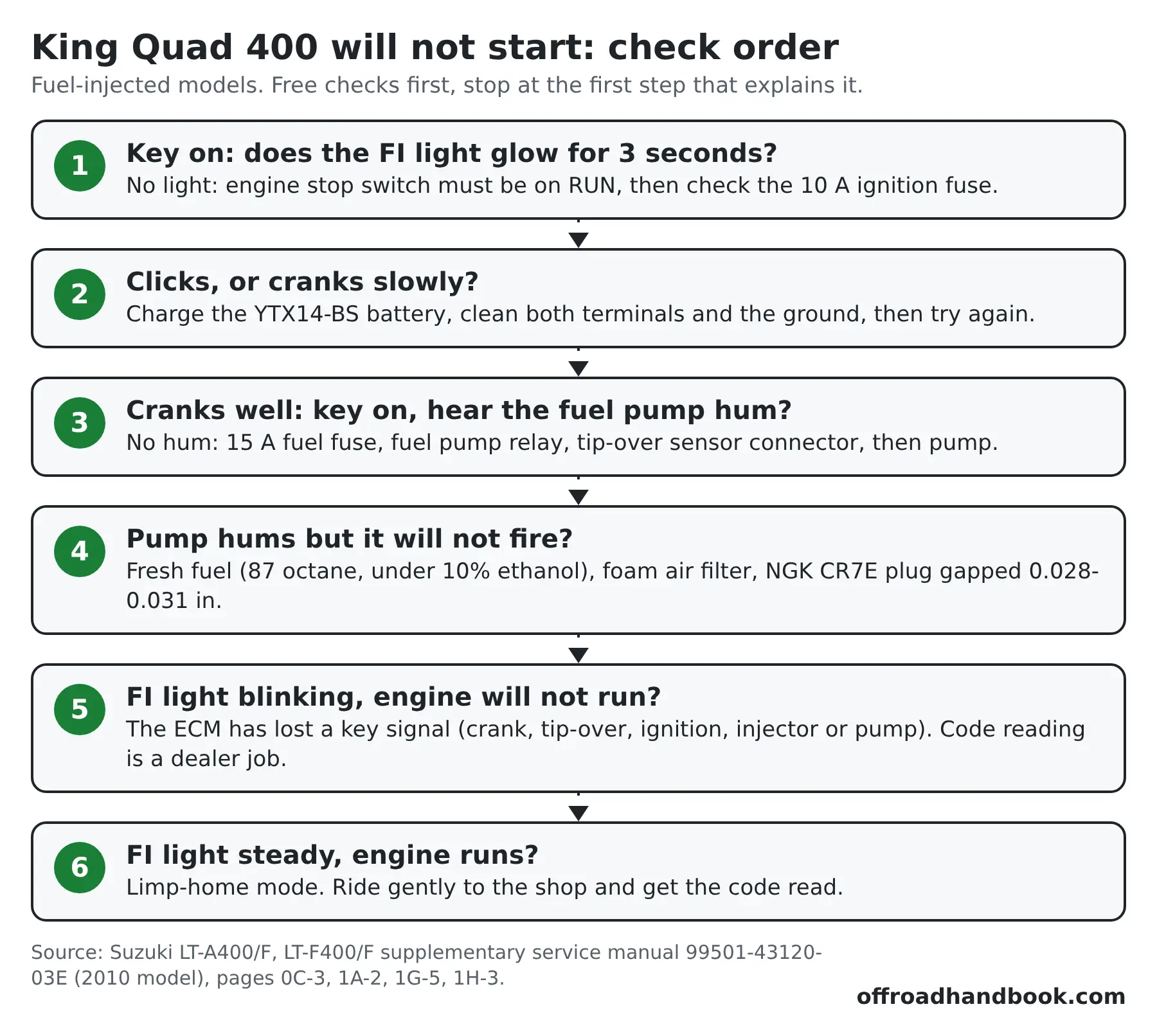
Work from the top and stop at the first step that explains the problem. Steps 1 to 4 need nothing but a fresh battery charge, a plug wrench and your ears.
Steps 5 and 6 are about the FI light. A blinking light means the ECM has stopped injection because a key signal is missing, and Suzuki says the vehicle cannot run.
King Quad 400 FI light and fault code checker
The checker only repeats Suzuki’s service data and the steps on this page. It cannot read codes from your ATV, and pulling a code needs a dealer-mode tool.
Use it to decide what to try before you call the shop. If the light is blinking or the oil temperature light is on, stop riding first.
1. Will not start, or starts and dies

A fuel-injected engine needs good voltage and a working pump circuit before it will run. Suzuki lists a clogged fuel filter, a weak pump or regulator, a bad injector and low battery voltage among the causes of frequent stalling.
- Turn the key on. The FI light should glow for 3 seconds. No light means the engine stop switch is off or the 10 A ignition fuse is blown.
- Charge the battery and clean both terminals. Suzuki specifies the YTX14-BS, 12 volts and 12 amp-hours, and warns against anything else.
- Check the 15 A fuel fuse. A fuse that blows again points to a short, so find it instead of fitting a bigger fuse.
- With the key on, listen for the fuel pump to run for a few seconds. If it is silent, check its connections, the fuel pump relay and the tip-over sensor.
- Pull the spark plug. Suzuki specifies an NGK CR7E or DENSO U22ESR-N with a gap of 0.028 to 0.031 in, torqued to 8 lbf-ft. Clean and dry a wet plug or replace it.
- Still nothing? Suzuki’s fuel pressure spec is about 42 psi and pump flow is 84 ml or more in 10 seconds. Both tests need special tools, so that is shop work.
A new plug is cheap, for example an NGK CR7E spark plug, and a 12-volt battery maintainer keeps the battery healthy between rides. Match the plug and battery to the numbers above.
2. FI light on or blinking
When you turn the key on, the FI light glows for 3 seconds and goes out. Suzuki says a steady light means the ECM has switched to fail-safe and the machine can still run, while a blinking light means injection has stopped and it cannot.
Codes are read in dealer mode with Suzuki’s mode select switch (tool 09930-82720) or the SDS tool, and they are stored in the ECM. Do not unplug the ECM coupler before the code is read, because that erases them.
| Code | P-code | Part | What Suzuki tests |
|---|---|---|---|
| 12 | P0335 | Crankshaft position sensor | 130 to 250 ohms; 4.0 V or more peak while cranking |
| 13 | P0105 | Intake air pressure sensor | About 2.0 V at idle; check the vacuum passage |
| 14 | P0120 | Throttle position sensor | About 0.6 V closed, 3.8 V open |
| 15 | P0115 | Engine oil temperature sensor | About 13 kilohms at 68 F |
| 21 | P0110 | Intake air temperature sensor | About 2.45 kilohms at 68 F |
| 23 | P1651 | Tip-over sensor | 15 to 25 kilohms |
| 24 | P0351 | Ignition coil circuit | Primary 3.1 to 4.14 ohms; secondary 25.6 to 34.6 kilohms |
| 32 | P0201 | Fuel injector circuit | 10 to 11 ohms at 72.5 F |
| 41 | P0230 | Fuel pump circuit | Fuel pump relay and wiring |
| 60 | P0480 | Cooling fan control | Cooling fan relay and wiring |
Four sensors have a fail-safe value: intake air pressure is fixed at 101 kPa, the throttle is treated as wide open, oil temperature as 176 F and intake air temperature as 104 F. That is why a bad sensor can leave the engine running but poorly.
Searching for “P0230” on a King Quad 400? It is code 41, the fuel pump circuit. Suzuki’s steps start with the fuel pump relay and its coupler.
3. Rough idle, stalling or weak power

Suzuki’s maintenance chart has the foam air cleaner element cleaned every 600 miles or 3 months, and the throttle body inspected for dirt or mud on the same interval. Both are free to check.
- Clean the foam air filter and look at the intake boots and throttle body joint. Suzuki lists air drawn in at that joint as a cause of overheating and weak power.
- Inspect the throttle body for dirt or mud and clean it.
- Check idle with a tachometer. Spec is 1,500 rpm, plus or minus 100, set with the idle air screw, which sits ½ to 3 turns back. Throttle cable play is 0.12 to 0.20 in.
- Use fresh fuel: unleaded, at least 87 octane, with less than 10% ethanol. Suzuki has the fuel line inspected every 600 miles and replaced every 4 years.
- If it still hesitates, the fuel filters in the fuel cock can be blown clean with compressed air, and Suzuki lists a throttle position sensor out of adjustment as a cause. Both involve pulling the tank or special tools.
The injectors, pump and sensors are shop work. Suzuki’s symptom table for frequent stalling lists a faulty IAP sensor, a clogged pump filter, the pump, the pressure regulator and the temperature sensors.
4. Running hot or oil temperature light on
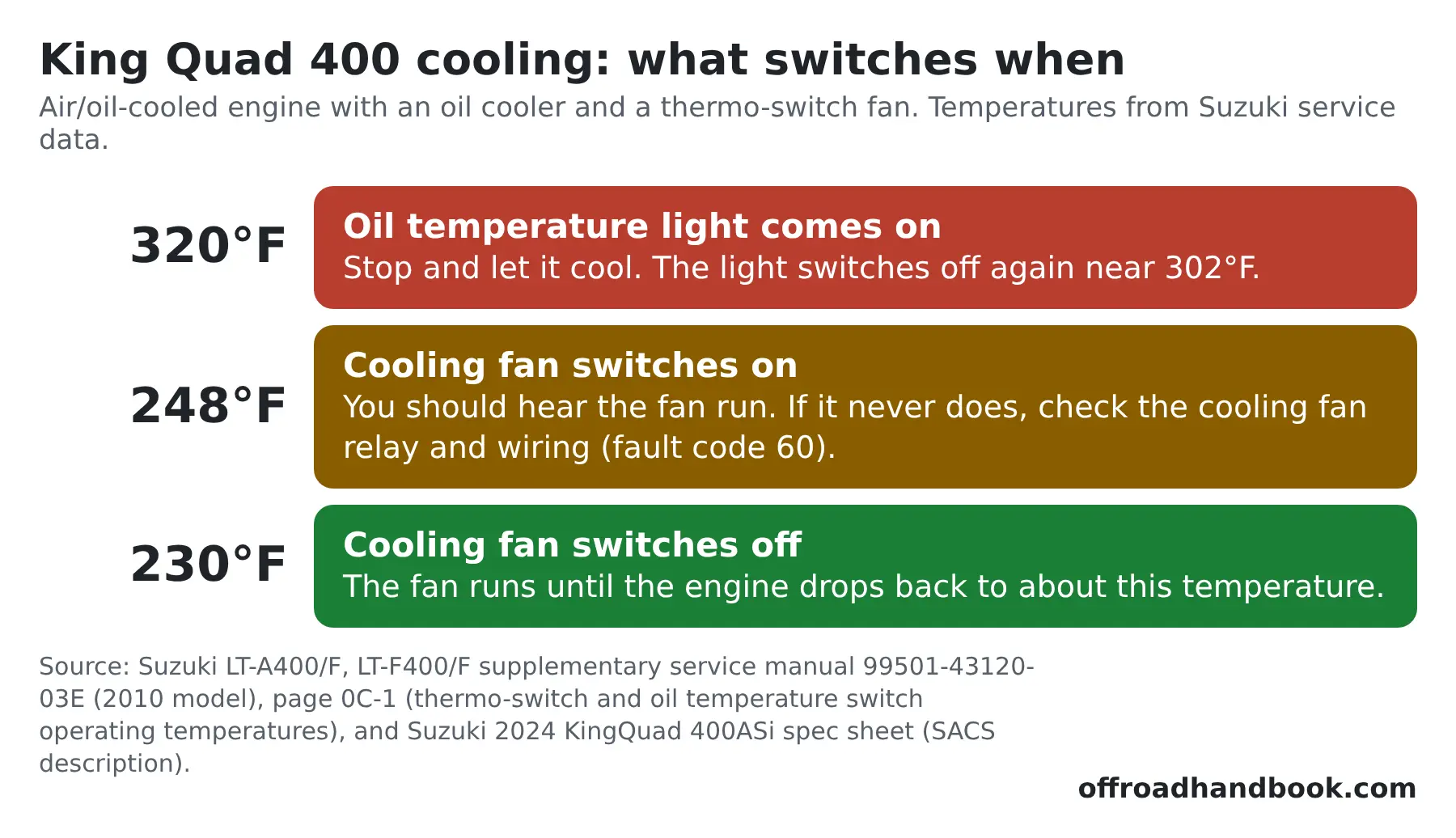
The King Quad 400 is air and oil cooled. Suzuki’s system, SACS, uses an oil cooler and a thermostat-controlled cooling fan, so there is no radiator or coolant to check.
Suzuki’s overheating list includes not enough oil, the wrong oil, heavy carbon build-up and air leaks that lean out the mixture. Check the oil level first. Suzuki specifies SAE 10W-40 with JASO MA, and 3.0 quarts for a change or 3.3 with the filter.
- Stop and let the engine cool when the oil temperature light comes on. The light switches on at about 320 F.
- Check the oil level and look at the cooler and fins. Packed mud blocks the airflow they rely on.
- Listen for the fan as the engine gets hot. It switches on near 248 F and off near 230 F.
- No fan means the cooling fan relay or its wiring. Code 60 points there, and the relay is tested the same way as the fuel pump relay.
Long, slow work in mud or heat is hardest on any air-cooled engine. Give it breaks, and wash the cooler once the engine is cold.
5. Slipping or wet drive belt

The automatic ASi uses a V-belt CVT. Dirt Wheels notes that most Suzuki 400 belts never fail, but any CVT can overheat if the machine gets stuck in a deep mud hole (Dirt Wheels test).
Suzuki’s chart inspects the drive belt every 600 miles or 3 months on the ASi, and the clutch every 1,200 miles on the manual FSi. The owner’s manual also has a section on draining the V-belt cover (contents listed here).
- After water crossings, drain the V-belt cover using the steps in your owner’s manual.
- Use low range for slow, heavy work. Suzuki builds the high and low sub-transmission for traction and fuel efficiency.
- If the belt slips after it is dry, get it inspected. Belt and clutch work is beyond the Suzuki pages used here, so it is a dealer or service-manual job.
The FSi has a five-speed manual gearbox with a centrifugal clutch, so it has no drive belt to burn up. Dirt Wheels says that is one reason it prefers the manual version.
6. Weak battery, slow crank or dead after sitting
Suzuki’s charging specs give you real numbers to test. You need a multimeter, for example a basic digital multimeter.
- Charge the battery fully. It is a YTX14-BS, 12 volts and 12 amp-hours.
- Check for a drain: with the key off, put a meter in series on the negative lead. Suzuki’s limit is under 1.0 mA.
- Check charging: run the engine at about 5,000 rpm with the lights on high beam. Battery voltage should be 13.5 to 15.0 V.
- Low charging voltage sends you to the generator and regulator. Generator coil resistance is 0.7 to 1.6 ohms, and no-load output is 125 V AC or more at 5,000 rpm when cold.
- A slow crank on a good battery points to the starter. Brushes are 12.0 mm new and 6.5 mm is the wear limit.
Everything past the first two steps is for someone comfortable with a meter. Disconnect the negative lead first when you work on the battery.
Recalls and safety notices
The CPSC recall database lists several Suzuki KingQuad recalls, but none names the 400. Searching by product name on October 17, 2026 found these, which owners often mix up with the 400.
| Recall | Date | Models | Problem | 400 included? |
|---|---|---|---|---|
| 05555 | Mar 2005 | 2005 LT-A700X KingQuad, Vinson 500 | Throttle lever case can freeze | No |
| 06566 | Jul 2006 | 2006 Eiger LT-A400K6, LT-A400FK6, LT-F400FK6 | Missing welds on suspension arm brackets | Eiger only |
| 11727 | Mar 2011 | 2008-2010 LT-A450X, 2009-2010 LT-A500X, 2008-2010 LT-A750X, some 2011 | Plastic fuel tank leak | No |
| 17721 | Dec 2016 | 2016-2017 LT-A750X, LT-A750XP | Battery can fail and stall the engine | No |
The 2006 Eiger recall matters only if you have a pre-2008 Eiger, which our Suzuki Eiger 400 problems guide covers. A dealer can still check your VIN against open campaigns.
For the larger sibling, see our King Quad 500 problems guide. For the general ATV checks, our ATV and UTV troubleshooting guide covers bogging, no-start, heat and belts.
King Quad 400 service numbers
| Item | Spec |
|---|---|
| Engine oil | SAE 10W-40, API SF/SG or SH/SJ with JASO MA; 3.0 qt change, 3.3 qt with filter; drain plug 16.5 lbf-ft |
| Spark plug | NGK CR7E or DENSO U22ESR-N; gap 0.028 to 0.031 in; replace every 4,000 miles |
| Idle speed | 1,500 rpm, plus or minus 100 |
| Fuel | Unleaded, 87 octane minimum, under 10% ethanol; 4.2 gal tank |
| Front differential oil | Hypoid gear oil SAE 90, API GL-5; 300 ml (10.1 oz); replace every 2 years |
| Final gear oil | Hypoid gear oil SAE 90, API GL-5; 350 ml (11.8 oz); replace every 2 years |
| Fuses | Main 30 A; fuel 15 A; five 10 A |
| Brakes | Fluid replaced every 2 years, hoses every 4 years |
| Wheel nuts | 43.5 lbf-ft front and rear |
| Tires | AT25x8-12 front, AT25x10-12 rear |
These come from the 2010 supplement and the 2024 sheet. Your owner’s manual wins if a number differs for your model year.
Adding a winch? Suzuki lists winch-ready mounts on the 400ASi, and our winch size calculator works out the pull rating. More free tools are on our off-road calculators page.
FAQ
Suzuki’s 2010 service data and 2024 spec sheet describe fuel injection, while 2008 models used a carburetor. A fuel-injected machine has an FI light on the meter.
No. It is air and oil cooled, with an oil cooler and a thermostat-controlled fan, so there is no radiator or coolant.
The ECM is not getting a crank, tip-over, ignition, injector, fuel pump or ignition switch signal, so the engine will not run. A dealer reads the code.
Suzuki lists an NGK CR7E or DENSO U22ESR-N with a 0.028 to 0.031 in gap.
The CPSC database has no recall naming the KingQuad 400. Recalls cover the 450, 500, 700 and 750, plus the older Eiger 400. A dealer can check your VIN.

I'm Suryashankar Dasgupta, the founder of Off-Road Handbook. I've been off-roading for years in the USA, including California and Texas, and have ridden mountain and desert terrain abroad. I've also driven a Jeep Compass for more than seven years, so I know the day-to-day side of Jeep ownership first-hand, from the Uconnect screen to the warning lights. Every guide here is researched from manufacturer owner's manuals, NHTSA recall and service-bulletin records and other trusted sources, checked against them before it is published, and corrected when we find a mistake. You can read how we work in our editorial policy: https://offroadhandbook.com/editorial-policy/
Like our off-road guides? Add Off-Road Handbook as a Google Preferred Source so our latest Jeep, ATV, UTV, trail, recovery, and off-road troubleshooting articles can appear more often in your Google Search experience.
Add us as a Preferred Source