Jeep Wrangler Leaking Water Underneath? Causes and Fixes
Last updated on October 26th, 2026 at 08:14 pm
Clear, odorless water dripping behind the front passenger side after you run the A/C is normal condensation. Water that is colored, slick or sweet-smelling is not condensation. Treat it as coolant until you prove otherwise. Water inside the cabin comes from seals, drains or the top, and Jeep's own leak manual says it does not always land where it got in.
Is it water, coolant or something else?
Slide a piece of white cardboard under the drip overnight, then check the color, the feel and the location. Never taste or sniff-test a fluid to identify it. Jeep's owner's manual warns that ethylene glycol coolant is poisonous if swallowed and says to clean up puddles right away so animals and children cannot reach them (2023 Wrangler (JL) owner's manual).
The table runs from the most common, harmless cause down to the ones that mean you should stop driving.
| What you see | Likely cause | What to do | Stop driving? |
|---|---|---|---|
| Clear, thin, no smell; small puddle behind the front passenger side; A/C running | A/C condensation from the evaporator drain | Nothing to fix. Confirm the coolant level holds steady. | No |
| Green, orange, pink or yellow; slick; sweet smell; near the front or radiator | Engine coolant | Check level with the engine cold, then look at hoses, radiator, bottle and water pump. Pressure test at a shop. | Yes if the temp gauge climbs or steam shows |
| Passenger footwell wet, sweet smell, windows fog | Coolant from the heater core (inside the dash) | Shop job. Do not rely on stop-leak additives. | Soon |
| Passenger footwell wet after A/C use, dry after rain | Plugged A/C drain or blocked air-intake and cowl drains | Clear leaves from the air intake and cowl, then check the A/C drain. | No |
| Interior wet after rain or a wash | Seals, top, door fit or body leak path | Water test the vehicle top-down; see below. | No |
| Carpet wet only when you open a door in the rain | Roof runoff, a known trait of the removable-top design | Wipe the carpet. Jeep's leak manual says this cannot be fixed. | No |
| Thin blue or glass-cleaner smell near the front bumper | Washer fluid | Check reservoir, hose and pump. | No |
| Red or brown, oily, any smell of fuel | Oil, transmission, steering or fuel | Fuel or suspected brake fluid: fix immediately per Jeep's manual. Others: dealer or shop. | Yes for fuel or brake fluid |
Color helps, but it does not settle it. Old or diluted coolant can look nearly clear, so a clear drip that shows up without A/C use, or a coolant level that keeps falling, still deserves a closer look.
Location helps too. Condensation lands near the passenger side firewall, while coolant pools toward the front under the radiator and engine.
Flowchart: which leak do you have?
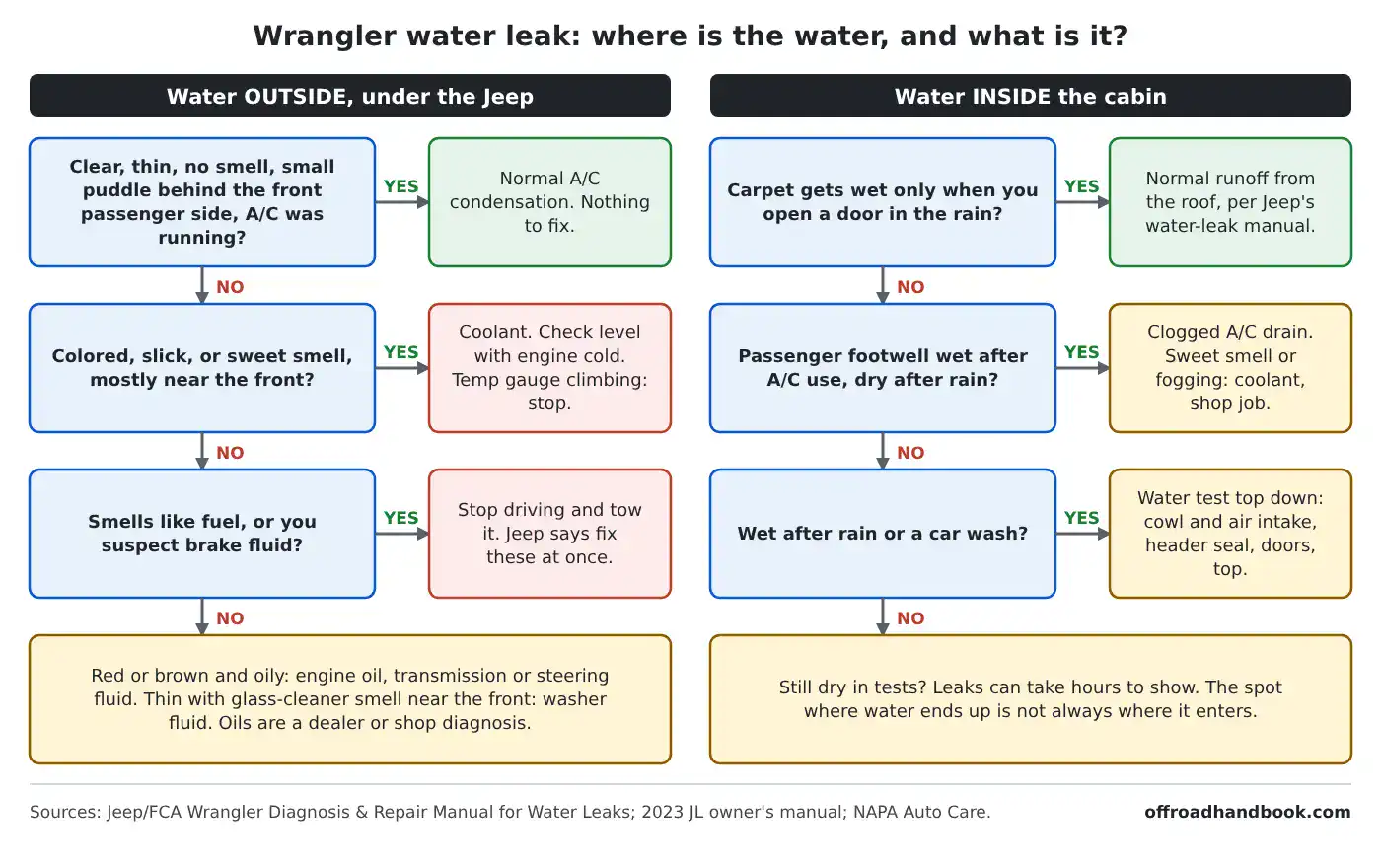
Start at the top of the column that matches where you found the water. Free checks come first, and anything involving fuel, brakes or an overheating engine ends the flowchart with a stop sign.
Every box in the chart is explained in the sections below, with the sources.
What is your Wrangler doing?
Pick where the water shows up and tick anything that applies. The checker lists what to check in order, free checks first and dealer-only items last.
Based on the tables and sections in this post: Jeep's water-leak manual, the 2023 JL owner's manual, FCA bulletins and NAPA Auto Care. It cannot diagnose a fault; it only sets the order of checks.
It does not replace a look under the Jeep. It keeps you from paying for a part before you have ruled out the free causes.
A/C condensation: normal until it is not
The A/C pulls moisture out of the cabin air and drains it through a tube under the vehicle. Normal condensation drips from the passenger side of the engine compartment near the firewall, and bigger puddles are expected on hot, humid days (NAPA Auto Care).
The water should be clear, odorless and feel like plain water. If it has color, feels oily or smells sweet, burnt or chemical, it is another fluid.
If the passenger carpet is damp after running the A/C, the drain is probably plugged or has come off its fitting, so the water backs up into the cabin. Damp carpet, a musty smell or wet mats after A/C use are the signs.
Look at the intake first: Jeep notes that leaves collected in the air intake in front of the windshield can reach the plenum and plug the water drains (2023 Wrangler (JL) owner's manual).
Coolant leak: the one that can wreck the engine
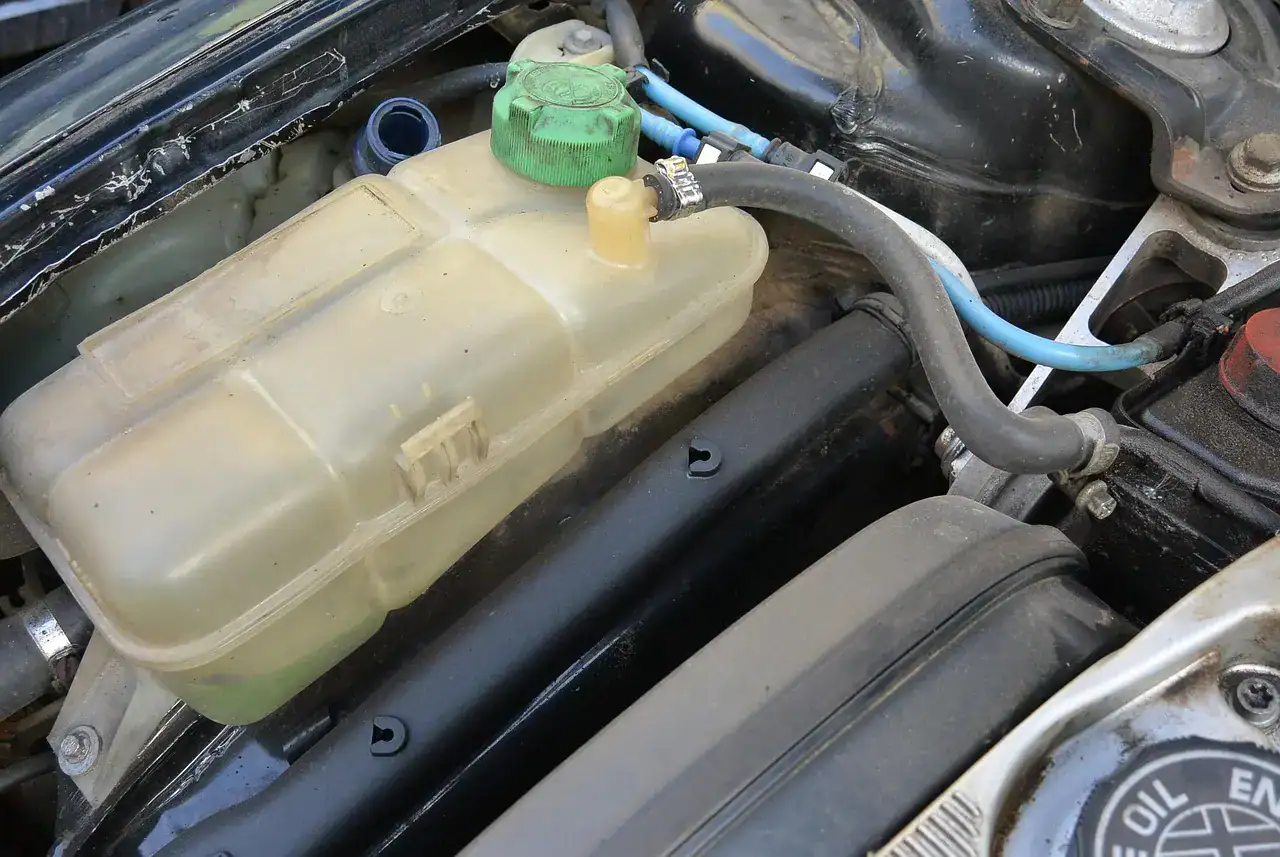
A coolant drip sits at the front of the engine, under the radiator or near the water pump, and leaves a slick, sweet-smelling puddle. Jeep's manual says to check under the vehicle after overnight parking for fluid leaks, and never to open the pressure cap while the radiator or bottle is hot (2023 Wrangler (JL) owner's manual).
If the temperature gauge climbs or you see steam, stop, shut the engine off and let it cool. Driving a Wrangler that is losing coolant is how a small hose leak turns into a head gasket job.
Check in this order
- Wipe a drip onto white paper and note the color, feel and smell.
- With the engine cold, check the coolant level in the overflow bottle and note it. Check again after a few days; a level that keeps falling means a real leak.
- Look for wet spots or crusty residue on the radiator seams, hoses, bottle seam, water pump and thermostat housing.
- Match your year and engine to the bulletins in the table below. These are dealer repairs, so ask about your VIN.
- Have a shop pressure test the system. It finds leaks you cannot see, and it is how Jeep's own bulletins confirm them.
Use the coolant your manual specifies. The 2023 JL manual calls for OAT coolant meeting MS.90032 mixed at a minimum of 50 percent with distilled water, and warns against mixing coolant types.
Known Wrangler coolant leaks by model year
| Vehicle | Problem | What the dealer does | Source |
|---|---|---|---|
| 2018-2021 JL, 2.0L turbo (including eTorque and PHEV engine codes) | Coolant leak or low level from the water pump inlet tube | Dealer pressure tests, then re-torques two fasteners to 11 N·m (97 in-lb) with medium-strength thread locker. Bulletin shows 0.6 hours. | TSB 07-001-22 Rev. A |
| 2022-2023 JL, 6.4L V8, built Aug 1 to Nov 7 2022 | Weak seam in the coolant overflow bottle | Dealer inspects (0.2 hours) and replaces the bottle if it leaks (0.5 hours). | TSB 07-004-23 |
| 2020-2022 JL, 3.0L diesel | Not coolant: the high-pressure fuel pump can fail and cause a fuel leak, abnormal noise or a warning light | Free remedy at a dealer. If a drip smells like diesel, do not drive. | recall 22V-767 |
Bulletins and recalls apply only to certain builds, so do not assume your Jeep is covered. Ask any Jeep dealer to run your VIN, or look it up on NHTSA's recall page, before you pay for a coolant repair.
Most Wrangler coolant leaks are ordinary wear: a hose, a clamp, the radiator or the water pump. The bulletins above are the exceptions that are free to fix.
Water inside the cabin
Jeep's own leak manual makes one point first: where the leak ends up does not always explain where it starts. Water that wets the passenger floor can come from the cowl, a rear wheel flare or a seal far from the carpet (Jeep/FCA Wrangler Diagnosis and Repair Manual for Water Leaks).
The same manual lists a normal condition that nothing can fix. When a door is open, water runs off the roof and can soak the carpet, which it likens to a convertible. If that is your only symptom, wipe it up and move on.
Cowl, air intake and drains
Clear the air intake in front of the windshield and the cowl area of leaves. Jeep's owner's manual warns that leaves that reach the plenum can plug the water drains (2023 Wrangler (JL) owner's manual). A hose poured into the cowl area is also how Jeep's manual tests for wet front carpet.
Doors, tops and seals
- Top and panels: Jeep says the seals and hard top panels must be clear of dust and debris before reinstalling, and the panels must be positioned properly to seal. Improper installation causes water to leak in (2023 Wrangler (JL) owner's manual).
- Wet top: Opening a door or lowering a window while the top is wet lets water drip into the interior. Jeep recommends the top be free of water before you open it.
- Storage: Careless handling and storage of removable roof panels, half-doors or door frames can damage seals and cause leaks.
- Door fit (JK): The leak manual's gap spec is 5.0 mm plus or minus 2.0 mm, with flushness 0.0 mm plus or minus 2.0 mm. If doors are adjusted, Jeep says the door primary seal must be replaced.
- Header and mucket seals: A header seal that is not bonded, a rolled-under mucket or missing foam on the panel or soft top rail are listed leak causes, so look before you buy a new top.
For soft top leaks in particular, see our guide on why a Jeep soft top leaks.
Older JK specifics
The FCA manual lists build-date fixes for wet front carpet on the JK. Rear wheel flare holes need a tape patch on vehicles built before 5/28/08 (hole 1) and 5/01/09 (hole 2), and foam over hole 3 on vehicles built before 7/22/08. Windshield header butyl applies to builds before 6/1/2008. Check the build date on the door jamb label.
How to find a water leak
Jeep's manual gives the method technicians use, and it differs from what most guides say. A car wash is the preferred test. If you use a hose, put it on top of the vehicle facing forward so water reaches all areas, and do not spray directly at the suspect spot because that can create a false leak (FCA water-leak manual).
- Dry the interior completely, pull the floor mats and check that the latches are engaged and no top seal is puckered or distorted.
- Run the vehicle through a car wash, or hose the top from the front, and have a helper watch inside with a flashlight.
- Mark where water first appears. It often travels along a seam or wire before it drips.
- If a door seal is the suspect, shine a flashlight around the seal from inside while a helper checks outside for light passing the seal. Jeep's owner's manual describes the same test for half-doors.
- Repair one area, then water test again before the next. Jeep says a leak you cannot reproduce may need hours of wet conditions to show.
After deep water, check the cooling and drivetrain too. Our guide to Jeep problems after mud or water covers that, and the water fording depth guide covers how deep is too deep.
Other fluids that look like water
- Washer fluid: A cracked reservoir, loose hose or failed pump. Thin, often blue, with a glass-cleaner smell.
- Brake fluid or fuel: Jeep's manual says that if you suspect a fuel or brake fluid leak, the cause should be located and corrected immediately. Do not drive it.
- Oil, transmission or steering fluid: Oily, red to brown. These need a dealer or shop diagnosis and are not worth guessing at.
- Exhaust drip: A little water from the tailpipe on a cold start is normal. Heavy white smoke with a sweet smell points to coolant burning, so see our Wrangler antifreeze smell guide and our Jeep overheating guide.
Cost and when to stop DIY
| Repair | Who | Cost class |
|---|---|---|
| Clear the air intake, cowl and A/C drain | You | Free to low |
| Re-seat a top, panels or half-doors and clean the seals | You | Free |
| Door adjustment and primary seal, header seal, hard top seal, mucket and foam | You or a body shop | Low to moderate for parts; bonding the seals takes care |
| Washer reservoir, hose or pump | You | Low |
| Coolant hose, radiator, bottle or water pump | Shop or dealer, pressure test first | Moderate to high |
| Dealer bulletin or recall items in the table above | Dealer | Free under the bulletin or recall terms |
| Heater core | Shop | High, because the dash comes apart |
| Fuel, brake fluid or transmission leaks | Dealer or shop | Tow it |
Get a written estimate for anything in the cooling system, and ask the dealer to check your VIN for open bulletins and recalls before you pay.
FAQs
If it is clear, odorless and appears after running the A/C, it is normal condensation. If it is colored, slick or sweet-smelling, treat it as coolant and check the level with the engine cold.
Some water getting in is a known trait of removable tops and doors. Jeep's own leak manual says water running off the roof when a door is open soaking the carpet is normal and cannot be fixed, but leaks with the doors closed are worth finding.
A/C water is clear, odorless and feels like plain water, and it drips near the passenger side of the firewall. Coolant is colored, slick and sweet-smelling. Do not taste it.
Not if the temperature gauge climbs or the level keeps falling. Pull over, let the engine cool and have it checked before driving on.
Common causes are plugged air-intake and cowl drains, a plugged A/C drain, worn door or top seals, a top that is not seated, or on older JKs, unsealed rear wheel flare holes. A sweet smell with fogging windows points to the heater core.
Related guides
- Why Does My Jeep Soft Top Leak? Common Causes and How to Fix It
- Why Does My Jeep Wrangler Smell Like Antifreeze? Causes, Fixes
- Why Is My Jeep Overheating? Common Causes and Fixes to Try
- Free off-road calculators

I'm Suryashankar Dasgupta, the founder of Off-Road Handbook. I've been off-roading for years in the USA, including California and Texas, and have ridden mountain and desert terrain abroad. I've also driven a Jeep Compass for more than seven years, so I know the day-to-day side of Jeep ownership first-hand, from the Uconnect screen to the warning lights. Every guide here is researched from manufacturer owner's manuals, NHTSA recall and service-bulletin records and other trusted sources, checked against them before it is published, and corrected when we find a mistake. You can read how we work in our editorial policy: https://offroadhandbook.com/editorial-policy/
Like our off-road guides? Add Off-Road Handbook as a Google Preferred Source so our latest Jeep, ATV, UTV, trail, recovery, and off-road troubleshooting articles can appear more often in your Google Search experience.
Add us as a Preferred Source