Kawasaki KRX 1000 Problems: Overheating, CVT and Fixes
Last updated on October 26th, 2026 at 08:04 pm
The Kawasaki Teryx KRX 1000 problems owners run into most are heat (a packed radiator, low coolant or a fan that never comes on), the CVT belt and clutches, a soft brake pedal and electrical gremlins. Start with whichever warning lamp is lit: Kawasaki’s spec sheets list both a water temperature lamp and a CVT belt warning lamp, and the free checks below are in the order to try them.
Kawasaki’s owner’s manual is the final word on values, so this guide sticks to what Kawasaki’s own spec sheets, parts diagrams and the federal recall database confirm. The only recall in that database that names the KRX 1000 is an aftermarket harness recall, covered in the recall section.
KRX 1000 problems at a glance
| Symptom | Check first (free) | Likely cause | Fix and cost class |
|---|---|---|---|
| Water temperature lamp on, gauge climbing, fan loud | Radiator fins for mud and grass; coolant level when cold; does the fan run when hot? | Packed radiator, low coolant, trapped air, fan circuit fault | Free to low (cleaning, coolant). Fan or internal leak: dealer |
| CVT belt lamp on, burning smell, slipping from a stop | Stop and let it cool; look in the CVT housing for water, dust and a glazed belt | Worn or glazed belt, water or dust in the housing | Low to moderate: a belt. Clutch work: dealer |
| Creeps or drags in gear, hard to shift, belt whine at idle | Belt condition; clean housing | Clutch drag from wear on the drive pulley weights, shoes or end-cover bushing (owner-reported) | Dealer measurement; parts by model year below |
| Soft or long brake pedal | Fluid level and color, pad thickness, wet spots at calipers and hoses | Worn pads, old fluid, air in the lines, a leak | Low (pads, fluid). A leak: dealer |
| Flickering gauges, EPS lamp, odd warnings | Battery voltage; terminals; chassis grounds; connectors | Weak battery, corroded ground, loose connector | Free to low |
| Fuel gauge reads wrong | Trip meter since the last fill versus the real fuel level | Level sender or wiring (owner-reported; no Kawasaki bulletin found) | Dealer to confirm |
What the KRX 1000 dash can tell you
According to Kawasaki’s 2020 and 2025 spec sheets, the instrument panel carries a water temperature readout and warning lamp, a bar-style CVT temperature display, a CVT belt warning lamp, an oil lamp, an engine check lamp, an EPS lamp, a seatbelt lamp and a digital battery gauge.
The spec sheets name those lamps but do not give the trigger points, so read the warning-lamp page of your owner’s manual. As a rule, treat the oil lamp, the water temperature lamp and the CVT belt lamp as reasons to stop, not to finish the trail.
Check order for a temperature lamp or CVT belt lamp
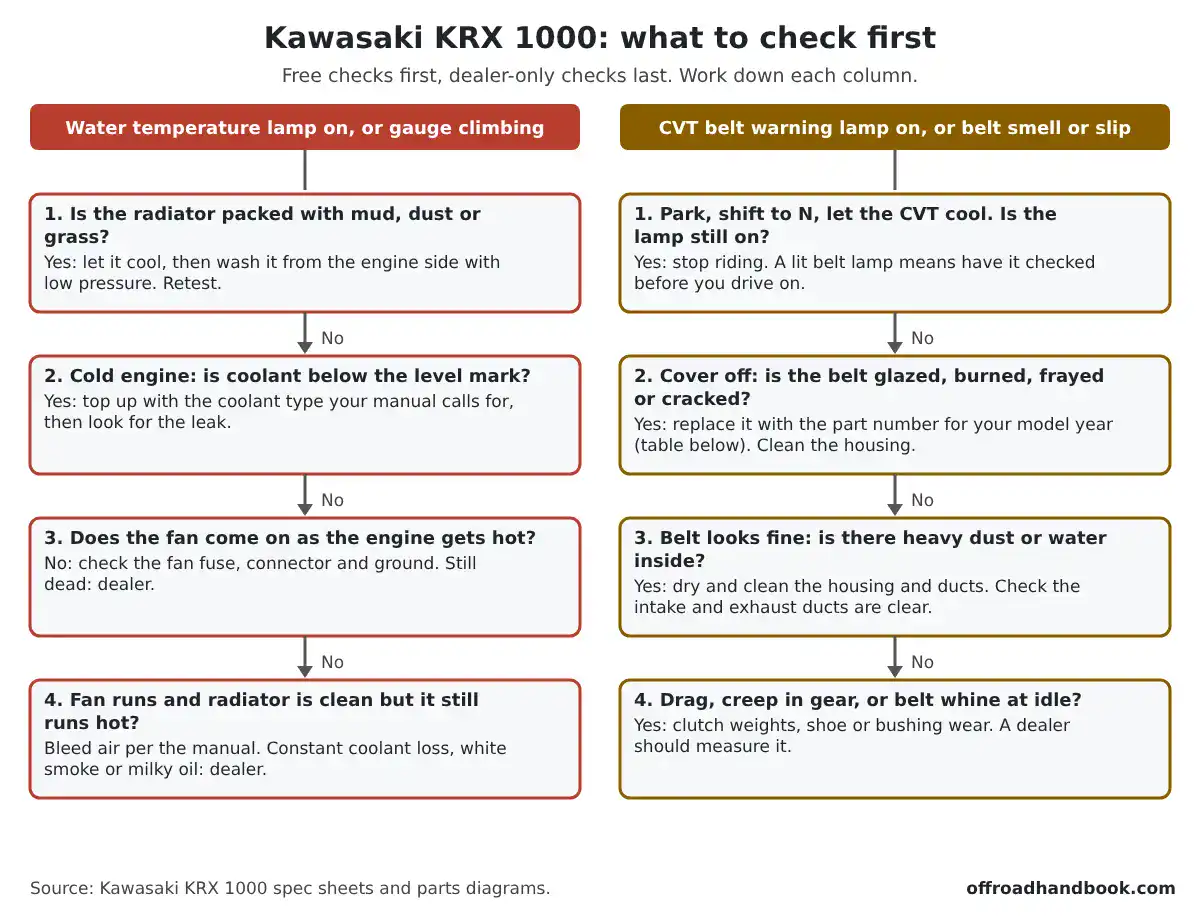
Work each column from the top. The first two or three steps cost nothing but a hose, a flashlight and a few minutes, and they fix most heat and belt complaints before a dealer is involved.
Stop at the first step that finds something, fix it, and retest before moving on. A dealer should handle anything past the last box in either column.
KRX 1000 symptom checker
Built from the checks in this guide, Kawasaki’s spec-sheet instrument list and the service-schedule items. It is a checklist, not a diagnosis, and your owner’s manual overrides it.
1. Overheating and cooling fan problems
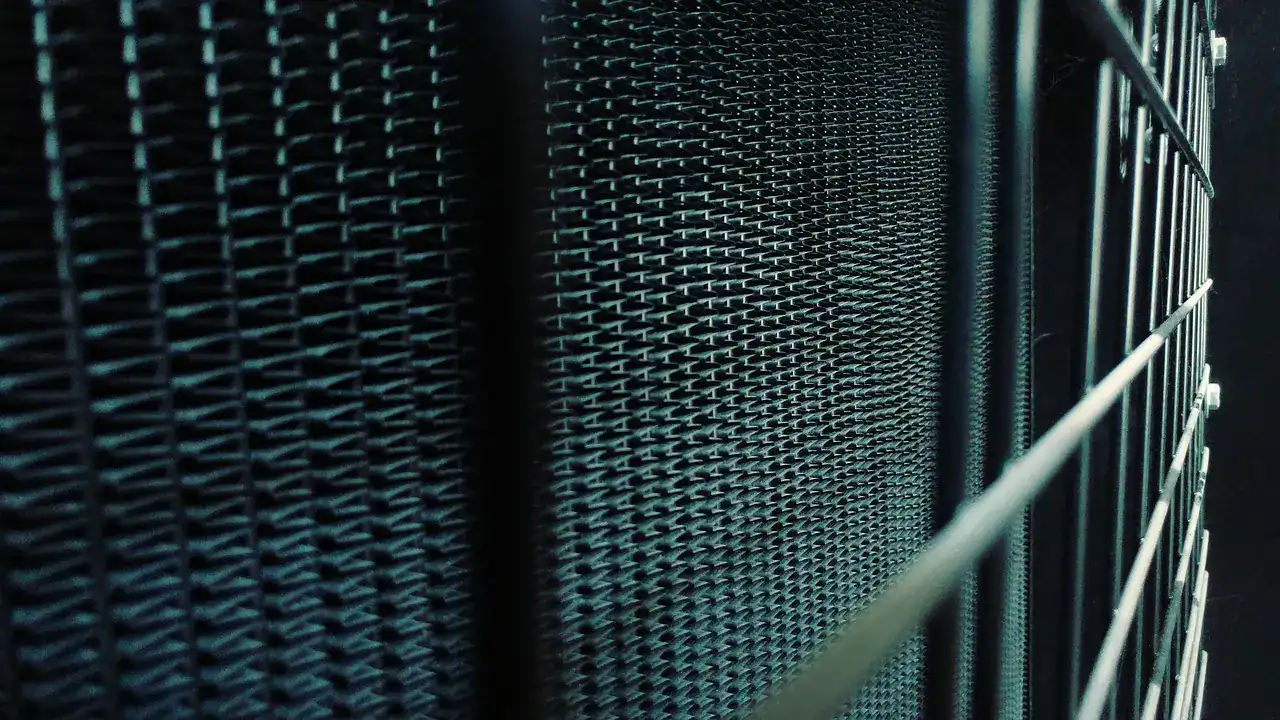
Heat is the most common KRX complaint in owner write-ups, mostly in slow, low-range work on hot or dusty days. Kawasaki’s service schedule, as reproduced by two US parts retailers, cleans the radiator after the first 50 hours or 600 miles and again every 100 hours or 1,200 miles.
Work through these in order, and never open the radiator cap on a hot engine.
- Let the engine cool, then look at the radiator and the screens or guards in front of it. Mud, dust and grass packed into the fins block airflow. Wash from the engine side with low pressure so the debris goes back out the way it came in.
- Check coolant with the engine cold, at the level marks on the reservoir, and use the coolant type your manual specifies. Look for drips, wet hose clamps and crusty residue. The schedule has hoses and connections checked every 100 hours or yearly.
- Run the engine at idle until it is hot and watch for the fan to come on. If it never does, check the fan fuse, the connector and the ground before blaming the fan itself. A fan that is powered and still dead is a parts and dealer job.
- After any coolant service, bleed trapped air using the procedure in your service manual. An air pocket can read hot even with a full reservoir.
- Constant coolant loss, white exhaust smoke or milky oil points at a head gasket or internal leak. Stop riding and see a dealer.
Slow, hard work in hot weather is when the lamp tends to come on. Keep the radiator clean, vary speed for airflow when you can and let the machine idle a few minutes before shutting off.
2. CVT belt, clutch drag and belt whine
The KRX 1000 uses an automatic CVT with a centrifugal clutch and H, L, N and R positions, according to the Kawasaki spec sheets. A belt that is glazed, burned or soaked slips, and the lamp or the smell tells you about it.
Dust and water in the housing slow belt grip, and worn pulley parts show up as drag. Check in this order:
- Park on level ground, shift to N, switch off and let it cool. Never open the cover on a hot CVT.
- Open the CVT cover and look for water, mud or dust. Dry and clean the housing and clear the intake and exhaust ducts.
- Inspect the belt: glazing, cracks, frayed edges or burned spots mean replace it. A worn belt that is replaced without finding the cause will burn again.
- Drag, creep in gear or whine at idle with a good belt points at the clutch. The service schedule inspects the drive pulley weights, the drive pulley shoes and the end-cover bushing every 100 hours or 1,200 miles, so ask the dealer to measure them against the manual.
Blogs and aftermarket shops often blame the factory clutch weights and sell uncoated weights or a clutch kit. Kawasaki does not publish that fix, so ask your dealer how a kit would affect your warranty before you change anything.
Belt and driven-converter part numbers by model year
Kawasaki changed the belt for 2025, so a part number from an older parts list may not fit. The numbers below come from Kawasaki’s online parts diagrams for the trims opened. Confirm with a dealer by VIN before ordering.
| Model year | CVT belt | Driven converter assembly | Roller (4 per assembly) |
|---|---|---|---|
| 2021 | 59011-0047 | 49094-0100 | 92122-0560 |
| 2022 | 59011-0047 | 49094-0106 | 92122-0560 |
| 2023 | 59011-0047 | 49094-0107 | 92122-0560 |
| 2024 | 59011-0047 | 49094-0107 | 92122-0560 |
| 2025 | 59011-0068 | 49094-0107 | 92122-0571 |
| 2026 | 59011-0068 | 49094-0107 | 92122-0571 |
The 2020 launch-year diagram was not available to check, so 2020 owners should ask a dealer for the belt number by VIN.
3. Soft or long brake pedal
Check pad thickness, the fluid level and its color, and look for wet spots at the calipers, hoses and fittings. Kawasaki’s service schedule, as reproduced by one US retailer, calls for a brake fluid change every 2 years and hoses every 4 years.
- Inspect pad thickness at every wheel and replace pads that are near the wear limit in your manual.
- Check the reservoir level and the fluid color. Dark or old fluid should be changed; use the fluid grade printed on the reservoir or in the manual.
- If the pedal is still soft after a fresh fluid change and a proper bleed, or you find a leak, stop riding. Brakes are the one system to let a dealer finish.
4. Electrical faults, EPS lamp and fuel gauge
Flickering gauges, an EPS lamp that stays on and warnings that come and go often start with a weak battery or a corroded ground. The cluster has a digital battery gauge, so start by reading it, then measure the battery with a multimeter: a rested, healthy battery should read about 12.6 V, and anything under 12.4 V needs a charge.
- Charge the battery and measure it again after it rests an hour.
- Clean and tighten both battery terminals and the chassis ground points. Reconnect with dielectric grease.
- Unplug and reseat the connectors you can reach, looking for green corrosion or bent pins.
- If the EPS lamp or the engine check lamp stays on, let a dealer read the codes. Do not clear them yourself.
Fuel gauge complaints show up in owner write-ups, but no Kawasaki bulletin was found, so treat them as unconfirmed. The tank holds 10.6 gallons per the spec sheets: reset the trip meter at each fill, write down your range and do not run the bar to empty.
Recalls and safety notices
| Date and number | What is covered | Hazard and remedy | Applies to a KRX 1000? |
|---|---|---|---|
| Sept. 2, 2020 (CPSC 20174) | IMMI SubZero and Click6 harnesses | Missing stitching can fail to restrain the occupant in a crash. Stop using until a dealer inspects; free replacement. | Only if you fitted these aftermarket harnesses; the part number and date are on the harness label |
| June 11, 2026 (CPSC 26550) | 2026 Teryx4 H2 and Teryx5 H2 (KRT1000D, F, G) | Drive converter sheave can break and throw fragments. | No. Different vehicles, not the KRX 1000 |
| Sept. 4, 2019 (CPSC 19777) | 2019-2020 Teryx and Teryx4 800 (KRF800, KRT800) | Incorrect joint assembly can cause loss of steering control. | No. Different vehicles, not the KRX 1000 |
Kawasaki can still run its own campaigns that the federal database does not list. Enter your VIN on Kawasaki’s recall page, or call Kawasaki at 855-878-4217 (7 a.m. to 4 p.m. Pacific, Monday to Friday, the number in Kawasaki’s June 2026 press release).
Earlier versions of this guide named a steering-fastener recall for the KRX 1000. That recall could not be matched to the KRX 1000 in the federal database, so it is gone.
KRX 1000 specs that matter when you repair it
| Spec | 2020 | 2025 |
|---|---|---|
| Maximum torque | 76.7 lb-ft at 7,000 rpm | 75.2 lb-ft at 7,000 rpm |
| Shocks | FOX 2.5 Podium LSC | Showa 2.5 |
| Ground clearance | 14.4 in | 14.8 in max, 14.2 in standard |
| Curb weight | 1,896.3 lb (1,898.5 lb CA) | 1,894.1 lb (1,896.3 lb CA) |
| Overall height | 75.0 in | 74.8 in |
| Turning radius | 19.4 ft | 20.3 ft |
| Fuel capacity | 10.6 gal | 10.6 gal |
| Tires | Maxxis Carnivore 31 x 10.00R15 8PR, bead-lock alloy wheels | Same |
Because specs shift by year, order parts by VIN. For tire changes, the tire size calculator shows how a different diameter shifts the speedometer reading, and the free off-road calculators page has the rest.
Service items that head off most of these problems
| Item | Interval (whichever comes first) |
|---|---|
| Radiator: clean | After the first 50 h or 600 mi, then every 100 h or 1,200 mi |
| Radiator hoses and connections: check | Every 100 h or 1,200 mi, or yearly |
| Coolant: change | Every 2 years (one retailer also lists 100 h or 1,200 mi) |
| CVT belt wear, drive pulley weights and shoes, end-cover bushing: inspect | Every 100 h or 1,200 mi |
| Air cleaner: clean and inspect | After 20 h or 120 mi, then every 50 h or 600 mi |
| Brake pad wear: inspect | After the first 50 h or 600 mi |
| Brake fluid: change; hoses: replace | Fluid every 2 years; hoses every 4 years |
Lists elsewhere also name spring sag, loose axle caps and high pedal placement. Those come from blogs without sources, so they are not covered here. For the same check order on other machines, see the ATV and UTV troubleshooting guide, or compare how a rival fails in the Polaris RZR XP 1000 problems guide.
FAQs
Kawasaki lists a CVT belt warning lamp and a CVT temperature display on the cluster, but the trigger points are in the owner’s manual. Treat a lit lamp as a stop: let it cool, then look for a glazed or burned belt and for water or dust in the housing.
Two US Kawasaki parts retailers reproduce the schedule as every 100 hours or 1,200 miles, whichever comes first. Your owner’s manual is the authority, and mud, sand and slow low-range work call for sooner.
The CPSC database lists one recall that names it, an aftermarket IMMI harness recall from 2020. Check your VIN on Kawasaki’s recall page for any Kawasaki-run campaign.
Kawasaki’s parts diagrams list 59011-0047 for the 2021 to 2024 trims checked and 59011-0068 for 2025 and 2026. Confirm by VIN with a dealer before ordering.
The usual causes are a packed radiator, low coolant, trapped air or a fan that never turns on. Check them in that order, and see a dealer for constant coolant loss.
Related guides
- Kawasaki Teryx4 Problems: 8 Common Issues and How to Fix Them
- ATV and UTV Troubleshooting: Bogging, No-Start, Heat and Belts
- Polaris RZR XP 1000 Problems: 8 Common Issues and Fixes

I'm Suryashankar Dasgupta, the founder of Off-Road Handbook. I've been off-roading for years in the USA, including California and Texas, and have ridden mountain and desert terrain abroad. I've also driven a Jeep Compass for more than seven years, so I know the day-to-day side of Jeep ownership first-hand, from the Uconnect screen to the warning lights. Every guide here is researched from manufacturer owner's manuals, NHTSA recall and service-bulletin records and other trusted sources, checked against them before it is published, and corrected when we find a mistake. You can read how we work in our editorial policy: https://offroadhandbook.com/editorial-policy/
Like our off-road guides? Add Off-Road Handbook as a Google Preferred Source so our latest Jeep, ATV, UTV, trail, recovery, and off-road troubleshooting articles can appear more often in your Google Search experience.
Add us as a Preferred Source