Kawasaki Teryx4 Problems: Overheating, Cab Heat and 4WD Fixes
Last updated on October 25th, 2026 at 10:50 am
This post contains Amazon affiliate links. As an Amazon Associate I earn from qualifying purchases, at no extra cost to you.
The Kawasaki Teryx4’s most common problems are heat with a red coolant light, fuel starvation, a slipping CVT belt, a weak battery that clicks without cranking, and 4WD that won’t engage. Most trace to short checks in the owner’s manual: coolant level, a mud-packed radiator, fuses, battery voltage and belt condition.
Recalls matter on this machine too, and they differ by model year. Every number below comes from the Kawasaki 2021 Teryx4 owner’s manual (KRT800J/K, part 99803-0171) and from CPSC recall notices, with page numbers in the captions.
| What you see | Likely cause (from the manual) | Free check first | Stop and see a dealer when |
|---|---|---|---|
| Red coolant light, running hot | Low coolant, mud-packed radiator, fan breaker tripped or fan fault, low oil | Reserve tank level (cold), rinse the radiator fins | Coolant keeps dropping or the fan never runs |
| Hot cab and footwells | Engine and exhaust close to the occupants; debris build-up | Clear debris around the engine and exhaust | Not a fault, but check for leaks near hot parts |
| Bogs or cuts out, or cranks but won’t start | Clogged tank vent, water in fuel, clogged air filter, fuel pump or its filter | Fuel level, tank vent, air cleaner | Fuel pump, filter or fuel smell near the seat |
| Rough idle or misfire | Dirty or wrong spark plug, plug wire off, valve clearance | Plug wires seated, plugs clean and gapped | Yellow engine light on, or valve clearance |
| Squeal, burning smell, slipping | Worn belt, high range under load, water in the CVT housing | Switch to low range for heavy work | Any belt slippage, or water in the CVT |
| Click, slow crank or no crank | Discharged battery, loose cables, blown fuse | Terminals, battery voltage, fuses | Battery and fuses are good but it won’t turn |
| 4WD or diff lock won’t engage | Shift not completed, battery disconnected, actuator or ECU fault | Stop, switch, then roll slowly | Display never changes after rolling |
| Soft pedal, clunks or heavy steering | Brake wear or fluid, torn joint boots, EPS fuse, held at full lock | Pedal free play, boots, fuses | Any soft pedal or steering fault |
This guide uses the 2021 manual that Kawasaki’s owner center lists for the Teryx4. Earlier 750 and 800 machines share the same basics, but confirm a number against the manual for your year before you fill, torque or gap anything.
For problems that apply to every ATV and UTV, see our ATV and UTV troubleshooting guide.
Teryx4 symptom checker
The checker repeats steps from the owner’s manual and the flowchart below. It cannot read codes or inspect the machine, so treat it as an ordered checklist, free checks first.
Gasoline fumes, a hot exhaust and a spinning fan are the real hazards on most of these jobs. Work outside with the engine off and cool, the key out and no smoking nearby.
1. Overheating and the red coolant light
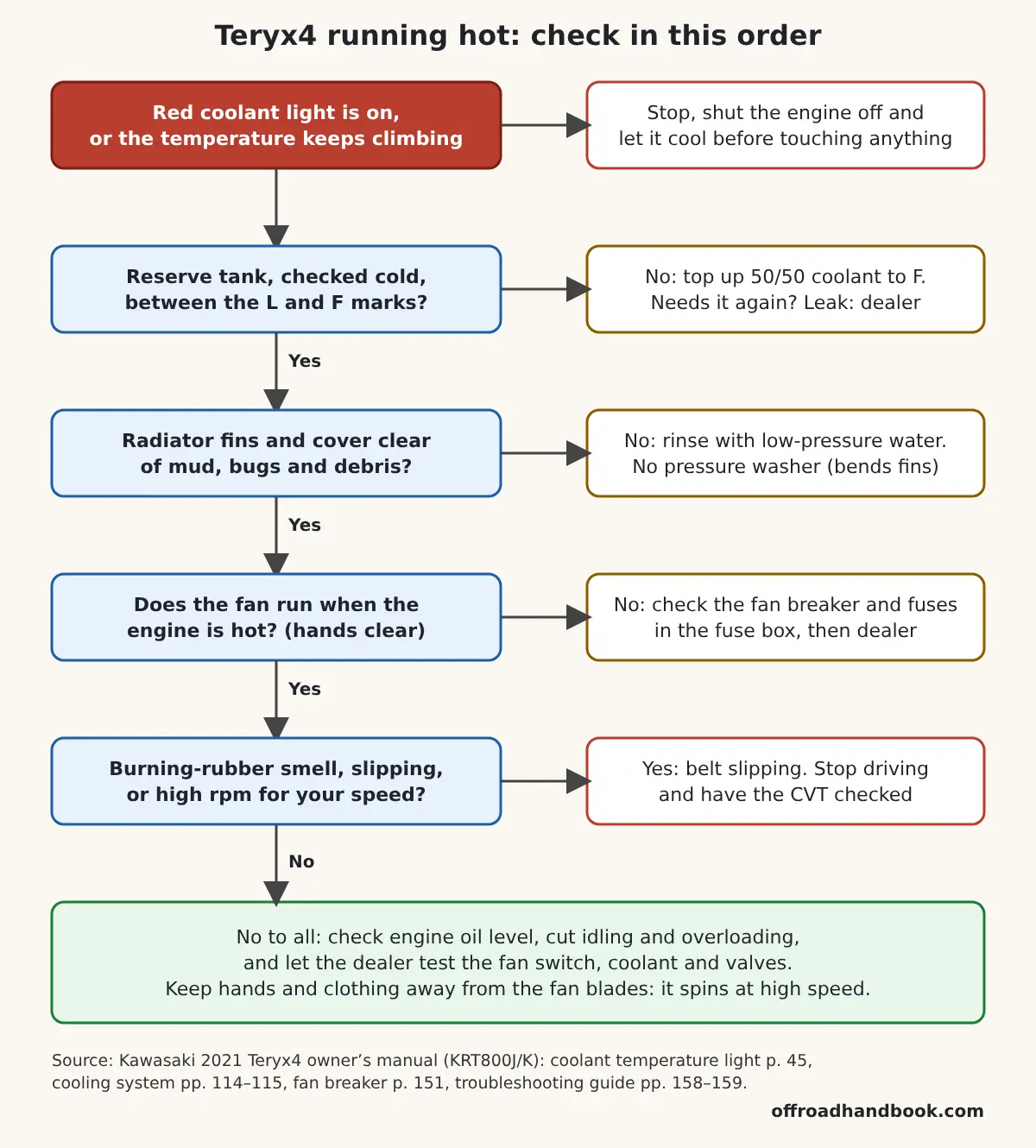
The red coolant temperature light stays on whenever the coolant runs too hot. Kawasaki’s instruction is to stop the engine, let it cool, check the reserve tank level, and make sure the radiator fan area is free of mud.
The manual’s troubleshooting list for an engine that stops or loses power names the same suspects: a clogged radiator, low or worn-out coolant, a fan malfunction, a tripped fan breaker, low engine oil, too much idling and overloading.
- Shut the engine off and let it cool. Read the reserve tank on level ground with the engine cold: the level belongs between the L and F marks.
- Top up through the filler to F with a 50/50 mix of water and permanent-type (ethylene glycol) antifreeze. Plain water is an emergency fix only. Total capacity is 4.0 L (4.2 US qt).
- Rinse the radiator cover and fins with low-pressure water. A pressure washer can bend the fins, and accessories in front of the radiator or behind the fan can choke airflow.
- Find the fan breaker in the fuse box under the front access cover. It resets itself, so a breaker that keeps tripping points to a fan or wiring fault for the dealer.
- Check the engine oil level and cut back on long idling or overloading.
Many owner write-ups point to a fan relay or a radiator fan switch. Owners do report fan-switch connector problems, but the Kawasaki manual lists a self-resetting breaker and gives no switch test, so treat the switch as a dealer check once the free steps pass.
If you keep adding coolant, the system is leaking. The coolant itself should be changed by a dealer on the schedule in the manual.
2. Heat in the cab
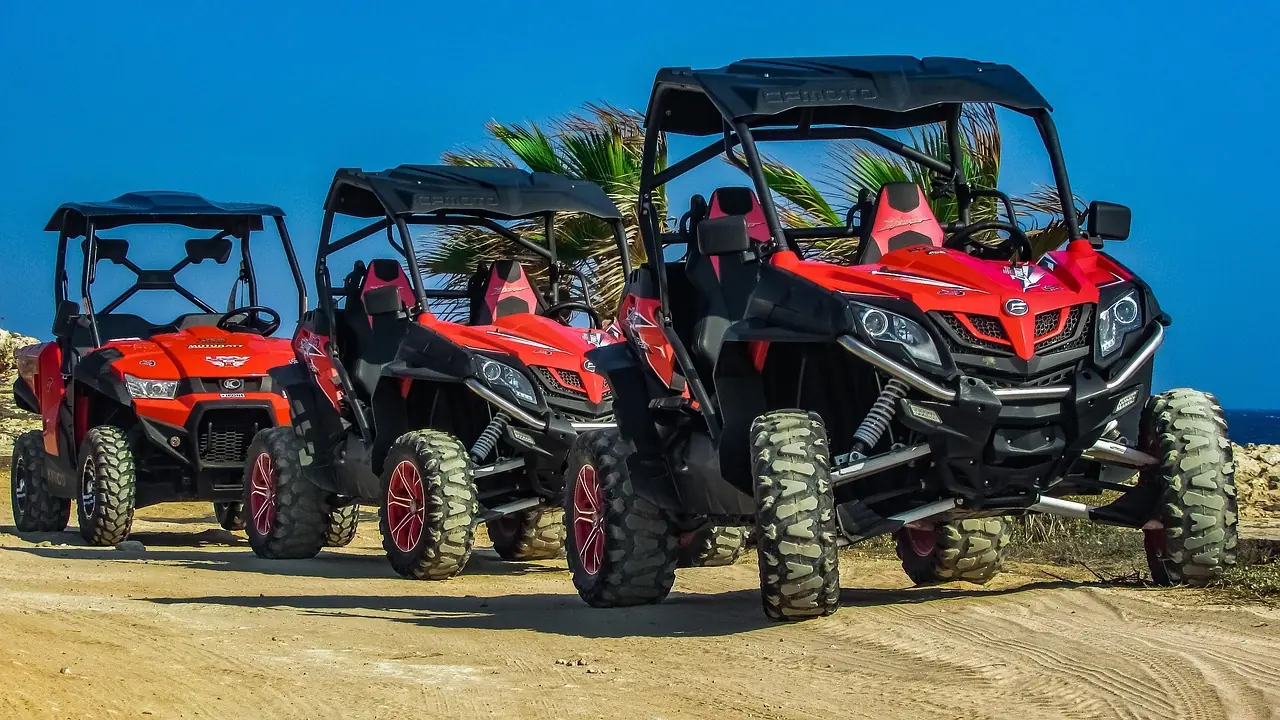
The Teryx4 puts the engine and exhaust close to the seats, and heat is the complaint SlashGear calls the biggest one. Kawasaki publishes no cab temperature figure, so every claim about how much a shield helps is owner-reported.
What the manual does say is that debris and flammable material building up around the chassis, engine and exhaust can cause mechanical problems and raise the risk of fire. Clear the engine bay after brush or tall grass, and look for fuel or oil leaks near hot parts.
Keep anything you add away from the radiator. If you buy aftermarket heat shielding, SlashGear puts the cost at a few hundred dollars, so make sure it does not block airflow. The KRX 1000 guide covers the newer, faster Kawasaki.
3. Bogging, cutting out or cranking but not starting
An engine that cranks but will not start has a short list of causes in the manual: no fuel in the tank, a clogged fuel filter (which is inside the pump), a pump fault, water in the fuel, a clogged air filter, a flooded engine, a clogged fuel tank vent, a plug wire off, dirty plugs or wrong valve clearance.
A machine that idles fine but dies under load lines up with the same list plus overheating and overloading. Work from free to expensive:
- Check the fuel level. The tank holds 30 L (7.9 US gal).
- Check the tank vent line for a clog or pinch.
- Clean the air cleaner element and make sure nothing blocks the intake.
- Push the plug wires fully on and check the plugs.
- After rain or a wash, suspect water in the fuel and let a dealer drain and test.
- Leave the pump and its filter to the dealer.
A fuel smell near the seat is different. The 2021 recall 21-739 covered loose fuel pump retainer plate bolts on certain Teryx4 and Teryx4 S LE VINs, so stop using the machine and call a dealer.
4. Rough idle and misfires
Kawasaki specifies an NGK CPR7EA-9 plug (search for it on Amazon), gapped 0.8 to 0.9 mm (0.031 to 0.035 in) and tightened to 13 N·m (115 in·lb). If a plug is oily or has carbon on it, clean it with a high flash-point solvent and a nonmetal brush, then reset the gap by bending the outer electrode only.
Replace a plug with a cracked insulator. Make sure the plug wires are fully seated before you blame the plugs.
Valve clearance, checked cold, is 0.07 to 0.12 mm (0.0028 to 0.0047 in) intake and 0.20 to 0.25 mm (0.0079 to 0.0098 in) exhaust, and Kawasaki leaves the adjustment to a dealer. If the yellow engine warning light comes on, the manual says to have a dealer check the vehicle.
5. Belt slipping, squealing or burning smell
The Teryx4 uses a belt-driven CVT, and the belt wears with normal use. Kawasaki says to inspect it at least every 100 hours or 2,000 km (1,200 miles), whichever comes first, and more often in hard use. The belt is a normal wear item, so warranty does not cover it.
Kawasaki lists these signs of excessive slippage. If you see any, stop driving until the damaged parts are repaired:
- A smell of burning rubber.
- Visible white smoke.
- Sluggish initial acceleration or loss of power.
- Engine rpm higher than normal for your speed.
- Engine vibration.
The manual blames high range on hills, with heavy loads or a trailer, exceeding load limits, mud or water deeper than recommended, extremely dusty conditions, driving on with a slipping belt, and not braking on descents. Use low range for heavy work.
Water in the CVT housing also causes slipping and power loss, and Kawasaki says to see a dealer. Stock tires are 27×9.00R14 front and 27×11.00R14 rear, and if you change size, the tire size calculator shows how far overall diameter moves from stock.
A whine is not on the manual’s slippage list, so start with the same checks and have a dealer inspect the belt and clutches. Our Mule 4010 guide covers a similar Kawasaki CVT.
6. Clicks but won’t crank
The manual’s guide for a starter that won’t turn lists three causes: a failed fuse (find out why it failed), battery cables with poor contact, or a discharged battery. Check them in that order of effort: cables first, then voltage, then the fuse box.
The battery is a sealed 12 V, 14 Ah unit. Kawasaki says to check voltage weekly if the machine sits, and to charge when it drops below 12.6 volts. Use a maintainer such as the BatteryMate 150-9, OptiMate 4, Yuasa MB-2040/2060 or Christie C10122S that Kawasaki names (battery maintainer search on Amazon).
Do not use an automotive quick charger, which can overcharge the battery. Charge at roughly one tenth of capacity, about 1.4 A for this battery, and disconnect the battery if the machine will sit four weeks or more.
Sulfation from a battery left discharged is not covered by warranty, and neither is a battery drained by leaving it connected. If the battery and fuses test fine and the starter still won’t turn, that is dealer work.
7. 4WD or diff lock won’t engage
The Teryx4 shifts 2WD, 4WD and diff lock with an electric switch. Stop completely before you turn it, and never shift while moving.
After you switch, the transmission shifts when the vehicle has rolled a short distance, so drive off slowly and watch for the 4WD symbol on the meter. A small clank as 4WD engages or disengages on hard ground is normal.
If the meter does not change, the manual says the electric shifter is working but the shift is not completing, so move slowly forward or back to help it. Diff lock works only with 4WD engaged, and top speed is limited to 24 km/h (15 mph) in that mode.
The manual’s causes for a real malfunction are failed actuators, a failed ECU or a disconnected battery. Check the battery connection and the fuses first, then see a dealer.
8. Brake wear, clunks and heavy steering
The front brakes are hydraulic discs and the rear brake is an enclosed, wet multi-plate design, so there are no rear pads to swap. Check pedal free play, which should be 2 to 10 mm (0.08 to 0.39 in), and use DOT 3 fluid from a sealed container only.
After driving through water, apply the brakes gently until the linings dry. Wet brakes lose efficiency and may wear faster, so check wear more often if you ride in water.
For clunks, inspect the CV joint boots on the axles and the tie-rod ends for tears, and have a dealer replace any torn boot. Recall 19-777 covers loss of steering control from incorrect joint assembly on 2019 and 2020 machines.
The manual gives four reasons for heavy steering: holding the wheel at full lock (the ECU cuts assist until it cools), a blown fuse, low battery voltage, or a disconnected harness or connector. Steering free play should be 0 to 20 mm (0 to 0.79 in).
Service numbers for the 2021 Teryx4
| Item | Specification | Manual page |
|---|---|---|
| Engine | 783 cc four-stroke V-twin, SOHC, liquid-cooled, fuel injected; 64 N·m (47 ft·lb) at 5,500 rpm | 14–15 |
| Coolant | 4.0 L (4.2 US qt); 50/50 water and permanent-type antifreeze | 15, 115 |
| Spark plug | NGK CPR7EA-9, gap 0.8–0.9 mm (0.031–0.035 in), 13 N·m (115 in·lb) | 116 |
| Valve clearance, cold | Intake 0.07–0.12 mm; exhaust 0.20–0.25 mm | 117 |
| CVT belt inspection | At least every 100 hours or 2,000 km (1,200 miles) | 128 |
| Battery | 12 V, 14 Ah sealed; charge below 12.6 V | 16, 147 |
| Fuel tank | 30 L (7.9 US gal) | 16 |
| Brake pedal free play, fluid | 2–10 mm (0.08–0.39 in); DOT 3 | 130 |
| Steering free play | 0–20 mm (0–0.79 in) | 134 |
| Diff-lock speed limit | 24 km/h (15 mph) | 79 |
| Maximum vehicle load | 497 kg (1,096 lb) with occupants, cargo and accessories; 4 seats | 17 |
| Water crossing | Never deeper than the bottom edge of the axle caps | 97 |
These are the numbers behind the checks above. Earlier years can differ, so use the manual for your VIN.
If you plan heavy loads or towing, the load rating is the one number worth memorizing, because overload shows up first as belt wear and heat.
Teryx4 recalls by model year
| Recall | Model years | Hazard | Remedy |
|---|---|---|---|
| 12-745 | 2012 Teryx4 750, 750 EPS, 750 EPS LE (about 7,000) | Steering gear and front brakes can fail | Free dealer repair |
| 16-714 | 2012–2013 Teryx4 750; 2014–2016 Teryx4 800 (about 19,500) | Sticks or debris can break through the floorboard | Floor board guards, damaged boards replaced |
| 19-777 | 2019–2020 Teryx and Teryx4 (about 2,600) | Incorrect joint assembly can cause loss of steering control | Free dealer repair |
| 21-739 | 2021 Teryx4 and Teryx4 S LE, certain VINs (about 100) | Fuel pump retainer plate bolts can loosen and leak fuel | Replace the bolts |
| 26-550 | 2026 Teryx4 H2 and Teryx5 H2 (about 3,585) | Drive converter sheave can break and throw metal fragments | Replace the sheave, add a clutch cover guard, reprogram the ECU |
Check your own VIN on Kawasaki’s recall page or with any dealer, because the CPSC notices cover model ranges and some VIN ranges are small. No Teryx4 recall for 2017, 2018 or 2022 to 2025 turned up in our CPSC check.
For another overview of what to inspect before a trail day, our free off-road checklist is handy.
FAQs
At least every 100 hours or 2,000 km (1,200 miles), whichever comes first. Kawasaki says to inspect it more often if you tow, work in mud or water, or ride in dusty conditions.
The coolant is too hot. Stop and let it cool, check the reserve tank is between L and F when cold, and make sure the radiator and fan area are free of mud.
Stop completely, turn the switch, then roll slowly a short distance so the shift can finish. If the meter never changes, the manual points to failed actuators, a failed ECU or a disconnected battery.
CPSC lists recalls for 2012 and 2013 750 models, 2014 to 2016 800 models, 2019 and 2020 models, certain 2021 VINs and the 2026 H2. Check your VIN on Kawasaki’s recall page.

I'm Suryashankar Dasgupta, the founder of Off-Road Handbook. I've been off-roading for years in the USA, including California and Texas, and have ridden mountain and desert terrain abroad. I've also driven a Jeep Compass for more than seven years, so I know the day-to-day side of Jeep ownership first-hand, from the Uconnect screen to the warning lights. Every guide here is researched from manufacturer owner's manuals, NHTSA recall and service-bulletin records and other trusted sources, checked against them before it is published, and corrected when we find a mistake. You can read how we work in our editorial policy: https://offroadhandbook.com/editorial-policy/
Like our off-road guides? Add Off-Road Handbook as a Google Preferred Source so our latest Jeep, ATV, UTV, trail, recovery, and off-road troubleshooting articles can appear more often in your Google Search experience.
Add us as a Preferred Source