Off-Road Tire Pressure Calculator: Air-Down PSI by Terrain
Last updated on October 29th, 2026 at 07:06 pm
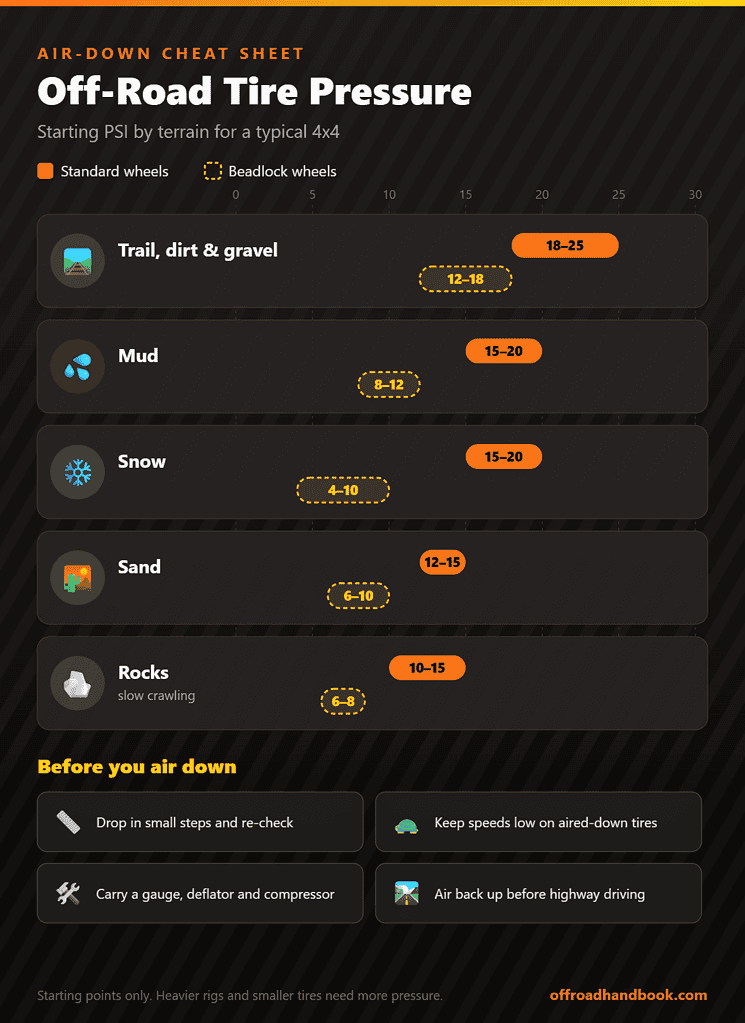
On standard (non-beadlock) wheels, typical starting pressures are 18–25 PSI for general trails, 15–20 PSI for mud or snow, 12–15 PSI for sand and 10–15 PSI for slow rock crawling. Go lower only at low speed, and air back up before driving on pavement. The Jeep club site California Jeeper's trail tire pressure guide also lists 12–15 PSI for sand and warns to stay above 12 PSI without beadlocks.
Air-down calculator: your starting trail pressure
Air-down calculator: a starting trail pressure for your terrain and wheels.
More free tools: see all our off-road calculators for tire size, regear, air-down pressure, winch size and more.
Airing down is the cheapest traction upgrade there is. Dropping tire pressure lengthens the tire’s footprint, lets the tread wrap over rocks, and helps the tire float on sand and snow instead of digging in. It also softens the ride on washboard. The catch is that every PSI you take out reduces sidewall support, so the right number depends on the terrain, your tires, your wheels, and how fast you’re going.
Use the ranges below as starting points, then adjust.
Starting pressures by terrain
These are typical starting points for a Jeep or similar 4x4 on all-terrain or mud-terrain tires, based on the ranges published by suspension maker MetalCloak. Beadlock wheels physically clamp the tire bead, so they allow much lower pressures.
| Terrain | Standard wheels | Beadlock wheels |
|---|---|---|
| General trail, dirt and gravel | 18–25 PSI | 12–18 PSI |
| Mud | 15–20 PSI | 8–12 PSI |
| Snow | 15–20 PSI | 4–10 PSI |
| Sand | 12–15 PSI | 6–10 PSI |
| Rocks (slow crawling) | 10–15 PSI | 6–8 PSI |
If you’re not sure where to start, 20 PSI is a sensible middle ground for most trails. Go lower only once you’ve seen how your tires behave.
What changes the right number
- Vehicle weight. A loaded Gladiator or a Jeep carrying camping gear and water needs more pressure than a stripped-down two-door on the same tires.
- Tire construction. Stiff load range E tires need to go lower to get the same footprint as softer C or D rated tires. Light, flexible tires reach a good footprint sooner.
- Tire size. Bigger tires with taller sidewalls tolerate airing down better than smaller, low-profile tires.
- Speed. Low pressure is for low speed. The faster you go, the more heat builds in a flexing sidewall and the easier it is to roll a tire off the rim in a turn.
- Rock type. Rounded rock suits low pressure. Sharp, broken rock and shale call for a bit more to protect the sidewalls.
Terrain notes
Rocks
Low pressure lets the tire mold around rock so it grips rather than bouncing off. Crawl slowly, pick lines that keep sidewalls away from sharp edges, and don’t go below about 12 PSI on standard wheels unless you know your tires and are prepared for the risk of unseating a bead.
Sand
Sand is all about flotation. If you start to bog, stop before you dig in, drop a few more PSI, and try again with steady throttle. Turn gently and avoid hard braking, since sharp inputs are what peel a soft tire off its bead.
Mud
Mud rewards a longer footprint but not a floppy tire. Moderate airing down usually works better than going very low. In sticky clay, a bit more pressure can help the tread clear itself.
Snow
Airing down helps in deep, soft snow. On packed snow and ice it helps much less, and you’ll often be back on plowed road soon, so be ready to air up.
How to air down and back up
- Check your normal cold road pressure before you start. It’s printed on the placard in the driver’s door jamb.
- Air down at the trailhead using a gauge or adjustable deflators. Guessing from how the sidewall looks isn’t reliable.
- Drive for 5–10 minutes and check how it feels: steering response, wheelspin, and how much the sidewall bulges.
- Adjust in small steps of about 2 PSI.
- Air back up to road pressure before you drive on pavement or at speed. Low pressure on the road hurts steering and braking and overheats the tires.
What to carry
- An accurate low-pressure tire gauge
- Deflators (optional, but they make airing down quicker and more consistent)
- A portable compressor rated for your tire size, or a CO2 or onboard air system (see how long it takes to air up 33s, 35s and 37s)
- A tire plug kit
- A valve core tool and spare valve cores
Signs you’ve gone too low
- Steering feels vague or delayed
- The tire folds over on obstacles or in turns
- You hear or feel the wheel rim touching rock
- The tire moves on the rim or loses air in a turn
If you see any of these, add a few PSI before you carry on.
FAQs
Around 18–25 PSI for general trails is a good start on standard wheels. Go lower for sand (12–15 PSI) and slow rock crawling (10–15 PSI), and adjust for your vehicle weight and tires.
Most guidance puts the practical floor at around 10–12 PSI on standard wheels, and only at low speed. Below that, the risk of the tire coming off the bead rises quickly, especially in turns.
A modest drop to around 25–30 PSI can smooth out washboard and add grip, but keep speeds sensible and air back up for pavement.
Yes. Driving on pavement at trail pressure affects steering and braking and can overheat and damage the tires.
Got a puncture out on the trail? See how to plug a flat tire on the trail and when not to.
Choosing between tire strength ratings? See load range C vs D vs E for off-road tires.
Related guides
- Off-Road Line Choice Tips for Beginners: How to Read Terrain
- Is the Bronco Sport Good in Snow? Traction Modes and Tire Tips
- How to Read Mud Tire Sizes: A Simple Guide to Every Number Shown
- How to Reseat a Tire Bead on the Trail: Safe Methods and Limits

I'm Suryashankar Dasgupta, the founder of Off-Road Handbook. I've been off-roading for years in the USA, including California and Texas, and have ridden mountain and desert terrain abroad. I've also driven a Jeep Compass for more than seven years, so I know the day-to-day side of Jeep ownership first-hand, from the Uconnect screen to the warning lights. Every guide here is researched from manufacturer owner's manuals, NHTSA recall and service-bulletin records and other trusted sources, checked against them before it is published, and corrected when we find a mistake. You can read how we work in our editorial policy: https://offroadhandbook.com/editorial-policy/
Like our off-road guides? Add Off-Road Handbook as a Google Preferred Source so our latest Jeep, ATV, UTV, trail, recovery, and off-road troubleshooting articles can appear more often in your Google Search experience.
Add us as a Preferred Source