Regear Calculator: What Gear Ratio Do You Need for Bigger Tires?
Last updated on October 29th, 2026 at 07:40 pm
To keep the same gearing after bigger tires, multiply your current axle ratio by new tire height ÷ old tire height. A 3.73 on 31.5 in tires moved to 35s needs about 3.73 × 35 ÷ 31.5 = 4.15, so 4.11 is the closest common ratio. Until you regear, those 3.73s act like 3.35s, which is why a truck on bigger tires feels sluggish and hunts for gears. Use the calculator below for your own sizes, axle ratio and highway RPM.
Regear calculator: axle ratio and highway RPM
Regear calculator: the axle ratio that restores your gearing after bigger tires.
Metric (265/70R17) or flotation (35x12.50R17). You can also type a measured height like 33.6.
More free tools: see all our off-road calculators for tire size, regear, air-down pressure, winch size and more.
Watch this on Instagram: @off_road_handbook
How it works: a tire that is 11% taller covers 11% more ground per turn, so the engine has to work as if the axle ratio dropped by the same amount. The ratio that restores your original gearing is current ratio × new diameter ÷ old diameter. Engine RPM uses the standard formula RPM = mph × axle ratio × transmission gear ratio × 336 ÷ tire diameter, as explained in Quadratec’s tire and gear ratio guide. The 336 comes from unit conversion (88 feet per minute per mph × 12 inches ÷ π).
What ratio do you need for 33s, 35s and 37s?
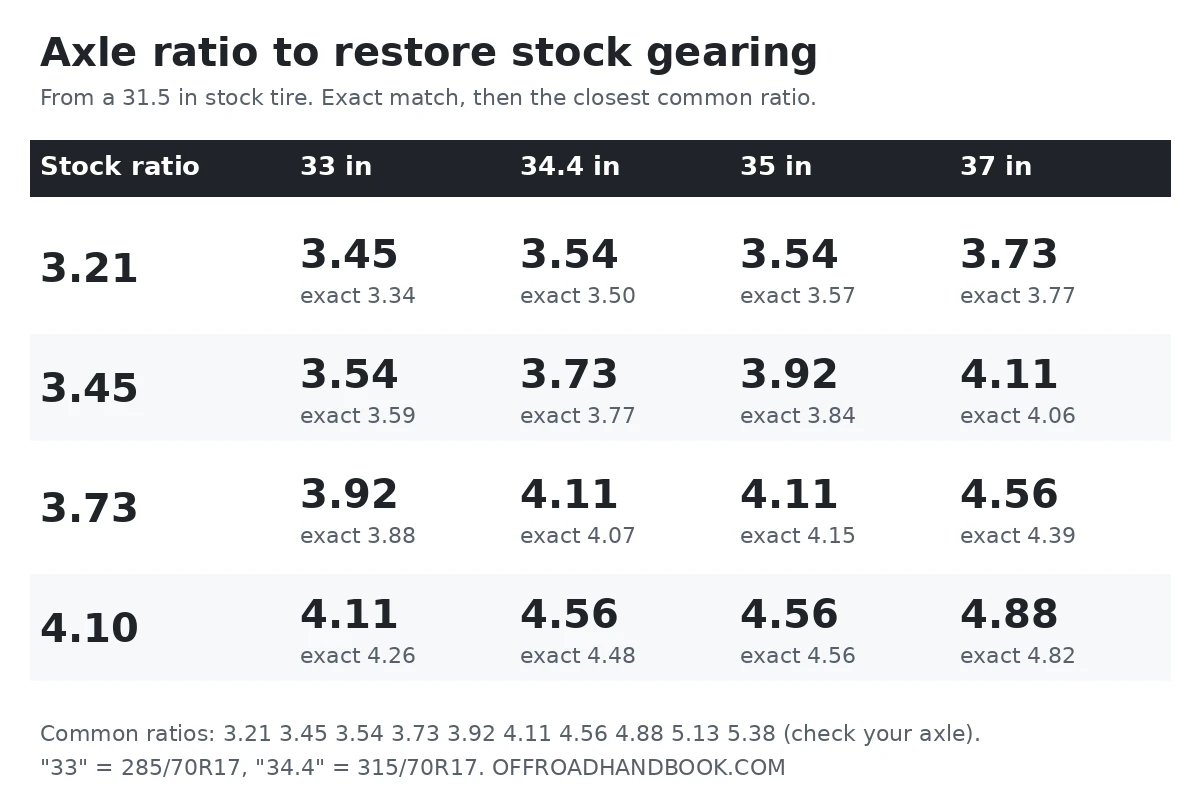
The chart starts from a 31.5 in stock tire (245/75R17) and shows the exact ratio that matches stock gearing, plus the closest common ring-and-pinion ratio. A metric "35" (315/70R17) is only about 34.4 in tall, so it needs a slightly smaller change than a true 35x12.50R17. For other starting sizes, use the calculator. On a JL Wrangler, the gear ratio for 37s by Wrangler trim and engine starts from Jeep's own factory ratios and tire specs instead.
Common ring-and-pinion ratios
Aftermarket gear sets for popular axles such as the Dana 44 are commonly sold in ratios like 3.21, 3.45, 3.54, 3.73, 3.92, 4.11, 4.56, 4.88, 5.13 and 5.38, as in this Yukon Dana 44 ring and pinion listing. Not every ratio fits every axle or carrier, so check fitment for your exact axle and model year before you order. Front and rear axles must always have the same ratio on a 4x4.
Exact match, a bit lower, or a bit higher?
- Closest match: brings back the factory feel for acceleration, shift points and highway RPM.
- Numerically higher (for example 4.56 instead of 4.11): more pulling power and slower crawl speed for heavy rigs, towing or rock crawling, at the cost of higher RPM on the highway.
- Numerically lower: lower highway RPM and quieter cruising, but slower acceleration and more downshifting on grades.
If you added weight along with the tires (armor, a winch, roof tent, camping gear), many builders lean toward the numerically higher option. Enter your top gear ratio in the calculator to compare highway RPM before you decide.
Planning to tow with a regeared Wrangler? Check Jeep's factory rating first: our Jeep Wrangler towing capacity by year table shows how the rating changes with doors and the original axle ratio.
If your mpg drops after the swap, our guide to how mud tires affect gas mileage has a calculator that corrects the odometer error and prices the difference.
Other things to plan for
- Speedometer: regearing to match the tires brings the axle-to-wheel ratio back, but the vehicle still needs the correct tire size and axle ratio programmed so the speedometer reads right. See the tire size calculator to see how far off it is now.
- Installation: setting up ring-and-pinion backlash and pinion depth takes special tools and experience. Most owners have a driveline shop do it.
- Break-in: new gears need a break-in period. Follow the gear maker’s instructions, which usually include gentle driving and a fluid change after the first few hundred miles.
New to gearing terms? Start with what gear ratios mean in off-roading, and see our Jeep JK picks for the 3.6 and 3.8 engines.
FAQ
What gears do I need for 35-inch tires?
From 3.73 gears on about 31.5 in tires, the exact match is about 4.15, so 4.11 restores stock gearing; 4.56 gives extra low-end pull. From 3.21 gears the match is about 3.57, closest common ratio 3.54. Your exact answer depends on your stock tire height.
Do I have to regear for bigger tires?
It is not required to drive, but the bigger the jump, the more you will feel slower acceleration, more downshifting and higher transmission load. Many owners live with a one-size jump and regear for two sizes or more.
Why use measured tire height?
Real mounted tires are often shorter than their nominal size. If you measure from the ground to the top of the tread at normal pressure and enter that number, the ratio and RPM will be more accurate.

I'm Suryashankar Dasgupta, the founder of Off-Road Handbook. I've been off-roading for years in the USA, including California and Texas, and have ridden mountain and desert terrain abroad. I've also driven a Jeep Compass for more than seven years, so I know the day-to-day side of Jeep ownership first-hand, from the Uconnect screen to the warning lights. Every guide here is researched from manufacturer owner's manuals, NHTSA recall and service-bulletin records and other trusted sources, checked against them before it is published, and corrected when we find a mistake. You can read how we work in our editorial policy: https://offroadhandbook.com/editorial-policy/
Like our off-road guides? Add Off-Road Handbook as a Google Preferred Source so our latest Jeep, ATV, UTV, trail, recovery, and off-road troubleshooting articles can appear more often in your Google Search experience.
Add us as a Preferred Source