Polaris General 1000 Problems: Belt, AWD and 15 MPH Limit Fixes
Last updated on October 26th, 2026 at 08:46 pm
This post contains Amazon affiliate links. As an Amazon Associate I earn from qualifying purchases, at no extra cost to you.
The Polaris General 1000 problems that come up most often are a slipping or burned drive belt, overheating from a mud-packed radiator, a front gearcase that stays locked after AWD, an EPS warning with heavy steering, and a machine that won't go past 15 mph because the driver's seat belt isn't latched.
Polaris's own owner's manual covers every one of those, and most can be fixed with the switch, fuse or cleaning step it describes. Four recalls also name the General 1000, so check your VIN before you buy parts.
This guide covers the gas General 1000 and General 4 1000 (non-XP), 2016 to 2023. Specs come from the 2022 GENERAL 1000 owner's manual and the 2020 GENERAL 1000 owner's manual unless noted. The General XP 1000 has its own manual and isn't covered here.
Which General 1000 problem do you have?
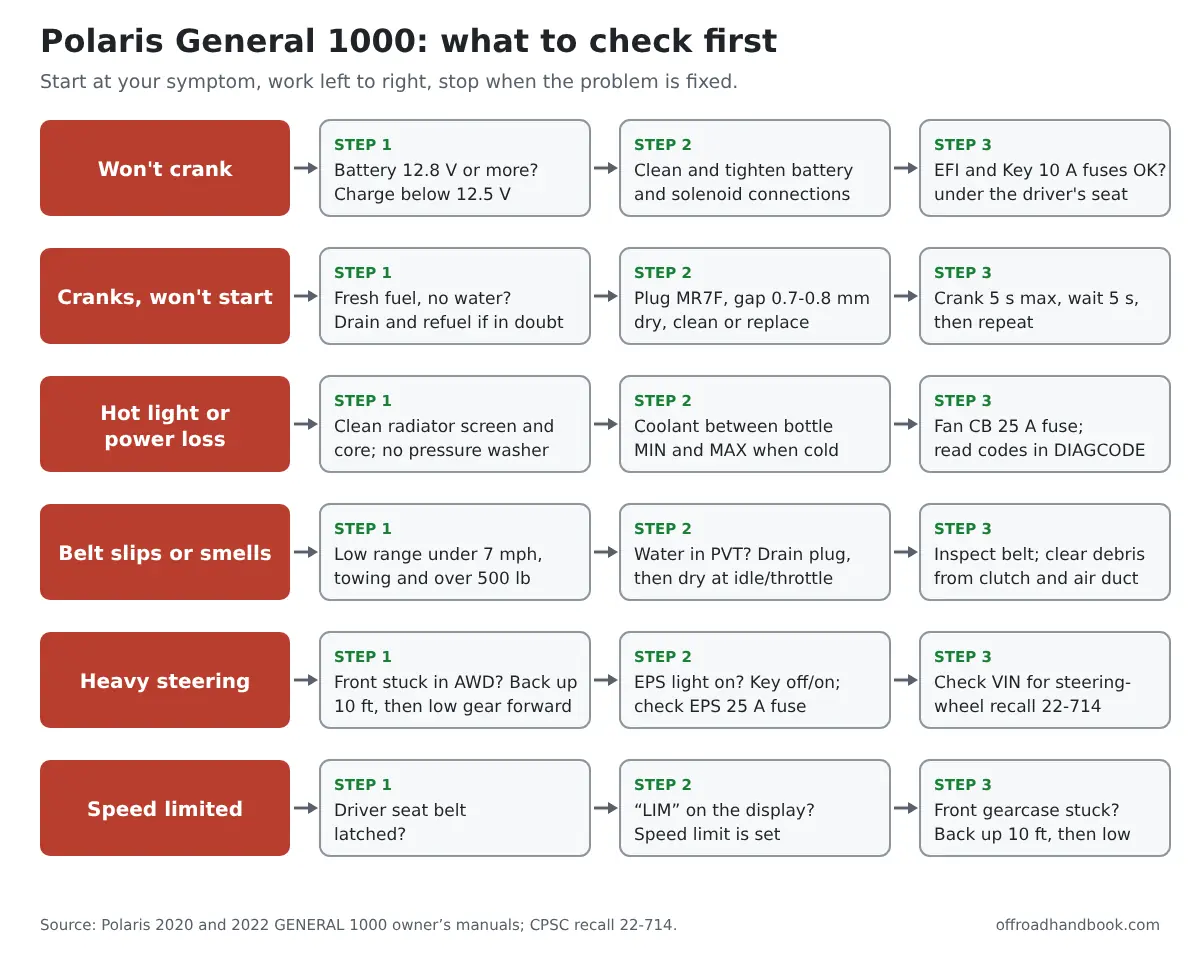
Start with the row that matches what the machine is doing. Each step is something Polaris tells owners to check before a dealer gets involved, and the order runs from the cheapest, most common cause to the least likely.
One rule first: if the General has rolled, been in a crash or sat in water above the floorboard, Polaris says to have it inspected before you start the engine. Everything below assumes the machine is otherwise undamaged.
General 1000 problems at a glance
This table pairs each symptom with the cause Polaris's manual points to and the first fix you can do yourself. The section numbers below each go deeper.
| Symptom | Most likely cause (per Polaris) | First fix you can do |
|---|---|---|
| Belt slips, squeals or smells burned | Driving in high range under load or at 3–7 mph; water in the PVT; cold belt | Use low range; dry the PVT; warm the belt below 30 mph for 1 mile |
| Hot light on or flashing, power drops | Radiator screen and core clogged; low coolant | Clean the radiator and screen; top up coolant at the overflow bottle when cold |
| Check engine light | EFI fault | Stop driving; read the code in the DIAGCODE menu before turning the key off |
| Won't crank | Low battery, loose battery or solenoid connections | Charge to 12.8 V; clean and tighten connections; check fuses |
| Cranks but won't start | Old fuel or water in fuel; fouled plug | Fresh fuel; inspect plug (MR7F, 0.7–0.8 mm gap) |
| Heavy steering after AWD | Front gearcase still locked | Back up at least 10 ft, stop, then drive forward in low |
| EPS light on, heavy steering | EPS shut down after 5 minutes key-on with engine off, or EPS fault | Cycle the key; if the light stays on, see a dealer |
| Won't go over 15 mph | Driver's seat belt not latched (interlock) | Latch the driver's belt; check for a "LIM" speed limit on the display |
Notice how many rows come back to operator habits rather than broken parts. The General's PVT (Polaris Variable Transmission) is a belt-driven CVT, and Polaris says plainly that belt slip "is responsible for creating excessive heat that destroys belts, wears clutch components and causes outer clutch covers to fail."
If you're not sure which row fits, or you want to know whether a recall covers your model year, the checker below combines both.
General 1000 problem and recall checker
Polaris General 1000 checker
Pick your model year, seat count and symptom to get the check order and any recalls that name your model.
How it works: the check order comes from the Polaris 2020 and 2022 GENERAL 1000 owner's manuals; recall coverage comes from CPSC notices 17-102, 17-763, 21-765 and 22-714 plus Polaris's July 2022 expansion. It flags model years named in a recall, not individual VINs.
1. Drive belt slipping, squealing or burning
Belt trouble shows up on nearly every General 1000 problem list, and Polaris's troubleshooting chart is blunt about why: most of the belt-burn causes it lists come down to range, speed and load. Low is the General's primary range. High is meant for hard-packed surfaces and light loads.
Polaris lists these belt-burn causes, with the fix for each:
- Loading onto a pickup or tall trailer in high range: use low.
- Starting up a steep incline: use low.
- Crawling at 3–7 mph: drive faster or use low more often. The gear-selector section says to use low any time you're below 7 mph for long stretches.
- Towing, pushing or plowing: low range only.
- Payload over 500 lb: the cargo-box label says the vehicle must be in low.
- Cold belt: warm the engine at least 5 minutes, then drive below 30 mph for 1 mile, or 5 miles or more below freezing.
- Stuck in mud or snow: shift to low and use quick, firm throttle to engage the clutch. Slow, easy clutch engagement is itself on Polaris's list of belt-burn causes. Too much throttle can roll the machine, so be careful.
- Wrong belt or no break-in: fit the correct belt and break in any new belt or clutch with light loads and no hard acceleration.
If a belt does let go, don't just slap a new one on. Polaris warns that failing to remove all debris from the clutch, cover, debris bracket and air duct "could result in vehicle damage, loss of control and severe injury or death." Open the clutch cover and clean it all out before you fit the new belt.
Polaris doesn't publish a belt life in miles. Its maintenance chart says to inspect the drive belt every 50 hours, 6 months or 500 miles. Carrying a spare is cheap insurance; check a fitment list for your model year before ordering a General 1000 drive belt on Amazon.
Shifting matters too. Polaris says to shift only when the General is stopped and the engine is at idle. Grinding or a lever that won't go in usually means one of those wasn't true, or the shift linkage needs the adjustment the maintenance chart lists every 50 hours.
2. Overheating and a flashing hot light
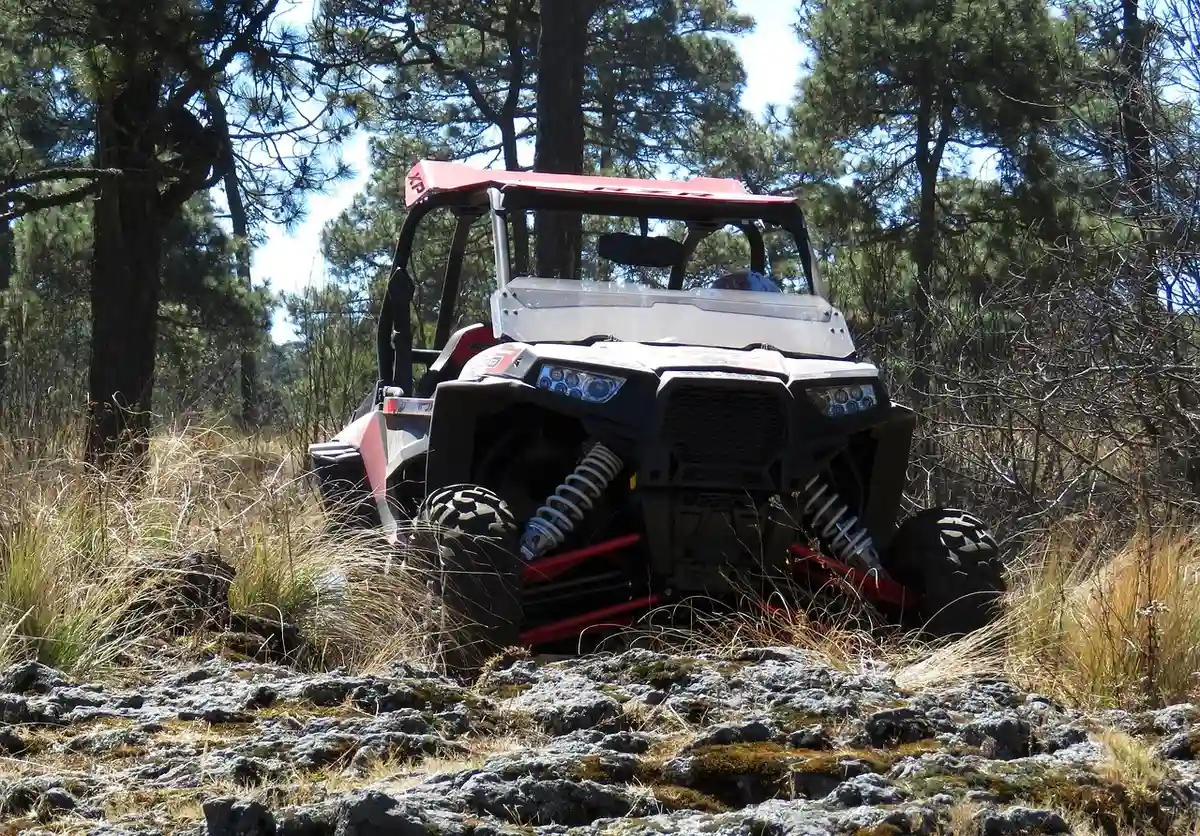
The over-temperature lamp means the engine is hot. If it flashes, Polaris says the overheat is continuing and the system will cut engine power on its own. From the seat, that can feel like the engine suddenly lost power.
Polaris's fix for an overheated engine is to clean the radiator screen and core and the engine exterior. It also warns that blocking airflow with accessories in front of the radiator or behind the fan can cause overheating. Skip the pressure washer: Polaris says high pressure can damage the fins.
Then check coolant the way the manual describes:
- Park level, in PARK, with the engine cool.
- Look at the overflow bottle. The level should sit between MIN and MAX.
- Add Polaris 50/50 premix through the bottle, not the radiator cap.
- Open the radiator cap only if the bottle is dry, and never while the engine is warm.
A bottle that keeps running dry points to a leak, which needs a dealer pressure test (the chart calls for one yearly). The cooling fan runs on a 25 A Fan CB fuse in the 2022 fuse box. Polaris says to drain and refill the coolant every 5 years; capacity is 5.44 quarts.
3. Check engine light: how to read the code
The check engine lamp means an EFI fault, and Polaris says not to operate the vehicle while it's on. The catch most owners miss: the General doesn't store codes. Turn the key off and the code is gone until the fault comes back.
Read it before you shut down:
- Press and hold MODE to open the settings menu.
- Toggle to "DIAGCODE" and press MODE.
- Write down all three numbers: the FMI, the SPN and the code count.
- Toggle up to see if there are more codes. A blinking check engine lamp means the code is an engine code; a blinking EPS lamp means it's a steering code.
Those numbers are what a dealer needs. The 2020 and 2022 owner's manuals explain how to read codes but don't list what each number means, so don't trust a random code chart for a different Polaris model.
4. Won't crank or cranks but won't start
For a dead click or nothing at all, Polaris's chart lists four causes: low battery voltage, loose battery connections, loose solenoid connections and loose electronic control box connections. Battery first. A fully charged General battery reads 12.8 V or more; below 12.5 V, Polaris says to charge it right away.
A basic digital multimeter answers that question in seconds. If the General sits for more than two weeks, Polaris recommends a BatteryMINDer 2012 AGM 2 A charger.
Next, check fuses. The 2022 manual puts the fuse center under the driver's seat:
- 10 A: EFI, Term, Accessory, UNSW, Drive, Key
- 15 A: Lights
- 25 A: Info, EPS, Fan CB
The 2020 manual has no amp list and notes that the power steering fuse sits on the steering harness near the fuse box, so check your own manual on older machines.
If it cranks but won't fire, Polaris points to fuel and spark: empty tank, water in the fuel, old fuel, or a fouled plug. The plug is an MR7F gapped 0.7–0.8 mm and torqued to 7 ft-lb. Crank for 5 seconds at most, key off, wait 5 seconds and try again.
Two related warnings: the "Check Battery" lamp usually means you're idling with lights, fan and accessories on, so drive at higher rpm or charge the battery. And if the whole cluster goes dark, Polaris says a battery over-voltage may have shut it off to protect it, which needs a dealer diagnosis.
5. AWD won't engage or the front stays locked
The General's AWD isn't full-time. With the switch in AWD, the front gearcase engages automatically when the rear wheels lose traction and lets go when they regain it. There's no time limit on leaving it in AWD.
Two rules explain most "my AWD is broken" posts. First, the electronics won't enable AWD until engine speed is below 3,100 rpm. Second, Polaris warns that switching to AWD while the rear wheels are spinning "may cause severe drive shaft and clutch damage." Let off the throttle first.
If steering stays heavy and speed feels restricted after you switch AWD off, the front gearcase is still locked. Polaris's fix:
- Stop the vehicle.
- Drive in reverse for at least 10 feet (3 m).
- Stop completely.
- Shift into low and drive forward.
If it's still locked, it's dealer time. Use the right fluid when you service the front gearcase: Polaris specifies Polaris Demand Drive Fluid, 7.5 oz, changed every 100 hours, 12 months or 1,000 miles.
One more switch position trips people up. The bottom position is TURF mode, an unlocked rear differential for protecting lawns. Polaris says never to use it on hills, sidehills, or loose or slippery ground, because one rear wheel can slip or lift and grab. Use AWD on that terrain.
6. EPS warning light and heavy steering
The EPS light comes on briefly at key-on. It also comes on when the EPS shuts itself down to save the battery, which happens 5 minutes after the engine stops if the key stays in ON. Turn the key off and on to reset it.
If the light stays on after the engine starts, the EPS isn't working. Polaris warns that driving on could permanently damage the EPS unit, so check the 25 A EPS fuse and then get it to a dealer. Keep the power steering unit clean, too; Polaris says mud around it stops it cooling.
Rule out the mechanical side as well. Steering freeplay should be 0.8–1.0 in (20–25 mm); more than that, odd noises, or a rough or "catchy" feel needs inspection. On 2020–2022 machines, look closely at the steering wheel spokes, which are the subject of recall 22-714.
7. General 1000 won't go over 15 mph
This one isn't a fault. The driver's seat belt has an interlock, and Polaris says vehicle speed "will be limited to 15 MPH (24 km/h) if the seat belt is not secured." Latch the driver's belt fully and the limit goes away.
If you're belted in and it's still slow, look at the display. Some Generals have a speed limitation function that shows "LIM" followed by a speed, such as "LIM 30." A front gearcase stuck in AWD also restricts speed (see problem 5).
There's also a load limit worth knowing. The center-console label says never to exceed 43 mph on a 2-seat General if total payload is over 430 lb, or 50 mph on a General 4 over 645 lb. The 2022 General 1000's maximum weight capacity is 1,030 lb, including riders, cargo and accessories, with 600 lb max in the box.
8. Belt slips after water, mud or snow
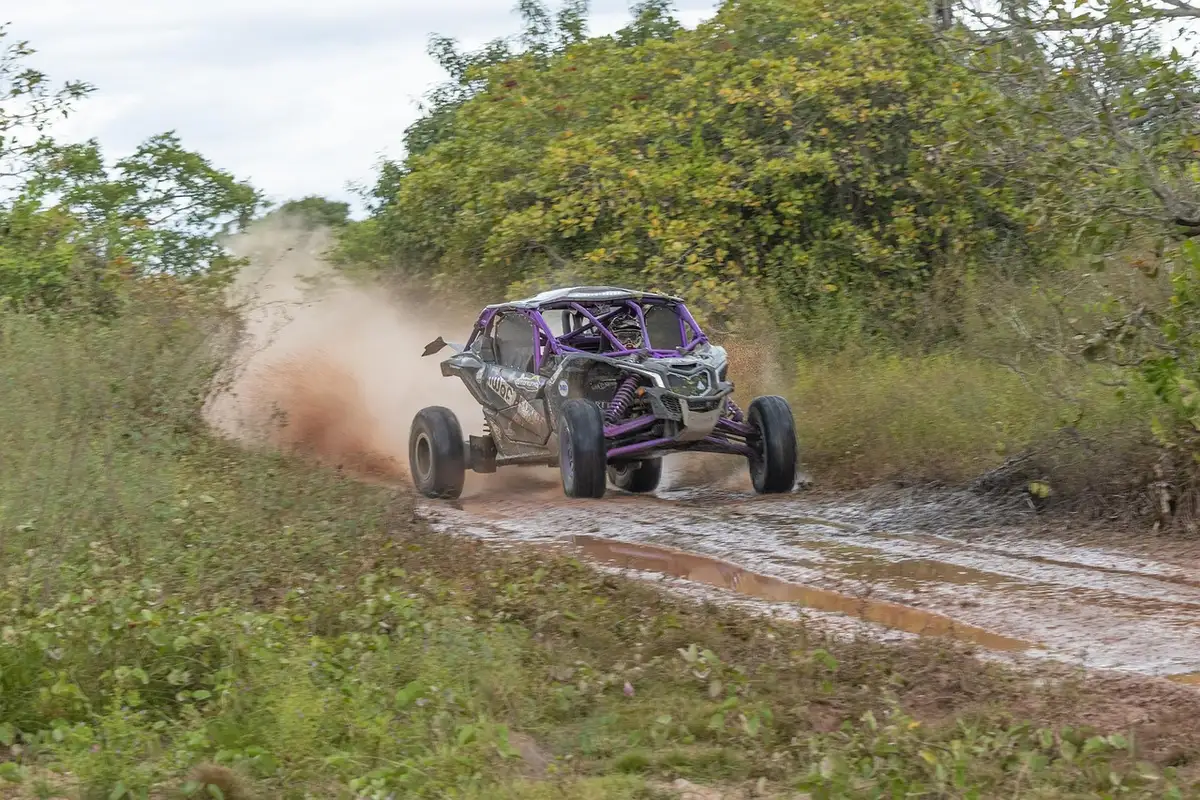
Water or snow in the PVT makes the belt slip, and a slipping belt heats up and burns. Polaris's drying procedure:
- Remove the clutch cover drain plug, let the water drain, and refit the plug.
- Put it in PARK with the brakes applied and start the engine.
- Use varying throttle for 10–15 seconds to dry the belt and clutches. Don't hold it wide open for more than 10 seconds.
- Let it settle to idle, shift to the lowest range and test for slip. Repeat if it still slips, then get it serviced.
If the General went deeper, Polaris says to take it in before starting it. If that's impossible: move to dry ground, dry the airbox (replace the filter if it's wet), dry the intake manifold, pull the plugs and turn the engine over on the starter, then dry or replace the plugs. Have it serviced either way.
Before the next crossing, check how deep you can safely go with our water crossing depth checker. Repeated leaks after crossings mean the clutch seals need a look.
Cooking a belt after water is not unique to Polaris; our CFMOTO ZForce 800 Trail problems guide covers the same CVT drain and belt checks on a rival 800 cc side-by-side.
Polaris General 1000 recalls by model year
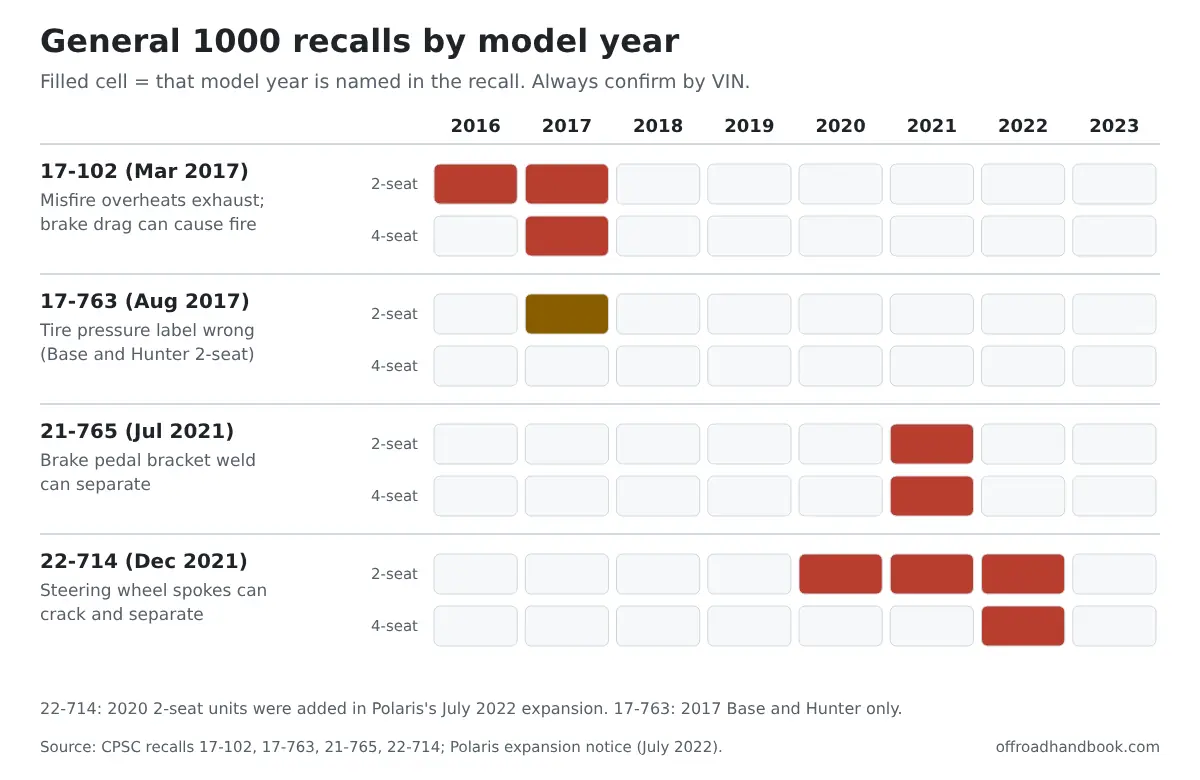
A used General is only as safe as its recall history. These four CPSC recalls name the non-XP General 1000 or General 4 1000. In each case, the CPSC tells owners to stop using the vehicle until it's repaired, and the repair is free.
| Recall | Models and years named | Hazard | Remedy |
|---|---|---|---|
| 17-102 (Mar 2, 2017) | 2016–2017 GENERAL 1000 EPS; 2017 GENERAL 4 1000 EPS (plus RZR models) | Engine misfire can overheat and melt exhaust parts; contaminated brake master cylinder can drag the brakes. Fire and burn hazard. | Free repair |
| 17-763 (Aug 22, 2017) | 2017 GENERAL Base and GENERAL Hunter (2-seat) | Inconsistent tire pressure information can lead to wrongly inflated tires. | New tire pressure label and manual update |
| 21-765 (Jul 22, 2021) | 2021 GENERAL 1000 and GENERAL 4 1000 (plus XP models) | Weld between the brake pedal pivot bracket and EPS mounting bracket can separate; loss of brakes. | Free inspection and repair |
| 22-714 (Dec 23, 2021) | 2021–2022 GENERAL 1000; 2022 GENERAL 4 1000 (plus XP and RZR models); expanded in July 2022 to more 2020–2022 GENERAL 1000 units | Steering wheel can separate; loss of control. | Free repair, including a new steering wheel |
Polaris says the expanded steering wheel recall covers about 38,900 vehicles worldwide, after 48 reports of broken or cracked spokes, including nine rollovers and five injuries. That's the one to check first on any 2020–2022 General 1000.
Confirm any machine by VIN on Polaris's off-road recall lookup at polaris.com or by calling Polaris at 800-765-2747, the number listed in the CPSC notices. A listed model year doesn't mean every unit was included.
General 1000 maintenance specs that prevent most of these problems
Most of the problems above start with skipped maintenance or the wrong fluid. Polaris defines severe use as frequent mud, water or sand, dusty riding, short cold trips, prolonged slow heavy-load work and extended idling, and wants service more often for those machines. In other words, most trail and farm Generals.
| Item | Spec (2022 GENERAL 1000) | Interval (whichever comes first) |
|---|---|---|
| Engine oil and filter | Polaris PS-4 5W-50, 2.5 qt | Break-in change at 25 hr / 500 mi, then 100 hr / 6 months / 1,000 mi |
| Transmission (main gearcase) | Polaris AGL, 44 oz; plugs 10–14 ft-lb | 100 hr / 12 months / 1,000 mi |
| Front gearcase | Demand Drive Fluid, 7.5 oz; plugs 8–10 ft-lb | 100 hr / 12 months / 1,000 mi |
| Drive belt | Inspect, adjust, replace as needed | 50 hr / 6 months / 500 mi |
| Spark plug | MR7F, 0.7–0.8 mm gap, 7 ft-lb | Inspect 100 hr / 12 months / 1,000 mi |
| Coolant | Polaris 50/50 premix, 5.44 qt | Check daily; replace every 5 years |
| Battery | 12.8 V full; charge below 12.5 V | Clean and test 25 hr / monthly / 200 mi |
| Brake fluid | Replace | Every 2 years |
| Tire pressure | 14-in wheels: 12 psi front, 14 psi rear; 12-in wheels (Sport/Base): 10 front, 18 rear | Before every ride |
| Lug nuts | Aluminum wheels 120 ft-lb; tapered nuts 60 ft-lb | Check occasionally and after service |
| Valve clearance | Dealer inspection | 5,000 mi |
Polaris recommends Polaris PS-4 5W-50 full synthetic oil and warns that mixing brands or using a non-recommended oil may cause serious engine damage. For the transmission, it specifies Polaris AGL gearcase lubricant.
Watch the oil level in cold weather. Polaris says a rising level can mean contaminants are collecting in the crankcase: change the oil right away, and stop using the machine if it keeps rising.
Those tire pressures are far lower than a truck's, and Polaris warns that improper pressure or overloading can cause loss of control. To see how terrain changes air-down numbers in general, try our off-road tire pressure calculator, but stick to Polaris's label on the General.
Towing has limits too. The spec page lists a 2,000 lb towing capacity, while the towing chart in the same manual gives 1,500 lb total towed load on level ground. Both cap hitch weight at 150 lb, and the chart limits towing speed to 10 mph in low range.
What other General 1000 problem guides get wrong
Several of the top-ranking General 1000 problem pages don't cite Polaris at all, and it shows:
- "Install thicker leaf springs" for bottoming out. The General 1000 has independent double A-arm suspension front and rear, with 12.25 in of front travel and 13.25 in of rear travel per Polaris. There are no leaf springs.
- "Keep the clutch lubricated." Polaris's maintenance chart lists the drive and driven clutches as inspect, clean and replace worn parts, done by a dealer. It says not to modify the precision-balanced PVT.
- No recall check. None of the top three pages lists the four recalls above, including the steering wheel recall.
- No mention of the seat belt interlock. None explains that an unlatched driver's belt limits the General to 15 mph.
If you also run a Ranger, the Polaris Ranger 1000 problems guide and the Ranger 700 XP problems guide cover those machines. For any brand, our ATV and UTV troubleshooting guide covers bogging, no-starts and belt heat in general.
Polaris General 1000 problems FAQ
How long does a Polaris General 1000 drive belt last?
Polaris doesn't publish a mileage. It says to inspect the belt every 50 hours, 6 months or 500 miles. Belt life depends on how often you use low range, how much you haul or tow, and whether the PVT stays dry.
Can I leave my General 1000 in AWD all the time?
Yes. Polaris says there's no limit to how long the General can stay in AWD. The front only drives when the rear wheels slip. Just don't switch into AWD while the rear wheels are spinning.
Why is my Polaris General limited to 15 mph?
The driver's seat belt isn't latched. The interlock limits speed to 15 mph until it is. If you see "LIM" and a number on the display, a speed limit has been set.
Does the General 1000 store trouble codes?
No. Codes show only while the check engine or EPS lamp is on, and they're lost when the key is turned off. Read them in the DIAGCODE menu and write down the FMI, SPN and count before you shut down.
Which General 1000 years have recalls?
CPSC recalls name the 2016–2017 (fire/brake drag), 2017 Base and Hunter (tire label), 2021 (brake pedal weld) and 2020–2022 (steering wheel) models. Check any machine by VIN with Polaris.

I'm Suryashankar Dasgupta, the founder of Off-Road Handbook. I've been off-roading for years in the USA, including California and Texas, and have ridden mountain and desert terrain abroad. I've also driven a Jeep Compass for more than seven years, so I know the day-to-day side of Jeep ownership first-hand, from the Uconnect screen to the warning lights. Every guide here is researched from manufacturer owner's manuals, NHTSA recall and service-bulletin records and other trusted sources, checked against them before it is published, and corrected when we find a mistake. You can read how we work in our editorial policy: https://offroadhandbook.com/editorial-policy/
Like our off-road guides? Add Off-Road Handbook as a Google Preferred Source so our latest Jeep, ATV, UTV, trail, recovery, and off-road troubleshooting articles can appear more often in your Google Search experience.
Add us as a Preferred Source