Polaris RZR XP 1000 Problems: Wet Belt, Overheating and EPS Fixes
Last updated on October 26th, 2026 at 08:46 pm
This post contains Amazon affiliate links. As an Amazon Associate I earn from qualifying purchases, at no extra cost to you.
Most Polaris RZR XP 1000 problems trace back to the drive belt, water in the clutch housing, overheating or a handful of electrical checks, and you can diagnose most of them for free. Polaris's own troubleshooting table puts driving habits, like crawling at 3–7 mph in High or loading a trailer in High, at the top of its list of belt killers.
Before you buy parts, run the VIN for open recalls. The CPSC lists eight recalls that cover XP 1000 model years from 2014 to 2025, and five of them are fire or burn hazards.
RZR XP 1000 problems at a glance
This table pairs each symptom with the free check Polaris points to first. Everything in it comes from the 2019 RZR XP 1000 owner's manual and the 2025 RZR XP 1000 owner's manual.
| Problem | What you notice | Check first (free) | Usual fix |
|---|---|---|---|
| 1. Belt slipping or burning | Burnt-rubber smell, revs climb but it won't pull, belt breaks | Were you crawling, climbing or loading in High? | Use Low, warm the belt up, replace the belt and clear ALL debris |
| 2. Wet belt | Slips right after water, mud or washing | Clutch-cover drain plug | Drain the cover and run the PVT drying procedure |
| 3. Overheating | Hot light on; flashing means the ECU is cutting power | Radiator screen and core, coolant level (cold) | Clean the core, top up and bleed coolant, check the fan circuit |
| 4. Check engine, misfire, stall | Light on, stumbling, backfiring, dies on the trail | Read the DIAGCODE before turning the key off | Fuel, vent line, intake filters, plugs, battery voltage |
| 5. Won't crank | Click or nothing at the key | Battery voltage at rest (12.8 V or more) | Charge the battery, tighten terminals, check the EFI fuse |
| 6. Stuck at 15 mph | Engine runs fine but speed tops out at 15 mph | Driver's seat belt | Latch the belt; a dealer checks the switch if it still limits |
| 7. EPS light, heavy steering | EPS lamp stays on, steering goes heavy | Was the key left on with the engine off? | Restart; EPS fuse; dealer diagnosis |
| 8. No front drive | AWD switch on, front wheels don't pull | Engine speed when you switched (must be under 3,100 rpm) | Re-engage with the rear tires gripping; fuse and front gearcase fluid |
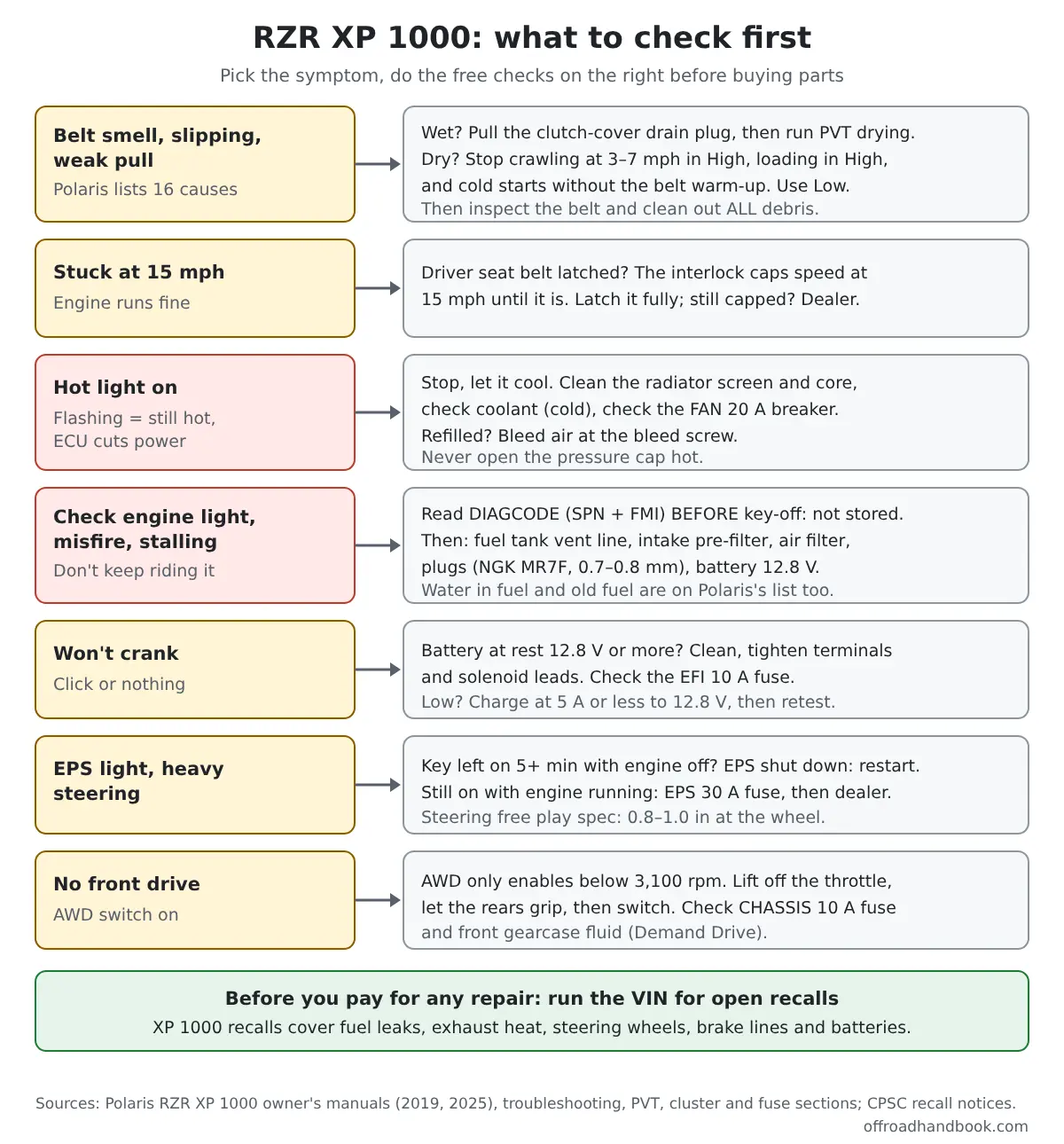
Seven of the eight first checks cost nothing but a few minutes with the machine parked; the eighth needs a cheap multimeter. The flowchart puts those same checks in the order to try them.
Fuse ratings in it come from the 2019 manual's fuse box. For other years, the label on your fuse box cover is the final word.
Free RZR XP 1000 symptom and recall checker
Pick your model year and the symptom. The checker lists the checks in the order Polaris's troubleshooting tables support, then shows every CPSC recall that names your model year.
A quick word on years: the 2014–2023 XP 1000 and the redesigned 2024–2025 XP 1000 share the 999 cc twin and most of the same troubleshooting advice. Fluid capacities, tire sizes and a few switches changed, so check the spec table before you pour anything in.
How it works: the checks come from the troubleshooting, PVT, cluster, EPS and AWD sections of the 2019 and 2025 Polaris owner's manuals. The recall list is the eight CPSC notices in the recall table further down. It's a starting point, not a diagnosis.
1. Drive belt slipping, burning or breaking
Belt trouble tops nearly every RZR XP 1000 problem list, and Polaris's troubleshooting table explains why. It lists 16 causes of belt wear or burn, and most of them are driving habits rather than defects.
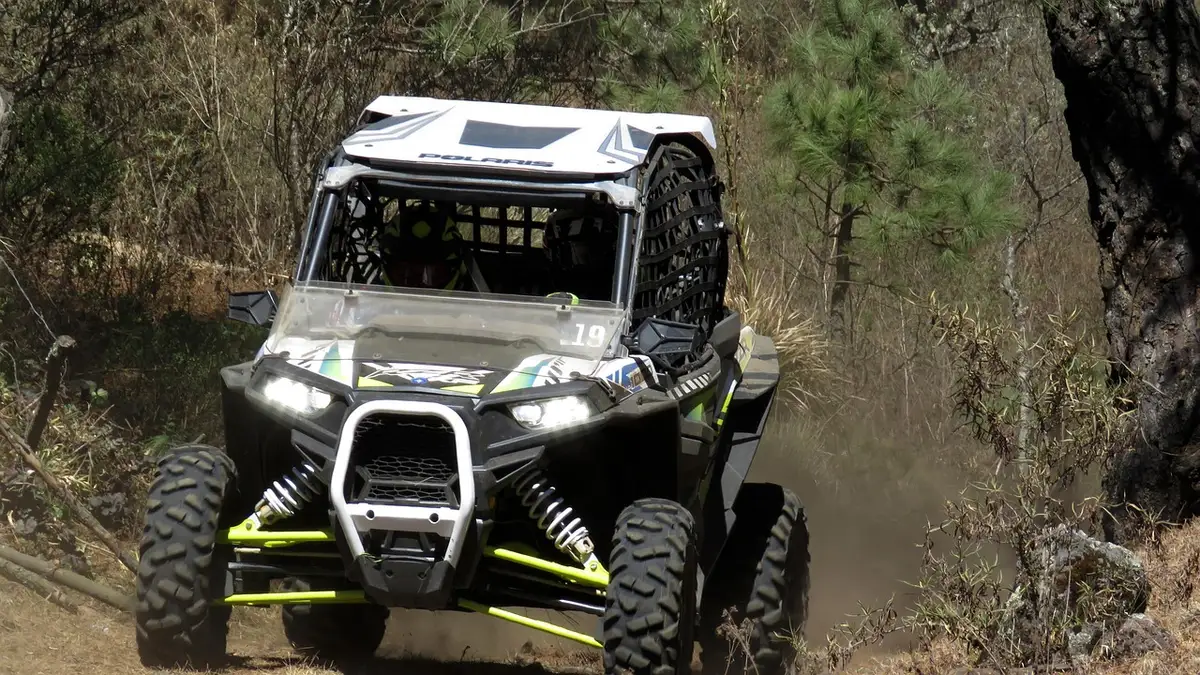
The core problem is slip. In Polaris's words, belt slip "is responsible for creating excessive heat that destroys belts, wears clutch components and causes outer clutch covers to fail." Polaris's fix is to switch to Low at slower speeds to extend the life of the belt and clutch parts.
Shift to Low before you do any of these:
- Crawling at 3–7 mph (the manual's exact range)
- Loading onto a pickup or tall trailer
- Starting out uphill on a steep grade
- Hauling, towing or pushing at low speed
- Climbing over big rocks or logs from a stop
- Getting unstuck in mud or snow, with fast but careful throttle (Polaris warns too much throttle can cause a rollover)
The 2025 manual adds a broader rule: use Low whenever you're consistently under 35 mph in hard-pulling terrain like mud, rocks or dunes. That's the setting most people forget.
Cold starts and new belts
A cold belt is stiff. Polaris says to warm the engine at least 5 minutes, then blip the throttle to about ⅛ in short bursts five to seven times in neutral. After that, ride under 30 mph for 1 mile, or 5 miles when it's below freezing.
A new belt or clutch also needs a break-in. Drive gently for the first 50 miles with light loads, or, on sand, dunes or mud, run the first 5 miles in Low. Skipping it is on Polaris's list of belt-failure causes.
Inspecting and replacing the belt
The 2025 manual says to replace the belt if you find fraying, hour-glassing, loose cords, missing cogs, abrasions or burns. If you're reusing a belt, put it back in the same direction of rotation. A new belt goes on with the part number facing out.
After a belt failure, cleanup matters more than the belt. Polaris warns that leftover debris in the clutch cover, ducts or engine bay can cause "vehicle damage, loss of control and severe injury or death." On 2025 models, torque the 14 clutch-cover fasteners to 4.4 ft-lb.
Belt part numbers changed over the years, so match the number printed on your old belt or in your manual before ordering. You can compare RZR XP 1000 drive belts on Amazon, including the genuine Polaris belt. Kawasaki changed its KRX 1000 belt number for 2025 as well; the KRX 1000 problems guide lists the numbers by model year.
2. Belt slipping after water, mud or washing
If the belt slips right after a creek crossing, a deep puddle or a wash, water probably got into the PVT (Polaris Variable Transmission) housing. A wet belt slips on the sheaves until it's dried out.
Polaris's PVT drying procedure:
- Remove the clutch-cover drain plug, let the water drain, then reinstall the plug.
- Put the transmission in PARK and hold the brakes.
- Start the engine and apply varying throttle for 10–15 seconds to blow out moisture. Don't hold wide open for more than 10 seconds.
- Let it settle to idle, brakes on, and shift to the lowest range.
- Drive forward slowly to test for slip. If it still slips, repeat.
Polaris then says the vehicle needs service as soon as possible. If water keeps getting in, have the clutch-cover seals inspected.
Prevention is simple. Polaris rates the XP 1000 for water up to floor level, no deeper, and warns the big tires can float the machine in deep or fast water. Our water crossing depth checker walks through how to judge depth before you commit.
When washing, don't spray toward the PVT intake or pre-filters.
If the machine was submerged or ran in water past the floor, Polaris says to have it serviced before starting the engine. If you can't reach a dealer first, the manual's fallback is to dry the airbox, fit a new air filter, dry the fuse box and pull the plugs before turning the engine over.
3. Overheating and the flashing hot light
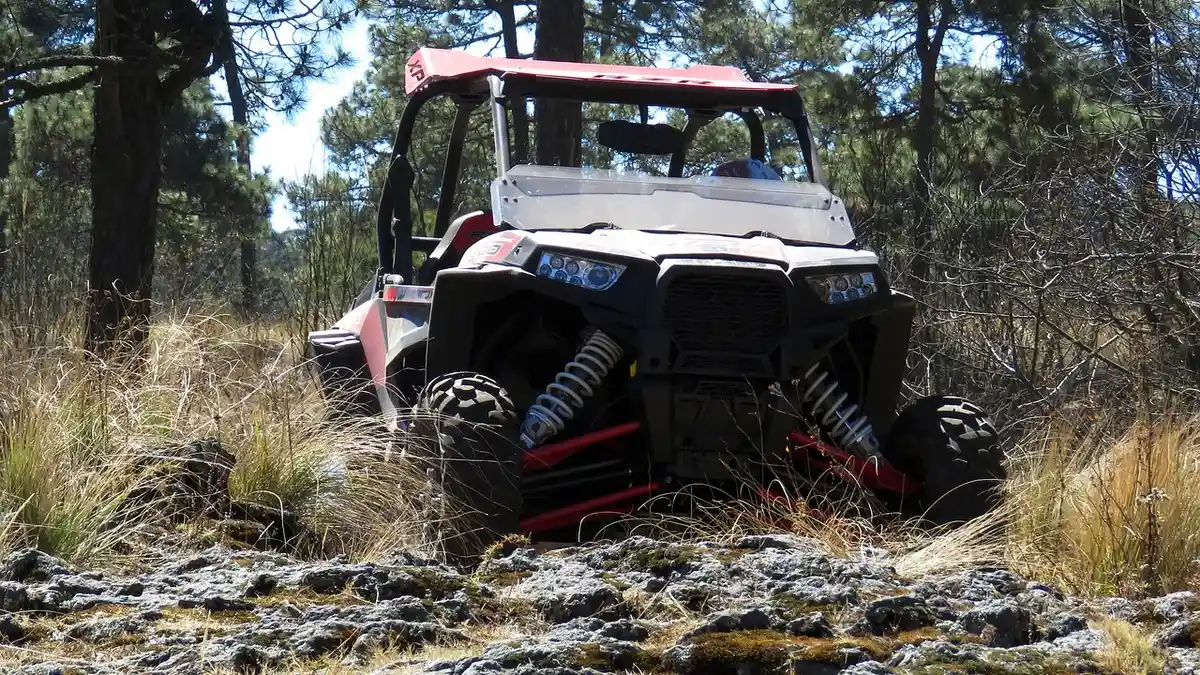
The over-temperature lamp means the engine is overheated. If it's flashing, the overheat is still there and the system will automatically cut engine power. That's why an overheated XP 1000 can suddenly feel gutless.
Work through it in this order once the engine has cooled:
- Clean the radiator screen, the radiator core and the engine exterior. Polaris lists this first for an overheated engine.
- Look for anything mounted in front of the radiator or behind the fan. Polaris says blocking or deflecting airflow can cause overheating.
- Check the overflow bottle. If it ran dry, check the radiator level too. Never remove the pressure cap while the engine is warm.
- After adding coolant, bleed the air: crack the bleed screw behind the seats until only coolant comes out, then tighten it.
- If the fan never runs, check the 20 A FAN circuit breaker (2019 fuse box), then have the fan circuit tested.
Washing can hurt cooling too. Polaris says high-pressure water can damage radiator fins and impair the radiator, so it recommends a garden hose and mild soap.
4. Check engine light, misfires and stalling
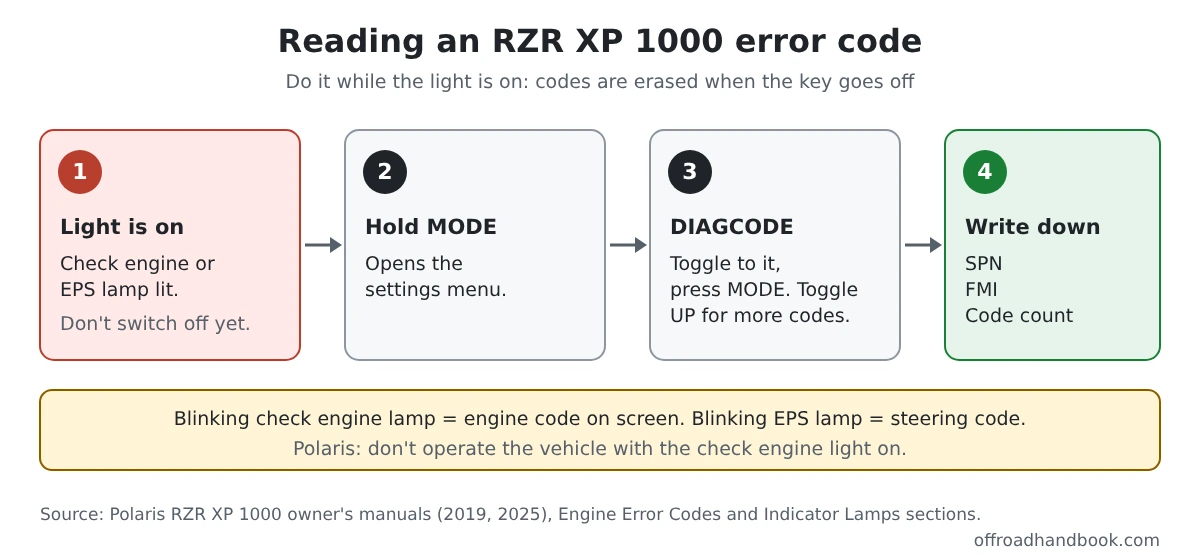
Polaris is blunt about this one: don't operate the vehicle with the check engine light on, because serious engine damage could result. Your first job is to capture the code.
Codes aren't stored. Once you turn the key off, the code is gone until the fault returns. While the light is on, press and hold MODE, toggle to DIAGCODE and press MODE again. Write down all three numbers: the SPN, the FMI and the code count. A dealer can work from those numbers.
For rough running, stalling or backfiring, Polaris's tables point to these owner checks first:
- Fuel: water in the fuel, old fuel or the wrong octane. Drain and refill with fresh recommended fuel.
- Fuel tank vent line: kinked or plugged lines and filters cause stalls. This same line was the subject of the 2015 recall.
- Air intake: a clogged or wet air filter, a plugged pre-filter (clean it with soapy water), or cargo blocking the intake vents.
- Spark plugs: fouled or wrongly gapped. Spec is NGK MR7F, gapped 0.7–0.8 mm, torqued to 7 ft-lb in both manuals.
- Battery: low voltage causes misfires too. Recharge to 12.8 V.
If you replace the plugs, check the gap before installing. Low fuel pressure, a clogged fuel filter and ignition timing are dealer-level jobs in Polaris's table.
5. Won't crank, or the check battery light comes on
For "engine doesn't turn over," Polaris lists low battery voltage, loose battery connections, loose solenoid connections and loose control-box connections. Start with a meter on the battery. A basic digital multimeter is all you need.
| Resting voltage | State of charge | What Polaris says to do |
|---|---|---|
| 12.8–13.0 V | 100% | Nothing |
| 12.5–12.8 V | 75–100% | May need a slight charge (3–6 hours) |
| 12.0–12.5 V | 50–75% | Charge (5–11 hours) |
| 11.5–12.0 V | 25–50% | Charge at least 13 hours, then verify |
| 11.5 V or less | 0–25% | Desulfating charger, at least 20 hours |
If the battery is good, clean and tighten the terminals and the starter solenoid leads. Then check the 10 A EFI fuse. On the 2019 layout, the fuse and relay center sits under the driver-side console.
The Check Battery light is a different message. Polaris says it usually means the engine is turning too slowly to keep the battery charged, often at idle with lights, fan and accessories running. Ride at higher rpm or charge the battery. Accessory lights and winches add to that load.
On 2024–2025 models, also check the recall below. The seat base can damage the red positive-terminal cover. Polaris's instructions say not to ride until it's fixed if that cover is damaged.
6. Stuck at 15 mph
If the engine pulls fine but the RZR won't go faster than 15 mph, check the driver's seat belt first. Both manuals say the driver's belt has an interlock that limits vehicle speed to 15 mph until it's fastened.
If it's latched and still capped, have a dealer check the belt switch and its wiring. Don't bypass it. If the hot light is flashing, the slowdown is the overheat power cut from problem 3, not the seat belt.
7. EPS light on or heavy steering
There's one harmless cause. If the key stays on for 5 minutes with the engine off, the EPS shuts itself down to save the battery and the lamp comes on. Restarting the engine clears it.
If the lamp stays on with the engine running, the EPS isn't working. Polaris warns that continued operation could permanently damage the EPS unit and make steering harder, so get it to a dealer soon. Before that, check the 30 A EPS fuse (2019 layout).
Also check free play. Turn the wheel lightly left and right on level ground; you should see 0.8–1.0 inch. Anything more, or steering that feels rough or catchy, needs inspection. On 2020–2022 machines, make sure the steering wheel recall has been done.
8. AWD won't engage or the front end clunks
The XP 1000 uses a demand-drive front gearcase. With the switch on AWD, it engages automatically when the rear tires lose traction and releases when they grip again. There's no time limit on running in AWD.
Two rules trip people up. First, the system won't enable AWD until engine speed is below 3,100 rpm, so flipping the switch at high revs seems to do nothing. Second, never switch to AWD while the rear tires are spinning. Polaris warns that can cause "severe drive shaft and gearcase damage."
If AWD still won't work, check the 10 A CHASSIS fuse, which feeds the AWD switch and coil on 2019 models. Then check the front gearcase fluid. Polaris specifies Polaris Demand Drive Fluid; check the current price on Amazon. Some 2024–2025 models have a three-position switch, so make sure it isn't in Turf (1WD) mode.
RZR XP 1000 recalls by model year
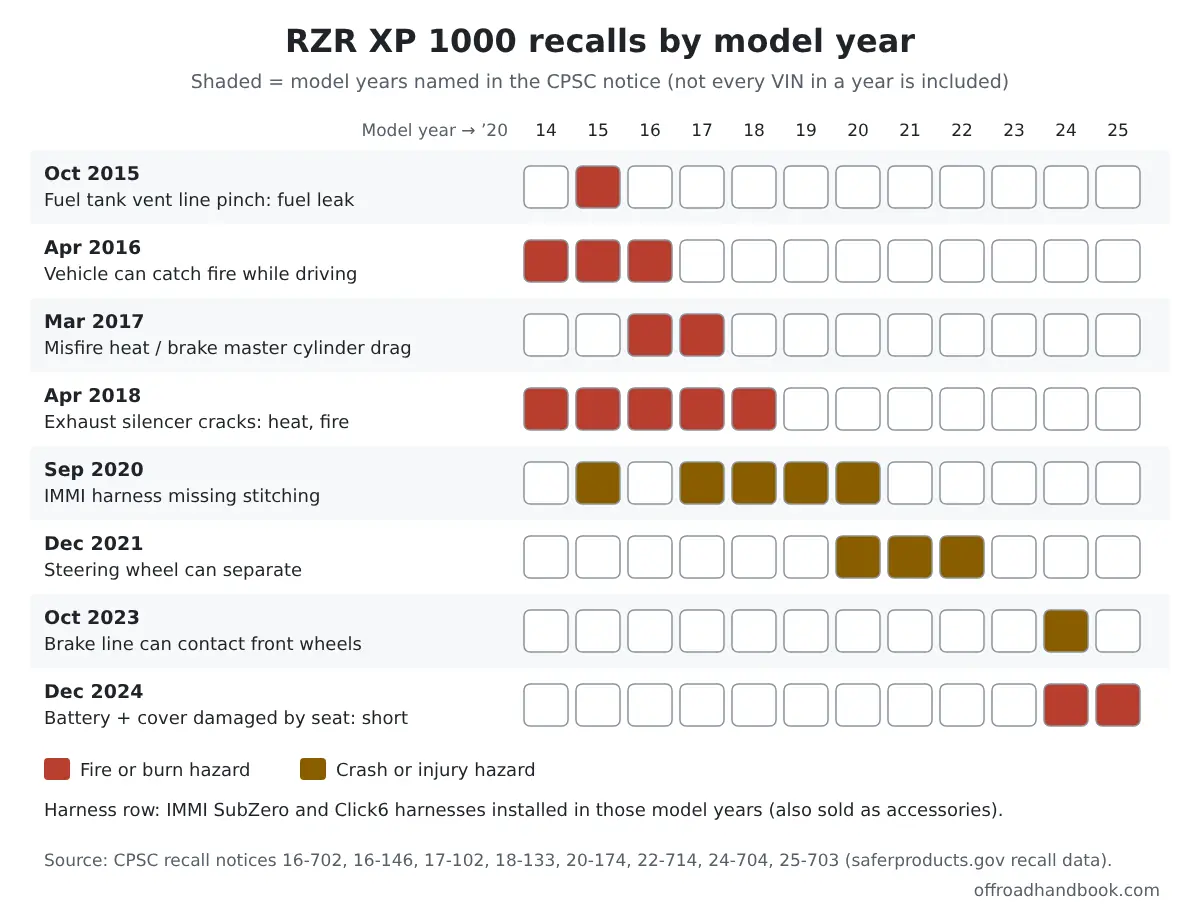
Off-road vehicles like the RZR are recalled through the Consumer Product Safety Commission, not NHTSA. So NHTSA's car recall search won't show them.
Here's every CPSC notice that names the XP 1000 or XP 4 1000, with the model years each one lists.
| Announced | Model years | Hazard | Units |
|---|---|---|---|
| Oct 2015 | 2015 | Fuel tank vent line can be pinched, so the tank leaks fuel (fire) | About 53,000, incl. RZR 900 |
| Apr 2016 | 2014–2016 | Vehicle can catch fire while driving | About 133,000, incl. RZR 900 |
| Mar 2017 | 2016–2017 | Misfire overheats exhaust parts, or brake master cylinder causes drag (burn, fire) | About 13,500, incl. other models |
| Apr 2018 | 2014–2018 | Exhaust silencer can crack (fire) | About 107,000 |
| Sep 2020 | 2015, 2017–2020 (if fitted) | IMMI 4- or 6-point harness missing stitching (injury) | About 162,000 harnesses |
| Dec 2021 | 2020–2022 (XP 4: 2021–2022) | Steering wheel can separate (crash) | About 8,800, incl. GENERAL |
| Oct 2023 | 2024 | Brake line can contact the front wheels, causing brake loss (crash) | About 2,500, incl. RZR Pro XP |
| Dec 2024 | 2024–2025 | Damaged battery terminal cover can short (fire) | About 21,000 |
Recalls cover specific VINs, so a listed year doesn't mean every machine from that year is included. Polaris's recall lookup or any Polaris dealer can check your exact VIN, and each notice lists a free remedy.
Buying used? Ask for proof the recalls were done, especially the fire recalls on 2014–2018 machines and the steering wheel on 2020–2022 machines. If the seller can't show it, have a dealer run the VIN before you pay.
Service specs you'll need: 2019 vs 2025 manual
Several of these fixes end with a fluid top-up or a torque wrench. These figures come straight from Polaris's manuals. If your machine is a 2014–2018 or 2020–2023, check your own manual too, because specs can change between model years.
| Item | 2019 RZR XP 1000 manual | 2025 RZR XP 1000 manual |
|---|---|---|
| Engine oil | PS-4 5W-50 (−35 to 100°F); PS-4 Extreme Duty 10W-50 (0 to 120°F) | PS-4 5W-50 (−35 to 100°F); PS-4 Extreme 0W-50 (−45 to 130°F) |
| Engine oil capacity | 2.5 qt* | 2.5 qt |
| Oil and filter change | At 25 hours or 1 month, then every 50 hours or 6 months | At 25 hours, then every 50 hours, 1,000 miles or 12 months (half that for severe use) |
| Transmission (AGL) | 44 oz | 55.8 oz |
| Front gearcase (Demand Drive Fluid) | 8.5 oz | 10.1–11.8 oz |
| Gearcase plugs | Transmission 10–14 ft-lb; front 8–10 ft-lb | Transmission 10–14 ft-lb; front 8–10 ft-lb |
| Spark plug | NGK MR7F, 0.7–0.8 mm, 7 ft-lb | NGK MR7F, 0.7–0.8 mm, 7 ft-lb |
| Lug nuts (aluminum wheels) | 120 ft-lb | 120 ft-lb |
| Hub retaining nut | 180 ft-lb | 180 ft-lb |
| Tire pressure, 2-seat | 16 psi front / 16 psi rear | 29 in tires: 16 / 16 psi; 30 in tires: 12 / 20 psi |
| Tire pressure, XP 4 | 19 psi front / 20 psi rear | 29 in tires: 19 / 20 psi; 30 in tires: 12 / 24 psi |
| Max weight capacity | 740 lb (XP 4: 900 lb) | 740 lb (XP 4: 900 lb) |
Polaris is firm about oil. Use Polaris PS-4 5W-50 or the cold- or hot-weather grade listed, don't use automotive oil, and never mix brands. Both manuals say mixing or a non-recommended oil may cause serious engine damage.
The transmission takes Polaris AGL gearcase lubricant. Note the 2025's larger capacities: pouring in the old 44 oz figure would leave a 2025 transmission about 12 oz low.
The tire pressures above are Polaris's label pressures for the stock tires and the rated load. If you're curious how pressure changes the footprint on sand or rock, our air-down tire pressure calculator explains the trade-offs, but stick to the label values unless you know what you're changing.
When to stop riding and call a dealer
- The check engine light is on. Polaris says not to operate the vehicle.
- The hot light keeps flashing after the screen and coolant checks.
- The EPS lamp stays on with the engine running.
- The machine was submerged past the floor. Don't restart it before service.
- Your VIN has an open fire, brake or steering recall.
- A belt exploded and you can't be sure you've cleared every scrap of debris.
Own a different Polaris? Our guides to RZR Pro XP problems and RZR 800 problems cover those machines. For a cross-brand checklist on bogging, no-starts, heat and belts, see our ATV and UTV troubleshooting guide. Cross-shopping Can-Am? Our Can-Am Maverick X3 problems guide covers its belt-protection messages and recall record.
RZR XP 1000 problems: FAQ
How long does an RZR XP 1000 drive belt last?
Polaris doesn't publish a belt life in hours or miles. The 2019 maintenance chart has the belt inspected every 50 hours and replaced as needed. Riding habits matter most: using Low below 35 mph in hard-pulling terrain and warming the belt on cold days are the two biggest things you control.
Why won't my RZR XP 1000 go over 15 mph?
The driver's seat belt interlock limits speed to 15 mph until the belt is fastened. If the belt is latched and it's still limited, have the switch checked. If the hot light is flashing, overheating is cutting power instead.
Can I use car oil in an RZR XP 1000?
No. Both the 2019 and 2025 manuals say "Do not use automotive oil" and warn against mixing brands. Use the PS-4 grade that matches your riding temperatures.
How do I read the error code on an RZR XP 1000?
With the check engine or EPS light on, hold MODE, toggle to DIAGCODE and press MODE. Record the SPN, FMI and count for each code. Codes are lost when the key is turned off, so read them before you shut down.
Where do I check RZR XP 1000 recalls?
Use Polaris's off-road recall lookup with your VIN, or ask any Polaris dealer. The recalls themselves are announced by the CPSC, so the NHTSA car recall tool won't show them.

I'm Suryashankar Dasgupta, the founder of Off-Road Handbook. I've been off-roading for years in the USA, including California and Texas, and have ridden mountain and desert terrain abroad. I've also driven a Jeep Compass for more than seven years, so I know the day-to-day side of Jeep ownership first-hand, from the Uconnect screen to the warning lights. Every guide here is researched from manufacturer owner's manuals, NHTSA recall and service-bulletin records and other trusted sources, checked against them before it is published, and corrected when we find a mistake. You can read how we work in our editorial policy: https://offroadhandbook.com/editorial-policy/
Like our off-road guides? Add Off-Road Handbook as a Google Preferred Source so our latest Jeep, ATV, UTV, trail, recovery, and off-road troubleshooting articles can appear more often in your Google Search experience.
Add us as a Preferred Source