Does 4WD Exempt You From Chains? Rules in CA, CO, OR, WA, UT
This post contains Amazon affiliate links. As an Amazon Associate I earn from qualifying purchases, at no extra cost to you.
Four-wheel drive gets you past most "chains required" signs in the West, but only with the right tires on all four corners, chains riding along in the cargo area, and no trailer behind you.
In California, Oregon and Washington the 4WD exemption disappears at the top level (R-3, a conditional closure, or "chains required on all vehicles"). Colorado's updated Traction Law cares about tread depth and tire rating, not just drivetrain, and Utah accepts M+S tires on 4WD but wants the snowflake, or chains, on 2WD.
The table below puts the five states side by side, straight from each state transportation agency. Then run your own rig through the checker further down.
4WD and AWD chain rules in 5 western states
| State | Sign levels | When 4WD/AWD can skip chains | Tire rule for that exemption | Must carry chains? | No exemption when |
|---|---|---|---|---|---|
| California | R-1, R-2, R-3 | R-2 (and R-1 if under 6,000 lb gross) | Snow-tread tires marked M+S, MS, M/S or MUD AND SNOW on all four | Yes, traction devices in chain control areas | R-3; towing at R-1 |
| Oregon | Carry chains; chains required (traction tires allowed or not); conditional closures | Most chain-required signs | M+S, all-weather radial or traction tires on all wheels; 6,500 lb or less unloaded; both axles powered | Yes | Towing; conditional closure for all vehicles |
| Washington | Traction tires advised; traction tires required; chains required; chains required on all vehicles | "Chains required" with all wheels engaged | Traction tires installed: ⅛ in tread and the M&S or All Season label with mountain/snowflake symbol; under 10,000 lb GVWR | Yes | Over 10,000 lb GVWR; "chains required on all vehicles" |
| Colorado | Traction Law; Passenger Vehicle Chain Law | Traction Law | At least 3/16 in tread on winter (snowflake), all-weather or M+S tires | Not stated for compliant 4WD | Passenger Vehicle Chain Law |
| Utah | Class I and Class II traction segments | Class II restrictions | M+S or 3PMSF tires on all wheels | Not stated in the rule | Over 12,000 lb GVW |
Two things jump out. First, three of the five states make an exempt 4x4 carry chains anyway, so "I have 4WD" isn't an excuse to leave them at home. Second, the weight cutoffs don't match: Oregon uses unloaded weight (6,500 lb), Washington uses GVWR (10,000 lb), and Utah uses GVW (12,000 lb).
That matters for full-size trucks. A three-quarter-ton pickup can sit under Washington's line and still be well past California's 6,000 lb R-1 exemption. Read the GVWR off your door-jamb sticker before the trip, not at the checkpoint.
Six checks before you pass a chain-control sign
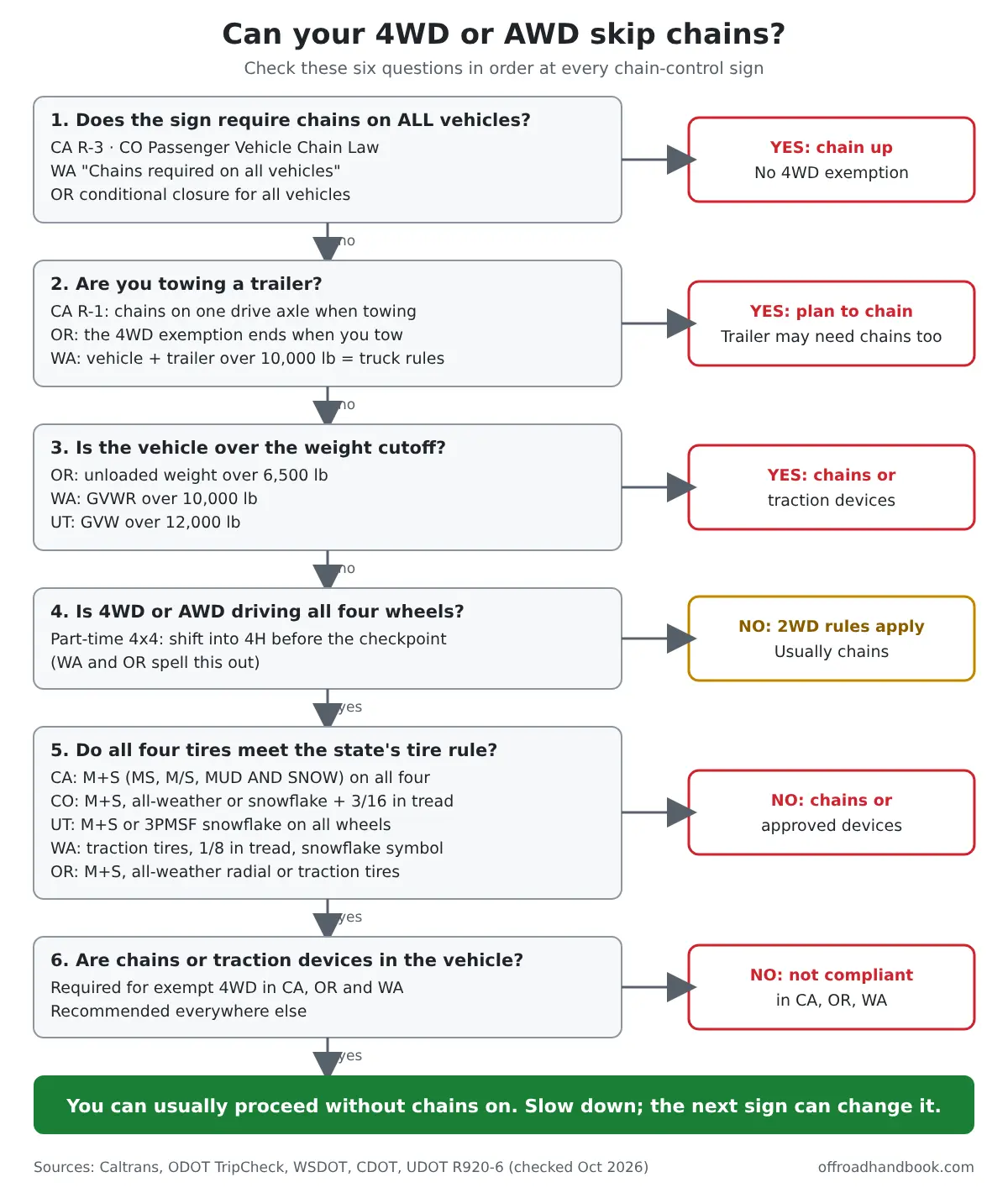
The order matters. Most people start with "do I have 4WD?" but that's question four. If the sign says all vehicles, if you're towing, or if your truck is over the weight line, the drivetrain never comes into it.
Question four trips up part-time 4x4 owners. Washington says vehicles with optional four-wheel drive must have all wheels engaged, and Oregon's exemption requires the vehicle to be "operated to provide power to both the front and rear wheels." Rolling through in 2H on a Wrangler, Tacoma or F-150 doesn't count.
If you're unsure which mode to use on a snowy highway, our guide to using 4H on the highway covers when it's safe.
Every state here lumps "four-wheel or all-wheel drive" together. If you're not sure which system your vehicle has, see 4WD vs AWD vs 4A.
Chain law checker for your 4x4
Pick the state and the exact sign you're facing, then describe your rig. The checker applies the official rule text for that state and tells you whether you can roll on, need to chain, or are in a gray area.
This checker encodes the official rule text from each state agency as of October 2026. It's a planning aid, not legal advice: posted signs and officers at the checkpoint always overrule it.
How it decides: California uses the Caltrans R-1/R-2/R-3 definitions, Oregon the TripCheck sign meanings and 4WD exemption list, Washington the WSDOT sign meanings and traction-tire definition, Colorado CDOT's November 2025 Traction Law text, and Utah Administrative Rule R920-6. Tread depth matters only where a state writes a number into the rule (Colorado's 3/16 in, Washington's ⅛ in).
A "gray area" result means the official wording is ambiguous for your setup. Treat it as "carry chains and be ready to put them on."
Do M+S mud and all-terrain tires count?
This is the question off-roaders care about most, because M+S and the three-peak mountain snowflake (3PMSF) are different markings, and not every M+S all-terrain or mud-terrain tire has the snowflake. The answer changes at the state line. Check your own sidewall; our guide on how to read mud tire sizes shows where the markings sit.
| Tires on all four (4WD engaged) | CA R-2 | OR chains required | WA chains required | CO Traction Law | UT Class II |
|---|---|---|---|---|---|
| M+S only, 6/32 in or more | Exempt (carry chains) | Exempt if 6,500 lb or less unloaded, carrying chains, not towing | Gray area | Compliant | Compliant |
| 3PMSF snowflake, 6/32 in or more | Exempt when the sidewall also shows M+S | Exempt (counts as traction tires) | Exempt (carry chains) | Compliant | Compliant |
| M+S, only 4/32 or 5/32 in left | No tread number in the rule | No tread number in the rule | Same as above (⅛ in = 4/32 in) | Not compliant: chains or device | No tread number in the rule |
| No M+S or snowflake mark | Chains | Chains | Chains | Chains or device | Traction devices on all drive tires |
Why Washington is a gray area: WSDOT defines traction tires as having "an eighth of an inch tread and a M&S or All Season label with a Mountain/Snowflake symbol." Read literally, the label and the snowflake go together, so an M+S-only mud tire may not pass. A tire with the snowflake removes the doubt.
Oregon has the opposite twist. Its 4WD exemption accepts M+S tires, but Oregon's "traction tires" (the ones that replace chains on 2WD) must be studded or carry the snowflake. So the same M+S tire works on your 4Runner but wouldn't qualify on a 2WD pickup.
State-by-state details that trip people up
California (Caltrans and CHP)
R-1 requires chains on all vehicles except passenger vehicles and light trucks under 6,000 lb gross weight with snow tires on at least two drive wheels. Anyone towing needs chains on one drive axle, and a trailer with brakes needs chains on at least one axle.
R-2 exempts 4WD/AWD with snow-tread tires on all four wheels, and Caltrans notes those vehicles must carry traction devices in chain control areas. R-3 means chains on everything, no exceptions. Caltrans says a highway is often closed before R-3 is imposed.
Caltrans also lists the speed limit in chain control as 25 or 30 mph. Its installers are independent businesses, not state employees, and aren't allowed to sell or rent chains, so bring your own.
Oregon (ODOT)
Oregon's exemption is the most detailed. All of these must be true: 6,500 lb or less unloaded, power to both axles, chains on board, M+S, all-weather radial or traction tires on all wheels, no trailer, and not being driven in a way that loses traction.
ODOT can also impose conditional closures. Its example for I-5 over Siskiyou Pass is "chains required on all vehicles excluding four wheel drive vehicles unless towing," where traction tires alone aren't enough. In very bad conditions, a closure can require chains on everyone.
Washington (WSDOT and WSP)
Washington has four steps. "Traction tires advised" is a recommendation for passenger vehicles. "Traction tires required" means traction tires or chains for vehicles under 10,000 lb GVWR. At "chains required," 4WD/AWD under 10,000 lb GVWR can skip chains only with traction tires installed, all wheels engaged and chains on board.
Studded tires don't satisfy a chain requirement in Washington, and they're legal only Nov. 1 to March 31. WSDOT also says any vehicle over 10,000 lb GVW, which can include large SUVs, must carry at least one set of chains over any mountain pass from Nov. 1 to March 31, even when no chain sign is posted.
Colorado (CDOT): the 2025 Traction Law change
Older guides say Colorado's Traction Law is satisfied by "4WD or AWD with 3/16 inch tread." CDOT's November 2025 release tightened the wording: 4WD and AWD now need at least 3/16 in tread on winter (mountain-snowflake), all-weather or M+S tires. Otherwise, chains or an approved alternative traction device go on two or more drive tires.
The Traction Law is in effect every year from Sept. 1 to May 31 on I-70 between Dotsero and Morrison, and CDOT can activate it on any state highway. The Passenger Vehicle Chain Law is the final step before closure, and then every vehicle needs chains or an approved device. CDOT's own pages describe the 2WD requirement differently, so 2WD drivers should check COtrip.org before heading up.
Utah (UDOT)
Utah splits restricted highways into Class I segments, where only vehicles over 12,000 lb GVW must be traction-device equipped, and Class II segments, where everyone must be. On Class II, the rule counts 4WD/AWD cars and light trucks with M+S or 3PMSF tires on all wheels as compliant.
A 2WD vehicle under 12,000 lb GVW needs 3PMSF tires on all wheels or traction devices on all drive tires. UDOT's map and summary sheet show which canyon routes are Class I and Class II.
Will chains fit on a lifted rig or oversized tires?
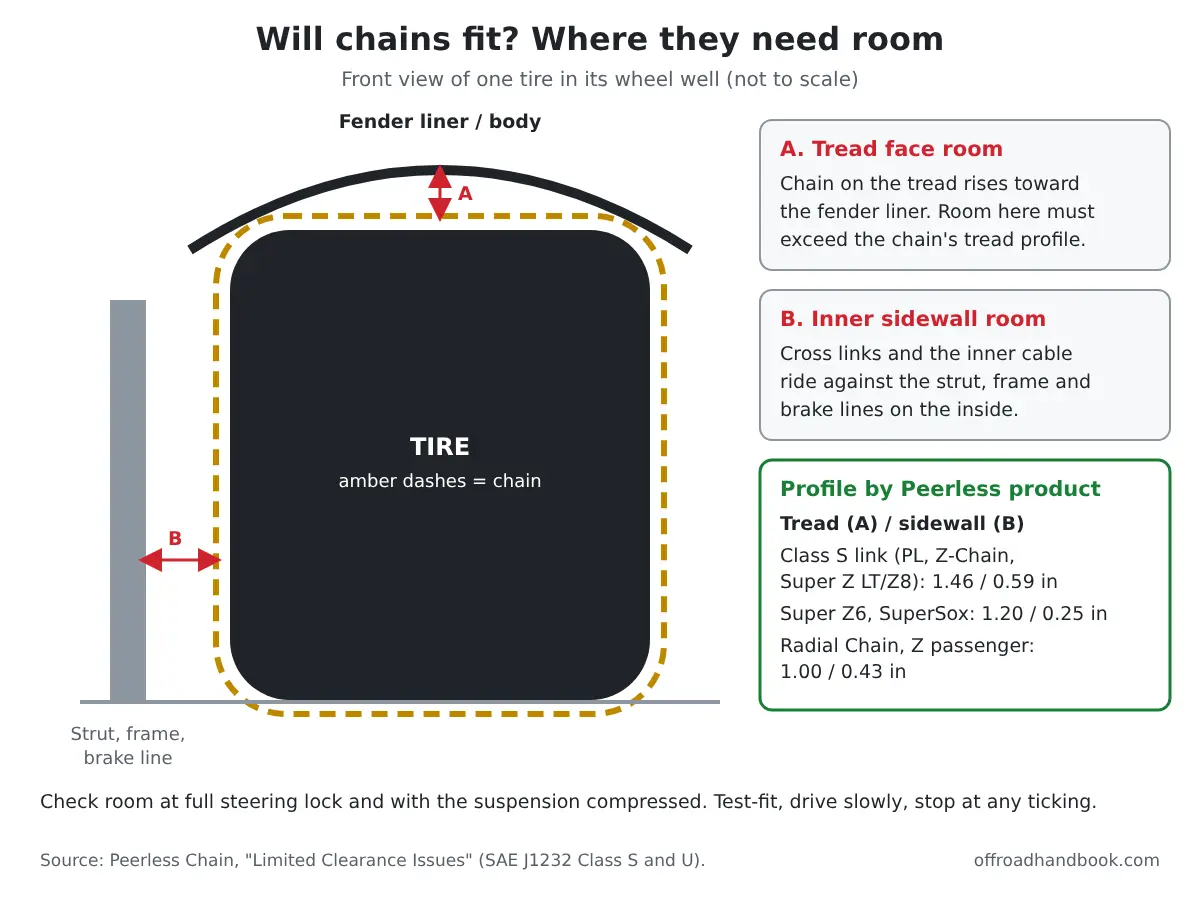
Being legal and actually fitting chains are two different problems. SAE J1232 sorts traction devices by how far they stand off the tire. Class S is for vehicles with restricted wheel-well clearance, and Class U is regular chain for vehicles with plenty of room.
Peerless lists its Class S link chains at 1.46 in off the tread face and 0.59 in off the inner sidewall. Its slimmer Super Z6 and SuperSox profiles are 1.20 in and 0.25 in. Your gap to the fender liner, strut, frame and brake lines has to be bigger than that.
Peerless adds that some owner's manuals rule out chains for certain tire sizes. Their advice is to test-fit, drive a short distance slowly, and stop and remove the chains at the first ticking sound. They also say not to exceed 30 mph with any traction product.
On a lifted truck with bigger tires, the inside sidewall often ends up closer to the control arms or sway bar than stock. Chains are sold by exact tire size, so confirm what's actually on the truck with our tire size calculator before you order. Then check the gap at full steering lock and with the suspension compressed.
Which tires get the chains on a 4WD?
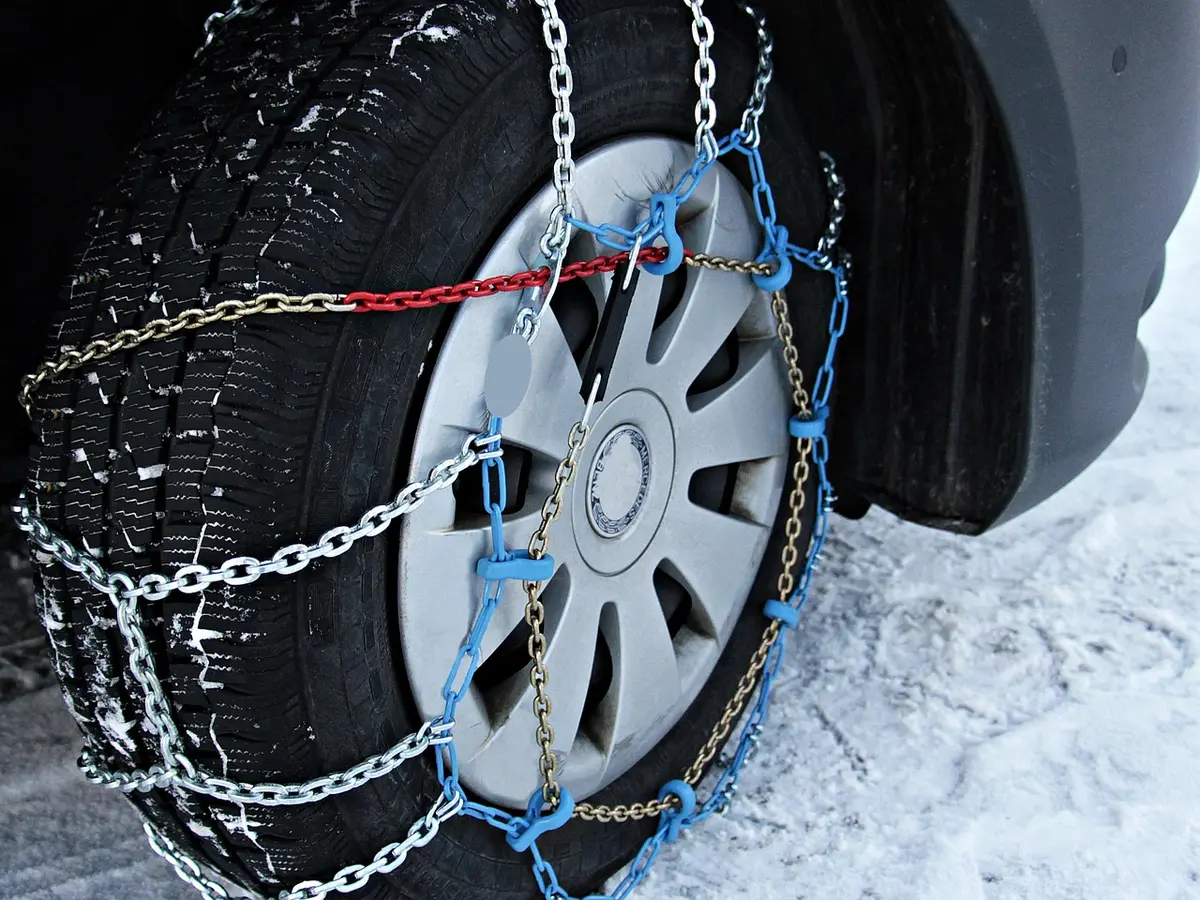
Your owner's manual decides this, because clearance is usually tighter at one end. WSDOT says that when chains are required on all vehicles, state law wants them on at least one set of two tires, either both fronts or both rears, and points drivers to the manual for specifics.
Colorado asks for chains or an approved device on two or more drive tires. Utah wants traction devices on all drive tires, which on a 4WD means all four, unless your tires already make you compliant. Caltrans publishes a chain installation chart for placement by vehicle type.
What to keep in the truck for chain season
- Chains sized to your exact tires. If clearance is tight, look at Class S options such as Peerless Super Z LT chains (check the current price on Amazon and match the size chart to your sidewall).
- A textile alternative for low-clearance setups. AutoSock is on Colorado's approved alternative traction device list. Search AutoSock tire socks by tire size. In Washington, an alternative must be on the WSP approved list to count.
- A tread depth gauge. Colorado's 3/16 in (6/32 in) and Washington's ⅛ in (4/32 in) are measurable. A cheap tire tread depth gauge settles it in your driveway.
- Gloves, a headlamp and something to kneel on. Practice one install at home; doing it the first time on a dark shoulder is miserable.
Pull completely off the roadway before installing chains, as Caltrans advises, and take them off only after the "End of Chain Control" sign at a safe pull-off.
Nevada, Idaho and other states
We left Nevada out of the table because we couldn't open NDOT's current requirements page to verify the wording, and secondhand summaries disagree on the weight cutoff. If you're driving the Nevada side of Lake Tahoe or I-80, check NVRoads or dial 511 before you go. The same goes for Idaho, Montana and Wyoming: use the state DOT's own page, and obey the sign in front of you.
FAQ
Do I need chains with 4WD in California?
At R-2 you can skip installing them if all four tires are marked M+S (or MS, M/S, MUD AND SNOW), but you still have to carry chains or traction devices. At R-3 everyone chains.
Do all-terrain tires count as snow tires?
Only if the sidewall says so. An M+S mark satisfies California, Oregon's 4WD exemption, Colorado (with 3/16 in tread) and Utah for 4WD. A 3PMSF snowflake covers Washington too.
Can I get a ticket for not carrying chains with 4WD?
Yes in states that require exempt 4x4s to carry them. Oregon lists failing to carry chains or traction tires as a Class C traffic violation, and Caltrans says the CHP can cite drivers who ignore chain signs.
Do studded tires replace chains?
Not in Washington: WSDOT says studded tires don't meet chain requirements. In Oregon, studded tires count as traction tires where those are allowed in place of chains.
How fast can I drive with chains on?
Caltrans lists the chain-control speed limit as 25 or 30 mph, and Peerless says not to exceed 30 mph with any traction product. Follow the lower of the posted limit and your chain maker's limit.
Sources
- Caltrans: Chain Controls / Chain Installation
- ODOT TripCheck: Oregon Chain Law and ODOT Winter Snow Zone
- WSDOT: Tires & chains
- CDOT: New Traction Law requirements (Nov. 20, 2025) and CDOT Traction and Chain Laws
- UDOT: Snow Tire & Chain Requirements (Rule R920-6)
- Peerless Chain: Limited Clearance Issues (SAE J1232)

I'm Suryashankar Dasgupta, the founder of Off-Road Handbook. I've been off-roading for years in the USA, including California and Texas, and have ridden mountain and desert terrain abroad. I've also driven a Jeep Compass for more than seven years, so I know the day-to-day side of Jeep ownership first-hand, from the Uconnect screen to the warning lights. Every guide here is researched from manufacturer owner's manuals, NHTSA recall and service-bulletin records and other trusted sources, checked against them before it is published, and corrected when we find a mistake. You can read how we work in our editorial policy: https://offroadhandbook.com/editorial-policy/
Like our off-road guides? Add Off-Road Handbook as a Google Preferred Source so our latest Jeep, ATV, UTV, trail, recovery, and off-road troubleshooting articles can appear more often in your Google Search experience.
Add us as a Preferred Source