4WD vs AWD vs 4A: What Each Setting Does and When to Use It
Last updated on October 26th, 2026 at 07:54 pm
Use 2H (two-wheel drive high) on dry pavement unless your truck has an automatic mode. 4H and 4L lock the front and rear driveshafts together and are meant for loose or slippery surfaces only. 4A, 4WD Auto, AUTO and 4H AUTO are automatic four-wheel-drive modes that the manuals of Ford, Ram, Chevrolet and Jeep allow for everyday roads. A true all-wheel-drive (AWD) vehicle has no switch to worry about and is built for pavement. Low range (4L) is for crawling, steep grades and heavy pulling, never for cruising.
The four kinds of drive system
The labels get mixed up because manufacturers use different names for similar hardware. What matters is whether the system can let the front and rear axles turn at different speeds.
- Part-time 4WD: A driver-selected transfer case locks the front and rear driveshafts together in 4H and 4L. There is no center differential, so the axles cannot turn at different speeds. This is the traditional truck setup.
- Automatic (on-demand) 4WD: A transfer case with an electronically controlled clutch sends power to the front axle as needed. It sits alongside 2H, 4H and 4L on the same switch or dial. Names include Ford 4A, Ram 4WD Auto, Chevrolet AUTO and Jeep 4H AUTO.
- Full-time 4WD: A center differential lets the axles turn at different speeds, so the system can run on any surface. Many have a lockable center differential and a low range for off-road use. Toyota calls its version "full-time four-wheel drive."
- AWD: Mazda defines it as a system that can deliver power to all four wheels without driver input, typically with no low range. It is designed for continuous on-road driving (Mazda USA).
What each setting does
2H: rear-wheel drive (or the default two-wheel mode)
Toyota's Tacoma guide says to keep the truck in 2WD for best fuel economy and performance under normal driving conditions (Toyota Tacoma Quick Reference Guide). Jeep and Chevrolet give the same advice for most streets and highways.
4H: four-wheel drive high
On a part-time system, 4H mechanically ties the front and rear axles together. On slick ground the tires slip enough to absorb the difference in distance traveled in a turn. On dry pavement they cannot, so the driveline binds, steering gets heavy, and tires and driveline parts wear. Ford says not to use 4H or 4L on dry, hard-surfaced roads because of noise, tire wear and possible damage (Ford F-150 owner manual). Our guide to using 4H on the highway covers the borderline cases, such as wet or snow-packed roads.
4L: four-wheel drive low
4L adds a low gear set in the transfer case for torque at crawl speed. Speed caps come from the manufacturers: Ram says not to exceed 55 mph in 4WD Low (2026 Ram 1500 owner's manual) and Jeep says not to exceed 25 mph in 4L on the Wrangler (2023 Wrangler owner's manual). For the shift procedure, see how to shift into 4-low.
4A, 4WD Auto, AUTO and 4H AUTO
These modes drive mainly one axle and bring in the other when sensors detect slip. Ram describes 4WD Auto as sending power to the front wheels and adjusting the front-to-rear split, for varying road conditions. Its manual says this transfer case is designed to be driven in 4WD Auto for normal street and highway conditions on dry, hard-surfaced roads. Chevrolet says to use AUTO when road conditions vary, with slightly lower fuel economy than 2HI (2024 Silverado 1500 owner manual). Jeep says the same for 4H AUTO and notes lower fuel economy than 2H.
Ford lists 4A as electronically controlled four-wheel drive that sends power front and rear as required, while restricting only 4H and 4L on dry pavement. Our F-150 section below goes into detail, and our FX4 vs Lariat comparison shows which F-150 trims get 4A.
What is safe on dry pavement: the original table
| System type | Dry pavement | Low range | US examples (what the manual says) |
|---|---|---|---|
| Part-time 4WD (4H locks axles) | 2H only. 4H and 4L can cause binding, tire wear and driveline damage | Yes, 4L | Ford F-150 4H/4L: not for dry, hard roads. Toyota Tacoma 2H/4H/4L: keep in 2WD for normal driving. Jeep Wrangler Command-Trac 2H/4H/4L: 4H and 4L for loose, slippery surfaces only. Ram and Chevrolet trucks without an auto position follow the same rule |
| Automatic 4WD (on-demand, selectable) | Yes, in the auto position. 4H and 4L still restricted | Yes, 4L on the same switch | Ford 4A, Ram 4WD Auto (street and highway on dry roads), Chevrolet AUTO (variable conditions), Jeep Wrangler 4H AUTO (street and highway on dry roads) |
| Full-time 4WD (center differential) | Yes in the normal high mode with the center differential unlocked. Check the manual for your model before using the locked modes | Yes, with lockable center differential | Toyota 4Runner full-time models (H4F, H4L, L4L positions). Jeep Selec-Trac and similar systems are also sold with an auto mode |
| AWD (no driver-selectable modes) | Yes, built for continuous on-road driving | Typically none | Ford Bronco Sport (see our Bronco Sport AWD guide), many crossovers |
Sources: Ford F-150 owner manual, 2026 Ram 1500 owner's manual (p. 203), 2024 Silverado 1500 owner manual (Drive Systems), 2023 Jeep Wrangler owner's manual (pp. 136-138), 2018 Tacoma Quick Reference Guide, 2018 4Runner Quick Reference Guide, Mazda USA. Model years differ, so check your own manual.
When to use each setting
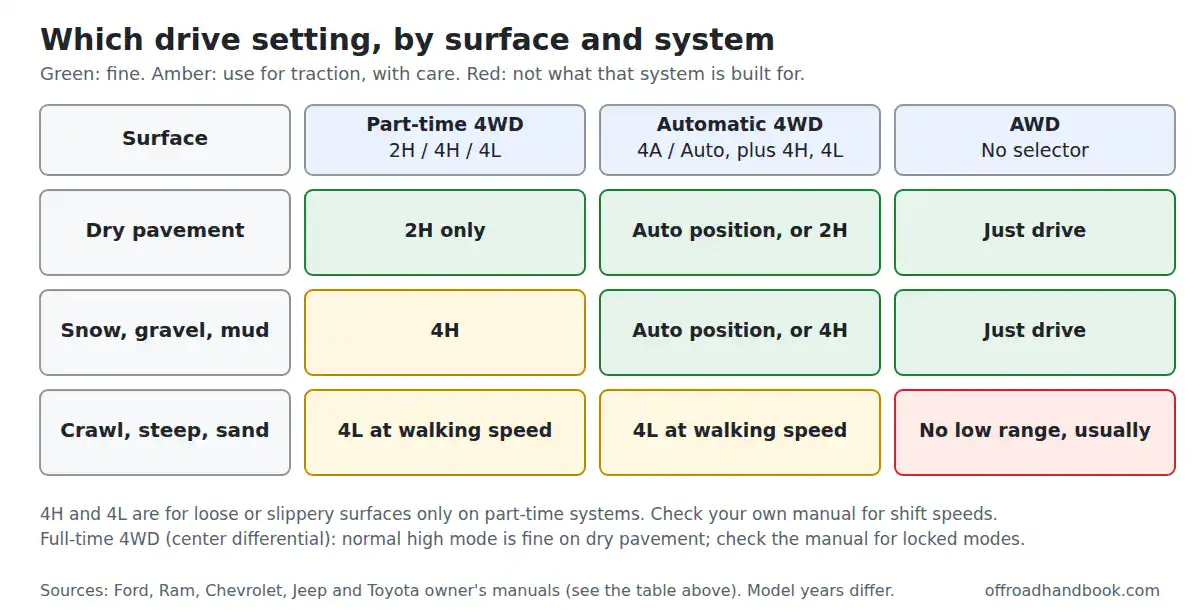
- Dry pavement: 2H, or the automatic mode if you want extra grip in changing weather.
- Snow, ice, gravel, packed dirt or mud: an automatic mode if you have one, otherwise 4H. Slow down. Four-wheel drive helps you go but does not shorten stopping distance.
- Steep descents, deep sand or mud, rock, or pulling a stuck vehicle: 4L at walking speed.
- Mixed roads: if you move between pavement and snow patches, the automatic mode avoids switching back and forth.
Symptoms that mean you are in the wrong mode
Binding in tight, low-speed turns on dry pavement, tires that skip or chirp, and a thump when you straighten out are signs of using a locked mode on high-traction ground. Chevrolet lists vibration in the steering, faster tire wear and driveline noise. Switch to 2H and the symptoms should stop. If shaking continues in 2WD or in an automatic mode, the cause is mechanical; see why a truck shakes in 4-wheel drive.
Safety note
Four-wheel drive does not add braking grip. Tires of equal size and wear matter on every system; Ram and Jeep warn that tire-size differences can damage the transfer case. Chevrolet and Ram warn that the transfer case Neutral position leaves the vehicle free to roll even in Park, so set the parking brake before using it. Follow your own owner's manual for shift speeds and procedures. For a compact-crossover example, see how a Jeep Patriot handles snow.
Ford F-150: what Ford says about 4A
Which F-150 trims have 4A
Ford’s 2026 spec sheet splits the 4x4 transfer case by trim. Older model years differ, so confirm in the manual for your year; the table shows the current split.
| Trim | Transfer case (Ford, 2026) | 4A position |
|---|---|---|
| XL, STX, XLT | Electronic shift-on-the-fly | Not listed on the spec sheet |
| Lariat, King Ranch, Platinum | Torque On Demand 2-speed automatic four-wheel drive | Yes, this is the automatic system that carries 4A |
| Lobo, Tremor, Raptor | 2-speed automatic AWD with mechanical-locking 4WD and Hi-Lock transfer case | Different system; use the mode names in your manual |
Our FX4 vs Lariat comparison covers what else separates those trims. FX4 is a package and does not change the transfer case.
If your selector shows only 2H, 4H and 4L, your truck has no 4A position, so the 4A advice below does not apply.
The limits that matter in the manual
These come from the owner manual supplement and apply to 4WD use in general. Check your own manual for your model year.
- Do not shift while the rear wheels are slipping or the accelerator is applied. Easing off the pedal during a “shift in progress” message can help it finish.
- 4L: bring the truck to 3 mph or less, put the transmission in Neutral, then move the control. If those conditions are not met in 30 seconds, the system returns to the previous mode.
- Wheel spin: Ford warns not to spin the wheels at over 34 mph (55 km/h) because the tires may fail.
- Dissimilar full-size spare: do not exceed 50 mph (80 km/h) with a 4WD mode on, do not switch into a 4WD mode unless stopped, and do not use 4WD on dry pavement.
- Parking: in Neutral the transfer case can disconnect the driveline, so set the parking brake and use Park.
For the full 4L procedure, see how to shift into 4-low.
What the 4X4 messages mean
| Message | What Ford says | What to do |
|---|---|---|
| Shift in progress | The system is still changing modes | Ease off the accelerator briefly |
| Shift Delayed Pull Forward | A transfer case gear tooth blockage is present | Move forward about 5 ft (1.5 m), then go back to Neutral |
| 4WD unable to disengage | A mechanical shift block was detected at speed after 2H was selected | Brake or accelerate momentarily, stop, or shift to Neutral and back to Drive |
| CHECK 4X4 | A 4X4 system fault is present; the truck usually stays in its previous mode | Have an authorized dealer check it |
A message that clears after one of those steps is normal. One that keeps coming back, or CHECK 4X4, is a dealer visit.
If a message stays on after you have tried the steps above, stop and have it checked rather than driving on.
FAQ
Is 4A the same as AWD?
Not exactly. 4A is an automatic mode on a 4WD truck that still has 4H and 4L. A dedicated AWD vehicle usually has no selector or low range. Both can run on dry pavement.
Can I leave my truck in 4H all the time?
Not on dry pavement with a part-time system. Ford, Ram, Jeep and Chevrolet all say 4H is for slippery or loose surfaces. Use 2H or an automatic mode.
Do I need to stop to shift?
It depends. Jeep says 2H and 4H AUTO shifts can be made moving, with a preferred speed of 0 to 45 mph. Shifting into 4L generally requires a stop or a crawl of 1 to 3 mph in Neutral. Check your manual.
Does 4A use more fuel than 2H?
Slightly. Chevrolet and Jeep both say their automatic modes give lower fuel economy than 2H or 2HI because the front axle is engaged.
Sources
- Ford F-150 owner manual, Using Four-Wheel Drive
- 2026 Ram 1500 owner's manual
- 2024 Chevrolet Silverado 1500 owner manual
- 2023 Jeep Wrangler JL owner's manual
- Toyota Tacoma 2018 Quick Reference Guide
- Toyota 4Runner 2018 Quick Reference Guide
- Mazda USA, AWD vs. 4WD vs. 2WD Systems
Wondering about the rest of the lineup? See which Broncos are true 4x4s, which are AWD, and which came in 2WD. For a car-based AWD crossover, see what the Ford Edge can and cannot handle off pavement.

I'm Suryashankar Dasgupta, the founder of Off-Road Handbook. I've been off-roading for years in the USA, including California and Texas, and have ridden mountain and desert terrain abroad. I've also driven a Jeep Compass for more than seven years, so I know the day-to-day side of Jeep ownership first-hand, from the Uconnect screen to the warning lights. Every guide here is researched from manufacturer owner's manuals, NHTSA recall and service-bulletin records and other trusted sources, checked against them before it is published, and corrected when we find a mistake. You can read how we work in our editorial policy: https://offroadhandbook.com/editorial-policy/
Like our off-road guides? Add Off-Road Handbook as a Google Preferred Source so our latest Jeep, ATV, UTV, trail, recovery, and off-road troubleshooting articles can appear more often in your Google Search experience.
Add us as a Preferred Source