Wrangler, Bronco and Tacoma Bolt Patterns: Which Wheels Swap?
This post contains Amazon affiliate links. As an Amazon Associate I earn from qualifying purchases, at no extra cost to you.
Jeep Wrangler JK, JL and Gladiator wheels use a 5x5 bolt pattern (5x127 mm) on a 71.5 mm hub. The 2021+ Bronco, Tacoma and 4Runner all share 6x139.7 mm (6x5.5 in), but their hub bores differ, and the Bronco Raptor uses 6x135 mm. So Jeep wheels never bolt onto those trucks. Between the six-lug trucks, a wheel only fits when its center bore is the same size as the hub or bigger.
That last point catches a lot of people buying used wheels. A set of take-off wheels from a 2020 Tacoma has the right six-lug pattern for a Bronco or a 2024 Tacoma, but whether it actually seats on the hub comes down to the hub bore and the lug thread. The chart below covers all three numbers.
Bolt pattern, hub bore and lug thread by vehicle
| Vehicle (years) | Bolt pattern | Hub bore | Stud thread | Factory lug torque |
|---|---|---|---|---|
| Jeep Wrangler YJ / TJ (1987–2006) | 5x4.5 in (5x114.3 mm) | 71.5 mm | Check your manual | Check your manual |
| Jeep Wrangler JK (2007–2018) | 5x5 in (5x127 mm) | 71.5 mm | ½ in x 20 | 100 ft-lb |
| Jeep Wrangler JL (2018+) | 5x5 in (5x127 mm) | 71.5 mm | M14 x 1.5 | 130 ft-lb |
| Jeep Gladiator JT (2020+) | 5x5 in (5x127 mm) | 71.5 mm | M14 x 1.5 | 130 ft-lb |
| Ford Bronco, non-Raptor (2021+) | 6x5.5 in (6x139.7 mm) | 93.1 mm | M12 x 1.5 | 100 lb-ft |
| Ford Bronco Raptor (2022+) | 6x135 mm | 87.1 mm | M14 x 1.5 | 150 lb-ft |
| Toyota Tacoma (2005–2023) | 6x5.5 in (6x139.7 mm) | 106.1 mm | M12 x 1.5 | 83 ft-lb |
| Toyota Tacoma (2024+) | 6x5.5 in (6x139.7 mm) | 95.1 mm | M14 x 1.5 | 97 ft-lb aluminum / 154 ft-lb steel |
| Toyota 4Runner 5th gen (2010–2024) | 6x5.5 in (6x139.7 mm) | 106.1 mm | M12 x 1.5 | 76 ft-lb aluminum / 83 ft-lb steel |
| Toyota 4Runner 6th gen (2025+) | 6x5.5 in (6x139.7 mm) | 95.1 mm | M14 x 1.5 | 97 ft-lb aluminum / 154 ft-lb steel |
I put this table together from the Jeep, Ford and Toyota owner's manuals we already used for the torque chart, then checked each bolt pattern and bore against at least two wheel or spacer makers' spec pages. They disagreed in one spot: Lock Off-Road lists the 2024+ Tacoma bore as 95.2 mm, while Burger Motorsports says 95.1 mm. I went with 95.1 mm because the 6th-gen 4Runner sources give that figure for the same hub. I left the YJ/TJ thread blank because I couldn't find a second source for it.
One trim note: every non-Raptor Bronco shares the 6x139.7 / 93.1 mm setup, from the Base on 16s up to the Sasquatch package, according to Hardrock's trim-by-trim list. Only the Raptor's hub is different.
Which factory wheels swap between these 4x4s?
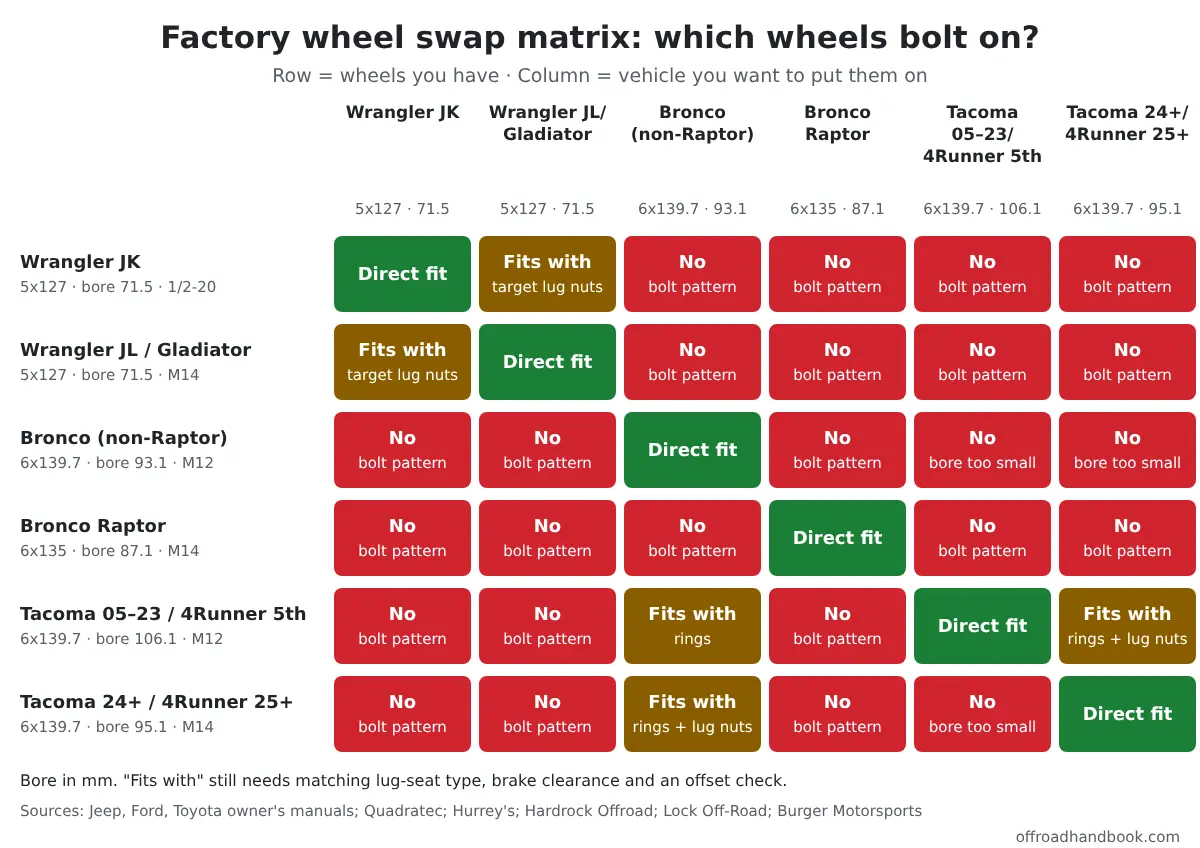
Read the matrix from the left. Each row is the set of wheels you already have, and each column is the vehicle you want to put them on. It comes straight from the three rules in the chart: the pattern has to match, the wheel bore has to be at least as big as the hub, and the lug nuts have to match the target vehicle's studs.
A few results surprise people:
- JK and JL wheels swap both ways. The pattern and bore are the same, but the threads differ (½-20 on the JK, M14 x 1.5 on the JL). Run the lug nuts that match the vehicle the wheels are going on, never the ones that came with the wheels.
- Older Tacoma and 4Runner wheels fit a Bronco, because a 106.1 mm bore clears the Bronco's 93.1 mm hub. Fill the gap with hub-centric rings and keep using the Bronco's own M12 lug nuts.
- Bronco wheels don't fit any Tacoma or 4Runner. Their 93.1 mm bore is smaller than every Toyota hub here, so the wheel can't sit flat on the hub face unless the bore is machined out.
- 2024+ Tacoma and 2025+ 4Runner wheels don't go back on older trucks (95.1 mm bore on a 106.1 mm hub). The other direction works with rings, as long as the lug nuts clear the holes (see below).
- The Bronco Raptor is a different hub. At 6x135 mm, its wheels don't swap with a regular Bronco or with either Toyota.
Wheel Swap Checker: will these wheels fit?
Pick where the wheels came from and the vehicle you want to mount them on. Add the wheel's offset and the target vehicle's stock wheel offset if you know them (the number is usually stamped or printed on the back of the wheel, like "+55" or "ET55"). The checker then shows how far the wheel will stick out compared with stock.
How it works: the checker compares the bolt pattern, hub bore and stud thread from the chart above. Offset change is simply the target's stock offset minus the new wheel's offset, in millimeters (25.4 mm = 1 in). It doesn't check brake caliper clearance, wheel width or tire size, so treat a "fits" result as the start of a test fit, not the final word.
If the swap also means a different tire size, run the numbers in our tire size calculator before you buy. It shows the diameter change, speedometer error and how much extra clearance the bigger tire needs.
Where other bolt pattern charts go wrong
Searching "Bronco bolt pattern" or "Tacoma center bore" turns up dozens of charts, and several popular ones contradict the factory data on the very spec that decides whether a wheel seats:
- Bronco bore listed as 106.1 mm. At least one widely shared 6x139.7 guide gives 106.1 mm for the Bronco. Wheel and spacer makers that build Bronco-specific parts (Hardrock, Hurrey's, Supreme Suspensions) all use 93.1 mm. If you believed 106.1, you'd buy Bronco wheels for a Tacoma, and they wouldn't seat.
- JK lug thread listed as M14 x 1.5. Some bolt pattern databases lump the JK in with the JL. The 2016 and 2018 Wrangler JK owner's manuals list ½ x 20 studs and 100 ft-lb, and Quadratec agrees.
- The 6th-gen 4Runner listed with the old 106 mm bore. One spec reference still shows 106 mm for 2025+. The 2025 4Runner moved to the newer Toyota hub, 95.1 mm with M14 studs (Lock Off-Road, Threepiece), which is why 5th-gen wheels no longer bolt straight on.
Many of those mistakes come from treating a bolt pattern as the whole fitment. It's only the first of the three checks.
How to measure a bolt pattern and hub bore yourself
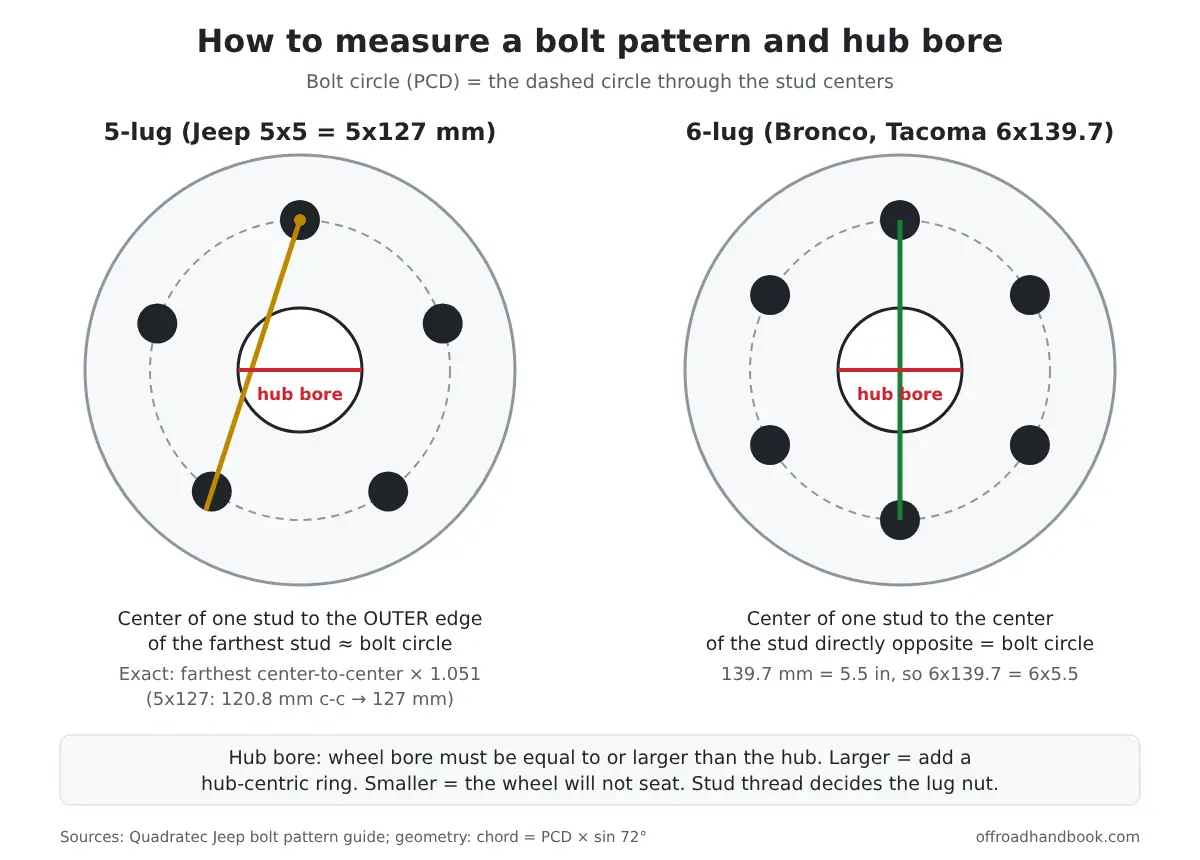
Measure when you're buying used wheels with no part number, or when the seller isn't sure what they came off. You need a tape measure or caliper, and a bolt pattern gauge makes 5-lug wheels easier (check the current price on Amazon).
- Count the lugs. Five or six is the first number of the pattern.
- Six-lug: measure from the center of one stud hole to the center of the hole directly across. 139.7 mm (5.5 in) means 6x139.7; 135 mm means 6x135.
- Five-lug: no hole sits directly across, so measure from the outer edge of one hole to the center of the farthest hole (skip one hole), or center to outer edge, which gives the same distance. About 5 in means 5x5 (Jeep JK/JL); about 4.5 in means 5x4.5 (YJ/TJ). Quadratec's Jeep wheel guide describes the same method.
- For an exact five-lug number, measure center to center between the two farthest holes and multiply by 1.051. That follows from the geometry: on a five-lug circle the farthest holes are 72° from straight across, so the chord equals the bolt circle × sin 72°. A true 5x127 pattern measures 120.8 mm center to center.
- Hub bore: measure across the center hole on the back of the wheel, where it meets the hub. A caliper beats a tape here, because 93.1 vs 95.1 mm is only 2 mm.
Hub-centric rings, lug nuts and seat type
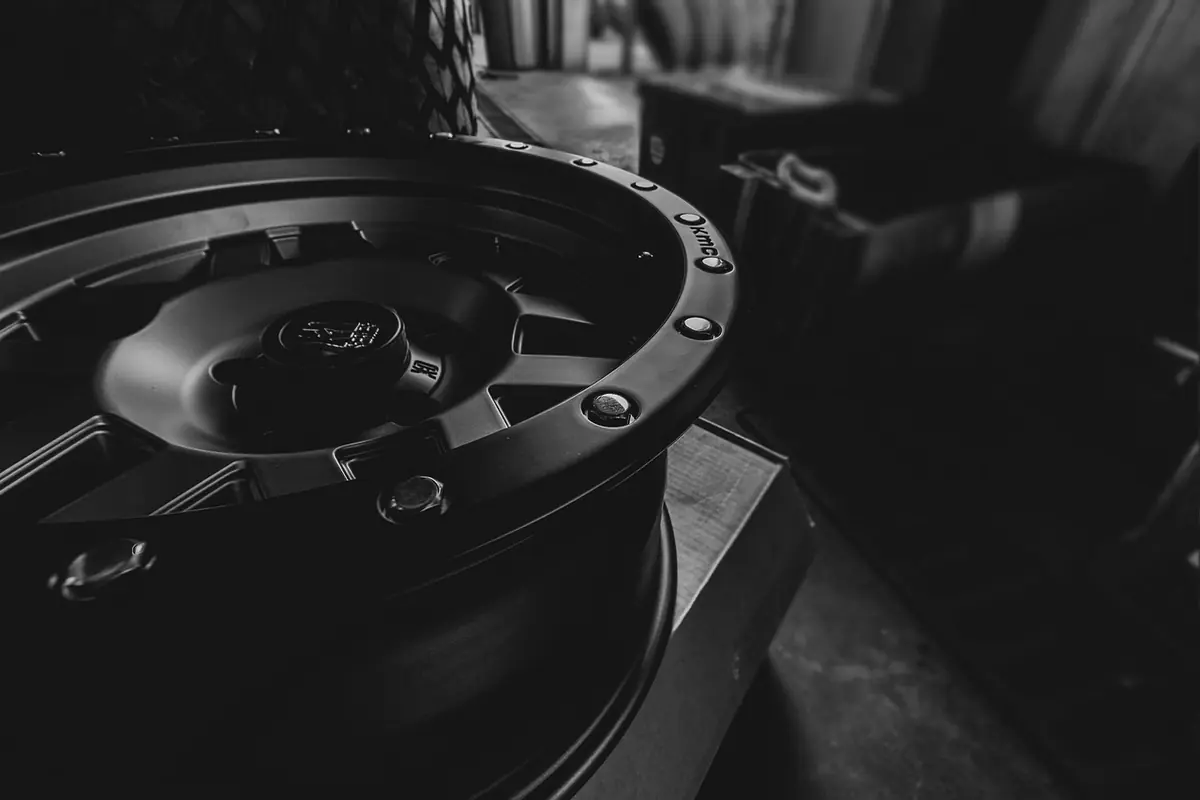
When the wheel bore is bigger than the hub, the lug nuts end up doing the centering job by themselves. A hub-centric ring fills that gap so the wheel centers on the hub the way the factory wheel did. Rings are sized by two numbers, wheel bore to hub (for example, 106.1 to 93.1 mm hub-centric rings for Tacoma wheels on a Bronco).
Lug nuts always follow the vehicle's studs, not the wheel. Two more details matter:
- Seat type. The lug nut's seat (conical, ball or flat with a washer) has to match the seat machined into the wheel. A mismatched seat won't clamp the wheel the way it was designed to. The wheel maker lists the seat type.
- Lug hole size. Toyota wheels made for M12 studs can have holes too narrow for standard M14 nuts. Moving them to a 2024+ Tacoma or 2025+ 4Runner can take narrow-shank M14 x 1.5 lug nuts made for that swap. Never drill out a wheel's lug holes yourself.
Wheel adapters can change a pattern (5x127 to 6x139.7, for example), but they add thickness and a second bolted joint at every corner. If you go that route, use hub-centric adapters built for your exact vehicle and follow the adapter maker's torque and re-check intervals.
Why offset still matters after the wheels bolt on
Factory offsets vary a lot between these trucks. Hardrock lists +55 mm on most Bronco wheels and +30 on the wider 17x8.5s. Lock Off-Road lists +55 to +60 on 2024+ Tacomas and about +15 on most 5th-gen 4Runners. Hurrey's lists +30 for 2nd and 3rd-gen Tacomas.
So a "fits" in the matrix can still look and drive very differently. A +15 4Runner wheel on a 2024 Tacoma that came with +55 wheels sits 40 mm (about 1.6 in) farther out on each side. That means more fender poke, more scrub radius and more chance of rubbing at full lock. Our guide to wheel offset and backspacing for 35s explains how to convert offset to backspacing and what each range does to clearance.
Jeep owners swapping JK wheels onto a JL for bigger tires should also check the tire limits in what fits a stock Wrangler JL without a lift. The wheel bolts on either way, but the tire you mount on it may not clear.
After the swap: torque and re-check
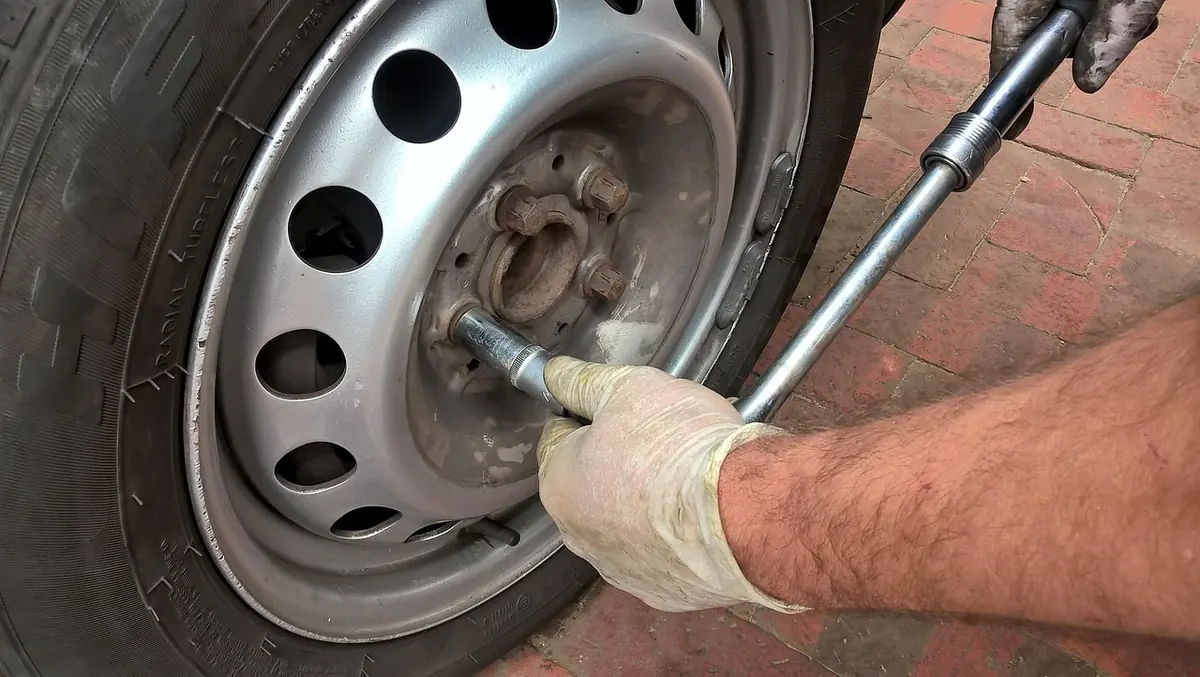
Torque the lug nuts to the target vehicle's spec in a star pattern with a torque wrench, not to whatever the wheels' original vehicle called for. Ford's Bronco manual and Toyota's 2024+ Tacoma and 2025 4Runner manuals say to retighten within 100 miles after a wheel goes back on, and the 2018 JK manual says to check after 25 miles. All the figures and manual links are in our lug nut torque specs.
Note the steel-vs-aluminum split on the 2024+ Tacoma and 2025+ 4Runner (154 vs 97 ft-lb). If you swap factory steel wheels for alloys, or the other way around, the torque changes with them. Also check the load index on the tires that come with used wheels against your truck's needs, using our tire load index chart.
Bolt pattern FAQ
Do JK wheels fit a Wrangler JL or Gladiator?
Yes, as far as pattern and bore go: both are 5x127 mm with a 71.5 mm bore. Use the JL's or Gladiator's M14 x 1.5 lug nuts with the seat type the JK wheel needs, and check caliper clearance on the first wheel before mounting the rest.
Will Tacoma wheels fit a Ford Bronco?
Tacoma wheels from 2005–2023 do: same 6x139.7 pattern, and their 106.1 mm bore clears the Bronco's 93.1 mm hub, so add hub-centric rings. 2024+ Tacoma wheels (95.1 mm bore) also clear it. Bronco wheels do not fit a Tacoma, because their bore is too small.
Will 5th-gen 4Runner wheels fit a 2025 4Runner?
Not directly. The pattern is the same, but the 2025 hub is 95.1 mm with M14 studs. The older 106.1 mm wheels need hub-centric rings, and you may need narrow-shank M14 lug nuts to clear the lug holes. Going the other way, 6th-gen wheels won't seat on a 5th-gen hub.
Is 6x139.7 the same as 6x5.5?
Yes. 139.7 mm is exactly 5.5 inches, and 5x127 mm is the same as 5x5 inches. 6x135 is a different pattern and does not interchange with 6x139.7.
Sources
- Jeep, Ford and Toyota owner's manuals for stud size and torque, linked individually in our lug nut torque chart
- Ford owner's manual, Bronco Raptor wheel nuts: fordservicecontent.com
- Quadratec, Jeep wheel bolt patterns and lug nut torque
- Hurrey's, bolt pattern, center bore and factory wheel spec reference
- Hardrock Offroad, Ford Bronco wheel fitment guide
- Bonoss, Bronco bolt pattern and center bore by year (Raptor 6x135 / 87.1 mm)
- Lock Off-Road, Tacoma and 4Runner fitment guides
- Burger Motorsports, 2024 Tacoma hub-centric spacer specifications
- Threepiece, 6th-gen 4Runner wheel and tire guide
- Supreme Suspensions, 2021–2022 Bronco hub-centric spacer specifications

I'm Suryashankar Dasgupta, the founder of Off-Road Handbook. I've been off-roading for years in the USA, including California and Texas, and have ridden mountain and desert terrain abroad. I've also driven a Jeep Compass for more than seven years, so I know the day-to-day side of Jeep ownership first-hand, from the Uconnect screen to the warning lights. Every guide here is researched from manufacturer owner's manuals, NHTSA recall and service-bulletin records and other trusted sources, checked against them before it is published, and corrected when we find a mistake. You can read how we work in our editorial policy: https://offroadhandbook.com/editorial-policy/
Like our off-road guides? Add Off-Road Handbook as a Google Preferred Source so our latest Jeep, ATV, UTV, trail, recovery, and off-road troubleshooting articles can appear more often in your Google Search experience.
Add us as a Preferred Source