Cold Weather Tire Pressure: Why LT Tires Drop More Than 1 PSI
This post contains Amazon affiliate links. As an Amazon Associate I earn from qualifying purchases, at no extra cost to you.
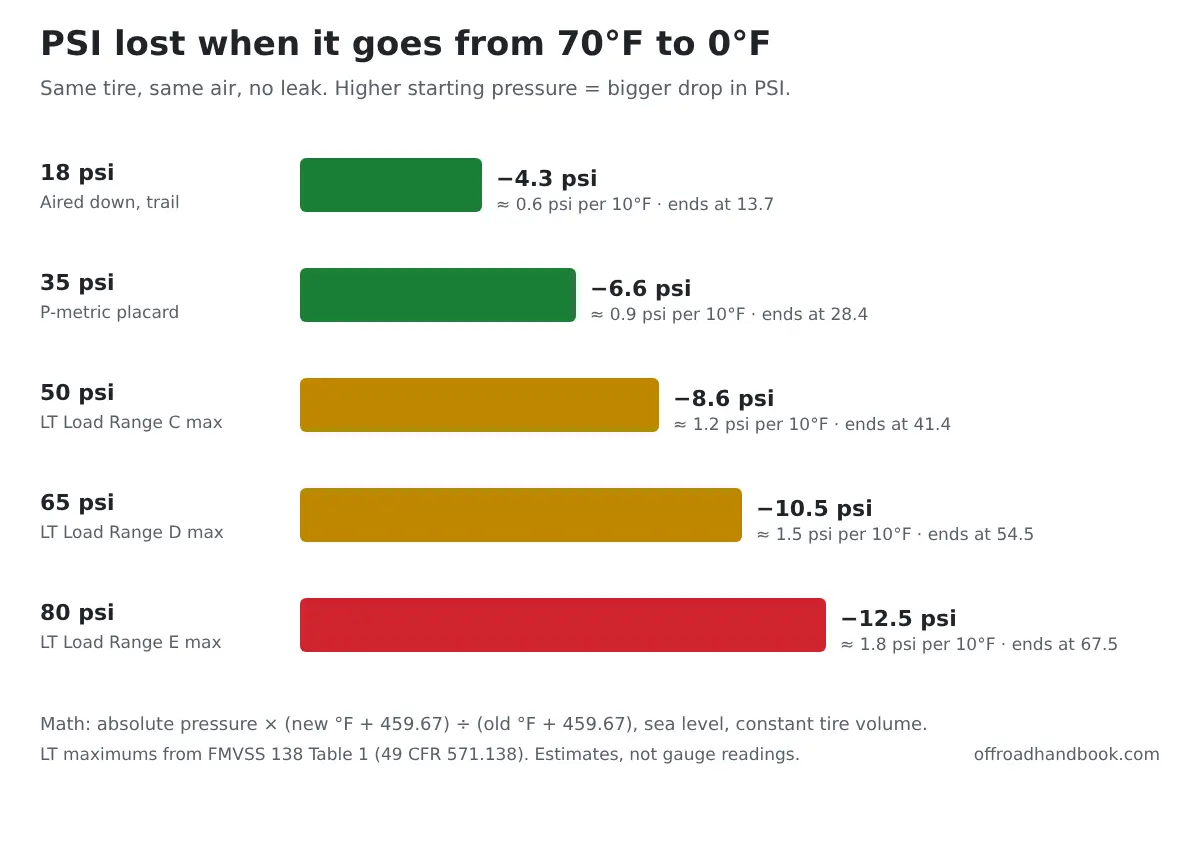
A tire set to 35 psi loses close to 1 psi for every 10°F the air cools, which is where the familiar rule of thumb comes from. But the drop grows with pressure: a light-truck tire at 80 psi loses about 1.8 psi per 10°F, so a 70°F-to-0°F cold snap takes it down roughly 12.5 psi. Aired-down trail tires lose less in psi but more as a share of what they started with.
The fix is the same for every tire: check pressure cold, outdoors, and fill to the door-placard number at the temperature you'll actually drive in. The calculator below works out your real drop, the gauge reading after an elevation change, and the point where your TPMS light is required to come on.
Cold-Weather Tire Pressure Calculator
Enter the pressure you set and the outdoor temperature when you set it, then the temperature now. Add elevations if you've driven up or down a mountain since. The door-placard pressure and tire type are optional; they unlock the TPMS and "how much to add" results.
How it works: the calculator uses Gay-Lussac's law on absolute pressure, not gauge pressure. It adds outside air pressure to your gauge reading, scales by the ratio of absolute temperatures (°F + 459.67), then subtracts the outside air pressure where you are now. Air pressure by elevation comes from the U.S. Standard Atmosphere formula published by Engineering Toolbox.
It ignores the small change in tire volume as the casing cools, and it can't see a leak. If your gauge reads 2 psi or more under the estimate, treat it as a leak.
How Much Pressure Drops per 10°F at Each PSI
AAA and Les Schwab both use the 1 psi per 10°F rule, and it's close for typical passenger-car pressures. AAA's Club Alliance guide quotes about 1 psi per 10°F in both directions.
The tire-monitoring maker Aperia, which works with commercial trucks, publishes 2 to 3 psi per 10°F instead (Aperia help center). Both figures are right for their tires. Pressure changes in proportion to absolute pressure, so higher-pressure tires move more psi for the same temperature swing.
| Pressure set at 70°F | Typical use | Drop per 10°F | Reading at 30°F | Reading at 0°F | Reading at −20°F |
|---|---|---|---|---|---|
| 15 psi | Aired down for sand or snow | 0.6 psi | 12.8 psi | 11.1 psi | 10.0 psi |
| 18 psi | Aired down for rocks | 0.6 psi | 15.5 psi | 13.7 psi | 12.4 psi |
| 30 psi | Passenger-style placard | 0.8 psi | 26.6 psi | 24.1 psi | 22.4 psi |
| 35 psi | Passenger-style placard | 0.9 psi | 31.2 psi | 28.4 psi | 26.6 psi |
| 40 psi | Passenger-style placard | 1.0 psi | 35.9 psi | 32.8 psi | 30.7 psi |
| 50 psi | LT Load Range C maximum | 1.2 psi | 45.1 psi | 41.4 psi | 39.0 psi |
| 65 psi | LT Load Range D maximum | 1.5 psi | 59.0 psi | 54.5 psi | 51.5 psi |
| 80 psi | LT Load Range E maximum | 1.8 psi | 72.8 psi | 67.5 psi | 63.9 psi |
| 110 psi | Commercial truck (check row) | 2.4 psi | 100.6 psi | 93.5 psi | 88.8 psi |
I worked out every row with the same absolute-pressure formula the calculator uses, then added the 110 psi row as a cross-check against Aperia's truck-tire figure. It lands at 2.4 psi per 10°F, inside Aperia's 2–3 psi range, which is why I trust the method for the LT rows.
Look at the right side of the table. A 35 psi tire that was perfect on a 70°F afternoon reads 28.4 psi at 0°F. That's a 19% drop with no leak at all.
Why LT Tires on Trucks and Jeeps Lose More
A gauge reads the difference between the air inside the tire and the air outside. The gas law, though, works on the total, so a 35 psi tire is really holding about 49.7 psi absolute at sea level. An 80 psi tire holds about 94.7 psi.
Cool both by the same amount and each loses the same percentage of its absolute pressure. A percentage of 94.7 is a bigger number than the same percentage of 49.7, so the LT tire loses nearly twice the psi.
That matters most on a loaded truck or overland rig running Load Range E tires near the pressure its load needs. A tire's load capacity on the load-and-inflation tables is tied to its pressure. If yours sits near the edge, check our Load Range C vs D vs E guide and the tire load index chart before a cold-weather trip with a full load.
Why the TPMS Light Comes On When It Gets Cold
Federal Motor Vehicle Safety Standard 138 covers vehicles up to 10,000 lb GVWR. It requires the low-pressure light to come on within 20 minutes once a tire falls to 25% below the placard pressure, or to a minimum pressure set for the tire type, whichever is higher (49 CFR 571.138, S4.2 and Table 1).
That's the latest point the light must come on. Nothing in the rule stops a maker from setting it to warn sooner, so your owner's manual has the final word for your vehicle.
| Tire type | FMVSS 138 minimum activation pressure | Example placard | Light required by | Outdoor temp that gets a tire set at 70°F there |
|---|---|---|---|---|
| P-metric, standard load | 20 psi | 35 psi | 26.3 psi | about −23°F |
| P-metric, extra load | 23 psi | 38 psi | 28.5 psi | about −26°F |
| LT Load Range C | 29 psi | 50 psi | 37.5 psi | about −32°F |
| LT Load Range D | 35 psi | See your placard | Higher of 75% of placard or 35 psi | Use the calculator |
| LT Load Range E | 35 psi | 60 psi | 45.0 psi | about −36°F |
| LT Load Range E | 35 psi | 45 psi | 35.0 psi (floor applies) | about −19°F |
The last column is the useful part. A tire filled correctly on a 70°F day shouldn't trip the federal threshold until roughly −20°F or colder from temperature alone.
So if your light comes on at 25°F, the cold is only part of the story. The tire was probably already a few psi low, it was filled indoors or right after a drive, or your system warns earlier than the minimum. Either way, get a gauge on it.
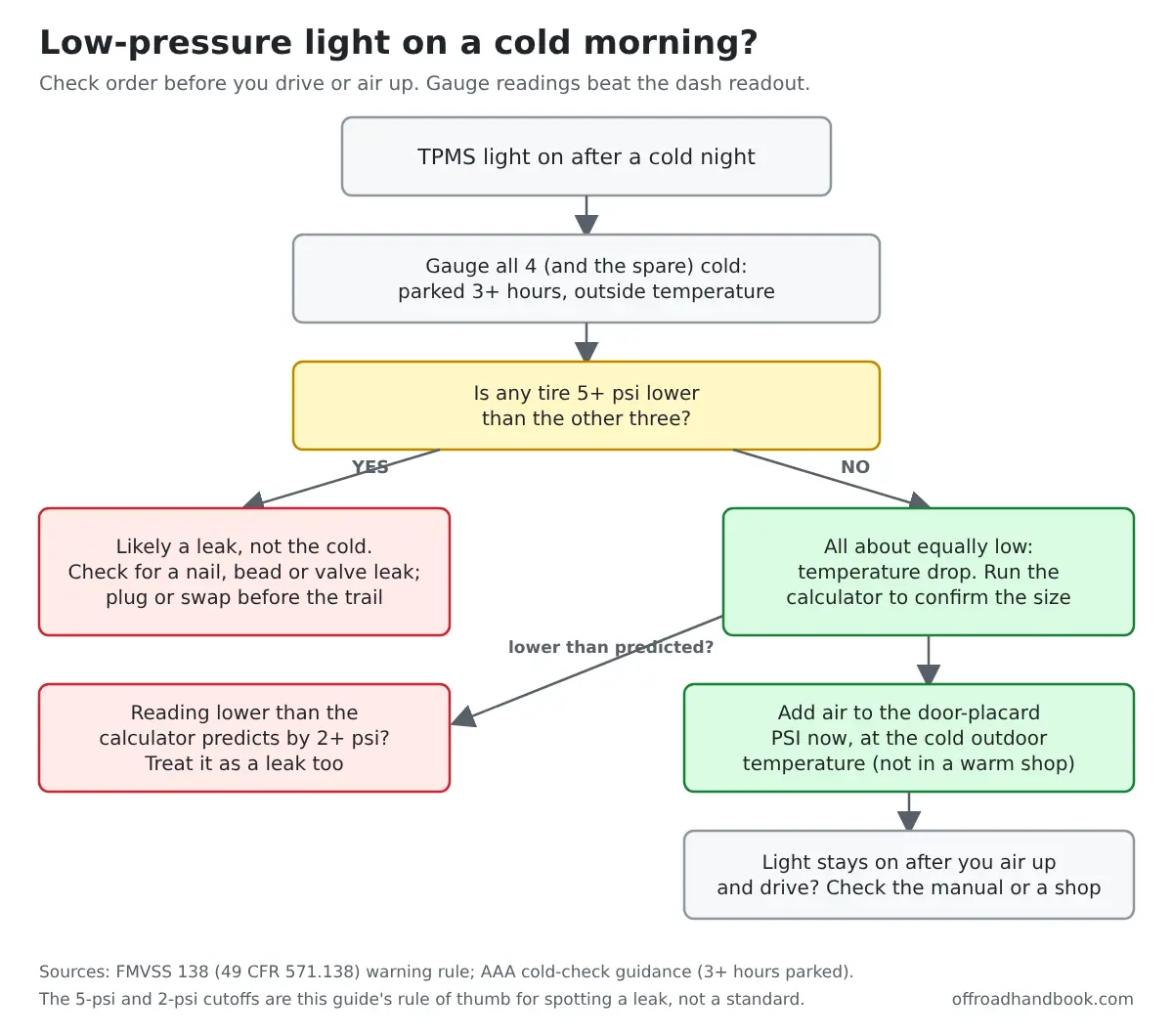
If one tire is clearly lower than the other three, look for a nail, a weeping bead or a leaky valve core. Our guide to plugging a flat on the trail covers what you can fix with a kit and when the tire needs a shop.
The Warm-Garage Fill Mistake
Placard pressure is a cold pressure. Fill to 35 psi inside a 65°F garage, back out into a 10°F morning, and the tire is low before you reach the end of the driveway.
Ideally, fill outdoors after the vehicle has sat. If you have to fill inside, overshoot by the amount the outdoor cold will take back. These are the garage targets that land on the placard outside:
| Placard (cold) | Fill to at 65°F if it's 30°F outside | …if it's 10°F outside | …if it's −10°F outside |
|---|---|---|---|
| 35 psi | 38.6 psi | 40.8 psi | 43.3 psi |
| 50 psi | 54.6 psi | 57.6 psi | 60.8 psi |
| 80 psi | 86.8 psi | 91.1 psi | 95.8 psi |
One caution: the tire must also be cold when you fill it in the garage. If you just drove in, the tread and the air are still warm, and you'll be chasing a moving number. AAA defines cold as parked for at least three hours.
Mountain Trips: Altitude and Cold Pull in Opposite Directions
Climbing makes the gauge read higher, because there's less outside air pushing back. Wikipedia's cold inflation pressure entry and Les Schwab both put it at about 0.5 psi per 1,000 feet.
| Elevation | Outside air pressure | Gauge change vs. setting at sea level |
|---|---|---|
| Sea level | 14.7 psi | 0 |
| 1,000 ft | 14.2 psi | +0.5 psi |
| 5,000 ft | 12.2 psi | +2.5 psi |
| 7,000 ft | 11.3 psi | +3.4 psi |
| 10,000 ft | 10.1 psi | +4.6 psi |
Here's the trap on a winter mountain run. Set 35 psi at sea level on a 70°F day, then drive to a 10,000-foot pass at 20°F. The cold takes about 4.7 psi and the altitude gives back about 4.6, so the gauge still reads close to 35.
Everything looks fine until you drop back down into the cold valley, where the reading falls to around 30 psi. Recheck after any big elevation change, cold, as both Les Schwab and Wikipedia advise.
Aired-Down Tires on a Cold Trail Day
At trail pressures the psi change is small, but each psi is a bigger slice of what you have. An 18 psi tire that goes from 70°F to 0°F loses 4.3 psi, or 24% of its pressure, more than the 19% a 35 psi tire gives up.
Winter days swing the other way too. Air down to 18 psi at a 20°F trailhead and, if the afternoon warms to 50°F, those tires will read about 20 psi. Check again at lunch rather than trusting the morning number, and start from our air-down PSI calculator for each terrain.
Overnight camps are the other case. Tires aired down in the afternoon sun will read lower at dawn, so gauge them before you roll, especially if you're already near the low end for your wheels.
How to Set Tire Pressure Right in Winter
- Let the vehicle sit at least three hours, so the tires are cold (AAA's definition).
- Check outdoors, ideally in the morning when it's coldest, with your own gauge. A digital tire pressure gauge is easier to read in gloves than a stick gauge.
- Fill to the pressure on the driver's door placard, not the maximum on the sidewall.
- If you can't fill outdoors, use the garage table or the calculator to overshoot by the right amount.
- Check the spare too; it cools just as much and is easy to forget.
- Recheck after a cold snap of 20°F or more, and after any trip with a big elevation change.
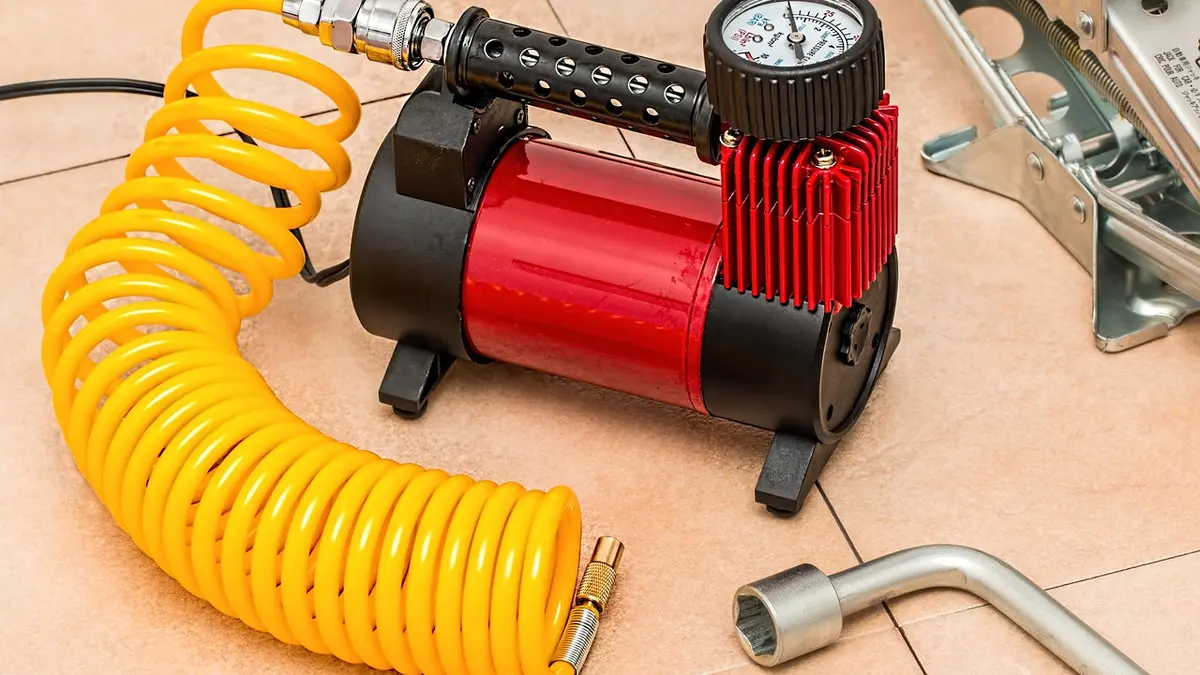
A 12-volt portable air compressor makes step 2 painless and doubles as your air-up kit after the trail; check the current price on Amazon. If you run big tires, our air compressor fill-time calculator shows how long a given pump takes to bring 35s back up.
Cold-Weather Tire Pressure FAQ
Should I add extra air for winter?
Not beyond the placard. Set the placard pressure with the tire cold at the outdoor temperature, and you're right for that temperature. Add more only when you fill in a warmer place than you'll drive in, as in the garage table.
Does nitrogen stop pressure loss in the cold?
No. Nitrogen follows the same gas law as air, which is already about 78% nitrogen, so a nitrogen-filled tire drops by essentially the same amount on a cold night.
Why does the TPMS light go off after I drive a few miles?
Driving heats the tires, and warm air reads higher, which can push a borderline tire back over the warning threshold. The tire is still low when cold, so add air at the next cold check rather than ignoring it.
Is 1 psi per 10°F close enough?
For passenger-style pressures around 30 to 40 psi, yes. For LT tires above 50 psi, use about 1.2 to 1.8 psi per 10°F from the table, or run the calculator with your real numbers.
Heading somewhere with chain controls this winter? Check whether your 4x4 is exempt in our 4WD chain-law guide for CA, CO, OR, WA and UT.

I'm Suryashankar Dasgupta, the founder of Off-Road Handbook. I've been off-roading for years in the USA, including California and Texas, and have ridden mountain and desert terrain abroad. I've also driven a Jeep Compass for more than seven years, so I know the day-to-day side of Jeep ownership first-hand, from the Uconnect screen to the warning lights. Every guide here is researched from manufacturer owner's manuals, NHTSA recall and service-bulletin records and other trusted sources, checked against them before it is published, and corrected when we find a mistake. You can read how we work in our editorial policy: https://offroadhandbook.com/editorial-policy/
Like our off-road guides? Add Off-Road Handbook as a Google Preferred Source so our latest Jeep, ATV, UTV, trail, recovery, and off-road troubleshooting articles can appear more often in your Google Search experience.
Add us as a Preferred Source