What Is a Diff Lock and When Should You Use One Off-Road?
Last updated on October 29th, 2026 at 07:40 pm
A diff lock (differential lock) forces both wheels on an axle to turn at the same speed. That keeps power going to the wheel that still has grip when the other one is in the air or on ice, mud or loose rock. You use it at low speed off-road and switch it off again before you reach pavement.
This guide covers how lockers differ from limited-slip and open differentials, when to lock and unlock, what two manufacturers say about using them, and a quick tool to see whether you need one. For the 4WD settings that come first, see our guide to 4WD vs AWD vs 4A.
Why an open differential leaves you stuck
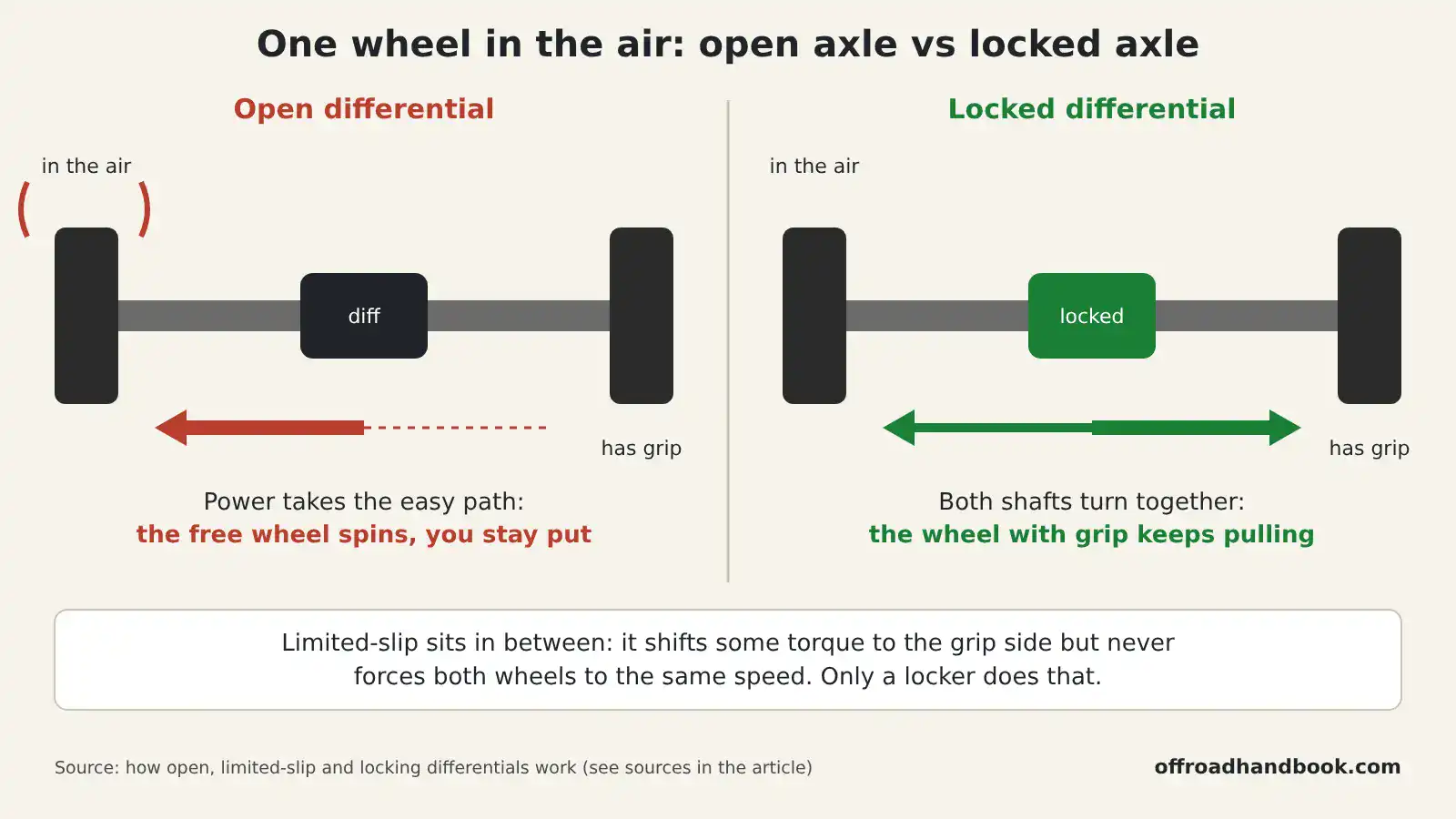
Every axle has a differential so the outside wheel can turn faster than the inside wheel in a corner. A standard open differential sends power to the wheel that is easiest to turn.
Lift one tire off a ledge or park it on ice, and that wheel takes the power and spins. The wheel with grip gets almost nothing, so the vehicle stops moving.
A locker removes that difference and splits the drive between both wheels, whatever the traction under each one.
Locker types compared
| Type | How it works | On pavement | Driver action | Best for |
|---|---|---|---|---|
| Open differential | Lets wheels turn at different speeds; power goes to the wheel with least resistance | Smooth and quiet | None | Everyday driving; most vehicles |
| Limited-slip (LSD) | Clutches or gears bias torque to the wheel with more grip; never fully locks | Close to open | None | Mixed road and light trail use, snow, towing |
| Selectable locker | Locks on demand by air, electric or cable actuation; open when off | Open when off | Switch on, switch off | Serious off-roading with normal road manners |
| Automatic locker | Locks under power and releases when coasting through a turn | Can clunk, chirp or scrub tires | None | Dedicated trail rigs |
| Spool | Permanently locks both axle shafts together | Tires scrub in turns | None | Competition and dedicated off-road builds |
Brake-based traction control is a fourth option. It brakes a spinning wheel so the open differential sends power across the axle. It works well on moderate terrain, but a true locker usually pulls harder on the toughest obstacles.
For one budget route, read our guide to lunchbox lockers.
Center diff locks vs axle diff locks
Full-time 4WD systems have a center differential between the front and rear driveshafts, and a center diff lock locks those two shafts together. An axle diff lock works across the left and right wheels instead.
Part-time 4WD systems already tie the front and rear driveshafts together when you select 4WD, so they have no center differential to lock. That is why a Jeep-style part-time system can still leave you stuck with one wheel in the air at each end.
When to lock the differential

Lock up when a wheel is likely to lift or lose grip and you need to keep moving at a crawl:
- Rock ledges and steps, where a wheel is likely to hang in the air
- Cross-axle ruts and holes, where diagonal wheels lose contact
- Deep mud, snow and sand, when you start losing momentum
- Steep, loose climbs where wheelspin would dig you in
Follow this order:
- Stop or crawl before the obstacle, with the wheels pointing as straight as you can.
- Select the drive mode your manual requires (many factory lockers need low range).
- Engage the rear locker first and wait for the indicator to confirm it.
- Add the front locker only if you still need it, because a locked front axle makes steering much heavier.
- Unlock as soon as the ground firms up.
When to leave it off
- On pavement or any high-grip surface: the wheels cannot turn at different speeds in a corner, so tires scrub and the axle takes extra stress
- At speed
- Once traction returns on the far side of the obstacle
- On ice, where a locked axle can slide when both wheels spin
Ford says its electronic locker is "for off-road use only and is not for use on dry pavement," and that dry-pavement use can cause increased tire wear, noise and vibration.
What the manufacturers say
| Source | What it says |
|---|---|
| Toyota 2024 Tacoma quick reference guide | The rear differential lock is for wheel spin in a ditch or on a slippery or rugged surface. ABS, brake assist, VSC, downhill assist and TRAC do not operate while the rear differential is locked. |
| Toyota 2017 Tacoma quick reference guide | Use the rear differential lock only when wheel spinning occurs in a ditch or on slippery or unpaved surfaces. |
| Ford owner's manual, rear electronic locking differential | Normal modes: can engage up to 20 mph and releases automatically at 25 mph. Off-road use only. If the indicator will not light, speed, an ABS event or a large rear wheel-speed difference may be the cause; a CHECK LOCKING DIFFERENTIAL message means a fault. |
Notice the Toyota point: with the rear locked, the stability and anti-lock systems stand down. That is one more reason to lock only when you need it and unlock afterward.
We could not open the Jeep Wrangler Rubicon owner's manual text, so we give no Rubicon speed limits here. Check the Axle Lock section of your manual before using one.
Do you need a locker?
On graded dirt roads and light trails, good tires, correct air pressure and traction control are usually enough. Our tire pressure calculator helps with the pressure part. Rock crawling, deep mud and technical trails are where a rear locker earns its cost, and front and rear lockers help most on the hardest trails.
Factory-locker trims are often cheaper than adding lockers later. Compare trims in our Gladiator Rubicon vs Mojave guide. Aftermarket pricing varies by axle, brand and shop, so get a quote for your exact axle; we do not list prices we cannot verify.
Not sure which setup fits? Pick your answers below.
Which differential setup fits how you drive?
Before a rock trail, check clearance too with the approach angle calculator: a locker will not help a bumper that hits first.
Watch this on Instagram: @off_road_handbook
FAQ
Can you drive on the road with the diff lock on?
No. On high-grip surfaces the wheels cannot turn at different speeds through corners, so tires scrub and the axle is stressed. Unlock when you are back on firm ground.
Is a limited-slip differential the same as a locker?
No. A limited-slip shifts more torque to the wheel with grip but still lets the wheels differ in speed. A locker ties them together.
Should I lock the front or rear differential first?
The rear. Add the front only if you still need traction, since a locked front axle makes steering much harder.
Do all 4x4s have diff locks?
No. Many have open differentials with brake-based traction control. Factory lockers are typical on off-road trims such as the Tacoma TRD Off-Road with a rear differential lock, and aftermarket lockers fit most axles.
Sources
- Toyota, 2024 Tacoma quick reference guide
- Toyota, 2017 Tacoma quick reference guide
- Ford owner's manual: electronic locking differential, rear axle
- Wikipedia: Locking differential (background on locker types)

I'm Suryashankar Dasgupta, the founder of Off-Road Handbook. I've been off-roading for years in the USA, including California and Texas, and have ridden mountain and desert terrain abroad. I've also driven a Jeep Compass for more than seven years, so I know the day-to-day side of Jeep ownership first-hand, from the Uconnect screen to the warning lights. Every guide here is researched from manufacturer owner's manuals, NHTSA recall and service-bulletin records and other trusted sources, checked against them before it is published, and corrected when we find a mistake. You can read how we work in our editorial policy: https://offroadhandbook.com/editorial-policy/
Like our off-road guides? Add Off-Road Handbook as a Google Preferred Source so our latest Jeep, ATV, UTV, trail, recovery, and off-road troubleshooting articles can appear more often in your Google Search experience.
Add us as a Preferred Source