Lunchbox Locker Explained: How It Works, Pros, Cons, Install
Last updated on October 20th, 2026 at 06:34 am
This post contains Amazon affiliate links. As an Amazon Associate I earn from qualifying purchases, at no extra cost to you.
A lunchbox locker is a drop-in automatic locker. It replaces the side gears and spider gears inside your axle’s existing differential carrier, so both wheels on that axle are driven together whenever you are on the throttle going straight. In a corner, the outside wheel is allowed to turn faster.
That design explains everything people notice about it: strong traction on rocks, ruts and mud, a low price and a short install, and a click or pop in turns. It locks the left and right wheels of one axle only. It does not link the front and rear axles.
How a lunchbox locker works
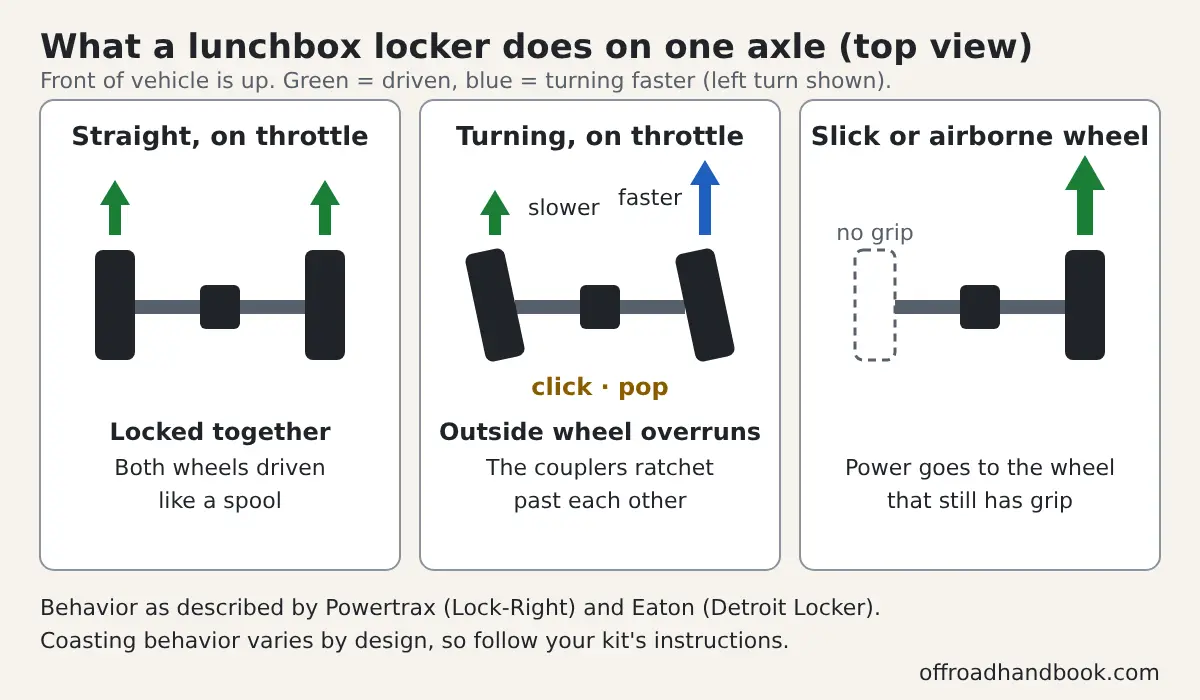
Powertrax describes its Lock-Right as fully automatic. Driving straight, it ties the axle shafts together like a spool. In a turn, the internal gears overrun so the outside wheel can spin faster. Off-road, power goes to the wheel that has traction, such as the one on the ground when the other is airborne.
Eaton calls its Detroit Locker a 100%-automatic locking differential for mild to extreme use. The difference is the hardware: a lunchbox locker reuses your carrier, while a full-carrier unit replaces it, per the overview on Wikipedia.
Lunchbox locker vs other automatic lockers
| Type | How it engages | Install | Road manners |
|---|---|---|---|
| Lunchbox drop-in (Powertrax Lock-Right) | Automatic, under throttle | Cover access on many axles: swap the side and spider gears. Powertrax says less than two hours for most applications | Light clicking in turns is normal; Powertrax recommends it for severe or recreational use |
| Drop-in with synchronizer (Powertrax No-Slip) | Automatic | No ring and pinion setup, no special tools or oils, per Powertrax | Powertrax claims full wheel differentiation on dry pavement and no ratcheting. That is a maker claim without independent data |
| Full-carrier automatic (Eaton Detroit Locker) | Automatic, keeps both wheels driving | Replaces the carrier, so the gear setup is part of the job | Eaton gives no road-manners figures |
Powertrax says some gear ratios need a more extensive install because of the ring gear thickness. Check your axle and ratio before you order, and follow the instructions in the kit.
Pros and cons
Pros
- Traction when one wheel is on a slick or unloaded surface, because power goes to the wheel with grip.
- Lower cost than a full-carrier unit, since it reuses the carrier you already have, per Wikipedia.
- No switch, air line or wiring. It works on its own.
- Short install on cover-access axles, with no special tools or oils according to Powertrax.
Cons
- Noise: Powertrax says a light clicking in turns is normal for lockers, with a ratcheting sound in long turns.
- Powertrax itself says the design’s “brute force characteristics” limit its use in mainstream applications, and points daily drivers to quieter, smoother units.
- You cannot turn it off. If you mostly drive on pavement, an open differential or a selectable locker is easier to live with.
- Owner reports on forums describe steering pull from a locked front axle on slick roads and a nervous feel in snow. Makers do not publish figures for this, so test any front locker slowly in an empty lot.
- Both axle shafts carry full torque. Ask the locker maker whether your shafts suit your tire size and use before you lock the axle.

Which one fits how you drive?
The tool below turns the points above into a short verdict and a checklist. Pick the axle and how you use the vehicle.
It only restates what the makers and the owner reports above say, so treat a front-axle verdict as a caution rather than a rule.
Based on Powertrax’s and Eaton’s published descriptions and the owner reports noted above. It does not replace the instructions that come with a specific locker.
Rear or front axle?
If you add one locker, most people choose the rear. A locked rear axle is easier to live with on the road than a locked front axle, which can fight the steering. On a part-time 4x4, the front axle is only driven when you engage 4WD, so its road manners show up less often.
If you go to bigger tires at the same time, check your gearing as well. Our regear calculator shows the ratio that matches a new tire size, and the 4-low guide covers when a locker and low range work together.
Installing a lunchbox locker
Powertrax lists two paths. On axles with a removable cover (AMC, Chrysler, Jeep, GM and late-model Ford), you work through the cover. On a Ford 9-inch and most imports, you pull the third member. Its summary says most installs take under two hours, but each kit ships with a detailed manual, and that manual is the one to follow.
- Park on level ground, set the parking brake and chock the wheels. Support the vehicle on jack stands if you remove a wheel.
- Drain the gear oil and remove the differential cover.
- Remove the cross-shaft bolt and the C-clips if your axle has them, then take out the side gears and spider gears.
- Fit the locker parts in the order the kit instructions give, and check that the axle shafts seat properly.
- Clean the cover surface, fit a new gasket or sealant, torque the cover bolts to spec, and refill with the gear oil your axle specifies.
- Test drive in an empty area and check for leaks and unusual noise afterward.
A torque wrench and a fluid pump make the job cleaner: torque wrench and gear oil pump are the usual shop pieces. If you are not comfortable setting up gears or checking axle fit, have a qualified shop do it.
FAQ
No. Both are automatic lockers, but a Detroit Locker is a full-carrier unit that replaces the carrier. A lunchbox locker reuses your existing carrier.
The outside wheel turns faster than the inside wheel, so the locker’s couplers ratchet past each other. Powertrax calls a light clicking in turns normal for lockers.
Yes, many people do, but expect noise and tire scrub in tight turns. Powertrax steers daily-driven vehicles toward quieter, smoother units, and owners report a more nervous feel on slick roads, especially with a front locker.
Sources: Powertrax Lock-Right, Powertrax No-Slip, Eaton Detroit Locker, Wikipedia: Lunchbox locker.
Related guides
- What is a diff lock and when to use one off-road
- 4WD vs AWD vs 4A: what each setting does
- Free off-road calculators

I'm Suryashankar Dasgupta, the founder of Off-Road Handbook. I've been off-roading for years in the USA, including California and Texas, and have ridden mountain and desert terrain abroad. I've also driven a Jeep Compass for more than seven years, so I know the day-to-day side of Jeep ownership first-hand, from the Uconnect screen to the warning lights. Every guide here is researched from manufacturer owner's manuals, NHTSA recall and service-bulletin records and other trusted sources, checked against them before it is published, and corrected when we find a mistake. You can read how we work in our editorial policy: https://offroadhandbook.com/editorial-policy/
Like our off-road guides? Add Off-Road Handbook as a Google Preferred Source so our latest Jeep, ATV, UTV, trail, recovery, and off-road troubleshooting articles can appear more often in your Google Search experience.
Add us as a Preferred Source