Why Does My Jeep Wrangler Smell Like Antifreeze? Causes, Fixes
Last updated on October 26th, 2026 at 08:04 pm
This post contains Amazon affiliate links. As an Amazon Associate I earn from qualifying purchases, at no extra cost to you.
A sweet, syrupy smell in a Wrangler is engine coolant leaking or burning off a hot part. Where you smell it tells you where to look. A smell inside the cabin that gets stronger with the heater on points to the heater core. A smell under the hood after shutoff points to a hose, clamp, cap or reservoir.
If the temperature gauge is climbing, you see steam or white smoke, or there are bubbles in the coolant bottle, stop. Jeep lists a strong coolant smell with those signs as overheating, and says it needs dealer service.
What to do first
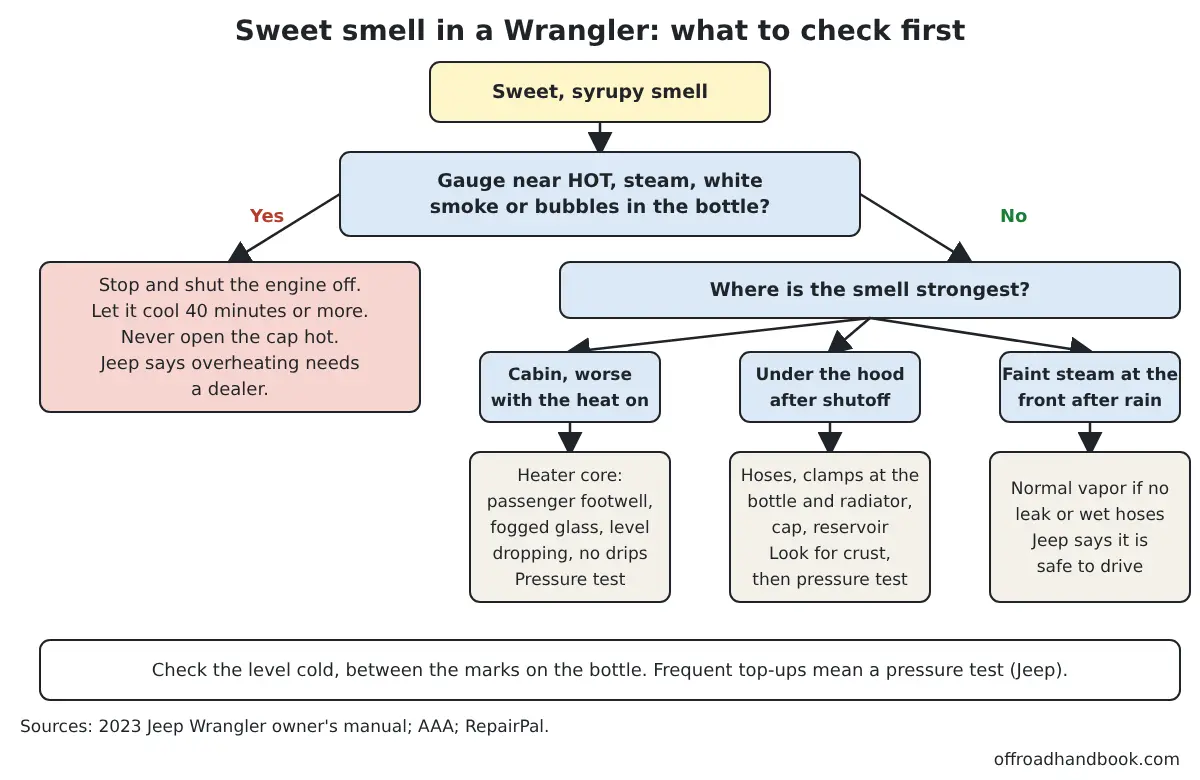
- Turn the engine off if the gauge is high or you see steam. Wait 40 minutes or more before opening anything, as AAA advises.
- Never open the radiator cap or bottle cap while the system is hot. Jeep warns that hot coolant or steam can badly burn you.
- When the engine is cold, check the level in the coolant bottle. It should sit between the marks. Jeep says the radiator normally stays full, so there is no need to open the radiator cap.
- Look under the vehicle for a puddle, then around hoses, clamps, the radiator and the water pump for wet spots or dried crust.
- If the level keeps dropping or you cannot find the leak, have the cooling system pressure-tested.
If the gauge is climbing, read why a Jeep overheats and what to do first.
Where is the smell coming from?
| What you notice | Likely cause | Check first | Who fixes it |
|---|---|---|---|
| Sweet smell in the cabin, stronger with the heater on, fogged glass, damp passenger footwell | Heater core leak | Feel the carpet under the dash, run the heater, check the level cold | Shop. The core sits deep behind the dash |
| Sweet smell near the engine after shutoff | Hose, clamp, radiator, water pump, cap or reservoir | Cool engine, look for wet spots and crust at connections | DIY look, shop pressure test |
| Smell with a climbing gauge, steam or white smoke | Overheating | Stop, cool down, do not open the cap | Dealer |
| Level drops but nothing drips | Leak inside the engine or at the heater core | Check the level cold, then pressure test | Shop |
| Faint steam at the front after rain or a wash, no leak found | Moisture turning to vapor | Look for radiator or hose leaks | Nothing to fix if none |
Is it a leak or normal vapor?
Jeep's manual describes one harmless case. After a few miles you may see vapor from the front of the engine compartment, which is moisture from rain, snow or humidity on the radiator turning to vapor when the thermostat opens.
If you find no sign of radiator or hose leaks, Jeep says the vehicle may be safely driven. The manual describes vapor only, so a sweet smell on top of it still deserves the checks above.
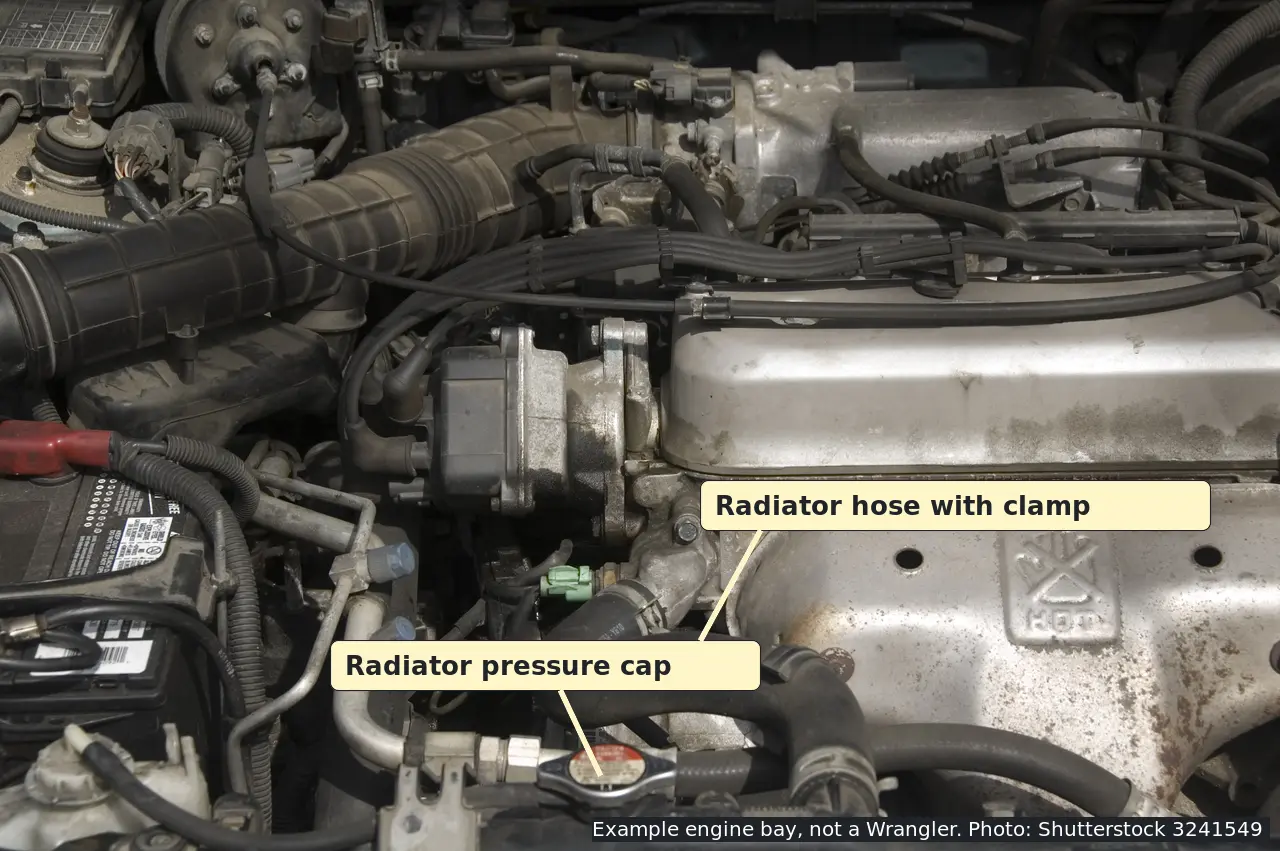
The manual also says to check the hoses for brittle rubber, cracks, tears and loose connections at the coolant bottle and the radiator. Keep the front of the radiator clean, and look for bugs and leaves. Rinse gently with a garden hose.
What coolant puddles look like
| Fluid | Typical color |
|---|---|
| Coolant | Blue, lime green, orange or sometimes pink |
| Engine oil | Gold or dark brown |
| Transmission fluid | Red |
| A/C condensation | Clear water, normal |
Which coolant and how much
The 2016 JK and 2023 JL manuals specify the same coolant. Jeep specifies Mopar 10-year, 150,000-mile OAT coolant that meets MS.90032, mixed at a minimum of 50 percent with distilled water. Do not exceed 70 percent coolant, and do not mix in HOAT or "globally compatible" coolant.
Jeep says not to use propylene glycol coolant, alcohol-based coolant, or extra rust inhibitors. If a non-OAT coolant goes in during an emergency, have a dealer drain and refill the system with OAT as soon as possible.
| Engine | Cooling system capacity | Manual |
|---|---|---|
| 3.6L V6, 2016 JK | 10.5 qt (9.9 L) | 2016 Wrangler manual |
| 3.6L V6, 2023 JL | 13.4 qt (12.7 L) | 2023 Wrangler manual |
| 2.0L turbo, 2023 JL | 11.8 qt, plus 3.7 qt (3.5 L) for the intercooler | 2023 Wrangler manual |
| 3.0L diesel, 2023 JL | 14 qt (13.2 L) | 2023 Wrangler manual |
To top up, search Amazon for Mopar OAT coolant and mix with distilled water. If the system needs special tools to refill, Jeep says to contact a dealer.
How to find a small leak
Hoses, clamps and the radiator are visible. A leak that only shows when the system is hot and under pressure is not.
That is what a pressure test is for. A shop or a cooling system pressure tester kit pumps the cooling system to its rated pressure with the engine cold and looks for drips.
Jeep says to have the system pressure-tested if you need to add coolant often. Follow the tester's instructions and your manual's cap rating, and never test on a hot engine.
Known Wrangler coolant leaks
Jeep's Technical Service Bulletin 07-004-23 covers a weak seam in the coolant overflow bottle on 2022 to 2023 JL Wranglers with the 6.4L V8 built between August 1 and November 7, 2022. The remedy is to inspect the bottle for leaks and replace it if needed (NHTSA copy of the bulletin).
NHTSA's recall database lists no coolant-system recall for 2007, 2012 or 2018 to 2024 Wranglers as of this writing, so a leak is usually a hose, clamp or part that has aged. Check your VIN on NHTSA's recall page for current campaigns.
Smell locator
Answer three questions and the locator returns the checks in order, free ones first and shop work last.
Every line comes from the sources linked in this post, and any hot-engine warning comes first.
Based on the 2023 Wrangler owner's manual, AAA and RepairPal. It does not replace a pressure test.
Is the smell dangerous?
Ethylene glycol coolant is poisonous if swallowed, and Jeep says to clean up ground spills right away so animals and children cannot reach them. Do not store it in open containers.
Coolant mist in the cabin from a heater core leak can fog the glass and is hard to wash off, according to RepairPal. Get that leak fixed rather than driving with the windows cracked.
FAQ
Coolant is leaking or burning off a hot part. Inside the cabin with the heat on, suspect the heater core. Under the hood after shutoff, suspect a hose, clamp, radiator, cap or reservoir.
Only if the gauge is normal, the level is steady and you see no steam. Jeep lists a strong coolant smell with a HOT gauge, white smoke or bubbles in the bottle as overheating, which needs dealer service.
Yes. A small leak can burn off a hot part, and a heater core or internal leak may not drip outside. A cooling-system pressure test finds them.
Not necessarily. Jeep says vapor after a few miles is moisture on the radiator, and that the vehicle may be safely driven if you find no radiator or hose leaks.
Related guides
- Why a Jeep overheats and what to do
- Jeep smells, overheating and electrical issues after off-roading
- Jeep 2.0 turbo problems, including coolant leaks
- Wet carpet that is not coolant: soft top leaks

I'm Suryashankar Dasgupta, the founder of Off-Road Handbook. I've been off-roading for years in the USA, including California and Texas, and have ridden mountain and desert terrain abroad. I've also driven a Jeep Compass for more than seven years, so I know the day-to-day side of Jeep ownership first-hand, from the Uconnect screen to the warning lights. Every guide here is researched from manufacturer owner's manuals, NHTSA recall and service-bulletin records and other trusted sources, checked against them before it is published, and corrected when we find a mistake. You can read how we work in our editorial policy: https://offroadhandbook.com/editorial-policy/
Like our off-road guides? Add Off-Road Handbook as a Google Preferred Source so our latest Jeep, ATV, UTV, trail, recovery, and off-road troubleshooting articles can appear more often in your Google Search experience.
Add us as a Preferred Source