Jeep Grand Cherokee Won’t Start? 12 Causes and How to Fix Them
Last updated on October 26th, 2026 at 07:53 pm
A Grand Cherokee that won't start falls into one of two groups. If it clicks or does nothing when you press the button or turn the key, the problem is almost always electrical: battery, cables, fob, or starter. If it cranks but never fires, look at fuel delivery and the crankshaft sensor.
Which group you are in cuts the list in half. This guide walks the 12 causes in diagnosis order, free checks first, and splits them by generation, because a 2012 model and a 2023 model fail in different ways. RepairPal's symptom page ranks the battery first, then the alternator and starter (RepairPal).
Start here: what you hear tells you where to look
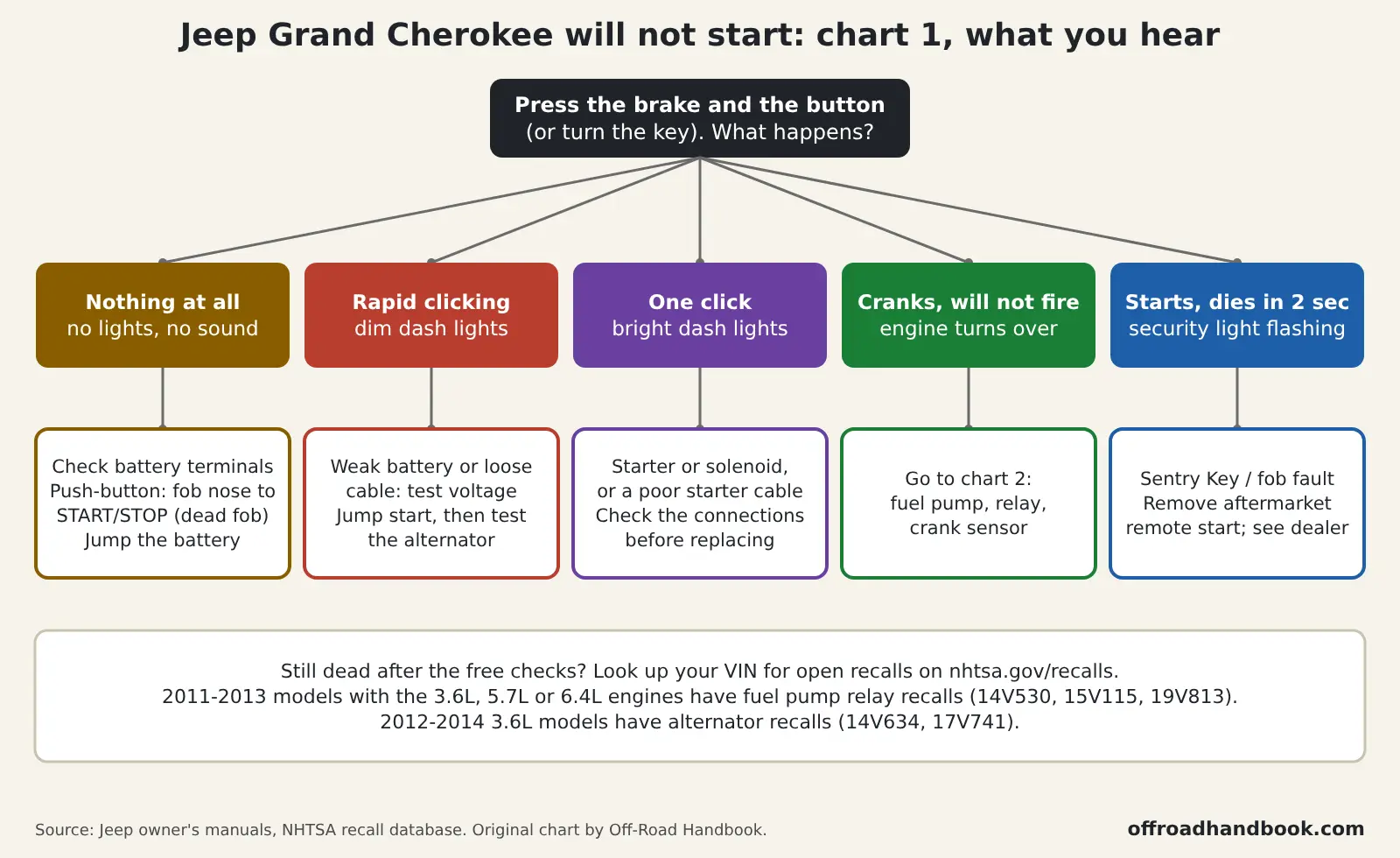
| What happens | Test first | Most likely cause | See |
|---|---|---|---|
| Rapid clicking, dim dash lights | Battery voltage at rest; terminals | Weak battery, loose cable, or a failed alternator that let it run down | 1, 2, 7 |
| One click, bright dash lights | Cable ends at the battery and starter | Starter or solenoid | 6 |
| No lights, no sounds, push-button model | Hold the fob nose against the START/STOP button | Dead key fob battery | 3 |
| Cranks normally, never fires | Listen for the fuel pump hum for about 2 seconds with ignition ON | Fuel pump relay or pump; crankshaft position sensor | 8, 9, 10 |
| Starts, then dies after about 2 seconds | Watch the security light | Sentry Key or fob fault, aftermarket remote start | 4 |
| Press button, nothing changes, message on screen | Read the cluster message | Fob not detected, or brake not pressed / not in Park | 3, 5 |
Jeep's manual also gives a useful baseline: on a push-button model the starter disengages automatically after 10 seconds if the engine fails to start. A long, steady crank that then stops is normal behavior, not a second fault.
Which generation do you have?
Recalls and failure patterns line up with generations. We checked NHTSA's recall database for every Grand Cherokee model year from 1999 to 2024 and kept only the campaigns that describe stalling, a fuel pump or relay failure, or a starting-system defect.
| Generation | Model years | Known no-start or stall campaigns (NHTSA) | What to check first |
|---|---|---|---|
| WJ | 1999-2004 | 04V112: 4.0L crankshaft position sensor wiring insulation may crack, causing stalls (2004 models). 06E011: certain aftermarket Airtex electric fuel pumps fitted to 1997-2004 models. | Crank sensor wiring; if the pump was replaced, the brand |
| WK | 2005-2010 | None found that describe stalling or a no-start. | Battery, cables, starter, then a scan |
| WK2 | 2011-2021 | 14V530, 15V115 and 19V813: fuel pump relay inside the TIPM-7 may fail and stall the engine (2011-2013, 3.6L, 5.7L, 6.4L). 14V634 and 17V741: 160-amp alternator may fail suddenly (3.6L, 2012-2014 and 2014). 3.0L diesel: 20V475, 23V411 (crank sensor tone wheel), 22V406 (high-pressure fuel pump). | Fuel pump relay on 2011-2013; alternator on 2012-2014 3.6L |
| WL | 2022 and newer | Some 2022 models did not recognize the key fob because of a faulty radio frequency hub module; Jeep replaced the hubs at no charge and did not call it a safety recall (KBB, Feb 2022). | Fob and RF hub; remote jump posts under the hood |
Open recalls are repaired free at a dealer. Enter your VIN before you spend money on a relay or alternator.
No-start symptom checker
Pick what the Jeep does when you try to start it, then your generation. The checker lists free checks first and points to the matching cause number below.
The checker only repeats the table above and the causes below, which come from the Jeep owner's manual and NHTSA recalls. It cannot read codes or inspect the Jeep, so treat it as a checklist.
The 12 causes, in diagnosis order
1. Weak or dead battery
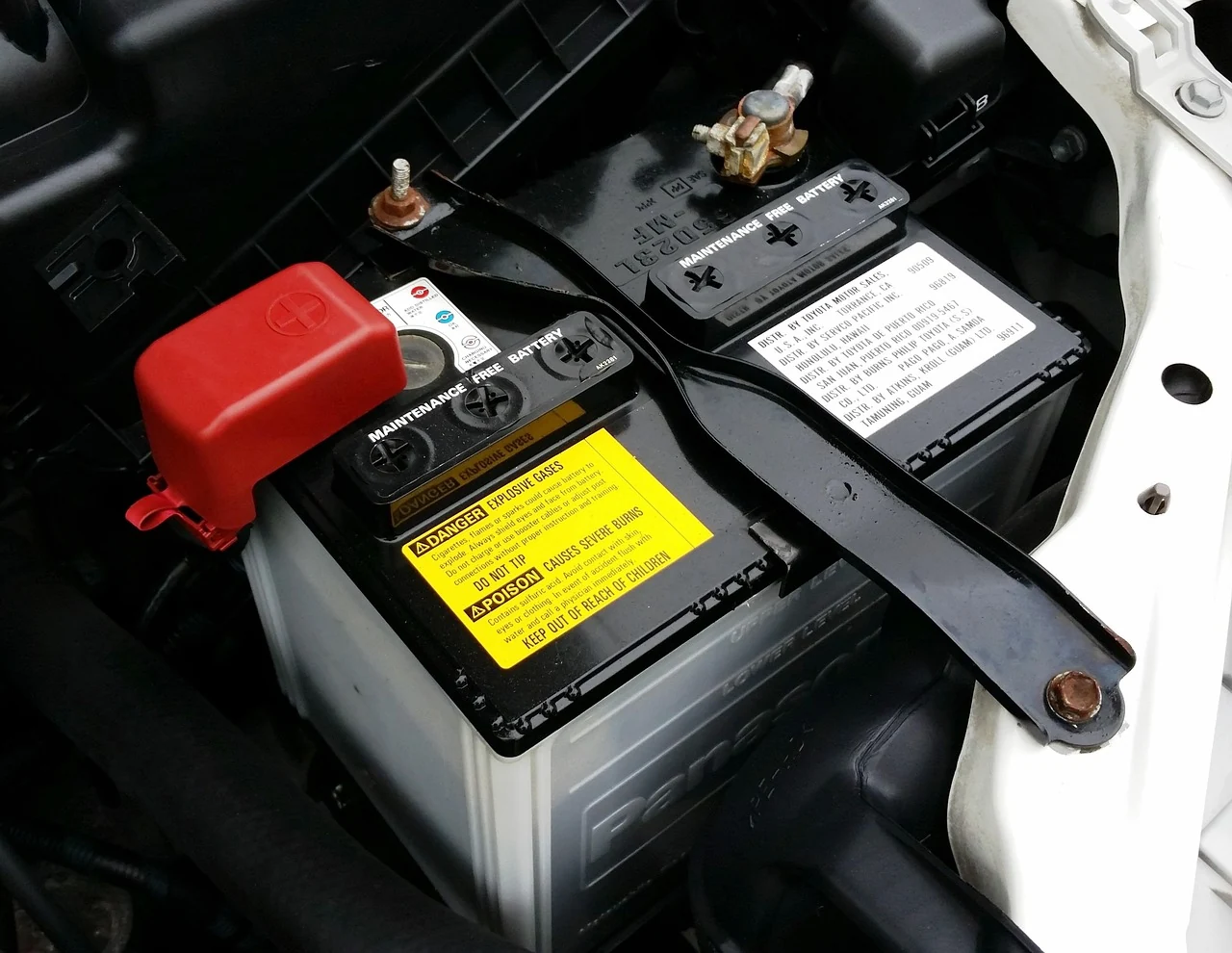
Rapid clicking, dim lights, or a slow crank point here first. Measure the battery with a multimeter before you do anything else.
As a common shop rule of thumb, a rested, charged flooded battery reads about 12.6 volts, and a reading near 12 volts or below may not turn the engine. This is not a Jeep specification, and AGM batteries read a little higher. With the engine running, a healthy charging system reads higher than the resting figure.
A battery that tests low needs a charge and a load test at a parts store. If it is old or fails the test, replace it.
How to jump-start a Grand Cherokee
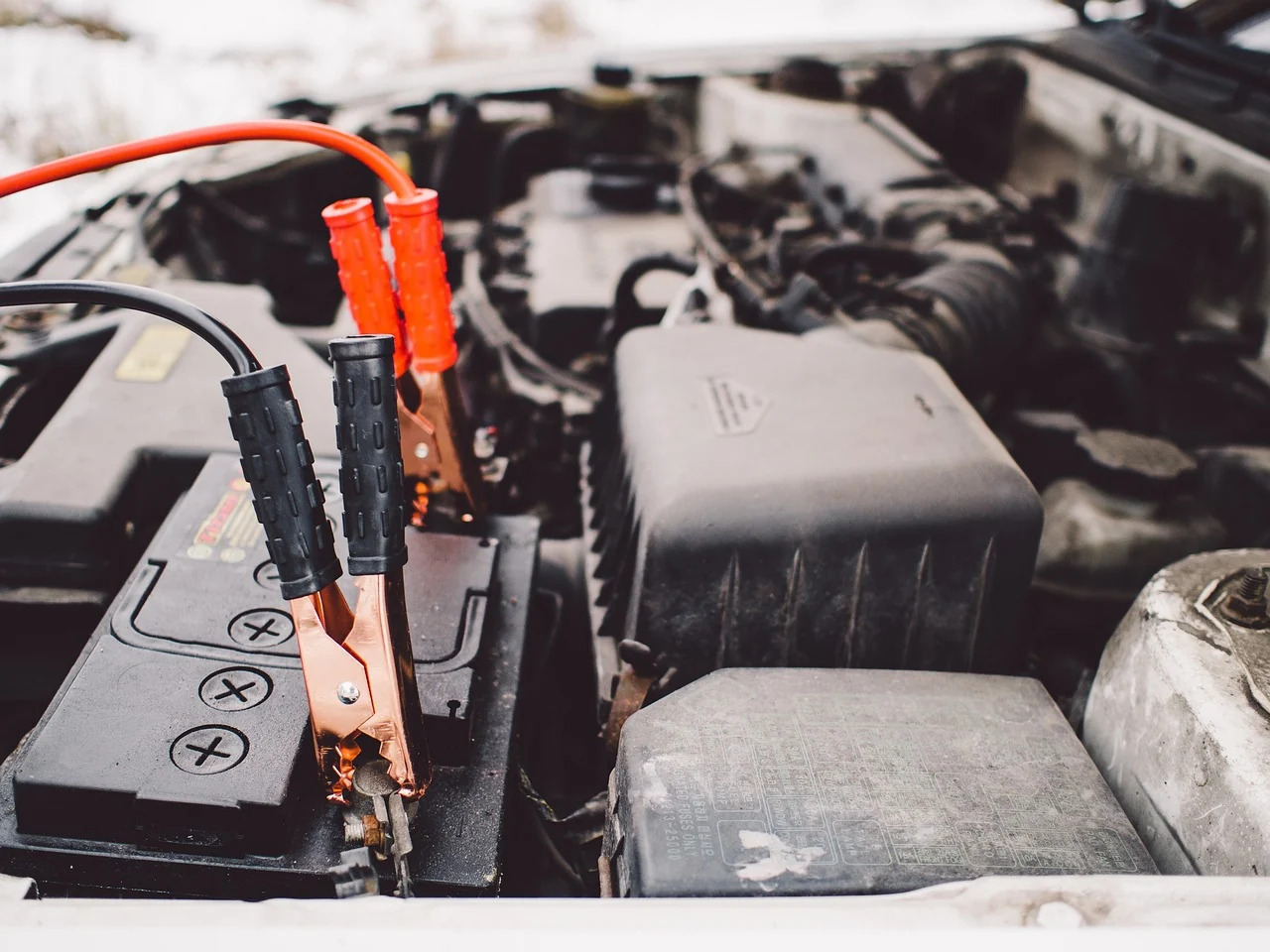
Jeep's owner's manual says to use only a 12-volt source, never a frozen battery, and never to jump off fuses. On newer models, remote jump posts sit under the hood: the positive post has a cap you lift.
- Apply the parking brake, shift to Park and turn the ignition off. Turn off the heater, radio and other accessories.
- Park the donor vehicle within reach without the vehicles touching, with its ignition off.
- Connect one end of the red cable to the positive (+) post on the Jeep, then the other red end to the donor's positive post.
- Connect one black end to the donor's negative (-) post, and the other black end to the Jeep's remote negative (-) post or a bare metal ground.
- Start the donor vehicle, then the Jeep. Remove the cables in the reverse order.
Older models place the battery under the hood without remote posts, so check your own manual for the correct connection points.
2. Loose or corroded terminals and cables
A battery can test fine and still deliver nothing. Look for white or green crust on the posts, a clamp you can twist by hand, or a cable that is hot after cranking.
Remove the clamps negative first, clean the posts and clamp faces with a wire brush, and reinstall them tight. This is free, so do it before buying parts.
If the button does nothing and the cluster shows "Key Fob Not Detected," the fob battery may be low or dead. The manual gives a backup method: put the nose side of the fob, the side opposite the emergency key, against the START/STOP button and push.
The manual also says to replace the fob battery, and notes that a qualified technician or dealer should do it.
4. Sentry Key immobilizer
Jeep's manual describes what the security light tells you. It turns on for three seconds at ignition ON as a bulb check. If it stays on afterward, there is an electronics fault. If it flashes, the system saw an invalid fob.
If a valid fob is used but the vehicle electronics have an issue, the engine starts and shuts off after two seconds. The manual also cautions that the Sentry Key system is not compatible with some aftermarket remote start systems, which can cause starting problems.
Unplug or remove an aftermarket remote starter first. If the light stays on, a dealer has the tools to check the fob and the module.
5. Not in Park, or no brake pedal
On an automatic push-button model the transmission must be in Park and you must press and hold the brake pedal while pushing the button. Hold the pedal firmly, not just touching it.
This sounds basic, but it is a free test, and a failed range switch can look the same as a dead starter.
6. Starter or solenoid
One loud click with bright dash lights and a good battery points to the starter circuit. Check that the large cable on the starter is tight and clean before you condemn the starter.
Replacing a starter is a straightforward job on some engines and a tight one on others, so check your engine's access before you commit.
7. Failed alternator that let the battery run down
A battery warning light, dimming lights while driving, or a stall followed by a no-start suggests the charging system. The 3.6L models built from April 2010 to January 2014 had alternator recalls for sudden failure and stalling.
Check your VIN against 14V634 and 17V741. A dealer repairs open recalls free of charge.
8. Fuel pump fuse and relay
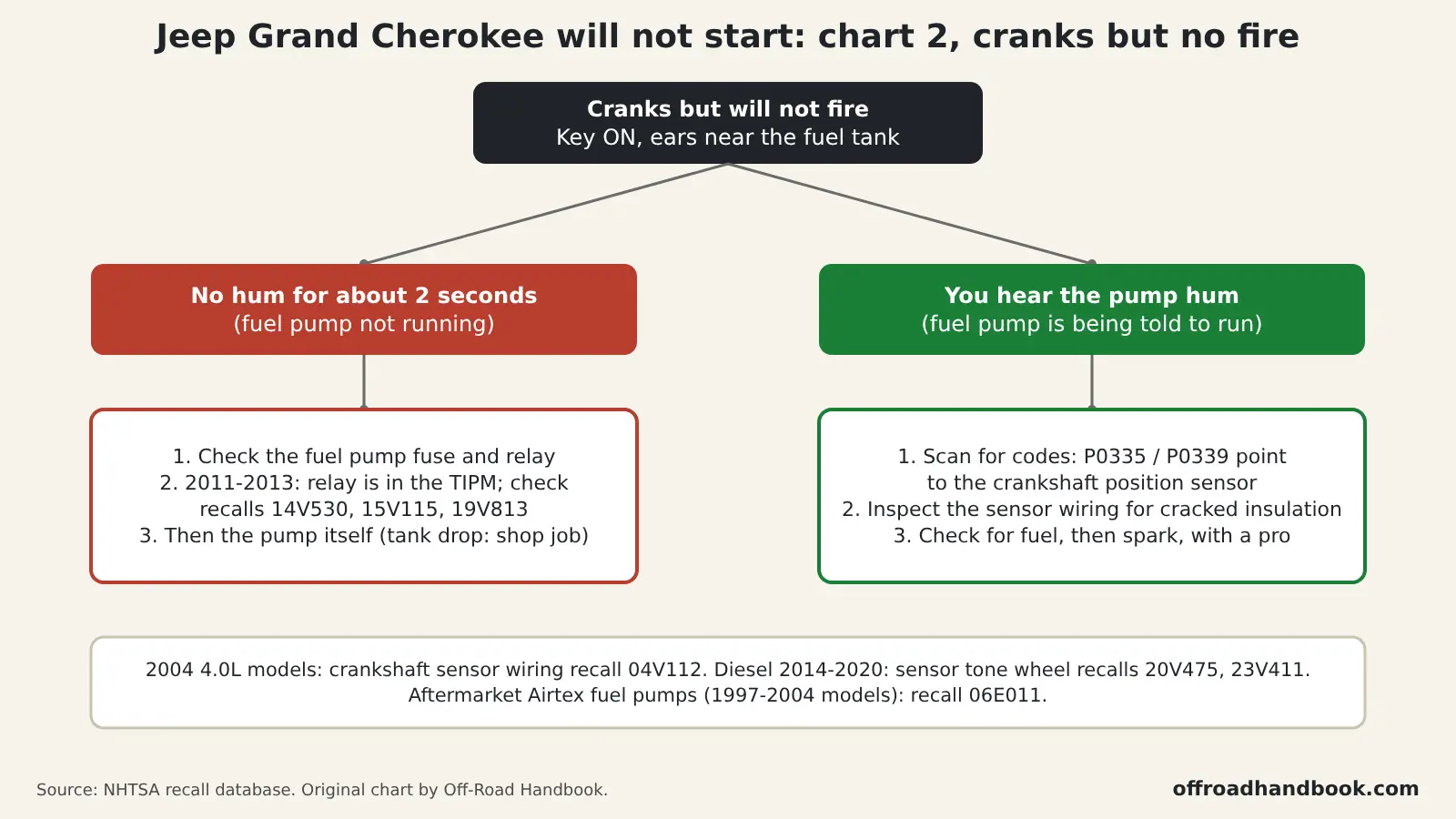
If the engine cranks but never fires, turn the ignition ON and listen near the rear seat or tank for a hum of about two seconds. No hum points to the pump circuit.
Check the fuse first, then the relay. On 2011-2013 models with the 3.6L, 5.7L or 6.4L, the relay sits inside the TIPM-7 and has three recalls: 14V530, 15V115 and 19V813. The fix moves the relay outside the module, and the 2019 campaign adds a harness.
9. Fuel pump
If the fuse and relay are good and there is still no hum, the pump itself may have failed. Sudden loss of power at speed is a common sign, but only a fuel pressure test confirms it.
The pump sits in the tank, so replacement is a shop job on most Grand Cherokees. Ask for the part brand: a recall covers certain aftermarket Airtex pumps fitted to 1997-2004 models (06E011).
10. Crankshaft position sensor
The engine computer uses this sensor to time fuel and spark. When it fails or its wiring breaks, the engine can crank without ever firing, or stall without warning.
A scan tool pointing to codes P0335 or P0339 supports the diagnosis. On 2004 4.0L models, check the wiring insulation, since NHTSA campaign 04V112 covers cracking that can let moisture upset the sensor.
11. Dirty throttle body
A carbon-coated throttle body more often causes rough idle or stalling than a true no-start, but it can make the engine start and then die. Clean it with throttle body cleaner only, with the ignition off and the battery disconnected.
Do not force the plate open by hand on an electronic throttle. Some models need an idle relearn afterward, so check the service information for your engine.
12. Module or wiring fault
When everything above checks out, a communication or module fault is likely. The 2022 fob recognition problem traced to the radio frequency hub is one example; the TIPM relay is another.
A scan tool that reads all modules will show communication codes. Stop guessing at this point and see a dealer, since module replacement usually needs programming.
When to stop and call for help
- The security light stays on or the engine dies after two seconds every time
- You smell fuel or see a leak while trying to start it
- The battery keeps going dead after a jump and a charge
- Open recalls show up for your VIN
Stay out of traffic while you diagnose, and keep the hood prop secure. If the vehicle stalled on the road, get it off the lane before you test anything.
If it starts but will not move once running, see our guide to a Grand Cherokee that won't move in gear. Other Grand Cherokee issues are covered in our air suspension problems guide, and our off-road calculators cover tire size, gearing and winch sizing for the trail.
FAQ
Why does my Grand Cherokee click but not start?
Rapid clicking usually means a weak battery or loose cable. A single click with bright lights points to the starter or its connections.
Why does it crank but not start?
The engine is turning but not getting fuel, spark or a valid sensor signal. Listen for the fuel pump hum, then check the fuse, relay and crankshaft sensor.
Yes. Hold the fob nose against the START/STOP button, as the manual describes, and press the button with the brake applied.
Is a no-start covered by a recall?
Sometimes. Fuel pump relay recalls cover 2011-2013 models, and alternator recalls cover 2012-2014 3.6L models. Check your VIN at nhtsa.gov/recalls.
Sources
- Jeep Grand Cherokee owner's manual: Sentry Key, starting, jump starting
- NHTSA recalls: search by VIN; campaigns above taken from the NHTSA recalls API for Jeep Grand Cherokee
- Kelley Blue Book: 2022 Grand Cherokee RF hub stop-sale
- RepairPal: Jeep Grand Cherokee won't start

I'm Suryashankar Dasgupta, the founder of Off-Road Handbook. I've been off-roading for years in the USA, including California and Texas, and have ridden mountain and desert terrain abroad. I've also driven a Jeep Compass for more than seven years, so I know the day-to-day side of Jeep ownership first-hand, from the Uconnect screen to the warning lights. Every guide here is researched from manufacturer owner's manuals, NHTSA recall and service-bulletin records and other trusted sources, checked against them before it is published, and corrected when we find a mistake. You can read how we work in our editorial policy: https://offroadhandbook.com/editorial-policy/
Like our off-road guides? Add Off-Road Handbook as a Google Preferred Source so our latest Jeep, ATV, UTV, trail, recovery, and off-road troubleshooting articles can appear more often in your Google Search experience.
Add us as a Preferred Source