Jeep Grand Cherokee Suspension Problems: Causes and How to Fix
Last updated on October 26th, 2026 at 07:52 pm
This post contains Amazon affiliate links. As an Amazon Associate I earn from qualifying purchases, at no extra cost to you.
A Grand Cherokee that clunks, wanders or sits low almost always has a worn sway bar link, bushing, ball joint, tie rod end or shock, and a flashlight plus a pair of jack stands will tell you which. If it is a 2021–2023 model, check your VIN for open recalls first. Jeep has recalled these SUVs for a front upper control arm bolt and for rear coil springs.
Below you will find a symptom table, the recall list by model year, a check order that starts with the free tests, a symptom checker, and what Jeep's own owner's manuals say. Models with Quadra-Lift air suspension have more failure points, which we cover in our Grand Cherokee air suspension guide.
Symptoms, causes and fixes at a glance
| Symptom | Likely causes, in order | Free check first | Fix and stop-driving rule |
|---|---|---|---|
| Clunk or rattle over small bumps | Sway bar end links, sway bar bushings, shock mounts | Pull on each link by hand and look for torn boots | Replace the links. Not urgent unless steering feels loose. |
| Clunk when braking, accelerating or turning | Control arm bushings, ball joints, loose wheel nuts | Check wheel nut torque and look for split bushings | Replace the worn arm or joint, then align. Stop driving if a wheel moves at the joint. |
| Wandering or loose steering | Tire pressure and wear, tie rod ends, bushings, alignment | Tire pressure, then tread wear by hand | Replace tie rod ends with play, then align. Loose steering means stop driving. |
| Bouncy ride, nose dive when braking | Worn shocks or struts, cupped tires | Look for oil on shock bodies and bounce each corner | Replace shocks on both sides of the axle. |
| Hum or growl that rises with speed | Wheel bearing, cupped tires | Feel the tread for scalloping | Replace a rough or loose bearing or hub. |
| One corner sits low | Broken or sagging coil spring, air leak on Quadra-Lift, 2021–2023 rear spring recall | Measure fender to ground at each corner | Coil springs: replace as a pair. Recall: dealer, free. Sudden drop: stop driving. |
| Noise or vibration over bumps on a 2021–2023 | Upper control arm pinch bolt (recall 24V-132) | Run your VIN at nhtsa.gov/recalls | Dealer replaces the bolts, free of charge. |
The order matters. Free checks come first because a loose wheel nut, a flat-spotted tire or a torn sway bar boot costs nothing to find and mimics much more expensive problems.
A bad sway bar link can sound like a worn ball joint, according to RepairPal's Grand Cherokee estimate page. Check the links before you condemn the joints.
How to find the problem, in order
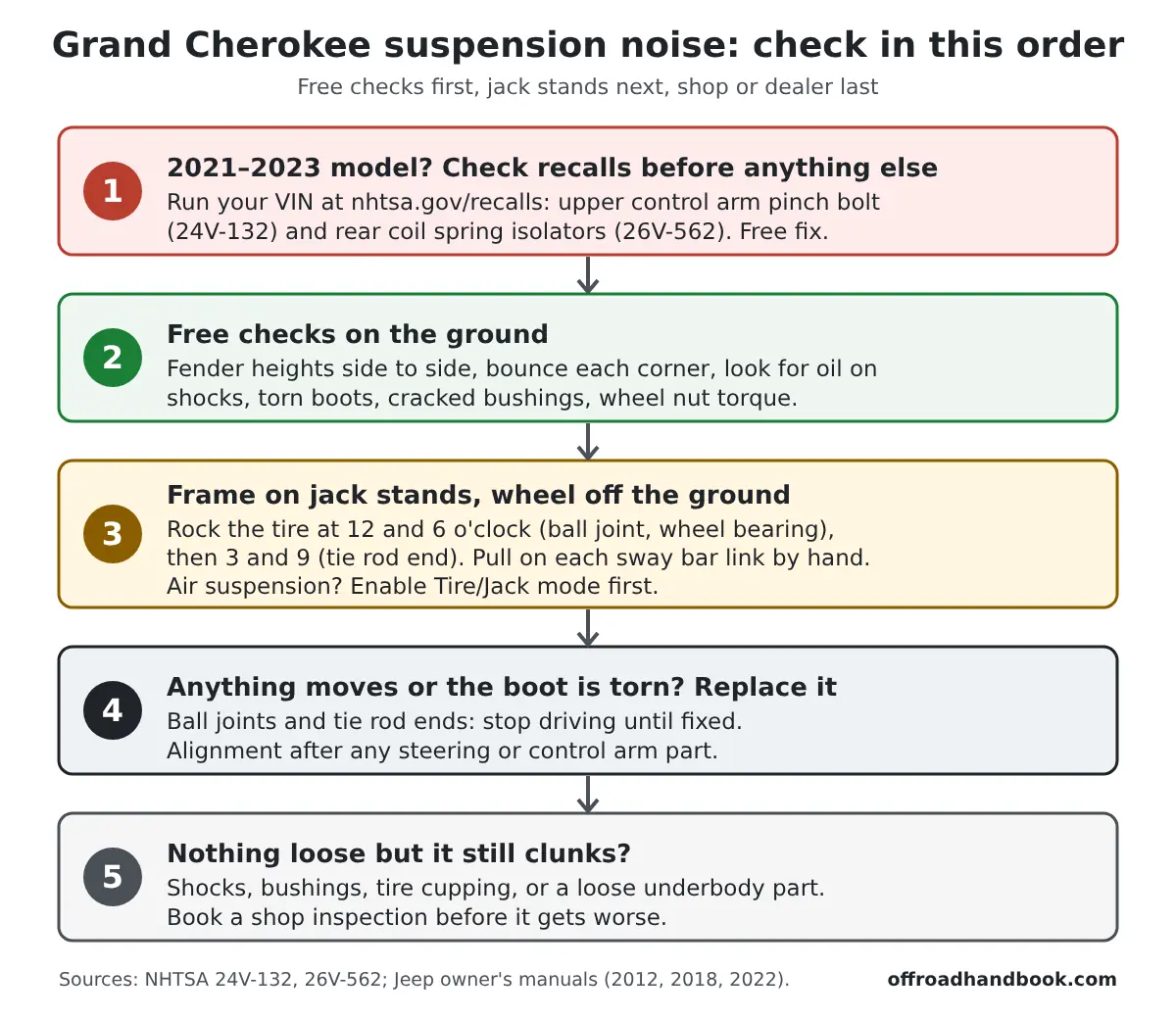
Jeep builds this inspection into the maintenance schedule. The 2012 owner's manual says to inspect the front suspension, tie rod ends and boot seals for cracks or leaks, and all parts for damage, wear, improper looseness or end play. The first inspection is at 16,000 miles or 12 months, and it repeats at each later 16,000-mile service.
The 2018 and 2022 manuals list the same front suspension and tie rod inspection in their schedules.
- Run your VIN at nhtsa.gov/recalls if the Jeep is a 2021–2023 model (see the recall table below).
- Park on level ground and measure from the top of each wheel opening to the ground. A corner that is clearly lower than its twin points to a spring, or on Quadra-Lift, an air leak.
- Bounce each corner. It should settle quickly. Look for oil on shock bodies, torn rubber boots and cracked bushings with a flashlight.
- Check wheel nut torque with a torque wrench (½-inch click-type torque wrench on Amazon). The manuals give 110 ft-lb in 2012 and 130 ft-lb in 2018 and 2022 (table below).
- Raise the front on a jack and support the frame on jack stands (jack stands on Amazon). Never work under a Jeep held only by a jack. On Quadra-Lift, enable Tire/Jack mode first.
- Grab the tire at 12 and 6 o'clock and rock it. Movement points to a ball joint or wheel bearing. Repeat at 3 and 9 o'clock for tie rod ends.
- Pull each sway bar link by hand. Have a helper turn the steering wheel while you watch the tie rod ends and joints.
Know Your Parts, a technician resource, describes the same hand test for tie rods: push and pull each outer end, and treat any free play as a reason to replace it. It also suggests a dry-park test where a helper turns the wheel from 10 o'clock to 10 o'clock while you watch for movement (see its inspection tips).
After off-road use, Jeep's 2018 manual tells owners to inspect the underbody, check steering and suspension for damage, and re-tighten loose chassis, steering and suspension fasteners to the values in the service manual.
2021–2023 models: check recalls before you diagnose
The newest Grand Cherokees have the most serious suspension recalls. Two of them involve parts that can fail without a clear warning, so run your VIN at nhtsa.gov/recalls before you spend a weekend chasing a clunk.
Jeep's own dealer document for recall 24V-132 says a damaged upper control arm pinch bolt may break, the arm may separate from the knuckle, and the wheel can fall outboard, which "can cause a vehicle crash without prior warning." Some news coverage calls a bump noise a warning sign. Do not count on that.
| Campaign | Models and years | Problem | What to do |
|---|---|---|---|
| 24V-132 (FCA 10B) | 2022–2023 Grand Cherokee, 2021–2023 Grand Cherokee L (338,238 vehicles) | Upper control arm pinch bolt damaged in assembly may break and let the arm separate from the steering knuckle | Dealer replaces the pinch bolts on both sides, free. FCA allows 0.2 labor hours. |
| 26V-562 (FCA 89D) | 2021–2023 Grand Cherokee L, 2022–2023 Grand Cherokee and Grand Cherokee 4xe (328,381 vehicles) | Rear coil springs may be incorrectly installed and detach while driving | Dealer replaces the rear coil spring lower isolators, free. It replaces 23V-413 and 26V-051, so earlier repairs need redoing. |
| 23V-352 (FCA 58A) | 2021–2023 Grand Cherokee L, 2022–2023 Grand Cherokee (89,372 vehicles) | Steering column intermediate shaft may disconnect from the u-joint and cause loss of steering control | Dealer inspects and replaces the shaft if needed, free. |
| 24V-131 (FCA 07B) | 2024 Grand Cherokee (250 vehicles) | Improperly machined steering knuckle may separate between ball joint and knuckle | Dealer replaces the steering knuckle, free. |
| 15V-469 (FCA R38) | 2015 Grand Cherokee built June 12–20, 2015 (5,492 vehicles) | Rear lower control arm may be incorrectly heat treated and fracture | Dealer inspects and replaces the arm if needed, free. |
Owners with an open recall should call a Jeep dealer or FCA customer service at 1-800-853-1403. Interim letters for 26V-562 were mailed September 29, 2026, and the final remedy letters follow once parts are ready, according to NHTSA's record.
If your VIN shows nothing open, the wear-item checks above still apply.
Not sure where to start? Pick your symptom
The checker follows the symptom table and the recall table above. Wheel nut torque comes from the 2012, 2018 and 2022 owner's manuals; repair costs come from RepairPal estimate pages. It is a guide to the order of checks, not a diagnosis.
Wheel nut torque deserves its own mention, because a loose wheel can feel exactly like a worn joint. The table shows what the manuals say.
What the owner's manuals say, by model year
| Model year | Wheel nut torque | Suspension inspection in the schedule | Quadra-Lift service modes |
|---|---|---|---|
| 2012 (WK2) | 110 ft-lb (150 N·m), star pattern, tighten twice, recheck after 25 miles | Front suspension, tie rod ends and boot seals: first at 16,000 miles or 12 months, then each 16,000-mile service | Tire change: hold Up and Down 5 to 10 seconds to disable leveling; driving over 5 mph restores it |
| 2018 (WK2) | 130 ft-lb (176 N·m), M14 x 1.50 | Front suspension and tie rod ends listed under additional inspections | Tire/Jack mode and Wheel Alignment mode, both enabled with the engine running |
| 2022 Grand Cherokee L (WL) | 130 ft-lb (176 N·m), M14 x 1.50 | Front suspension and tie rod ends listed in the schedule | Tire/Jack mode and Wheel Alignment mode, enabled through the touchscreen with the ignition on |
Torque numbers jumped between those years, so do not carry a number from an older Jeep to a newer one. Torque the nuts in a star pattern, and use a calibrated torque wrench with a six-sided deep-wall socket, as the 2018 manual specifies.
Both the 2018 and 2022 manuals say the Wheel Alignment mode must be enabled before an alignment on Quadra-Lift models. Tell the alignment shop, or the car can read a false ride height. Our bigger tires on a Grand Cherokee guide covers why changing tire size also changes how the suspension and speedometer behave, and the tire size calculator shows the numbers.
Problem by problem
Sway bar end links
Links are the first suspect for a rattle over small bumps. They are cheap, easy to reach and wear from boots tearing. A torn boot, or a link you can move by hand, means replace it.
RepairPal's Grand Cherokee page lists the job at $144 to $197 across model years, which includes $90 to $118 in parts and $54 to $79 in labor.
Control arm bushings and ball joints
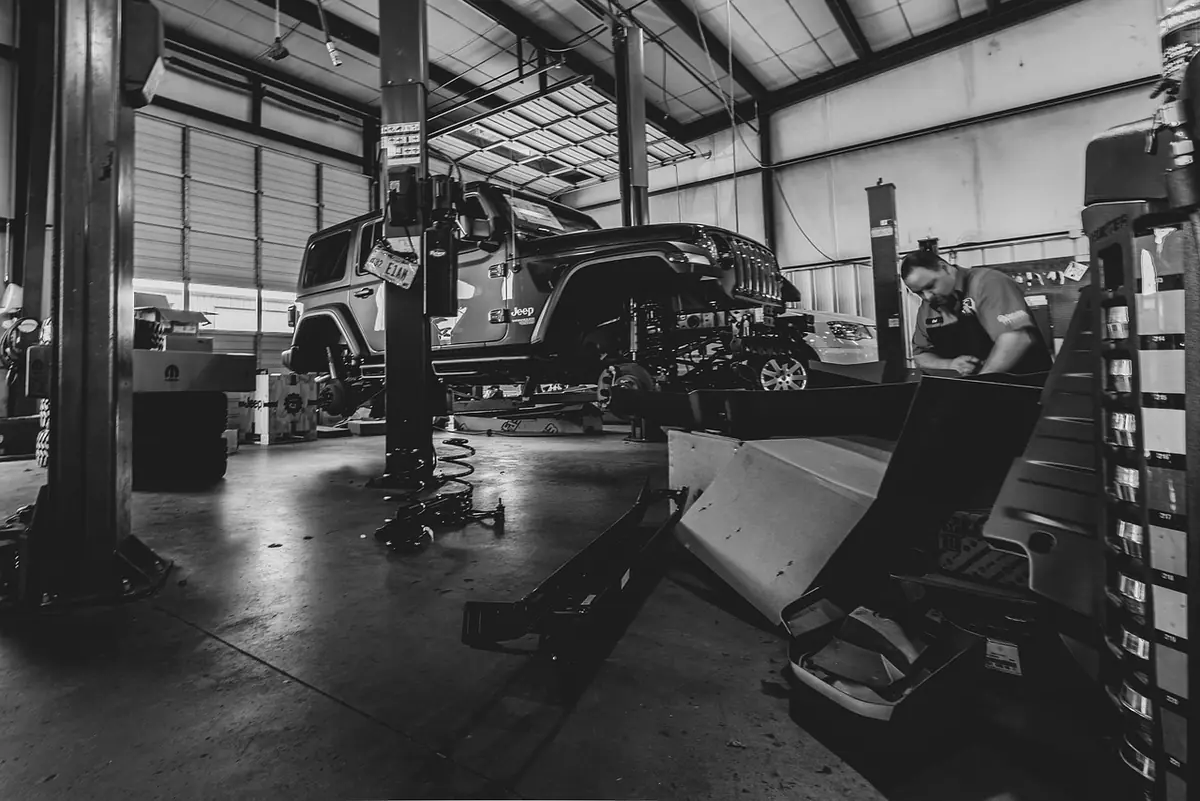
Cracked bushings and worn ball joints cause a clunk when you brake, accelerate or turn, plus vague steering and uneven tire wear. Inspect with a flashlight first, then with the wheel off the ground.
Knowing which joint carries the load matters for a proper play test. Know Your Parts says loaded and unloaded joints are tested differently, and that a pry-bar test can mislead when bushings are worn. Leave the measurement to a shop with the manufacturer limits, and expect an alignment after the repair.
Tie rod ends
Play in a tie rod end gives loose or wandering steering. Even small wear in each end can add up to a large toe error, so a new outer tie rod always needs an alignment.
Shocks and struts
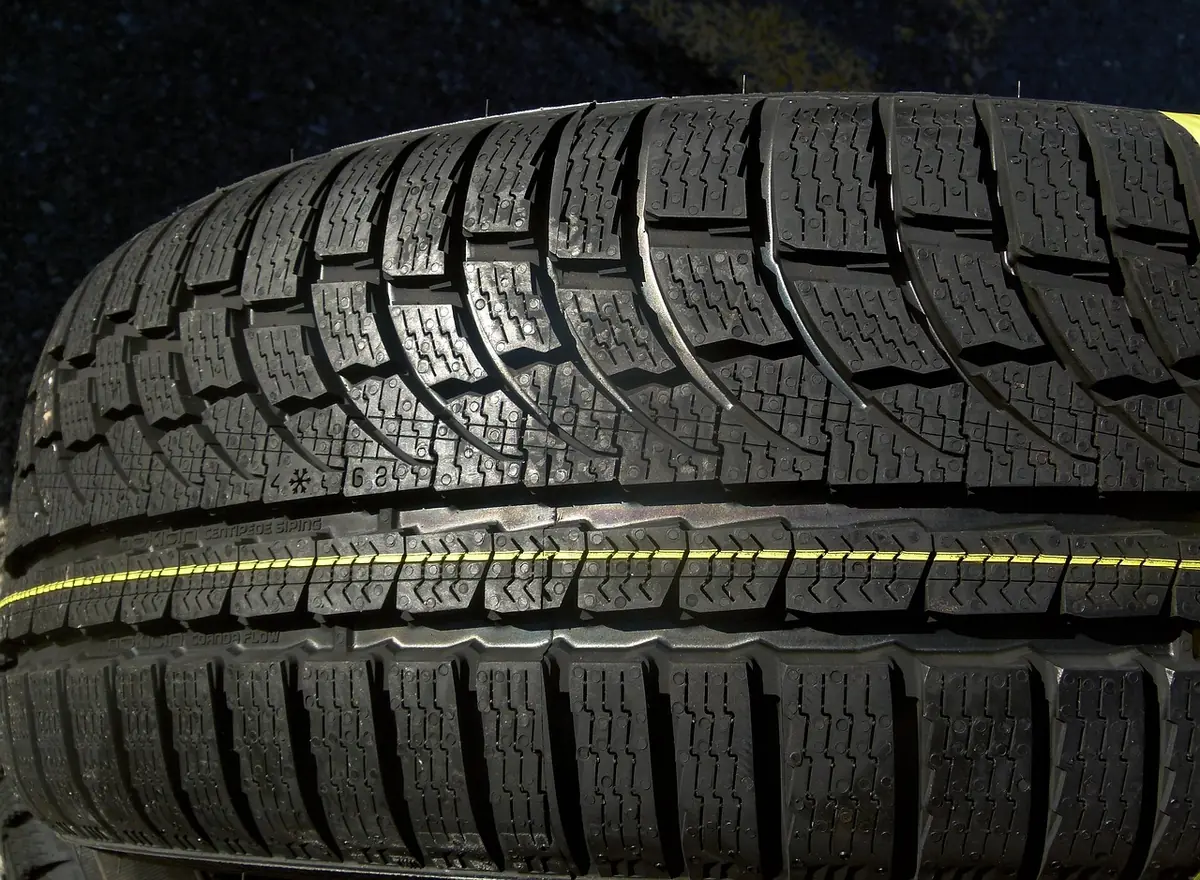
Worn shocks make the ride bouncy and let the nose dive under braking. Oil on the shock body means the seal has failed. Check the tires too, because cupped or scalloped tread can cause a bouncy ride and a rumble that feels like worn shocks. Replace both sides of an axle together so damping stays even.
Wheel bearings and hubs
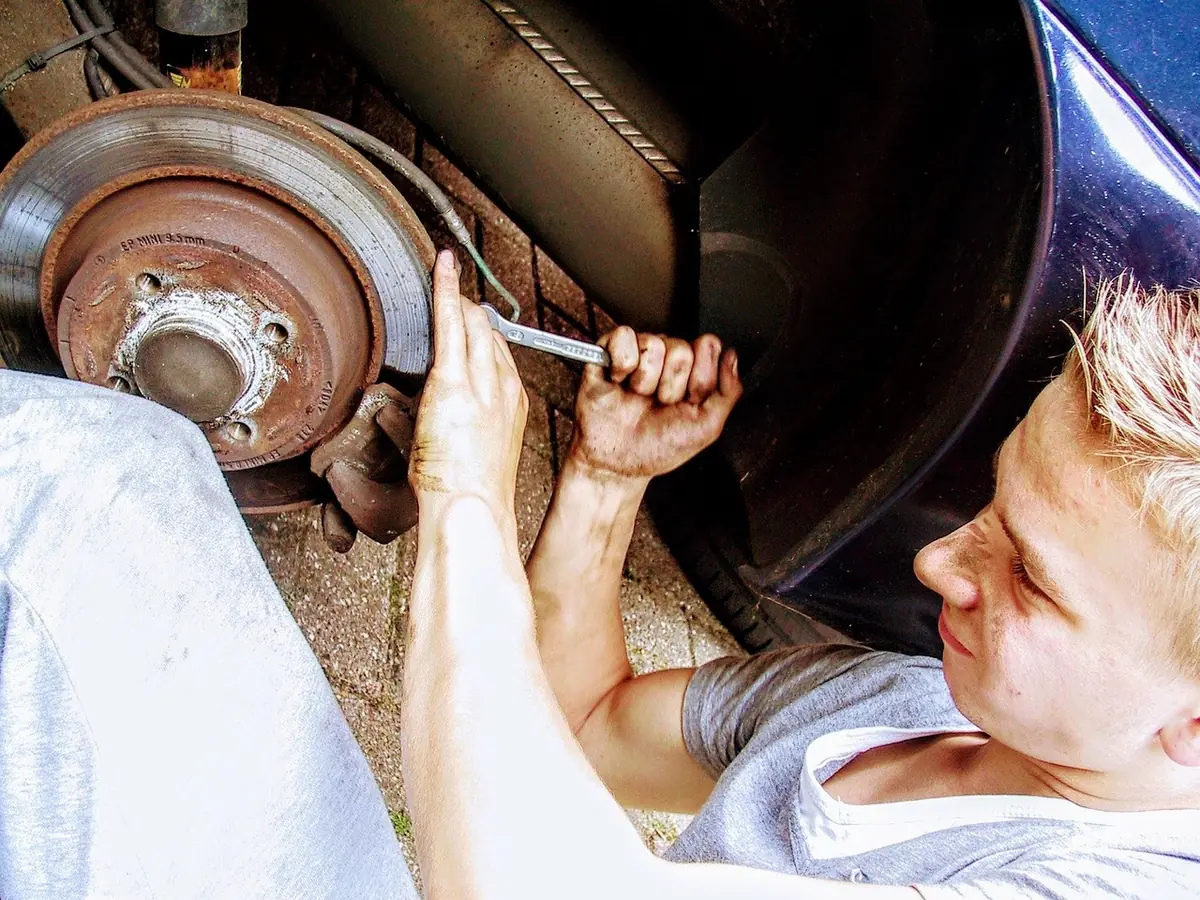
A hum or growl that rises with speed can be a wheel bearing, but cupped tires sound the same. Run a hand over the tread, then spin and rock the wheel off the ground. A rough or loose bearing should be replaced before a long trip.
Sagging or broken coil springs
A corner that sits low or drops suddenly points to a spring. Replace springs as a pair on the same axle, and get an alignment if the ride height changes. On 2021–2023 models, check the rear spring recall before replacing anything.
What it costs
| Job | Cost range | Source |
|---|---|---|
| Sway bar link kit, all Grand Cherokee years | $144 to $197 | RepairPal, updated September 2026 |
| Sway bar link kit, 2011–2015 | $155 to $204 | RepairPal |
| Sway bar link kit, 2016–2021 | $122 to $162 | RepairPal |
| Sway bar link kit, 2022–2025 | $200 to $234 | RepairPal |
| Suspension system inspection, 2023 Grand Cherokee L | $98 to $143 | RepairPal |
| Open safety recall repair | Free at a Jeep dealer | NHTSA, FCA |
Ask any shop whether an alignment is included in a control arm or tie rod quote.
When to stop driving
Stop and get the Jeep checked right away for loose or vague steering, a clunk that gets rapidly worse, a visibly broken spring, a corner that suddenly drops, or any play at a ball joint or tie rod end on jack stands. A separated ball joint or tie rod can cause a loss of control.
If a 2021–2023 Jeep has an open recall, call the dealer before driving it on the highway.
Quadra-Lift air suspension
Air suspension adds air springs, a compressor, a valve block and height sensors. A leak makes the compressor run more often, which wears it out. Jeep's manuals warn that the system holds high-pressure air and say to see an authorized dealer for service.
Use the overnight height check and the leak test in our Grand Cherokee air suspension problems guide.
Why Quadra-Lift Drops After Off-Road Driving
Trail use does not automatically damage air suspension, but extra height changes, full wheel articulation, mud, and small impacts can turn an aging seal or fitting into a visible failure. If the Jeep sits low after a trail day, the system is usually losing air, misreading ride height, or protecting an overworked compressor.
The pattern helps: if one corner drops, suspect a leak or a height sensor at that corner. If the whole Jeep drops, look at the compressor, valve block, calibration, or a system-level fault.
- Rock strike near a line: a nicked plastic air line may only leak at certain heights.
- Mud around sensor arms: packed mud can restrict a ride-height sensor linkage.
- Full extension in Off-Road 2: old air spring folds can open small cracks when stretched.
- Repeated raise and lower commands: extra cycling exposes a weak compressor.
- Cold overnight parking: existing leaks show up more as seals contract.
| What you notice after the trail | Most likely area | Check first |
|---|---|---|
| Front drops when parked | Front air struts or lines | Soapy-water leak test at full height |
| Rear drops overnight | Rear air springs or fittings | Spring folds, line connections, valve block |
| Drops after bumps | Height sensor linkage | Broken arm, loose bracket, damaged connector |
| “Service Air Suspension” message | Stored fault code | Scan before replacing parts |
| Will not rise after several tries | Compressor protection or failure | Stop cycling, let it cool, scan codes |
Safe driveway test after a trail day
- Park on flat ground and set the parking brake.
- Measure from the wheel center to the fender lip at all four corners at normal ride height.
- Measure again after one hour and the next morning to see whether one corner or the whole Jeep is dropping.
- Raise to the highest setting if the system allows it, then spray soapy water on the spring folds, fittings, and visible lines and watch for bubbles.
- Scan for air suspension codes before clearing anything.
- Check the height sensor arms for loose, bent, or disconnected links.
- Do not keep pressing the raise button if the compressor sounds strained or a warning is showing, and avoid highway speeds while a corner is visibly low.
Repair options: fix the original system or convert to coils
Your best repair path depends on how you use the SUV, how long you plan to keep it, and whether height adjustability matters to you.
Keeping the factory air setup preserves ride-height modes, load leveling, and the comfort Jeep intended. That matters if you tow, drive rough trails, or bought the Grand Cherokee specifically for Quadra-Lift capability. A proper repair usually means replacing the failed part and any upstream cause, such as a leak that damaged the compressor.
A coil conversion removes future air-system complexity, but it also removes the system's core benefit. For some owners, that trade is worth it. For others, especially those who use off-road height settings, it's a downgrade.
Factory air repair vs coil conversion
| Option | Best for | Pros | Trade-offs |
|---|---|---|---|
| Repair factory air system | Owners who want stock function | Keeps height modes, comfort, leveling | Parts and diagnosis can cost more |
| Partial repair only | Short-term ownership | Lower immediate cost | May miss root cause |
| Coil conversion | Owners prioritizing simplicity | Fewer air-system parts to fail | Loses adjustable height and original feel |
A balanced rule works well here:
- Repair the air system if the Jeep is otherwise in good shape and you value comfort, towing stance, or trail clearance.
- Consider conversion if multiple major components have failed and you no longer need the adjustable system.
- Avoid piecemeal guessing if you want a lasting fix.
How to prevent repeat failures
The best prevention is reducing compressor strain, keeping moisture out of the system, and responding early to small leaks.
Air suspension is not fragile by default, but it is less forgiving when maintenance is delayed. If the vehicle starts leaning, don't keep driving for weeks and hope it clears itself. Every extra compressor cycle adds wear.
Habits that help the system last longer
- Park on level ground when checking for overnight sag
- Act on new warning messages quickly
- Inspect ride height after temperature swings
- Replace leaking parts before the compressor burns out
- Recheck calibration after sensor or strut work
Who should handle the repair
- DIY owners: Good fit for leak checks, visual inspections, and valve block replacement if you have tools and a scan method.
- Independent suspension shop: Best for mixed mechanical and electronic diagnosis.
- Dealer or Jeep specialist: Smart choice when calibration, software, or model-specific faults are involved.
Not every warning means the whole system is done. Many air suspension faults start small and only become expensive because the first symptom was ignored.
Not sure the problem is the air suspension? Clunks, loose steering and bouncy rides are more often worn end links, bushings, ball joints or shocks. See our guide to Jeep Grand Cherokee suspension problems.
FAQs
Worn sway bar end links are the most common cheap cause. Control arm bushings, ball joints and tie rod ends are next. On 2021–2023 models, check recall 24V-132 for the upper control arm pinch bolt.
A sway bar link rattle is usually not urgent. A worn ball joint, tie rod end, broken spring or recalled pinch bolt can cause a loss of control, so stop driving until it is checked.
On coil-spring models, a sagging or broken spring. On Quadra-Lift, an air leak or height sensor fault. On 2021–2023 models, also check the rear coil spring recall 26V-562.
Enter your 17-character VIN at nhtsa.gov/recalls. Dealers repair open safety recalls at no charge.
Related guides
- Jeep Grand Cherokee Air Suspension Problems: Symptoms and Fixes
- Jeep Grand Cherokee Wheel Interchange: What Fits and What Doesn't
- Bigger Tires on a Jeep Grand Cherokee Without a Lift: What Fits

I'm Suryashankar Dasgupta, the founder of Off-Road Handbook. I've been off-roading for years in the USA, including California and Texas, and have ridden mountain and desert terrain abroad. I've also driven a Jeep Compass for more than seven years, so I know the day-to-day side of Jeep ownership first-hand, from the Uconnect screen to the warning lights. Every guide here is researched from manufacturer owner's manuals, NHTSA recall and service-bulletin records and other trusted sources, checked against them before it is published, and corrected when we find a mistake. You can read how we work in our editorial policy: https://offroadhandbook.com/editorial-policy/
Like our off-road guides? Add Off-Road Handbook as a Google Preferred Source so our latest Jeep, ATV, UTV, trail, recovery, and off-road troubleshooting articles can appear more often in your Google Search experience.
Add us as a Preferred Source