Kawasaki Mule PRO-FXT Problems: Recalls, Warning Lights, Fixes
Last updated on October 25th, 2026 at 10:51 am
The Kawasaki Mule PRO-FXT's most serious problems are the ones covered by federal recalls: steering shaft wear and an oil-leak fire risk on 2015–2020 models, a rollover-structure recall on some 2019 units, and an engine-start fire recall on 2024 PRO-FXT 1000s. Everyday faults are starting, stalling, overheating, belt slip and power steering or 4WD trouble.
Check your VIN for open recalls first. Then use the symptom table, the checker and the flowchart below. They follow the order in Kawasaki 2018 MULE PRO-FX/FXT owner's manual: free checks first, dealer work last.
Mule PRO-FXT symptoms, causes and first fixes
The causes in the table are Kawasaki's own, in the order its troubleshooting guide prints them (manual pages 180–181). The last column is the check to do first.
| What you see | Causes Kawasaki lists | Check first |
|---|---|---|
| Starter will not turn | Blown fuse, poor battery cable contact, discharged battery | Clean and tighten the cables, charge and test the battery, then check the main power fuses |
| Cranks but will not start | No fuel, water in the fuel, clogged air filter or intake, flooded engine, plugged tank vent, plug wire off, wrong valve clearance, dirty plug | Fuel, tank vent hose, air filter and plug wires. Valve clearance and plugs are dealer work |
| Engine stops | The no-start list, plus overheating: long idling, overload, wrong plug, clogged radiator, low or old coolant, fan breaker, low oil | Coolant level when cold, radiator screen and fins, oil level |
| Sluggish, no power | Overheating, compression leak, clogged air filter, dirty or worn plug, wrong oil, water in the fuel, slipping drive belt, water in the CVT housing | The free checks above, then a dealer for belt, compression and valves |
| Red coolant temperature light | Coolant too hot while running | Stop, let it cool, check coolant cold, clear mud from the radiator and fan |
| Heavy steering or red EPS light (EPS models) | ECU protecting against overheating, blown fuse, discharged battery, loose connectors | The 40 A steering fuse in the front access cover. Stop driving and see a dealer if the light stays on |
| 2WD/4WD or diff lock will not engage | Failed actuators, failed ECU, disconnected battery | Stop completely before switching. See a dealer if the indicator light will not clear |
| Soft or mushy brake pedal | Air in the brake line (Kawasaki warning) | Fluid level between MIN and MAX, then a dealer inspection right away |
| Rough idle | The ECU controls idle and it cannot be adjusted | Air filter and tank vent hose. A dealer inspects the fuel injection if idle stays unstable |
Most of these checks cost nothing. The manual gives valve clearance, plug service, brake fluid changes and belt inspection to a Kawasaki dealer, so those are the points where a shop is the right next step.
Kawasaki publishes no repair prices, and owner-reported numbers vary too much to quote, so this guide gives none. For other UTVs, start with our ATV and UTV troubleshooting guide.
Check the recalls first
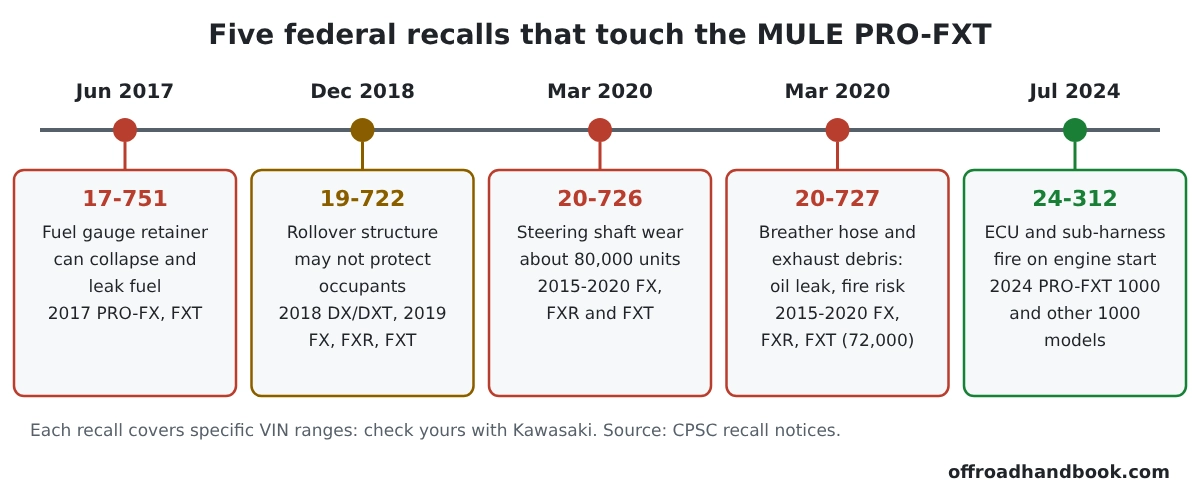
Five federal recall notices cover Mule PRO models, and the timeline shows when each was announced. Each notice covers set VIN ranges, so two Mules of the same year can differ.
Every notice tells owners to stop using the vehicle until the free dealer repair is done. If your dealer confirms the repair is already on record, that recall is closed for your vehicle.
| Recall | Date | Models and years | Problem | Reports |
|---|---|---|---|---|
| 17-751 | Jun 20, 2017 | 2017 PRO-FX and PRO-FXT, including EPS, LE, Camo and Ranch Edition (the notice covers about 6,600 Kawasaki vehicles in all) | Fuel gauge retainer can collapse and leak fuel (fire hazard) | None reported |
| 19-722 | Dec 6, 2018 | 2018 PRO-DX and DXT; 2019 PRO-FXT, FX and FXR. About 1,000 vehicles | Rollover structure can fail to protect occupants | None reported |
| 20-726 | Mar 19, 2020 | 2015–2020 PRO-FX, FXR and FXT (also DX and DXT 2016–2020). About 80,000 | Steering shaft can wear and affect steering control | 453 reports, no injuries |
| 20-727 | Mar 19, 2020 | 2015–2020 PRO-FX, FXR and FXT. About 72,000 | Debris can ignite on the exhaust manifold; frozen water can block the breather hose and let oil leak | 165 oil leaks, 84 fires, 3 injuries |
| 24-312 | Jul 25, 2024 | 2024 PRO-FXT 1000 LE and other 2024 PRO-FX, FXR and FXT 1000 models. About 19,100 | Improper combustion at engine start (fire hazard); repair is an ECU reprogram and a sub-harness | 3 fires, no injuries |
Call Kawasaki at 866-802-9381 (7 a.m. to 4 p.m. Pacific, Monday to Friday) or search your VIN on Kawasaki's recall page.
The CPSC notices for the 2020 recalls say only that the fix is a free dealer repair, so this guide does not describe the repair steps.
Which Mule PRO-FXT do you have?
The name covers two engines. The 2015–2023 PRO-FXT, sold as the PRO-FXT 820 in 2025–2026, has an 812cc three-cylinder gasoline engine. The PRO-FXT 1000 has a 999cc engine, and Kawasaki's U.S. product page confirms the size.
| Spec | PRO-FXT / PRO-FXT 820 | PRO-FXT 1000 |
|---|---|---|
| Engine | 812cc, 4-stroke, 3-cylinder, DOHC, liquid-cooled, gas | 999cc, 4-stroke, 2-cylinder, DOHC, liquid-cooled, gas |
| Max torque | 48.0 lb-ft at 3,500 rpm | 83.3 N·m at 4,500 rpm (about 61 lb-ft, converted) |
| Compression | 9.5:1 | 10.1:1 |
| Fuel system | DFI, 34 mm throttle body | DFI, 38 mm throttle body |
| Alternator | 75 A | 90 A |
| Cargo bed load | 999 lb (3-person), 350 lb (6-person) | 453 kg (3-person), 159 kg (6-person) |
| Towing | 2,000 lb | 907 kg |
| Fuel tank | 7.9 gal | 29.9 L |
Kawasaki's spec sheets list no top speed. The 45 mph figure that older versions of this post and many other pages repeat could not be verified, so it is gone.
The troubleshooting steps and service numbers here come from the 2018 owner's manual for the 812cc machine. The 1000 uses a different engine, so confirm fluid amounts and plug parts in your own manual. The older MULE 4010 is a different machine: see our Mule 4010 problems guide.
Mule PRO-FXT symptom checker
Pick your model year, engine and symptom. The tool lists your checks in order: free first, then tools, then the dealer. It also shows the recalls that match your year.
Every step comes from the manual and recall notices linked in this post. Nothing is guessed, and where the manual says nothing, the tool says so.
The checker cannot read codes or test parts. It puts the free checks ahead of the shop visit so you do not pay for a diagnosis the cables, fuse or radiator screen could have answered.
If it tells you to stop, stop. A red EPS, oil pressure or temperature light is a reason to shut the engine off, not a diagnostic step.
Engine will not start: Kawasaki's order
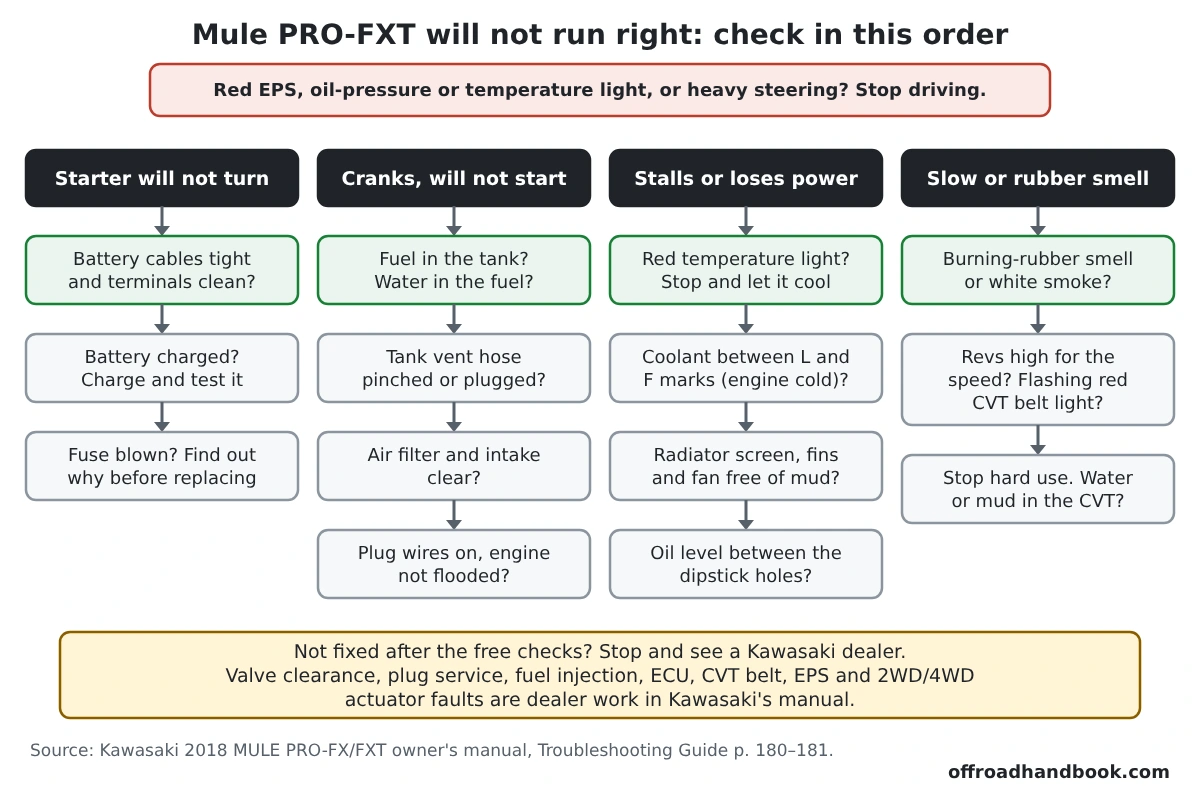
- Start it the way the manual says: close the doors, buckle the seat belts, set the parking brake, put the shift lever in N, then turn the key to START. A starter lockout keeps the starter from running in H, L or R unless the brake is applied (p. 93).
- Do not run the starter longer than 5 seconds, and wait 15 seconds between tries. Kawasaki says longer cranking overheats the starter and drops battery power.
- Check the battery cables for firm contact and charge the battery. If it is run down, the manual allows a 12-volt booster battery with jumper cables (p. 94–95).
- Check the main power fuses under the battery cover. Look for bare wires first, since a blown fuse has a cause (p. 169–170).
- Check the fuel tank and the fuel tank vent hose. Kawasaki says that if the tank is full but the engine feels like it is running out of fuel, check the vent and hose (p. 140).
- Check the air filter and that each spark plug wire is on its plug. Valve clearance and plug service are dealer jobs.
On a jump-start, battery gas is explosive. Kawasaki says to make the last connection away from the battery, to the engine bracket bolt, and never to the battery negative, electrical parts or fuel lines.
After the engine starts, take the jumper cables off with the negative cable first. Then put the battery cover back and lower and latch the cargo bed.
Warning lights: what Kawasaki says to do
The multi-function display carries indicator lights for the engine, cooling, oil, belt and steering. The table is a plain-English version of the manual's wording on pages 43–44.
| Light | What Kawasaki says | What to do |
|---|---|---|
| Red CVT belt check | The belt protection mode is active after hard use, such as revving with the wheels stuck or exceeding the load. The light flashes. It also comes on for 3 seconds at ignition | Back off the throttle, avoid that use and use the "When Stuck" steps. Have the belt inspected |
| Yellow engine warning | Comes on when engine parts fail to function properly | Have a Kawasaki dealer check it |
| Red EPS (EPS models) | Lights briefly at start-up. At any other time, the ECU, actuator or wiring has a fault | Stop driving immediately and contact a dealer |
| Red coolant temperature | Coolant temperature is too high while running | Stop, let it cool, check coolant and the radiator fan area. Do not keep running |
| Red oil pressure | Blinks if oil pressure is dangerously low, or with the key on and the engine off. Goes out at proper pressure | If it blinks while running, stop the engine and check the oil level |
| Red seat-belt reminder | Stays on about 8 seconds at ignition. Blinks if the vehicle moves without the operator's belt buckled | Buckle up |
Overheating, the temperature light and cab heat
If the red temperature light stays on, stop the engine and let it cool. Kawasaki says prolonged running with the light on can cause engine damage from overheating.
- Let the engine cool. The cooling system is pressurized, and the manual warns not to open the radiator cap when hot.
- With the engine cold, check the coolant level in the reserve tank. It should sit between the L and F marks (p. 129).
- Clean the radiator screen and fins with a low-pressure stream of water. Kawasaki warns that high-pressure water can damage the fins.
- Check that the radiator fan is free of mud and debris. Disconnect the negative battery cable before touching the fan, because it can start by itself.
- Check the oil level on the dipstick, between the F and L holes.
The fan breaker is on the front access cover, and the manual says no reset is needed because the fan circuit returns to normal by itself. If you have to add coolant often, there is probably a leak. Have the cooling system inspected.
Heat in the footwell and hood scoops
Kawasaki's manual does not mention cab heat. Owners report hot air coming off the radiator into the cab, mostly in summer and without a windshield. That is an owner report, not a Kawasaki finding.
Kawasaki does warn against unauthorized accessories in front of the radiator or behind the cooling fan, because they can obstruct or deflect airflow and lead to overheating. A scoop or vent that redirects radiator air is a risk, not a proven fix.
Debris, oil and fire risk
The manual's cleaning section warns that debris or flammable material around the engine, electrical parts and exhaust can cause fires. Inspect those areas often (Cleaning, p. 172), and if debris has collected, park outside, stop the engine, let it cool and remove it.
That warning matches the 2020 recall on 2015–2020 models, where debris on the exhaust manifold and an oil leak from a frozen breather hose were the hazards. Never park or store a Mule in an enclosed space without inspecting it first.
CVT belt slip, mud and water
The PRO-FXT uses a belt-driven CVT. Kawasaki says neglecting it can leave a severely worn or damaged belt locking up the transmission and wheels. Inspect the belt at least every 100 hours or 2,000 km (1,200 miles), and sooner when pulling a trailer or driving in mud, deep water or heavy dust (p. 141).
Kawasaki lists these signs of belt slippage. If you see them, do not keep driving until damaged parts are repaired.
- A burning-rubber smell or visible white smoke.
- Sluggish take-off or loss of power.
- Engine rpm higher than normal for the same speed.
- Engine vibration.
What wears the belt fastest, per the manual: high range on hills, with heavy loads or a trailer; exceeding load or trailer weight; mud or water deeper than recommended; extreme dust; continued slippage; and not using the brake while descending. Use low range for heavy loads, climbing hills, trailers and sustained low-speed work.
If water has entered the CVT housing, the manual says it will cause belt slip and loss of power, and to consult a dealer.
When you are stuck
Release the throttle right away to protect the belt. Shift to L, push the diff lock switch to LOCK and try to escape by slowly revving. If that fails, the manual points to a winch (an optional part on most models) or a tow from another vehicle. Our winch size calculator shows the pull rating your load calls for.
Never shift between H or L and R while moving or above idle, since the transmission could be damaged. Stop completely to shift.
Steering, brakes and 4WD
Steering
Steering wheel free play should be 0–20 mm (0–0.79 in), with smooth action and no rough spots or strange noises (Daily Checks, p. 91). Loose or wandering steering on a 2015–2020 Mule is a reason to check recall 20-726 before anything else.
On EPS models, a blown 40 A fuse makes the steering heavy. Replace it with the same rating, and disconnect the battery cables first to avoid shock. If a new fuse blows, Kawasaki points to the ECU or the harness and connectors.
Brakes
Brake wear is self-adjusting. If the lining on either pad is under 1 mm (0.04 in), replace both pads in that caliper as a set. Kawasaki says a dealer should do the inspection and replacement, and that air in the line can make the pedal mushy.
Do not mix brake fluids. If the fluid is below the lower line, check for leaks before filling to the upper line.
2WD, 4WD and diff lock
Stop the vehicle completely before using the 2WD/4WD or diff lock switch. After shifting there is a brief delay before the 4WD symbol changes, so drive off slowly so it can engage. A small clank on hard ground as it engages is normal, according to the manual.
Do not shift to locked-axle mode in a turn. Kawasaki warns it can reduce steering response and cause loss of control. If the diff lock light will not go out, push the switch to LOCK while stopping, or turn the key off and on again. If it stays on, see a dealer.
Rough idle, stalling and the throttle body
Idle speed is controlled by the ECU and cannot be adjusted. The specified idle is 1,050 ±50 rpm (p. 139). If idle is unstable or out of range, Kawasaki says to have a dealer inspect the fuel injection system.
Many owner posts blame carbon in the throttle body for rough idle. The manual lists no throttle-body cleaning procedure, so treat that as an owner-reported fix and check the air filter, tank vent and throttle pedal free play (2–10 mm) first.
A plugged fuel tank vent can also make the engine stall or lose power, which is easy to mistake for a fuel pump problem. Check the vent hose before the pump.
Service numbers from the manual
These figures come from the 2018 owner's manual for the 812cc PRO-FXT. Use them as a check against your own year's manual, not as a replacement for it.
The manual assigns spark plug cleaning, valve clearance, coolant changes, brake fluid changes and CVT belt inspection to a Kawasaki dealer.
| Item | Value |
|---|---|
| Engine oil | SAE 10W-40, API SG, SH, SJ, SL or SM with JASO MA, MA1 or MA2. Capacity 2.4 L (2.5 US qt) |
| Oil change | First service at 20 hours or 120 miles, then every 100 hours or 6 months, whichever comes first |
| Coolant | 50/50 water and permanent ethylene-glycol antifreeze (green), 5.9 L (6.2 US qt). Change every 2 years |
| Spark plug | Standard TORCH 7026, alternative NGK IFR6B11. Gap 0.9–1.1 mm (0.035–0.043 in). Torque 20 N·m (15 ft-lb) |
| Idle speed | 1,050 ±50 rpm, set by the ECU |
| Free play | Throttle pedal 2–10 mm. Brake pedal 2–10 mm. Steering wheel 0–20 mm |
| Brake pad minimum | 1 mm (0.04 in) lining thickness. Replace both pads in the caliper as a set |
| CVT belt inspection | At least every 100 hours or 2,000 km (1,200 miles) |
| Power steering fuse | 40 A (EPS models), in the front access cover |
| Accessory sockets | Do not exceed 120 watts on the sockets and connector together |
| Replace by age | Fuel hose 5 years, brake fluid 2 years, brake hoses 4 years |
FAQs
Yes. CPSC lists recalls 17-751 (2017 fuel gauge retainer), 19-722 (2018–2019 rollover structure), 20-726 (2015–2020 steering shaft), 20-727 (2015–2020 breather hose and exhaust debris) and 24-312 (2024 PRO-FXT 1000 engine start fire). Check your VIN with Kawasaki.
The coolant is too hot. Stop the engine, let it cool, then check coolant when cold, the radiator screen and fins, and the fan area. Kawasaki says not to keep running the engine with the light on.
The 2018 owner's manual for the 812cc model calls for SAE 10W-40, API SG, SH, SJ, SL or SM with JASO MA, MA1 or MA2, and a capacity of 2.4 L (2.5 US qt). Check your own manual for the 1000.
The belt protection mode is active after hard use such as revving with the wheels stuck or exceeding the load. Back off the throttle, avoid that use and have the belt inspected.
Kawasaki's spec sheets list no top speed. It is a work vehicle, not a speed machine, and the 45 mph figure repeated online could not be verified.
Related guides
- ATV and UTV Troubleshooting: Bogging, No-Start, Heat and Belts
- Kawasaki Teryx4 Problems: 8 Common Issues and How to Fix Them
- 8 Common Kawasaki Brute Force 750 Problems and How to Fix Them

I'm Suryashankar Dasgupta, the founder of Off-Road Handbook. I've been off-roading for years in the USA, including California and Texas, and have ridden mountain and desert terrain abroad. I've also driven a Jeep Compass for more than seven years, so I know the day-to-day side of Jeep ownership first-hand, from the Uconnect screen to the warning lights. Every guide here is researched from manufacturer owner's manuals, NHTSA recall and service-bulletin records and other trusted sources, checked against them before it is published, and corrected when we find a mistake. You can read how we work in our editorial policy: https://offroadhandbook.com/editorial-policy/
Like our off-road guides? Add Off-Road Handbook as a Google Preferred Source so our latest Jeep, ATV, UTV, trail, recovery, and off-road troubleshooting articles can appear more often in your Google Search experience.
Add us as a Preferred Source