Honda Big Red UTV Problems: Causes and Fixes by Symptom
Last updated on October 17th, 2026 at 09:33 am
This post contains Amazon affiliate links. As an Amazon Associate I earn from qualifying purchases, at no extra cost to you.
Most Honda Big Red (MUV700) problems start with something free to check. Shift only when stopped with the engine at idle, start in neutral or with the brake pressed, and keep the battery charged and the foam air cleaner clean. Honda's owner's manual covers the rest.
Everything below follows the Honda 2013 MUV700 Big Red owner's manual (publication 31HL1640), with page numbers so you can look each step up. Honda introduced the Big Red for the 2009 model year. Items that come only from owners are labeled as owner-reported.
Honda Big Red problems by symptom
| What you see | Free check first | Likely cause | Next step | Manual page |
|---|---|---|---|---|
| Starter silent or only clicks | Lever in neutral or brake pressed; battery leads | Not in neutral, loose lead, blown fuse, low battery | Charge the battery, replace a blown fuse with the same rating; dealer if still dead | 178-179 |
| Starter turns, engine will not fire | Fuel level, spark plug cap | Out of fuel, flooded engine, loose plug cap, weak battery | Hold the pedal fully down while cranking; dealer if it still will not start | 63, 179 |
| Hard starting when cold | Battery charge, oil grade against the temperature chart | Weak battery, oil too thick for the temperature | Charge the battery, match oil to the chart; dealer if it persists | 100, 160 |
| Will not go into gear or will not move | Stopped, foot on brake, engine at idle, firm lever motion | Shifting above idle or while rolling; locked transmission | Key off then on; emergency valve procedure; dealer | 27, 181-182 |
| Engine light (PGM-FI) on or flashing | Key off, wait, key on, watch the lamp | A fault stored by the engine system | Flashing: restart and have it hauled to a dealer. Steady: drive normally, dealer inspects | 17, 181 |
| Loses power, stalls, pings or backfires | Air cleaner, drain tube, spark plug, fuel age and octane | Dirty air cleaner, fouled plug, low octane, stale fuel | Clean and oil the foam element, check the plug; dealer for backfire, misfire or rich running | 95, 119-122, 130, 180 |
| High coolant/oil temperature light | Mud on radiator, coolant level, fan fuse, oil level | Blocked airflow, low coolant or oil, blown fan fuse | Follow the flowchart below; dealer if the light stays on | 186-187 |
| 4WD or diff lock lamps do not match the lever | Lever changed only when stopped at idle; drive a few yards turning | Mode not fully engaged | Dealer if the lamps still do not match | 28-29 |
| Oil level reads wrong | Level ground, warm-up, clean dipstick | Reading error, overfilled or low oil | Fill only to the upper mark | 101-102 |
| Dim lights, flickering display, fan will not run (owner-reported) | Battery leads, fuses, battery charge | Electrical fault; one expert suspects a short or the regulator | Dealer tests the charging system | 188-191 |
Work down each row left to right. The free checks cost nothing and take minutes, so they come before any parts or dealer visit.
Wear gloves and let the engine and exhaust cool before touching anything. Honda warns that exhaust carries carbon monoxide, so run the engine only outdoors or with good ventilation.
What is your Big Red doing?
Pick the symptom that matches your machine. The checker lists Honda's checks in order, free ones first and dealer-only work last.
Based on the Honda 2013 MUV700 Big Red owner's manual (31HL1640); page numbers are shown with each check. Fault codes and internal repairs need a Honda dealer.
The checker only repeats what the manual says. It cannot read fault codes or measure anything, so a dealer visit is the right call whenever it says so.
If your symptom is not listed, scroll to the section that sounds closest and read its dealer notes.
Honda Big Red will not start
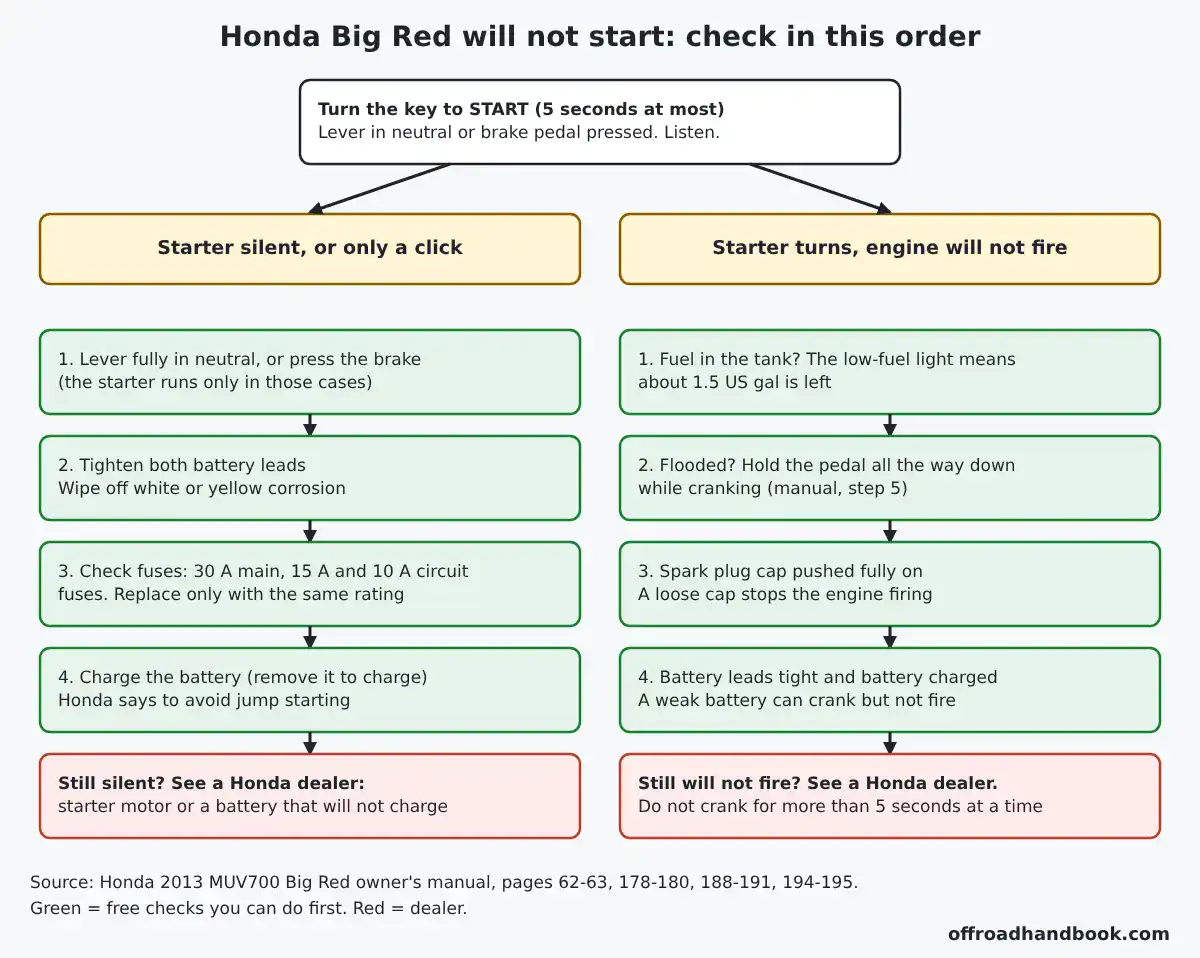
Honda splits no-start problems by what the starter does. Turn the key to START and listen before you touch anything.
Starter silent or only clicks
The starter runs only when the shift lever is in neutral or the brake pedal is pressed. Work through these in order:
- Move the shift lever fully into neutral, or press the brake pedal, then try again.
- Tighten both battery leads and wipe off any white or yellow corrosion.
- Check the fuses under the front hood in the battery compartment: a 30 A main fuse and circuit fuses of 15 A (two) and 10 A (four). Turn the key off first.
- Charge the battery. If charging does not help, the starter or battery needs a dealer.
Replace a blown fuse only with the same rating. A fuse that blows again quickly points to a real electrical fault, and Honda says to leave it and see a dealer (manual pp. 188-191).
Honda says to avoid jump starting. Remove the battery and charge it, using a charger made for your Honda, because an automotive charger can overheat the battery (pp. 160, 194). The standard battery is a YTX14-BS, 12 V 12 Ah (p. 203).
If you have no other option, Honda's jump-start steps put the negative clamp on the front differential lock cable stay, not on the battery. Never jump a battery that may be frozen (pp. 194-195).
Starter turns but the engine will not fire
Honda lists four causes: out of fuel, a flooded engine, a loose spark plug cap, and weak or loose battery cables. The low-fuel light comes on at about 1.5 US gal left (p. 17).
Use Honda's start procedure (p. 63). It also clears a flooded engine.
- Parking brake on, lever in neutral, brake pedal pressed, foot off the accelerator.
- Turn the key to START for no more than 5 seconds. If it does not catch, turn the key off and wait about 10 seconds.
- If it will not start or stalls right away, repeat with the accelerator halfway down.
- If it still fails, hold the pedal all the way down while cranking to clear flooding.
Push the spark plug cap on firmly and recheck the battery leads. If the machine has been through deep water, Honda says to inspect the air cleaner housing drain tube more often and clean it before starting if you see deposits (p. 122).
Hard starting in cold weather
The manual has no separate cold-start procedure, but several of its notes matter in winter. A battery that sits in extreme cold can freeze, so do not jump it (p. 194). Check coolant often in freezing weather (p. 114).
Oil grade also matters. Honda's standard oil is SAE 10W-30, and its chart allows thinner grades as the climate gets colder (p. 100).
| Oil grade | Lowest average temperature on Honda's chart | Note |
|---|---|---|
| 10W-30 or 10W-40 | about 14°F (-10°C) | Honda's standard grade is 10W-30 |
| 5W-30 | about 5°F (-15°C) | Read from the printed chart, so approximate |
| 0W-30 | about -22°F (-30°C) | All three grades are shown up to the warm end of the chart |
Keep the battery on a slow charge between rides in cold months. Honda recommends slow charging a stored battery every 30 days (p. 157).
Honda Big Red will not shift or will not move
The Big Red's shift lever has three positions: drive (D), neutral (N) and reverse (R). Honda says to move it only when the vehicle is stopped, your foot is on the brake and the engine is idling, using a firm motion (p. 27).
Shifting above idle or while rolling can damage the transmission. Some owners report a stiff selector until the engine warms up, but Honda's guidance does not change: stopped, idling, firm motion.
- Stop completely, press the brake, let the engine settle to idle, then move the lever firmly.
- Check the engine oil level and grade (pp. 99-102). Honda warns that low oil can damage the engine and transmission.
- On machines with the digital display, a dash that blinks where the gear letter should be means the transmission is not properly in gear. Turn the key off, then on. If it keeps blinking, see a dealer (p. 21).
- If the engine light is blinking, follow the engine light steps below first.
The maintenance schedule lists engine oil and the front and rear differential oils, and no separate transmission fluid service (pp. 82-83). Do not go looking for a transmission dipstick.
The machine will not move at all
If the engine light is not blinking and the vehicle will not move, Honda says the transmission may be locked. Its emergency valve procedure is a way to limp home, not a repair (p. 182):
- Shift to neutral, apply the parking brake and turn the ignition off.
- Loosen the screw and release the lock plate on the left side of the front crankcase.
- Turn the emergency valve all the way in. With the engine running, the machine moves forward slowly at idle.
- Tighten the screw and lock plate, then see a Honda dealer as soon as possible.
Related: if you are comparing it with Honda's later Pioneer 700 side-by-side, see our Honda Pioneer 700 problems guide.
Honda Big Red engine light on or flashing
The PGM-FI malfunction indicator lamp comes on for a few seconds at key-on as a bulb check. If it stays on or flashes while you drive, the engine system has found a problem (p. 17).
- Stop the machine and turn the ignition off.
- Wait for the engine to stop, then turn the ignition on and watch the lamp.
- Blinking: restart the engine and drive to a place where it can be loaded and hauled to your dealer.
- Back to normal: you can drive as usual after restarting, but Honda urges a dealer inspection.
The manual gives no way to read the stored fault at the dash, so the code needs the dealer's tester. Reduce speed in the meantime, as Honda advises.
Honda Big Red loses power, stalls, pings or backfires
Honda lists a short set of causes for a Big Red that starts but runs poorly. Start with the cheap, free items.
- Air cleaner: the foam element controls how much dirt reaches the engine. Honda says to clean it every 600 miles or 100 hours, and more often in dust, sand, snow, mud or freezing weather (pp. 82, 118-121).
- Air cleaner housing drain tube: if you see deposits in it, clean it before starting (p. 122).
- Spark plug: standard is NGK BKR5E-11 or Denso K16PR-U11, gap 0.039 to 0.043 in (1.00 to 1.10 mm). Heavy deposits or wear mean replace it (pp. 130-132).
- Accelerator pedal freeplay should be 3/16 to ⅜ in (5 to 10 mm). Too much delays throttle response, and none can make idle erratic (p. 128).
- Fuel: Honda calls for unleaded pump gasoline of 86 octane or higher and says never to use stale or contaminated gasoline (p. 95).
Light pinging under heavy load, such as a hill climb, is no cause for concern. Pinging at steady speed under normal load means change gasoline brands, and if it persists, see a dealer (p. 95).
Idle speed is 1,400 plus or minus 100 rpm with no adjustment provided (p. 201). A rough idle is a dealer item, not something to chase with a screwdriver.
Honda sends these symptoms straight to a dealer: misfiring, a rich or sooty exhaust, backfire, running on after the key is off, and dying when hot from a clogged fuel filter (p. 180).
Honda also lists hard starting, rough idle and poor driveability as symptoms to have repaired (p. 208). Some online lists blame a seat belt switch for lost power. The troubleshooting pages in Honda's manual list no such cause, so check the items above first.
Honda Big Red high coolant/oil temperature light
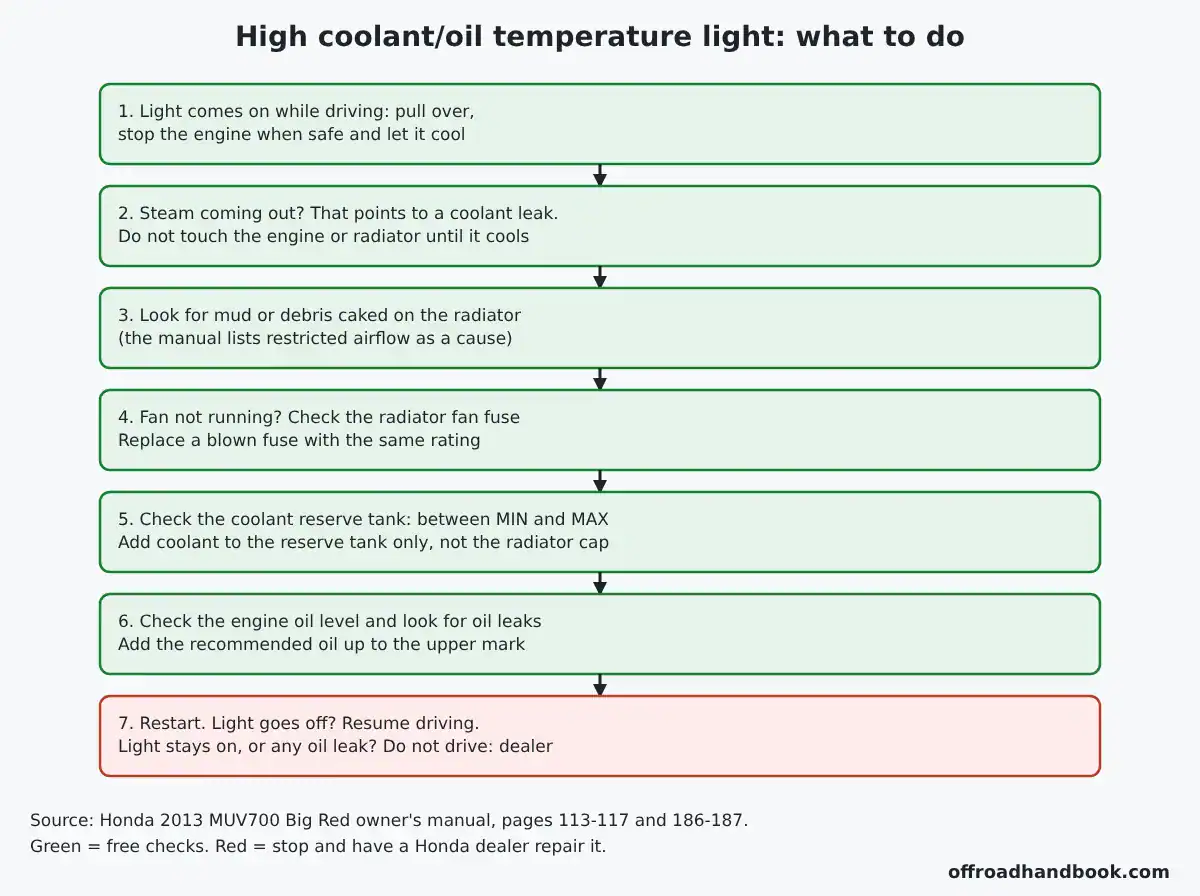
The light comes on when coolant or engine oil is hot enough to shorten engine life. It also lights briefly at key-on. If it comes on while you drive, stop as soon as it is safe, switch the engine off and let it cool (p. 16).
Honda's listed causes are mud caked on the radiator, long idling, an oil leak, a coolant leak, low oil, low coolant, or hard use in adverse conditions (p. 186).
- A steaming engine means a coolant leak. Wait until the steam stops and do not touch the engine or radiator.
- Check for mud or debris blocking the radiator. Wash it with low water pressure only, because high pressure bends the fins (p. 117).
- If the fan is not running, check the radiator fan fuse in the battery compartment and replace it with the same rating.
- Check the coolant reserve tank under the front hood, between MIN and MAX. Add coolant to the reserve tank only, never at the radiator cap (pp. 114-115).
- Check the oil level and look for leaks. Add the recommended oil up to the upper mark.
Coolant is a 50/50 mix of Pro Honda HP coolant or an equivalent ethylene glycol antifreeze and distilled water. The system holds 3.5 US qt (pp. 113, 201).
If the light will not go off after adding coolant, do not drive: the engine needs repair. Take it to a dealer. Honda also says to have the radiator checked if more than 20% of the airflow surface is restricted (pp. 117, 187).
Honda Big Red 4WD and diff lock lamps do not match the lever
Honda's drive mode lever has three positions, and the dash lamps tell you which one is engaged. Change modes only when the vehicle is stopped and the engine is idling, because changing while moving can damage the drivetrain (pp. 28-29).
| Drive mode lever | 4WD lamp | Front diff lock lamp | What it does |
|---|---|---|---|
| 2WD | Off | Off | Power to the rear wheels, both differentials unlocked |
| 4WD rear diff lock | On | Off | Power to all four wheels, rear differential locked |
| 4WD all diff lock | On | On | Power to all four wheels, front and rear differentials locked |
After you change modes, drive a few yards making right and left turns and confirm the lamps match the table. If they do not come on or go off as shown, see your dealer (p. 29).
Expect heavier steering in the locked modes. Honda says all diff lock needs extra space and effort to steer, so use it for maximum traction, not on pavement or hard ground.
Lamp is on but nothing seems to drive the front wheels
Some owners report that a front driveshaft can come out of the front differential after hard use on uneven ground. That is owner-reported and not covered in the manual, but it is a free look.
- Check the front differential oil level at the lower edge of the fill inspection hole on level ground (p. 109).
- Look at the driveshaft boots and the shafts where they enter the differential. Honda lists driveshaft boots as an inspection item (pp. 83, 155).
- If a shaft looks out of place or a boot is torn, stop driving and see a dealer.
Honda Big Red oil level looks wrong
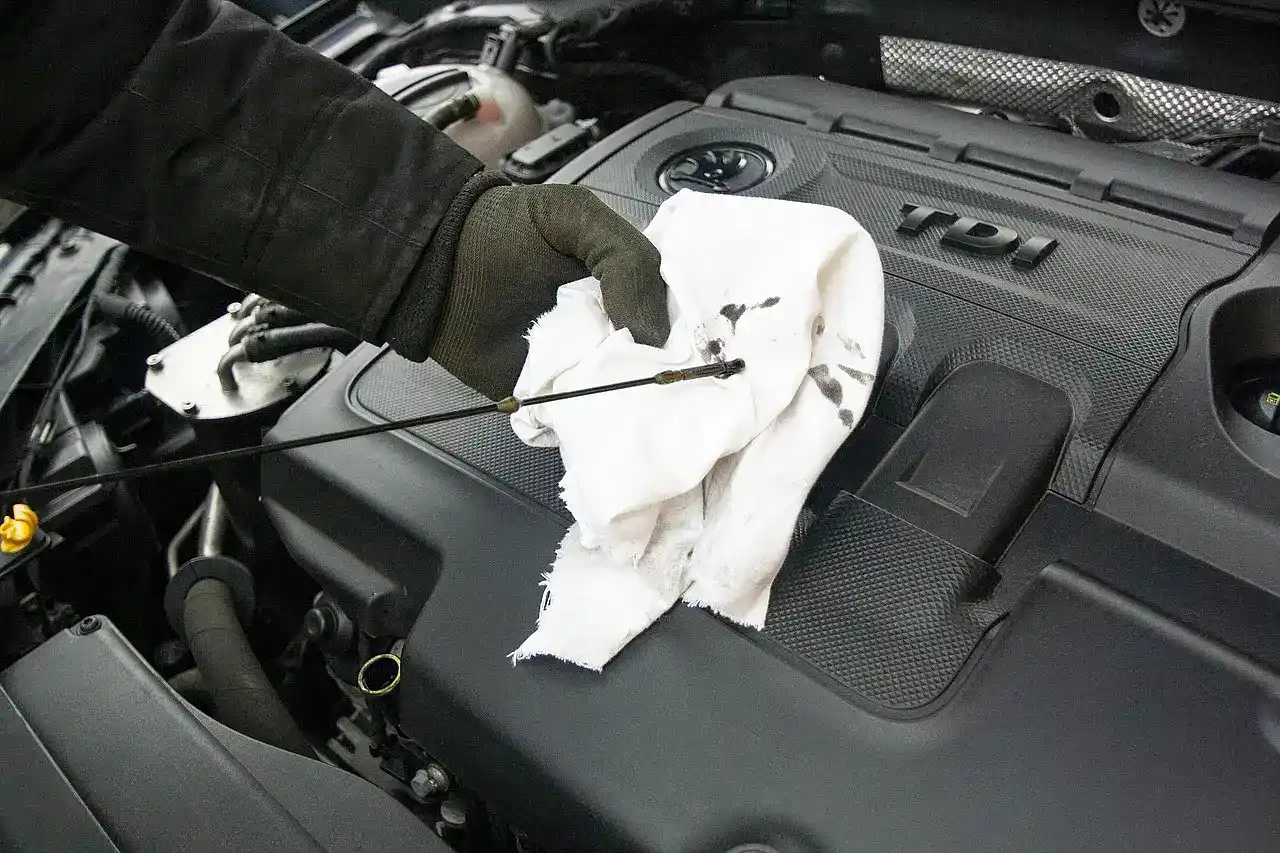
Check the oil each day before you drive. Honda's method differs from many machines: warm the engine, stop it, then wait before reading the dipstick (p. 101).
- Park on firm, level ground.
- Start the engine in a ventilated area and idle 3 to 5 minutes, then stop it and wait 2 to 3 minutes.
- Remove the seat (pull both latches at the front, slide forward and lift) and the rubber dust cover.
- Pull the dipstick from the front crankcase cover and wipe it clean.
- Insert it without screwing it in, then pull it out. The oil should sit between the lower and upper marks.
If it is low, add the specified oil through the fill cap up to the upper mark. Honda notes the fill hose is long and the oil drains into the engine slowly, so go slowly. Do not overfill (p. 102).
Running the engine with an improper oil level can cause serious engine damage, the manual warns. That includes overfilling.
Oil and fluid numbers from Honda
| Item | Specification | Page |
|---|---|---|
| Engine oil | SAE 10W-30, API SG or higher (not energy conserving), JASO MA; Pro Honda GN4 or equivalent | 99, 200 |
| Engine oil capacity | 2.9 US qt after draining; 3.1 US qt with filter change; 4.3 US qt after disassembly | 200 |
| Oil drain bolt / oil filter bolt torque | 18 lbf-ft (25 N-m) / 13 lbf-ft (18 N-m) | 204 |
| Front differential oil | SAE 80 hypoid, GL-4 or GL-5; 22.5 US oz on a change | 109-110 |
| Rear differential oil | SAE 80 hypoid, GL-4 or GL-5; 15.7 US oz on a change | 111-112 |
| Differential fill and drain bolt torque | 9 lbf-ft (12 N-m) | 204 |
| Coolant | 50/50 Pro Honda HP coolant and distilled water; 3.5 US qt | 113, 201 |
| Spark plug | NGK BKR5E-11 or Denso K16PR-U11; gap 0.039 to 0.043 in | 130, 201 |
| Fuel | Unleaded, 86 octane or higher; tank 7.93 US gal | 95, 200 |
| Tire pressure (cold) | Front 10 psi, rear 18 psi; stock tire 25x10.00-12 | 202 |
| Wheel nut torque | 79.7 lbf-ft (108 N-m) | 185, 204 |
Tire pressure is the one spec here you will change by terrain. Our off-road tire pressure calculator shows how air-down pressures shift on sand, mud and rock, but Honda's cold numbers are the starting point.
Dim lights, flickering display and a fan that will not run
Some Big Red owners report electrical gremlins together: headlights dimming under throttle, a flickering instrument panel, a flashing engine light, backfiring and a coolant fan that stays off. One 2012 owner described exactly that in an ATV.com answer column, and the columnist suspected a short or a failing voltage regulator.
That is one owner and one opinion, not a confirmed Big Red fault. It is still a sensible order of checks, since Honda tells owners to look at fuses first when anything electrical stops working (p. 188).
- Charge the battery, then tighten both battery leads and clean the terminals.
- Check every fuse, not just one, and replace blown ones with the same rating (pp. 188-191).
- Check that the radiator fan fuse is good if the fan will not run.
- If symptoms continue with a good battery and fuses, have a dealer test the charging system. The manual lists the generator output as 0.410 kW at 5,000 rpm (p. 203).
Dim lights and a weak battery can also point back to a battery that no longer holds a charge, which Honda says belongs with the dealer if charging does not help (p. 194).
Parts and supplies to keep on hand
These match Honda's own specs from the table above. Confirm the part number against your manual before you buy: an NGK BKR5E-11 spark plug, Pro Honda GN4 10W-30 oil and foam air filter oil for the element.
Honda stores spare fuses in the battery compartment. Restock any you use, in 30 A, 15 A and 10 A ratings, so the next blown fuse does not end the ride.
When to stop and call a Honda dealer
- The engine light is blinking, or it stays on and the machine runs badly.
- The transmission will not move after the emergency valve procedure, or shifting is rough once oil level and technique check out.
- The temperature light will not go off after you add coolant, or there is any oil or heavy coolant leak.
- A new fuse of the same rating blows again.
- You see backfiring, misfire, a sooty exhaust, or the engine runs on after the key is off.
- The 4WD and diff lock lamps still do not match the lever.
- Any crash damage. Honda says to have the dealer inspect the frame, suspension, seat belts and occupant protective structure after a serious crash (p. 192).
For a quick general checklist before each ride, see our free off-road checklist. For belt-driven machines, our ATV and UTV troubleshooting guide covers the belt problems the Big Red does not have.
FAQs
Honda says to avoid it and to charge the removed battery instead. If there is no other option, use a charged 12 V battery and clamp the negative cable to the front differential lock cable stay. Never jump a frozen battery.
Honda specifies SAE 10W-30, API SG or higher without the energy-conserving label, JASO MA, such as Pro Honda GN4. The engine takes 2.9 US qt after draining, or 3.1 US qt with a filter change.
The owner's manual lists shaft final drive and no drive belt in the maintenance schedule. The shift lever has D, N and R, and the spec table gives three transmission ratios plus reverse.
No. Honda says to move the shift lever and the drive mode lever only when stopped with the engine at idle, because doing it while moving can damage the transmission or drivetrain.
A search of the CPSC recall database for Honda products from 2008 to October 2026 turned up side-by-side recalls for Pioneer and Talon models, and none that name the MUV700 Big Red. Check your VIN with a Honda powersports dealer to be sure.
Related guides
- Honda Pioneer 700 problems: 8 common issues and how to fix them
- 9 common Honda Pioneer 500 problems and how to fix each one
- ATV and UTV troubleshooting: bogging, no-start, heat and belts
- Free off-road checklist

I'm Suryashankar Dasgupta, the founder of Off-Road Handbook. I've been off-roading for years in the USA, including California and Texas, and have ridden mountain and desert terrain abroad. I've also driven a Jeep Compass for more than seven years, so I know the day-to-day side of Jeep ownership first-hand, from the Uconnect screen to the warning lights. Every guide here is researched from manufacturer owner's manuals, NHTSA recall and service-bulletin records and other trusted sources, checked against them before it is published, and corrected when we find a mistake. You can read how we work in our editorial policy: https://offroadhandbook.com/editorial-policy/
Like our off-road guides? Add Off-Road Handbook as a Google Preferred Source so our latest Jeep, ATV, UTV, trail, recovery, and off-road troubleshooting articles can appear more often in your Google Search experience.
Add us as a Preferred Source