Honda Pioneer 700 Problems: No Start, PGM-FI Light and Shifting
Last updated on October 25th, 2026 at 10:50 am
This post contains Amazon affiliate links. As an Amazon Associate I earn from qualifying purchases, at no extra cost to you.
The most common Honda Pioneer 700 problems are no-starts from a weak battery, loose lead or blown fuse, rough running, overheating from mud, a lit PGM-FI light, and shifting or 4WD trouble. Four recalls also cover 2014, 2017, 2017–2020 and 2021 machines. Honda’s manual covers the first checks; dealers handle the rest.
Every number below comes from the Honda Pioneer SXS700 owner’s manual or from CPSC recall notices. The manual edition we could open is the original-generation one, so check your own year’s manual for small differences. Anything the manual leaves to a dealer is marked that way.
Also weighing Honda’s earlier Big Red? See our Honda Big Red (MUV700) problems guide, built from Honda’s own owner’s manual.
Pioneer 700 problems at a glance
| What you see | Free check first | What Honda lists as the cause | Who fixes it |
|---|---|---|---|
| Starter is silent | Neutral or brake pedal, fuses, battery leads | Not in neutral, blown fuse, loose lead, low battery | Dealer if the starter itself is bad |
| Starter turns, engine will not fire | Fuel level, spark plug cap, battery bolts | Out of fuel, flooded engine, loose cap, weak battery | Dealer if charging and the basics fail |
| Runs rough, pings or smokes black | Fuel octane and brand | Wrong fuel, clogged fuel filter, rich mixture | Dealer for misfire, backfire, soot, filter |
| Coolant/oil temperature light | Mud on the radiator, coolant and oil level | Restricted airflow, idling, leaks, low fluids | Dealer for leaks or a light that stays on |
| Electrics dead | Fuses, main fuse is 40 A | Blown fuse | Dealer if a new fuse does not fix it |
| PGM-FI light on or blinking | Stop, key off, key on, recheck | A stored fault only a dealer can read | Dealer |
| Will not shift or move | Stop at idle before shifting; oil level | Shifting while moving, transmission lock | Dealer |
| 4WD or diff lock does nothing | Lever position and dash indicators | Mode changed while moving | Dealer |
The first six rows are Honda’s own troubleshooting pages. The last two come from the driving sections, because the manual has no repair steps for them.
Recalls are a separate check. They are in problem 8, and the checker below flags the ones that fit your model year.
Pioneer 700 will not start? Check in this order
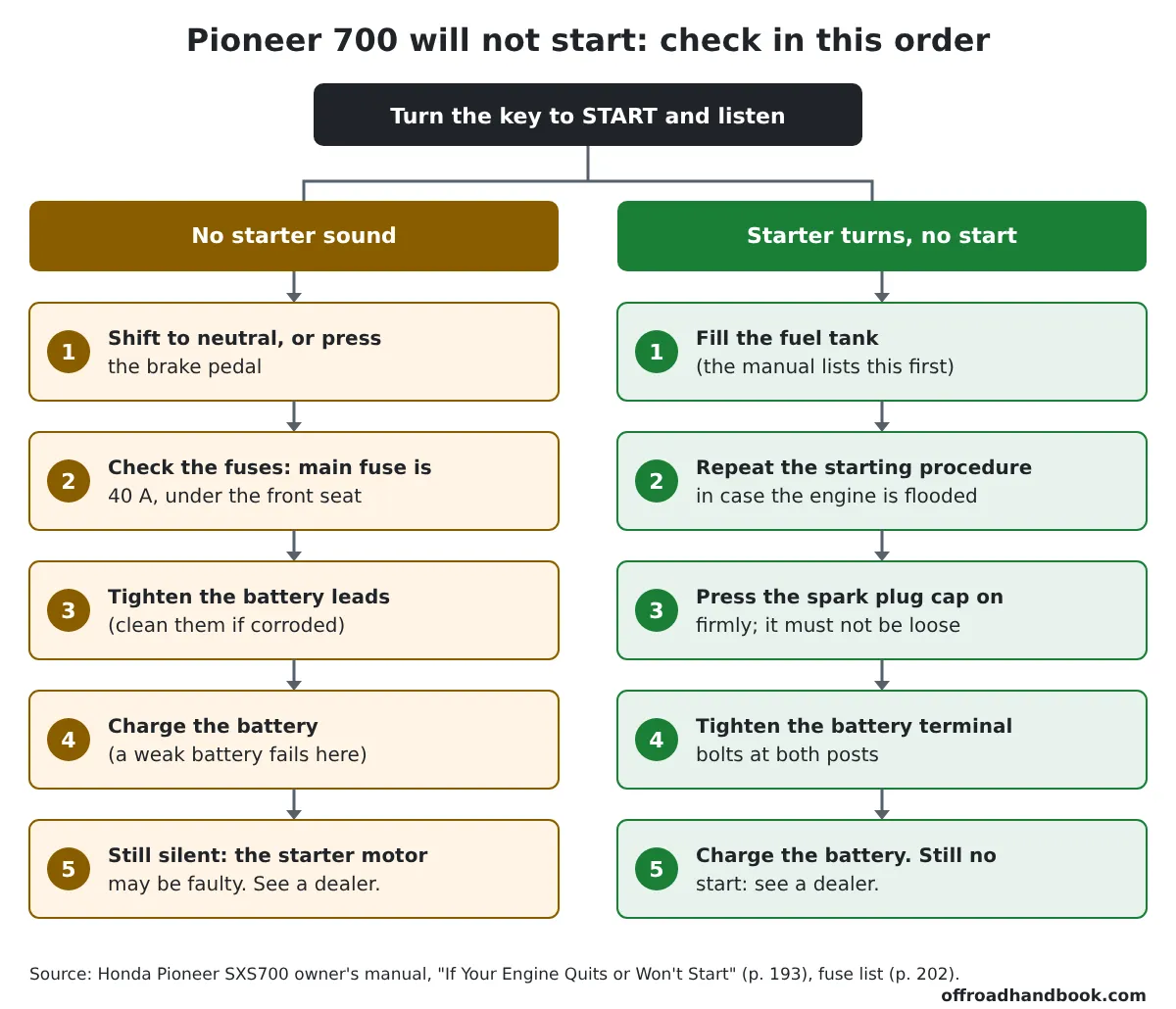
Turn the key to START and listen. Which branch you are on decides the checks. Start at step 1 and stop at the first one that fixes it, since steps 1 to 4 on each side cost nothing.
Never skip the battery. Both branches end at a charger, because a weak battery causes both a silent starter and a starter that turns slowly without firing.
Pioneer 700 problem checker
The checker only repeats steps from Honda’s manual and the CPSC notices on this page. It cannot read codes or inspect the machine, so treat it as an ordered checklist.
The model year only changes the recall line. The checks themselves are the same for every year.
1. Starter silent, or engine will not start

Honda splits this into two cases. If you turn the key to START and hear nothing, the manual lists a transmission not in neutral, a blown fuse, a loose battery lead, a low battery or a faulty starter motor.
- Shift into neutral, or press the brake pedal.
- Replace a blown fuse with one of the same rating.
- Tighten the battery lead.
- Charge the battery. If charging does not help, see a dealer.
- If everything else checks out, the starter motor may be faulty. See a dealer.
If the starter turns but the engine will not fire, the manual lists an empty tank, a flooded engine, a loose spark plug cap, loose battery cables or a weak battery. Fill the tank, repeat the starting procedure, seat the cap and tighten the terminal bolts.
Battery care matters most. Honda says to disconnect the negative lead first and connect the positive first on reinstall, and to slow charge a stored battery every 30 days. A 12-volt battery maintainer handles the storage part.
Batteries give off explosive hydrogen gas. Wear eye protection, keep sparks away, and have a shop do the work if you are unsure.
2. Rough running, pinging and smoke
This is Honda’s “starts but runs poorly” page. Pinging under load: switch to the recommended octane or change gasoline brand. The spec page lists unleaded fuel at 86 pump octane or higher.
Misfires, erratic running, rich “blubbering” or sooty exhaust, backfire and run-on after key-off all say “see your dealer.” So does poor fuel flow from a clogged fuel filter. Do not guess at injectors or fuel pressure.
Two owner jobs are on the schedule. Clean the air cleaner elements, more often in dust, sand or snow, and check the housing drain tube.
Also check the spark plug: NGK BKR5E-11 or DENSO K16PR-U11, gap 0.039–0.043 in. A BKR5E-11 spark plug is easy to keep as a spare.
Valve clearance is a dealer job unless you have the tools and service data. The cold spec is 0.006 in intake and 0.013 in exhaust. Ticking from the top end is a reason to book that check, not to keep riding.
3. Overheating and the temperature light

The light should only flash briefly at key-on. Honda lists restricted airflow to the radiator, such as caked mud, extended idling, leaks, low oil or coolant, and prolonged harsh use as the causes.
- If the gauge reads full and the light stays on, pull over and stop the engine. Driving on can cause serious engine damage.
- Look for steam. Steam means a leak, so wait until it stops and keep your hands off the radiator system.
- Check for anything blocking airflow to the radiator, and wash the mud off.
- If there is no obvious cause, leave the engine idling so the fan and coolant keep moving, and watch the light.
- If the fan is not running, shut the engine off and check the radiator fan fuse.
- When cool, check the coolant reserve tank under the hood between MIN and MAX.
Add coolant if the tank is empty, and do not ride until you do. The system holds 3.6 US qt of Pro Honda HP coolant or an ethylene glycol equivalent for aluminum engines, mixed 50/50 with distilled water. Keep antifreeze above 40%.
A mild leak lets you creep to a stop while you watch the gauge. A severe leak, or a light that stays on after the coolant and oil are right, means the engine needs a dealer.
4. Blown fuses and dead electrics
Honda says to check for a blown fuse first when anything electrical fails. The main fuse (40 A) sits under the front seat behind the right-side dust cover. The circuit fuses (three 15 A and three 10 A) are in the battery compartment.
Turn the ignition off before touching any fuse, so you do not short a circuit. A spare main fuse is stored in the fuse box cover. Replace a blown fuse only with one of the same rating, then see if the part works.
5. PGM-FI warning light
If the PGM-FI light comes on or blinks while you ride, stop and turn the key off. After the engine stops, turn the key on again and look at the light.
- Blinking: restart and drive only to a place where the machine can be loaded and hauled to a dealer.
- Back to normal: you can drive as usual, but Honda urges a dealer inspection.
The manual has no code list for this light, so do not trust a blink count from a forum. A dealer reads the stored fault.
6. Shifting trouble and a transmission that will not move
Honda’s rule is simple. Move the shift lever only when the vehicle is stopped and the engine is idling, or you can damage the transmission. Park with the brake pedal pressed, shift to neutral and set the parking brake.
Then check the oil, since Honda warns that some oils affect clutch operation. Idle 3 to 5 minutes, stop, wait 2 to 3 minutes, and read the dipstick without screwing it in. Use SAE 10W-30, JASO T 903 MA, API SG or higher, not labeled energy conserving.
Avoid oils with graphite or molybdenum additives, which can interfere with clutch operation. Capacity is 2.9 US qt after draining and 3.1 US qt with a filter change.
If it will not move and the light is not blinking
Honda describes an emergency valve for a locked transmission. It is a get-it-home measure, and the manual says to have a dealer inspect the vehicle as soon as possible.
- Move the shift lever to neutral and set the parking brake.
- Turn the ignition switch off.
- Loosen the screw and release the lock plate on the left side of the front crankcase.
- Turn the emergency valve all the way in.
- With the engine at idle, the vehicle should move forward slowly. Retighten the screw and the lock plate.
7. 4WD or diff lock not engaging

The drive mode lever sits to the right of the shift lever and has three positions: 2WD, 4WD and 4WD with diff lock. Both lights off means 2WD, the 4WD light alone means 4WD, and both lights means diff lock.
Honda says to change drive mode only when stopped with the engine idling. Steering takes more effort in 4WD and more room and effort with the diff lock on.
If the lever, the lights and the technique are right and the front wheels still do nothing, that is a dealer diagnosis. The manual gives no owner test, and the driveshaft boots are on the inspection schedule, so look for torn ones.
8. Recalls on the Pioneer 700

Four recalls touch the Pioneer 700.
Each covers only certain serial numbers or VINs, so a model year match is not enough. Check your VIN with a Honda dealer, on powersports.honda.com under Recall Information, or at 866-784-1870.
| Recall | Date | Models | Hazard | Fix |
|---|---|---|---|---|
| 15-706 | Oct 16, 2014 | All 2014 Pioneer 700, about 15,400 | Debris on the middle skid plate can touch the exhaust: smoke or fire | Free updated skid plate |
| 17-744 | May 9, 2017 | Certain 2017 units, about 2,200 | Front passenger seat belt buckle can fail | Free dealer repair |
| 21-711 | Dec 3, 2020 | Certain 2017–2020 with EPS, part of about 118,600 Pioneer 700 and 1000 units | Can lose steering control; 8 reports, no injuries | Stop riding, free inspection and repair |
| 22-020 | Nov 18, 2021 | Certain 2021 with EPS, about 1,400 across three models | Can lose steering function; 1 report | Free yoke joint and hardware |
Do not ride an affected machine until a dealer has dealt with it. Each repair is free, and Honda says it is contacting known purchasers, but a VIN check is the sure way to know.
We found no newer Pioneer 700 recall when we checked in October 2026.
Service numbers from the manual
| Item | Spec |
|---|---|
| Fuel | Unleaded, 86 pump octane or higher; tank 7.9 US gal |
| Engine oil | SAE 10W-30, JASO T 903 MA, API SG or higher; 2.9 US qt drained, 3.1 US qt with filter |
| Oil filter bolt torque | 13 lbf·ft (18 N·m) |
| Coolant | Pro Honda HP or ethylene glycol for aluminum; 50/50 distilled water; 3.6 US qt |
| Spark plug | NGK BKR5E-11 or DENSO K16PR-U11; gap 0.039–0.043 in |
| Valve clearance (cold) | Intake 0.006 in; exhaust 0.013 in; dealer inspection |
| Idle speed | 1,400 ± 100 rpm, no adjustment |
| Fuses | Main 40 A; circuit 15 A (three) and 10 A (three) |
| Tires and pressure | 25x8-12 front, 25x10-12 rear; 10 psi front, 12 psi rear to 661 lb load; 18 psi rear at maximum load |
| Wheel nut torque | 98 lbf·ft (133 N·m), crisscross pattern |
| Rear final gear oil | 4.7 US oz; drain plug and fill cap 9 lbf·ft |
| Front final gear oil | Hypoid GL-4 or GL-5, SAE 80; check every 1,800 mi or 300 hours |
| Maintenance minder | First service at 100 mi or 20 hours, then every 600 mi or 100 hours |
The manual’s maintenance schedule has no drive belt row. It lists gear ratios for 1st, 2nd, 3rd and reverse and a shaft final drive, so there is no CVT belt to slip or burn.
For the same checks on other machines, see our Honda Pioneer 1000 problems guide and the ATV and UTV troubleshooting guide.
Honda says to keep the spark plug and air cleaner dry and to cross water no deeper than about 10 inches. Our water crossing depth checker and the off-road calculators page have more free tools.
FAQ
SAE 10W-30 meeting JASO T 903 MA and API SG or higher, not labeled energy conserving. Capacity is 2.9 US quarts after draining and 3.1 quarts with a filter change.
Honda’s maintenance schedule lists no drive belt. The manual gives gear ratios for 1st, 2nd, 3rd and reverse and a shaft final drive.
If the starter is silent, check neutral or the brake pedal, the fuses and the battery leads. If it turns but will not fire, check fuel, the spark plug cap and the battery.
Yes. CPSC lists 15-706 for 2014, 17-744 for 2017, 21-711 for 2017–2020 with electric power steering, and 22-020 for 2021. Only certain VINs are covered, so check yours.
Cold, 0.006 in intake and 0.013 in exhaust. Honda marks the inspection as dealer service unless you have the tools and training.

I'm Suryashankar Dasgupta, the founder of Off-Road Handbook. I've been off-roading for years in the USA, including California and Texas, and have ridden mountain and desert terrain abroad. I've also driven a Jeep Compass for more than seven years, so I know the day-to-day side of Jeep ownership first-hand, from the Uconnect screen to the warning lights. Every guide here is researched from manufacturer owner's manuals, NHTSA recall and service-bulletin records and other trusted sources, checked against them before it is published, and corrected when we find a mistake. You can read how we work in our editorial policy: https://offroadhandbook.com/editorial-policy/
Like our off-road guides? Add Off-Road Handbook as a Google Preferred Source so our latest Jeep, ATV, UTV, trail, recovery, and off-road troubleshooting articles can appear more often in your Google Search experience.
Add us as a Preferred Source