Suzuki King Quad 500 Problems: Symptoms, Causes and Fixes
Last updated on October 17th, 2026 at 09:35 am
The Suzuki King Quad 500 problems owners run into most are starting and electrical faults, a fuel-injection warning light, a coolant-temperature warning, a blinking differential-lock light and, on power-steering models, a heavy-steering warning. Start with the battery, the fuses and the dash lights, because Suzuki's own manual explains what most of them mean.
Suzuki has also recalled two groups of KingQuad 500s: 2009 to 2011 models for a fuel-tank leak and 2020 models for an underfilled rear final gear. Check the recall table before you spend money on parts.
Suzuki publishes no list of known defects for this quad. Recalls are public; technical service bulletins are sold through Suzuki's manuals site and were not available to us. Everything below comes from Suzuki's manuals, brochure and recall notices, and owner-reported items are labeled.
KingQuad 500 symptom, cause and fix table
| Symptom | Check first (free) | Likely cause | Fix | DIY or dealer |
|---|---|---|---|---|
| Dash dark, nothing happens at key-on | Battery terminals and ground; 30 A MAIN fuse | Dead battery, loose or corroded terminal, blown MAIN fuse | Charge battery, clean and tighten terminals, replace fuse with the same rating | DIY |
| Clicks or cranks slowly | Battery charge; 15 A IGNITION fuse (starter relay circuit) | Weak battery, bad connection, blown fuse | Charge or replace battery; fix connections; same-rating fuse | DIY, dealer if starter or relay is suspect |
| Cranks but will not start | FI light; fuel in tank; 10 A FUEL fuse; spark plug | Out of fuel, fouled plug, fuel-injection fault, no spark | Add fuel, clean or replace plug; FI fault or no spark needs a dealer | DIY first, then dealer |
| Red FI light blinking | Nothing to fix at home; check battery charge and fuses | FI system fault; Suzuki says the engine will not start | Dealer diagnosis | Dealer |
| FI light steady | Note when it started; check fuses | FI system fault; engine may keep running | Ride gently, book a dealer scan | Dealer |
| Stalls or idles rough | Fuel level; spark plug; air filter | Low fuel, fouled plug, dirty filter, FI fault | Clean or replace plug and filter; FI light on means dealer | DIY, dealer if FI light |
| Coolant temperature light on | Stop and let it cool; reservoir level; radiator mud; 15 A FAN fuse | Light means coolant above 120 C (248 F): low coolant, clogged radiator, fan circuit | Top up 50:50 coolant, wash radiator, fix fan fuse | DIY, dealer if it returns |
| Steering suddenly heavy, EPS light on | 40 A EPS fuse | Power steering stopped assisting | Check fuse; ride slowly to a safe stop | Dealer |
| Diff-lock or 4WD light blinking or stuck | Selector position; slow speed; turn bars side to side | Lock not yet engaged or not yet released | Follow the engage and release steps below | DIY, dealer if it stays |
| Weak brakes or rear brake fade | Front fluid level, pad wear; recall check for 2020 models | Worn pads, low fluid, underfilled rear final gear (2020 recall) | Replace pads in pairs; recall repair is free | DIY pads, dealer for recall |
| Fuel smell or wet tank top | Stop riding; check recall by VIN | Fuel pump retainer gasket leak (2009 to 2011 recall) | Free dealer inspection, tank replaced if needed | Dealer |
This quad has fuel injection, so there is no carburetor, jet or choke to clean. Advice built around those parts does not apply here. For carbureted machines, see our guide to ATV and UTV troubleshooting.
Work down each row from left to right: free checks first, tools second, dealer last. The guide to the same checks in more detail starts below the symptom tool.
Check KingQuad 500 recalls first
Two Suzuki recalls cover the KingQuad 500, and both are free repairs. The CPSC regulates ATVs, not NHTSA, so look up the notices below or call Suzuki at (714) 572-1490 with your VIN. Suzuki's own recall lookup only supports street-motorcycle VINs, per its recalls page.
A third recall is listed for the Vinson LT-A500F and the 2005 KingQuad 700. It is not a KingQuad 500, but the names get mixed up, so it is in the table.
| Recall | Models covered | Problem | Remedy |
|---|---|---|---|
| March 2011, CPSC 11-727, Suzuki campaign 2A13 | All 2009 to 2010 LT-A500X/XP; certain 2011 LT-A500X/XP built before Dec. 11, 2010 (also 2008 to 2010 LT-A450X and LT-A750X) | Plastic fuel tank sealing surface at the fuel pump opening may be too narrow, so the gasket can leak fuel. About 29,000 ATVs; 19 leak reports, no injuries. | Do not ride. Free dealer inspection (about 2 hours); tank replaced if needed. CPSC, Suzuki letter |
| February 2021 letter | 2020 LT-A500XM0 KingQuad 500 | Rear final gear, which shares oil with the oil-bath rear brake, was not fully filled. The rear brake can run hotter and lose stopping power. | Do not ride. Free repair (about 1.5 hours): dealer replaces components and oils, and tops off front differential oil. Suzuki letter |
| March 2005 (different models) | 2004 to 2005 LT-A500F and LT-F500F Vinson; 2005 LT-A700X KingQuad | Water can enter the throttle lever case and freeze, so the throttle sticks and does not return to idle. | Free dealer repair. CPSC |
If your quad is in a recall group, do that repair before diagnosing anything else. A leaking tank and a brake that fades are not parts-swapping problems.
Suzuki's recall page lists no other KingQuad 500 notices at the time of writing, but it lists campaigns by letter, not VIN, so a phone call settles it.
What is your KingQuad 500 doing?
Pick the closest symptom and the tool lists checks in order: free ones first, basic tools next, dealer last.
Based on the Suzuki LT-A500XP owner's manual, the 2025 Suzuki brochure and Suzuki recall notices. Not a substitute for your own manual or a dealer.
If a check involves fuel, a hot engine or an electrical test, stop when you are unsure. A manual-listed warning applies to the spark test: it can shock, and it is not for anyone with a heart condition or pacemaker.
KingQuad 500 dash lights and what they mean
At key-on, the FI and coolant temperature, neutral, differential lock and reverse lights come on for 2 seconds and the display shows every segment. If one stays dark or stays on, that is your first clue.
| Dash light | What it means | What to do |
|---|---|---|
| FI mark and red light steady (Mode A) | Fuel injection system failure; engine may keep running | Ride gently, book a dealer scan |
| Red light blinking (Mode B) | Fuel injection system failure; engine will not start | Dealer |
| Coolant temperature light | Coolant temperature above 120 C (248 F) | Stop, shut off, let cool, do not run until it goes out |
| EPS light | On at key-on until the engine starts. On while riding: power steering may not work properly | Steering stays possible but heavier; dealer |
| Differential lock light blinking | Switch on, front differential not yet locked | Turn bars side to side at low speed |
| Differential lock light steady after switching off | Lock not yet released | Should go out shortly after you start moving |
Differential lock works only from 4WD, and Suzuki limits vehicle speed to about 22 mph (35 km/h) while it is engaged. Both front wheels turn at the same speed, which makes steering harder, so use it slowly and only when 4WD is not enough.
On the left bar, an override button lets you exceed the normal speed limiter in forward diff lock or reverse when stuck in mud. Hold it only as long as you need it, and keep reverse speed low, because the manual warns about loss of control.
KingQuad 500 fuse map: what each fuse protects
A blown fuse explains more no-start and no-power complaints than any expensive part. Always replace a fuse with the same rating. Suzuki warns that the wrong fuse, foil or wire can seriously damage the electrical system.
| Fuse | Rating | Protects | What stops working if it blows |
|---|---|---|---|
| MAIN | 30 A | All electrical circuits | Everything, dash dark |
| HEAD-HI | 10 A | High beam and speedometer light | High beam, speedometer light |
| HEAD-LO | 10 A | Low beam | Low beam |
| FUEL | 10 A | Fuel injection system and fuel pump | Starting and running |
| IGNITION | 15 A | Diff lock relay, drive relay, 2WD/4WD motor, horn, starter relay, ignition coil, speedometer light, brake light | Cranking, spark, 4WD and diff lock, horn, brake light |
| FAN | 15 A | Cooling fan | Fan, leading to overheating at low speed |
| P-SOURCE | 10 A | Output terminal (12 V outlet) | Accessory outlet |
| EPS | 40 A | Electric power steering | Power assist |
The last column is our reading of what each circuit covers, not a Suzuki statement. A short-circuit blows fuses repeatedly, and swapping in a bigger fuse only moves the damage somewhere else.
Per the manual, the main fuse is under the seat. Photograph the fuse layout before you pull anything so everything goes back where it came from.
KingQuad 500 will not start: diagnostic flowchart
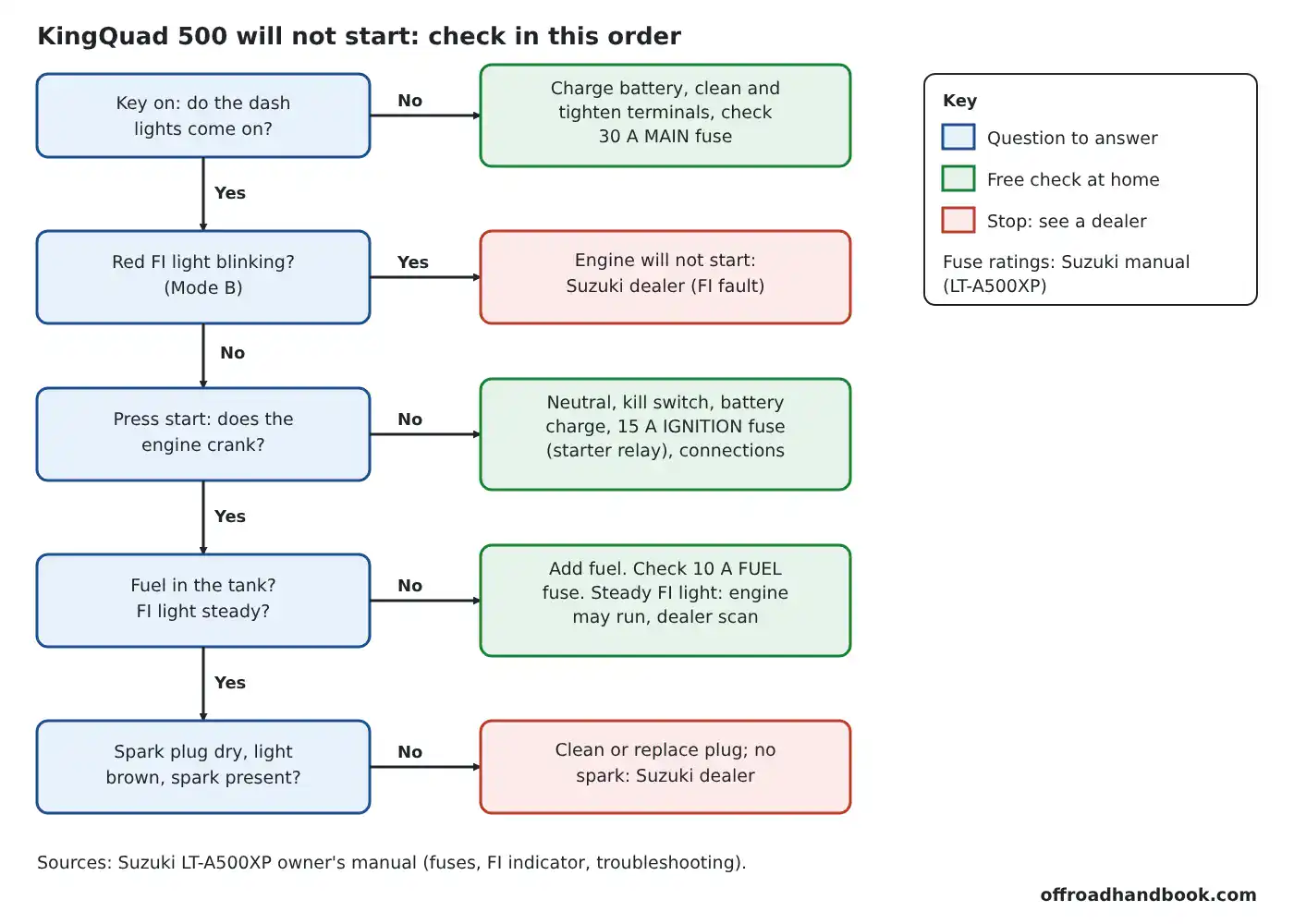
Run it top to bottom. Each green box is a free or cheap check, and each red box is where Suzuki's manual tells you to stop and take the quad to a dealer.
The manual's own troubleshooting chapter is short: fuel supply, ignition spark and a stalling checklist. The checks below add the fuses, lights and recall notes from the same documents.
1. Will not crank, clicks or has a dead dash
Symptoms: Nothing on the dash, a single click, or a slow, labored crank.
- Engine stop switch in run, key fully on, shift display showing N.
- Battery terminals and ground: clean and tight.
- Battery charge. Recharge before riding; the manual warns against exceeding the maximum charging rate.
- 30 A MAIN and 15 A IGNITION fuses.
- Starter relay and starter motor (dealer if the battery and fuses are good).
Fix: The battery sits behind the seat. Remove the seat, take off the bracket bolts, and disconnect the negative (-) terminal first; reinstall the bracket bolts with Suzuki thread lock "1342", per the manual. Suzuki's 2025 spec sheet lists an 18-amp battery.
Cold makes it worse: the manual says battery output falls below -4 F (-20 C), so charge or replace it before cold starts. Never leave the ignition in the lights-on position with the engine off.
Cost and time: Terminals and fuses are minutes and cost nothing beyond a fuse. We could not verify retail prices for batteries or starters, so ask your dealer.
Stop and see a dealer: A new fuse blows again soon, or the starter will not spin with a charged battery.
2. Cranks but will not start
Symptoms: The engine turns over normally but never fires.
- FI light: blinking red means the engine will not start (dealer).
- Fuel in the tank. The manual starts here.
- 10 A FUEL fuse.
- Spark plug: remove after the muffler cools, then check for fouling. A light brown insulator is correct; white or dark means see a dealer.
- Spark test: the manual describes it, with a shock warning; no spark means a dealer.
Fix: Add fuel, clean or replace a fouled plug, replace a blown FUEL fuse with a 10 A fuse. The specifications page lists NGK CR6E or Denso U20ESR-N plugs.
Many owners listen for the fuel pump to hum for a couple of seconds at key-on. That is owner-reported rather than a Suzuki statement, so treat silence as a reason to check the FUEL fuse, not as proof the pump is dead.
Cost and time: A plug and fuse check is a short job. We could not verify parts prices.
Stop and see a dealer: No spark, a blinking FI light, or a fuel smell.
3. FI light on or blinking
Symptoms: An FI mark and red light on the dash.
- Steady (Mode A): the engine may keep running. Note when it started.
- Blinking (Mode B): the engine will not start.
- Battery charge and the FUEL and IGNITION fuses, since low power is a free thing to rule out.
- Dealer scan for the stored fault.
Fix: Suzuki's manual gives no home repair for FI faults and tells you to see a dealer. Fault codes are read with dealer tools, so reading them yourself is not covered by Suzuki's public documents.
Cost and time: Diagnosis is dealer-priced; we have no verified figure.
Stop and see a dealer: Any FI light that stays on or blinks.
4. Stalling and rough idle
Symptoms: The engine dies at idle, hunts, or cuts out under throttle.
- Fuel level in the tank.
- FI light state: on means dealer.
- Spark plug fouling: clean or replace.
- Air filter and intake: dirt, water or a loose boot. Suzuki says the panels are designed for easy filter access.
- Coolant light: if it is on, treat it as overheating first (see below).
Fix: The manual's stall checklist is fuel, then plug fouling. Replace a dirty filter and plug before chasing sensors.
Cost and time: A plug and filter inspection is quick. No verified parts prices.
Stop and see a dealer: The stall continues after the free checks, or the FI light is on.
5. Overheating and the coolant temperature light

Symptoms: The coolant temperature light comes on, the temperature display flickers,.
- Stop and shut the engine off. Suzuki says not to run it until the light goes out.
- When completely cool, check the reservoir level between F and L.
- Top up with a 50:50 mix of distilled water and engine coolant.
- Hose mud off the radiator and check that the thermostatically controlled fan runs.
- 15 A FAN fuse.
Fix: The light comes on above 120 C (248 F). Coolant capacity is 2.5 L (2.6 US quarts) per the manual.
Do not open a hot radiator or reservoir cap. Low coolant and a mud-packed radiator are the free things to rule out first. The water crossing depth checker helps you plan crossings that could soak connectors and the engine bay.
Cost and time: Washing a radiator and topping up coolant take minutes. We could not verify thermostat or water pump prices.
Stop and see a dealer: The light returns after the checks, or coolant is disappearing.
6. Power steering (EPS) warning and heavy steering
Symptoms: The EPS light comes on while riding and steering feels heavier.
- Slow down and stop safely. The EPS light normally comes on at key-on and goes out after the engine starts.
- 40 A EPS fuse.
- Dealer inspection.
Fix: Suzuki says the ATV can still be steered if power steering fails, but it will feel heavier. Replace a blown EPS fuse only with a 40 A fuse.
A 2025 brochure does not list electric power steering for the current 500AXi, so check whether your quad has it before looking for this fuse.
Cost and time: A fuse check is free. We could not verify EPS repair costs.
Stop and see a dealer: EPS light on while riding, or the new 40 A fuse blows.
7. Differential lock and 4WD light problems
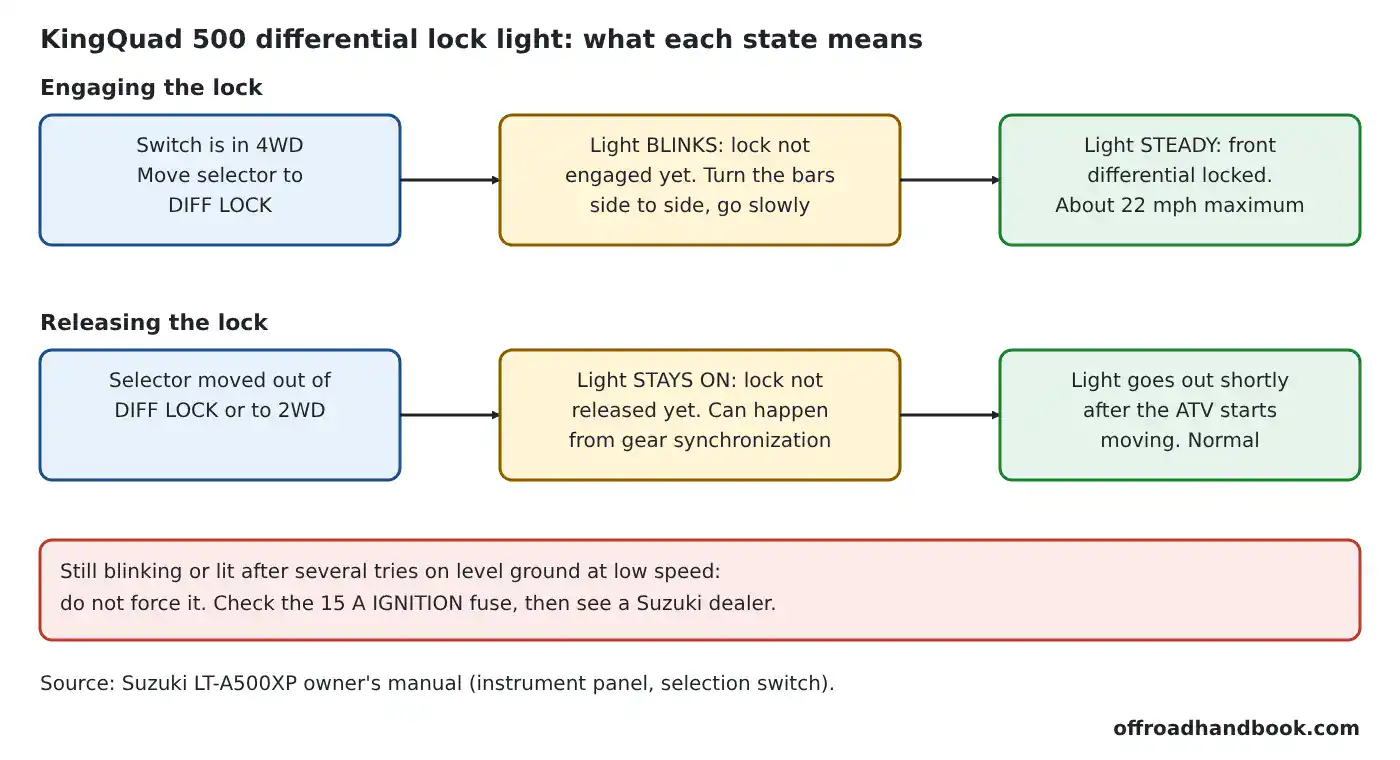
Symptoms: The diff-lock light blinks, or 4WD or diff lock seems stuck on.
- Stop completely before changing modes; the selector goes into DIFF LOCK only from 4WD.
- Blinking means not engaged: turn the bars side to side at low speed.
- A light that stays on after switching to 2WD can clear once you move.
- 15 A IGNITION fuse (diff lock relay, drive relay, 2WD/4WD motor).
- Dealer.
Fix: Engine speed is limited while the light blinks, and the manual says vehicle speed is limited to about 22 mph in diff lock. A quad that will not go faster in diff lock is working as designed.
Cost and time: Following the engage and release steps is free. We could not verify actuator or relay prices.
Stop and see a dealer: It still blinks or stays lit after several slow tries.
8. Battery drain and charging trouble
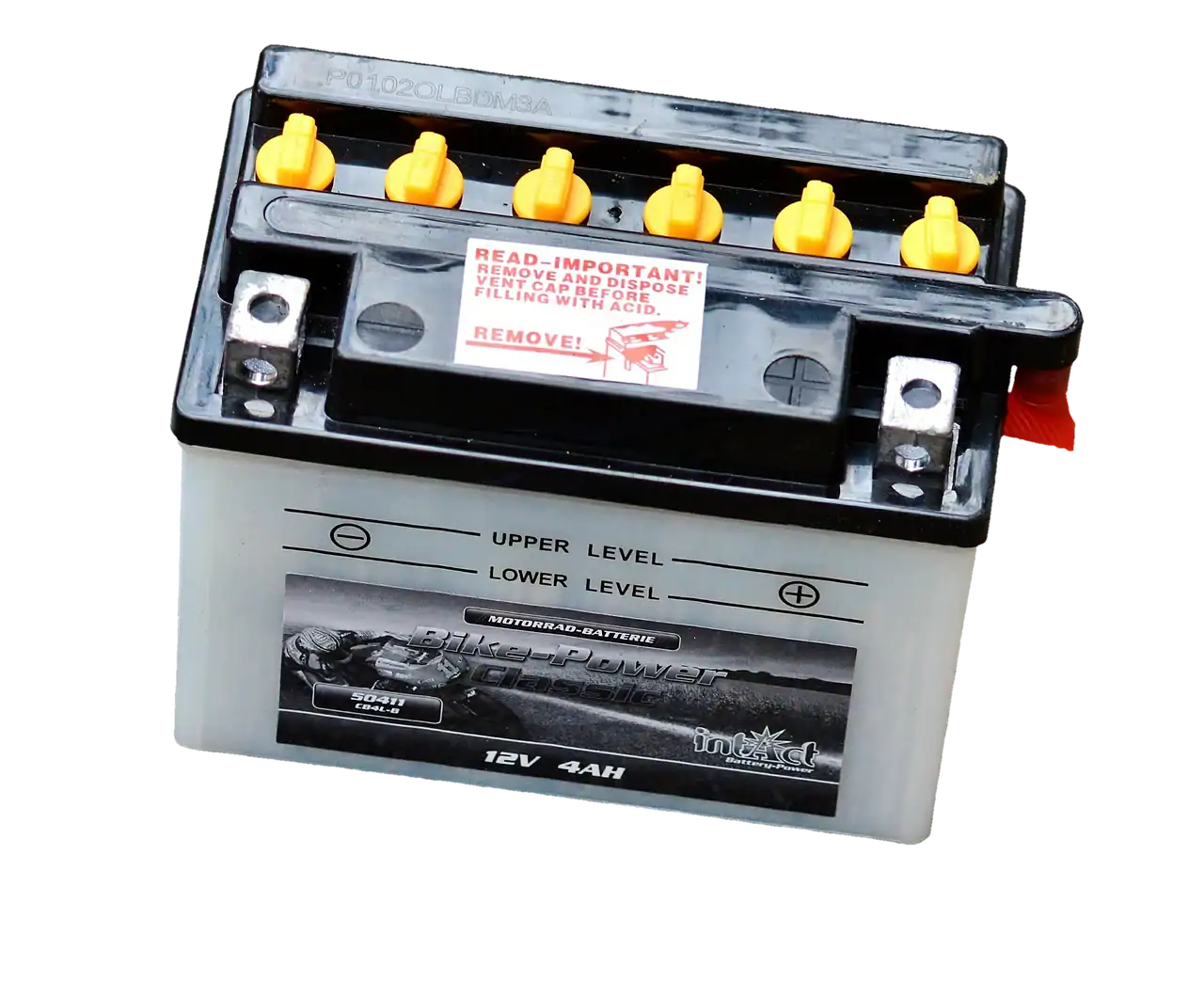
Symptoms: The quad starts after a charge, then is flat again the next time.
- Ignition left in the lights-on position, or lights and accessories left on.
- Corroded or loose terminals and ground.
- Accessories wired straight to the battery, including winch and aftermarket lights.
- Battery condition after a full charge.
- Charging system test at the dealer.
Fix: The battery is sealed and described as maintenance-free by Suzuki. Charge it within its maximum rate and have the dealer check it periodically.
The photo shows a typical small 12 V battery. Yours is sealed and listed at 18 Ah in the manual.
Charging-voltage specifications are in the service manual, which we could not open. Skip guessing numbers and ask a dealer to test the stator and regulator.
Cost and time: A charge and terminal clean is an evening. No verified prices for batteries or charging parts.
Stop and see a dealer: The battery goes flat repeatedly after a full charge.
9. Weak brakes and rear brake fade

Symptoms: A soft lever, long stopping distance, or a rear brake that loses bite on long descents.
- Front brake fluid level and pad wear, checked before every ride.
- Pad wear after mud, water or sand; check more often than the schedule says.
- Rear brake adjustment: pedal first, then lever.
- Rear final gear oil level on 2020 models (recall).
- Dealer bleed and rear brake service.
Fix: Replace pads in pairs; changing one side gives uneven braking. The rear brake is a sealed, oil-bathed multi-disc type, so there are no rear pads to inspect.
Final gear oil capacity is 770 ml (26.0 US oz) and front differential oil is 500 ml (16.9 US oz), per the specifications page. Recall repair on 2020 models takes about 1.5 hours and is free.
Cost and time: Pad replacement is a short job; we could not verify pad prices.
Stop and see a dealer: Rear brake fade on a 2020 LT-A500XM0, a soft lever after pads and level checks, or any leak.
10. Fuel smell, leaks and the 2011 fuel tank recall
Symptoms: A fuel smell, a wet fuel tank top, or fuel dripping near the pump opening.
- Stop riding and park outdoors or in a ventilated space away from flame.
- Check your VIN against the 2009 to 2011 recall group.
- Dealer inspection of the fuel pump opening.
Fix: Suzuki's campaign 2A13 covers all 2009 to 2010 LT-A500XP models and certain 2011 LT-A500X/XP models. The dealer inspects the sealing surface and replaces the tank if needed, free.
Cost and time: Free under the recall; the inspection is about 2 hours per the Suzuki letter.
Stop and see a dealer: Any fuel leak, always.
11. Hard shifting and drive problems
Symptoms: The shift lever will not go into gear, or the quad feels sluggish.
- Come to a complete stop before shifting.
- Check the shift position display.
- Check the drive mode: diff lock limits speed to about 22 mph.
- Dealer for shift linkage and drive belt inspection.
Fix: Suzuki's maintenance schedule lists the drive belt as an inspection item, but its public owner's manual gives no belt measurements or replacement steps. We have not published belt specs we could not verify.
Cost and time: We could not verify belt prices or labor.
Stop and see a dealer: Burning smell, belt slipping or grinding from the drive area.
Buying a used KingQuad 500: what to check
- Turn the key on and watch the 2-second light check; a light that never comes on or never goes out is a warning.
- Run the VIN past Suzuki for the 2009 to 2011 fuel tank recall and the 2020 rear final gear recall.
- Cycle 2WD, 4WD and diff lock; the light should blink, then hold steady.
- Check that the EPS light goes out after the engine starts, if the quad has power steering.
- Look at the front brake fluid level and pad wear.
Smaller sibling? Our Suzuki KingQuad 400 problems guide covers that model. Gear up before any trail ride; see what to wear ATV riding and the free off-road calculators.
KingQuad 500 problems FAQ
No. Suzuki lists electronic fuel injection, so there is no carburetor, jet or choke to clean.
It blinks while the lock is engaging. Turn the handlebars side to side at low speed until it holds steady. If it keeps blinking, see a dealer.
Yes. Suzuki recalled 2009 to 2011 models for a fuel pump gasket and tank leak, and 2020 models for an underfilled rear final gear. Both repairs are free.
Suzuki says the ATV can still be steered but will feel heavier. Slow down, stop somewhere safe and have a dealer inspect it.
Sources
- Suzuki LT-A500XP owner's manual (ManualsLib copy): fuses, instrument panel, selection switch, troubleshooting, specifications
- Suzuki 2025 KingQuad 500AXi brochure and specifications
- CPSC recall 11-727 (March 2011) and Suzuki campaign 2A13 letter
- Suzuki 2020 KingQuad 500AXi rear final gear recall letter
- CPSC 2005 Vinson and KingQuad alert and Suzuki recalls page

I'm Suryashankar Dasgupta, the founder of Off-Road Handbook. I've been off-roading for years in the USA, including California and Texas, and have ridden mountain and desert terrain abroad. I've also driven a Jeep Compass for more than seven years, so I know the day-to-day side of Jeep ownership first-hand, from the Uconnect screen to the warning lights. Every guide here is researched from manufacturer owner's manuals, NHTSA recall and service-bulletin records and other trusted sources, checked against them before it is published, and corrected when we find a mistake. You can read how we work in our editorial policy: https://offroadhandbook.com/editorial-policy/
Like our off-road guides? Add Off-Road Handbook as a Google Preferred Source so our latest Jeep, ATV, UTV, trail, recovery, and off-road troubleshooting articles can appear more often in your Google Search experience.
Add us as a Preferred Source