Load Range C vs D vs E: Which Off-Road Tire Should You Run?
Last updated on October 15th, 2026 at 11:25 pm
For most lightly modified Jeeps and half-ton trucks, Load Range C or D gives the best mix of ride, flex and trail durability. Load Range E earns its extra weight and stiffness when the vehicle is heavy (steel bumpers, winch, roof rack, trailer towing) or when you spend your trail days aired down on sharp rock. Load range is not a "toughness upgrade" you get for free, so match it to the weight you actually carry and the terrain you actually drive.
What load range actually means
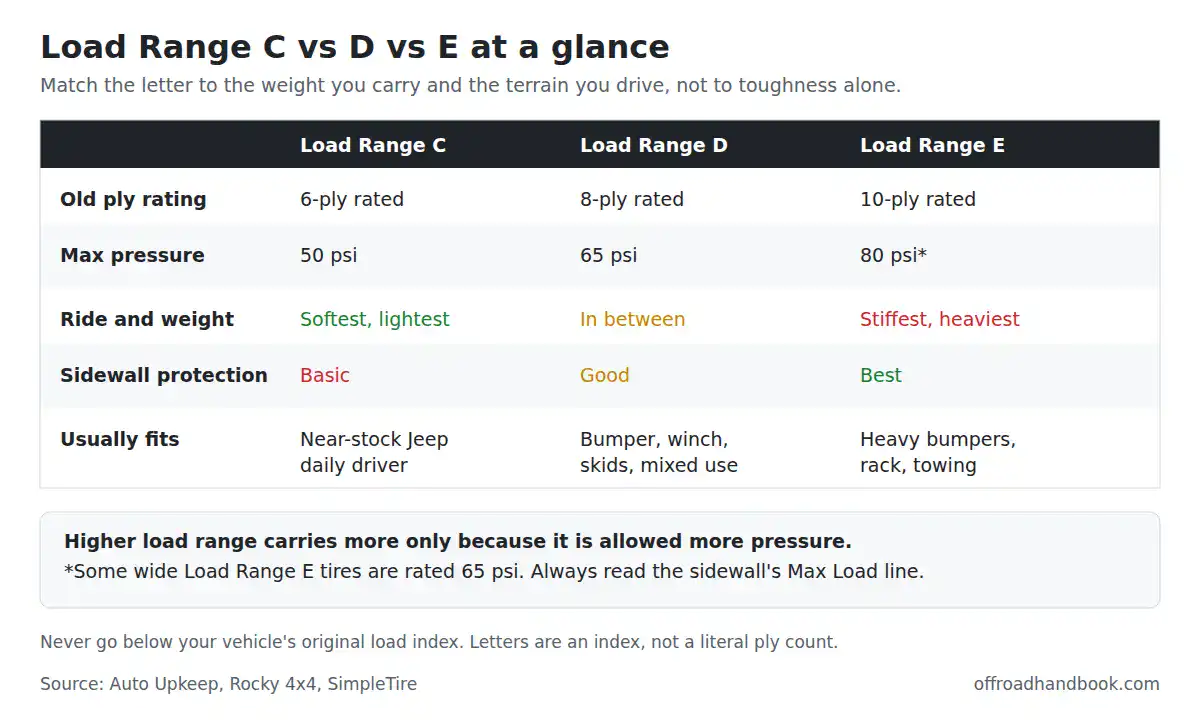
Load range is a letter on LT (light truck) tires that tells you how much load the tire can carry at its maximum inflation pressure. The older "ply rating" numbers survive only as an equivalency: B is 4-ply rated, C is 6, D is 8, E is 10 and F is 12 (Auto Upkeep). Modern radials don't contain ten literal plies; the letter indexes strength and the pressure the tire is built to run.
Commonly published maximum pressures are 50 psi for C, 65 psi for D and 80 psi for E (Rocky 4x4). There's one catch: some wide LT tires (roughly 295 mm, or 11.6 inches, section width and wider) are Load Range E but rated at only 65 psi, so always read the sidewall instead of assuming. The sidewall's "Max Load ... at ... psi" line is the real spec for your tire.
The point most guides bury: a higher load range doesn't carry more weight at the same pressure. It carries more because it's allowed a higher pressure. At 20 psi on the trail, a C and an E of the same size are both supporting the vehicle on a lot of flexing sidewall. What differs is how stiff and puncture-resistant that sidewall is.
C vs D vs E: how to choose
| Your setup | Usually the right pick | Why |
|---|---|---|
| Near-stock Wrangler, Cherokee or Gladiator, daily driver, light trails | Load Range C (or stock P-metric/XL) | Softer ride, better compliance, lighter tire |
| Wrangler or truck with bumper, winch or skids; mixed street and trail | Load Range D, or a light E | Extra sidewall protection without a big ride penalty |
| Heavy bumpers, rack, camping gear, trailer towing | Load Range E | Capacity and heat resistance under weight |
| Rock crawling aired down to low single-digit or teen psi | D or E | Sturdier sidewall resists cuts and bead roll |
| Fast desert or washboard runs | D or E, per tire maker's guidance | Heat and impact loads are higher |
These pairings follow the general guidance in Rocky 4x4's comparison, which pairs C with lighter TJ/XJ-style builds, D with moderately built JK/JL rigs, and E with fully armored or towing rigs. They're guidelines, not rules. A 5,000 lb JL on 35s with armor runs differently than a stripped two-door.
The trade-offs nobody should skip
Weight and ride
Stiffer, thicker sidewalls transmit more road feedback. Moving up to E on a light vehicle can make the ride "significantly stiffer" (SimpleTire), and Rocky 4x4 notes E tires can be roughly 8-12 lb heavier per tire, which means more unsprung weight, slightly lower mpg and more strain on suspension parts. If your tires already feel harsh, read our piece on why mud tires ride rough before adding more stiffness.
Puncture resistance and bead retention
This is where heavier construction pays off. Thicker sidewalls are harder for sharp rock to penetrate, and at 12-18 psi a stiff E sidewall resists rolling the bead off the rim. If you air down regularly, see our off-road tire pressure guide and, for the repair side, how to plug a flat on the trail.
Pressure on pavement
Don't inflate an E tire to its 80 psi maximum for the street. Overinflated tires ride hard, wear down the center of the tread and lose grip. SimpleTire warns that too little pressure causes flexing and heat build-up, while the maximum is a ceiling, not a target. Start from your vehicle placard, then fine-tune with the tire maker's load and inflation table and a tread-wear check. A heavier tire on the same vehicle often needs a slightly different pressure than the factory tire did.
Match the tire to the vehicle, not only the trail
- Read the door placard for the factory tire size, load index and pressure.
- Don't go lower than the original load index. A stock P-metric tire can be replaced with an LT of equal or greater load carrying capacity; a lower capacity tire is a safety problem, however tough it looks.
- Know your real weight. Add bumpers, winch, rack, tent, fuel and water. Weigh the loaded vehicle at a scale if you're unsure.
- Check the size. Taller or wider tires change fit and gearing; see how to read tire sizes and our tire guide.
- Keep the spare consistent. If you run E tires, carry a matching E spare, not a smaller, softer-sidewall tire. See also whether you can off-road on street tires and how mud tires affect gas mileage.
FAQ
Is Load Range E better for off-road?
Only when your weight or terrain calls for it. It resists punctures and bead rolls better, but rides stiffer and weighs more. On a light Jeep, C or D often flexes and rides better.
Does load range E mean 10 plies?
No. It's an equivalency index tied to strength and maximum pressure, not a literal ply count (Auto Upkeep).
Can I run a Load Range E tire at low pressure?
Yes, aired down for the trail, but the tire is then carrying load at a pressure well below its rating. Keep speeds low, re-inflate before pavement, and don't exceed what your vehicle and tires can safely carry.
Do all Load Range E tires have an 80 psi maximum?
No. Wide E tires are often rated 65 psi. Read the sidewall.
Should I replace C with E on a stock Jeep?
Not automatically. If you added heavy gear or tow regularly, yes; otherwise expect a harsher ride for little real benefit.
Related guides
- How to Reseat a Tire Bead on the Trail: Safe Methods and Limits
- Wheel Offset and Backspacing for 35s on a Wrangler or Tacoma
Want to check a tire against your axle rating? Use our tire load index chart and free axle rating checker.

I'm Suryashankar Dasgupta, the founder of Off-Road Handbook. I've been off-roading for years in the USA, including California and Texas, and have ridden mountain and desert terrain abroad. I've also driven a Jeep Compass for more than seven years, so I know the day-to-day side of Jeep ownership first-hand, from the Uconnect screen to the warning lights. Every guide here is researched from manufacturer owner's manuals, NHTSA recall and service-bulletin records and other trusted sources, checked against them before it is published, and corrected when we find a mistake. You can read how we work in our editorial policy: https://offroadhandbook.com/editorial-policy/
Like our off-road guides? Add Off-Road Handbook as a Google Preferred Source so our latest Jeep, ATV, UTV, trail, recovery, and off-road troubleshooting articles can appear more often in your Google Search experience.
Add us as a Preferred Source