Kinetic Rope vs Snatch Strap vs Tow Strap: Pick the Right One
Last updated on October 30th, 2026 at 06:11 pm
Carry a snatch strap or a kinetic rope for getting unstuck, and a tow strap only for pulling a rolling vehicle. A tow strap barely stretches, so using it for a running yank can slingshot the stuck vehicle toward you and overload whatever it’s hooked to. A kinetic rope stretches the most, up to about 30%, while a classic nylon snatch strap stretches roughly 15–20%. Either one works if it’s sized to the lighter vehicle and attached to a real recovery point. That last part matters more than which one you buy.
Tow strap vs snatch strap vs kinetic rope: what each one does
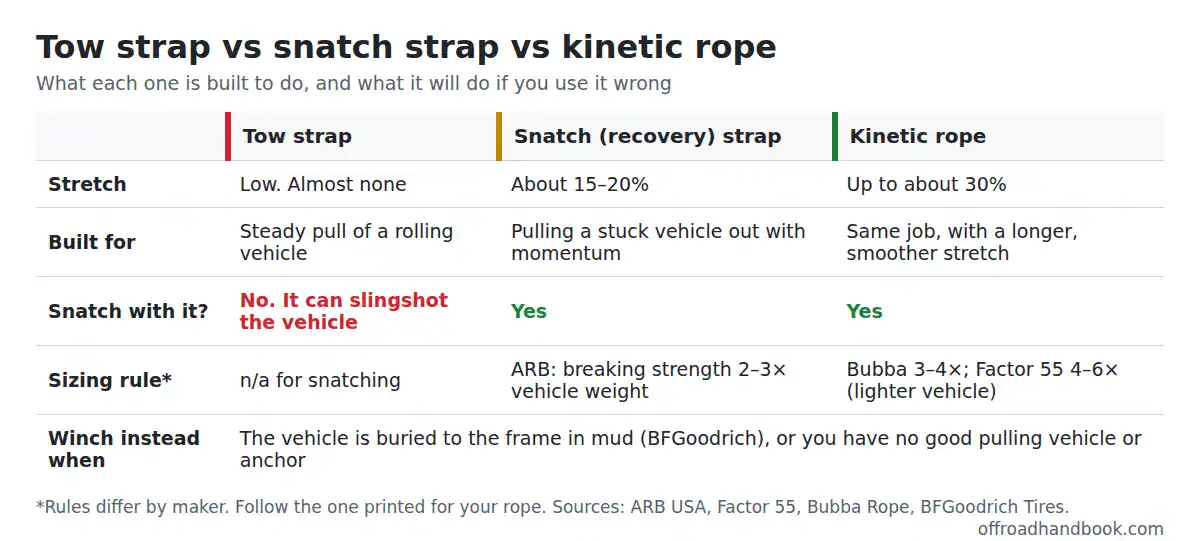
Factor 55 describes a tow strap as a flat woven cord for towing another vehicle, and warns that its low stretch will “slingshot the vehicle being towed toward the tow vehicle” if you use it as a recovery strap. A recovery strap or kinetic rope is the opposite: it’s made to stretch, store energy as the pulling vehicle rolls forward, then give that energy back to the stuck one. BFGoodrich puts snatch-style straps at around 15% stretch and kinetic ropes at up to 30%.
Both are made from nylon. The difference you’ll feel is how the pull arrives. The extra stretch of a kinetic rope is why it’s popular for sand and snow, where the pulling vehicle can’t build much speed before the line comes tight.
Which one should you buy?
| Your situation | Best pick | Why |
|---|---|---|
| Daily driver that sometimes sees snow or a muddy field | Kinetic rope sized to your vehicle | Stretches the most; handles the most common “stuck, not buried” jobs |
| Budget kit, mostly trail days with a group | Snatch strap (a 20% stretch, 30 ft strap like ARB’s is a common choice) | Cheap, proven, and easy to find in the right rating |
| Moving a dead vehicle on pavement or a flat lot | Tow strap or a rigid tow bar | It’s a steady pull; no stretch needed |
| Axle-deep in mud with nothing to build speed | Winch | BFGoodrich advises against strap recovery on a completely mud-buried vehicle |
| Solo, no second vehicle | Winch plus a tree trunk protector | Rope and strap both need a second vehicle |
How to size it: three brands, three rules
Here’s what most guides skip: there is no single industry formula. ARB USA's Recovery Basics says to pick a snatch strap with a minimum breaking strength (MBS) of two to three times the gross vehicle weight, and to size it to the lighter vehicle when two are involved, so you don’t overload that vehicle’s recovery points. Bubba Rope recommends multiplying the weight of the vehicle being recovered by three or four. Factor 55 sizes its kinetic ropes at roughly four to six times GVWR.
Those numbers aren’t contradictory. Each maker rates and tests its own line differently, so follow the rule printed on the package for the rope you actually own. As an example, a loaded 5,000-lb Jeep Wrangler works out to 10,000–15,000 lb MBS under ARB’s rule and 15,000–20,000 lb under Bubba’s. A 30-ft strap rated at 17,500 lb MBS, like ARB’s ARB705, falls in the overlap. Sizing to the lighter vehicle matters because, as ARB notes, a line that’s too strong for it can overload its recovery points.
Two terms get mixed up on packaging. MBS is where it breaks. Working load limit (WLL) is a safe figure set well below that. A shackle should carry a stamped WLL; ARB’s guidance is a minimum of 3.25 tons.
Where you can and can’t hook it
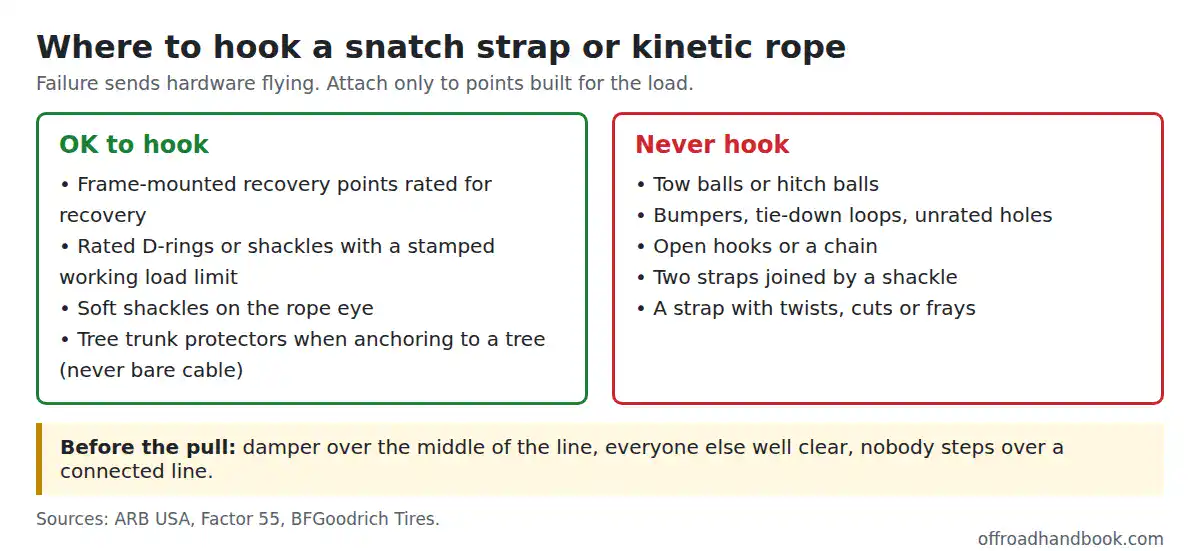
This is where recoveries go wrong. Both Factor 55 and BFGoodrich's recovery guide say never attach a recovery line to a tow ball or hitch ball. Under load, a failed ball becomes a projectile. Use frame-mounted recovery points rated for recovery, rated D-rings or shackles, or a soft shackle on the rope eye. Don’t join two straps with a shackle, and don’t use a chain.
Your owner’s manual is the place to check what your factory hooks or eyes are rated for. The wording varies by model and year, and some manufacturers describe tow eyes as emergency towing points rather than recovery points. If your manual doesn’t clearly bless them for a snatch, buy rated bolt-on recovery points or a bumper that has them.
How to do a kinetic or snatch pull, step by step
- Stop and look first. Clear mud or sand from in front of every tire and from under the frame if it’s resting on the ground. Air down if you haven’t already (see our off-road tire pressure guide).
- Line the vehicles up straight. BFGoodrich suggests leaving about three feet of slack for the first pull. Side loads on recovery points are a no.
- Connect to rated points on both vehicles with D-rings or soft shackles. Open the shackle pin, seat it, then back it off a half to one full turn so it doesn’t seize (ARB).
- Lay a damper over the middle of the line. A recovery damper or a heavy blanket helps hold the line down if something lets go (ARB, BFGoodrich).
- Clear everyone out. Spectators stay well away until the recovery is over. Nobody steps over a connected strap.
- Pull steadily. Bubba Rope’s guidance is to keep the assisting vehicle at or under 5 mph. The stuck driver can start with slack in the line and drive out as the rope loads.
- Reset if needed. If it doesn’t pop free, back up, re-set the slack and try again, but let a strap rest between pulls so its elasticity recovers (ARB).
Spotters and drivers should agree on signals before anything is hooked up. Our guide to off-road spotting signals covers the hand signals most groups use.
Mistakes that turn a stuck vehicle into an injury
- Using a tow strap or a chain for a running snatch.
- Hooking to a tow ball, a bumper hole or a tie-down loop.
- Skipping the damper because “it’s just a little pull.”
- Buying by brand or price without checking MBS against the lighter vehicle’s weight.
- Using a frayed, cut or sun-chewed strap. BFGoodrich lists worn straps as a don’t.
- Trying to snatch a vehicle that is already buried to the frame instead of digging out or winching.
If you’re building a recovery kit for the first time, put it on your pre-trip list alongside the items in our Jeep off-road prep checklist. And remember that on a busy trail, helping someone else is part of the deal; our trail etiquette guide covers how to offer and accept a pull.
FAQ
Can I use a tow strap to pull a stuck vehicle?
Only for a slow, steady pull when the vehicle is already free to roll. Don’t use it for a running start. Low stretch means no energy cushion, and a failure or snap can send the vehicle or hardware toward the other driver.
Is a kinetic rope better than a snatch strap?
For most people it’s the smoother option because it stretches more (up to about 30% versus roughly 15–20%). A snatch strap is cheaper and perfectly adequate when sized and rigged correctly.
How long should a recovery rope or strap be?
Thirty feet is a common length for retail straps and ropes, such as ARB’s 30-ft strap and Factor 55’s ⅞-inch by 30-ft rope. The extra length gives the line more room to stretch.
Can I attach a recovery rope to my trailer hitch?
Not to the ball. Factor 55 and BFGoodrich both say not to. Use a rated recovery point or a shackle-style recovery hitch made for the purpose, and check its rating.
Sources
- ARB USA: Recovery Basics, Part I
- Factor 55: Tow Strap vs. Recovery Strap/Kinetic Rope
- BFGoodrich Tires: Off-Road Recovery Gear and Safety Guide
- Bubba Rope: Rope Facts
Safety note: recovery gear stores a lot of energy. Follow the manufacturer’s instructions for your specific gear and vehicle, and when in doubt, don’t pull.
Recovering solo, with no second vehicle? A winch is the other option, and our guide on what size winch you need shows how rope layers change the pull you actually get. To double that pull or winch from an off-angle anchor, see how to rig a snatch block.

I'm Suryashankar Dasgupta, the founder of Off-Road Handbook. I've been off-roading for years in the USA, including California and Texas, and have ridden mountain and desert terrain abroad. I've also driven a Jeep Compass for more than seven years, so I know the day-to-day side of Jeep ownership first-hand, from the Uconnect screen to the warning lights. Every guide here is researched from manufacturer owner's manuals, NHTSA recall and service-bulletin records and other trusted sources, checked against them before it is published, and corrected when we find a mistake. You can read how we work in our editorial policy: https://offroadhandbook.com/editorial-policy/
Like our off-road guides? Add Off-Road Handbook as a Google Preferred Source so our latest Jeep, ATV, UTV, trail, recovery, and off-road troubleshooting articles can appear more often in your Google Search experience.
Add us as a Preferred Source