Can-Am Commander Problems: No Start, Limp Home and Fuse Chart
Last updated on October 26th, 2026 at 08:46 pm
This post contains Amazon affiliate links. As an Amazon Associate I earn from qualifying purchases, at no extra cost to you.
Most Can-Am Commander problems come down to eight things: a D.E.S.S. key the gauge won't read, a blown fuse, a flooded engine, water in the CVT, a belt cooked by running high range when it should be in low, a limp-home or sensor fault, overheating from packed radiator fins, and a speed cap that turns out to be the seat belt or the key.
All eight show up in BRP's own operator's guides, and most of them can be checked on the trail in a few minutes.
Pick your symptom below for the check order. The fuse numbers, gauge messages and specs further down come straight from the 2023 and 2026 Commander operator's guides.
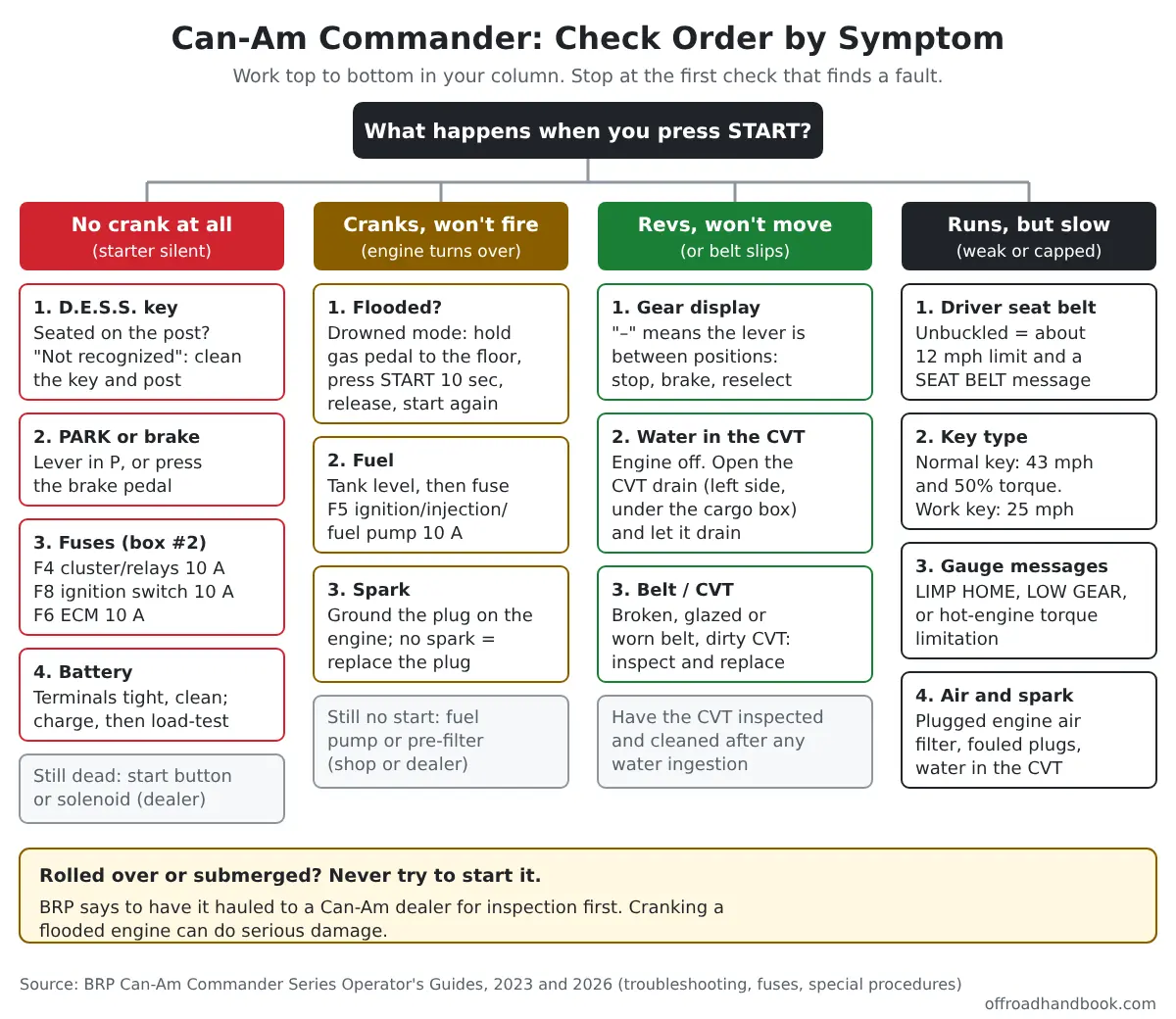
Commander Symptom Checker: What to Check First
The checker follows the order in BRP's troubleshooting guidelines, with fuse numbers from the fuse tables in the same guides. It's a starting point, not a scan tool. Anything that ends at "dealer" needs a BRP diagnostic tool or a qualified shop.
One rule overrides everything here. If the Commander rolled over or went under water, BRP says never to start the engine. Have it hauled to a Can-Am dealer for inspection first.
The 8 Most Common Can-Am Commander Problems
The details below come from the 2023 and 2026 Commander guides, which cover the Rotax 650 cc single ("700") and 976 cc V-twin ("1000R"). Older Commanders can differ in fuse layout and gauge messages, so check your own year's guide.
1. Nothing happens when you press START
Start with the key. The Commander uses a D.E.S.S. (Digitally Encoded Security System) key that has to sit firmly on its post on the upper console. If the gauge shows D.E.S.S. KEY NOT RECOGNIZED, BRP's fix is to clean the key. BAD KEY means it's a key for a different machine.
Next, the interlocks. The engine only starts in PARK, or out of PARK with the brake pressed. It also refuses to start if the gas pedal is pressed 50% or more. BRP says not to hold START longer than 10 seconds.
Then the fuses and battery. In fuse box #2 behind the driver's seat, check F4 (cluster/relays), F8 (ignition switch) and F6 (ECM), all 10 A. Clean and tighten the battery terminals and charge the battery. If you jump it, BRP says red to the battery positive and black to the chassis, and never to the steering column or anything touching the DPS.
2. It cranks but won't start
A Commander that cranked a few times and quit is often just flooded. BRP builds in a "drowned mode" that cuts injection and ignition while you crank:
- Put the key on the D.E.S.S. post.
- Press the gas pedal all the way down and hold it.
- Press START for 10 seconds.
- Release START, then release the gas pedal.
- Press START again to start normally.
If that fails, pull the plugs, crank a few times to clear fuel, and fit new or dry plugs. Plug spec is NGK LMAR8AI-8 gapped 0.028–0.031 in on the 700, and two NGK LMAR8C-9 at 0.031–0.035 in on the 1000R.
A dry plug points to fuel. Check the tank, then fuse F5 (ignition/injection/fuel pump, 10 A). After that, BRP lists a clogged pump pre-filter or a failed fuel pump, which are shop jobs.
3. The engine revs but the Commander won't move
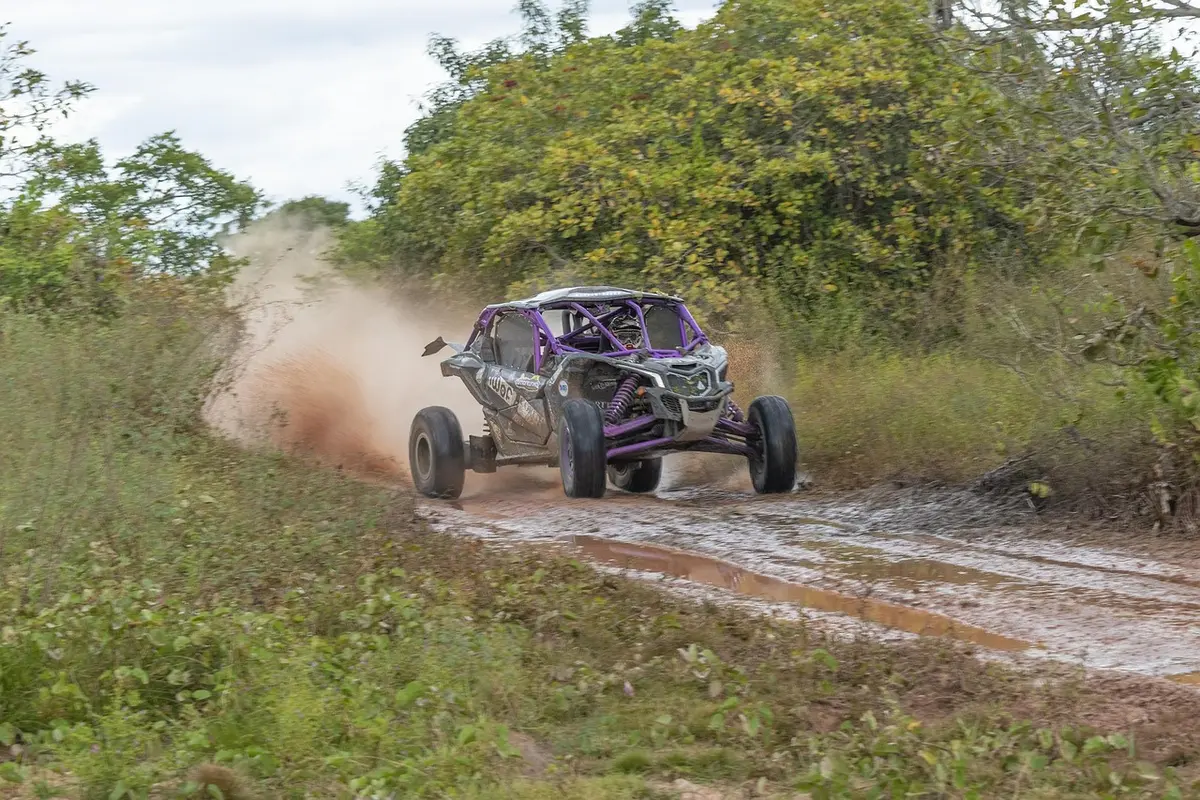
BRP's description is exact: with water in the CVT, "the engine will accelerate but the vehicle will remain still." Shut the engine off right away. The CVT drain sits on the left side of the vehicle under the cargo box. Let it drain completely before you try again.
BRP then wants the CVT inspected and cleaned, and it states that failures from water ingestion aren't covered by warranty. Before deep crossings, compare the water against your intakes with our water crossing depth checker.
Two other causes look the same. A dash (–) on the gear display means the shift lever is sitting between positions. And a snapped belt gives you engine noise with no drive at all.
4. Belt slipping, squealing or burning
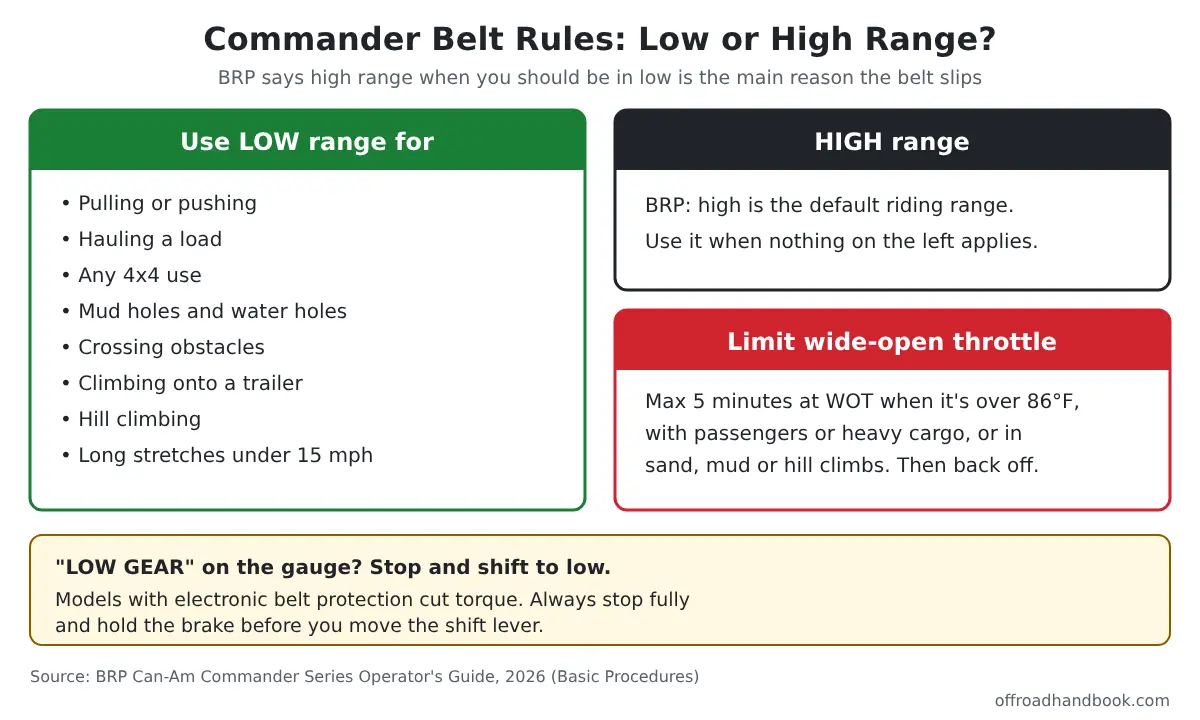
Belts are the classic Commander complaint, and BRP is blunt about the cause: the main reason the belt slips is running high range when you should be in low. Low range is for pulling, pushing, hauling, any 4x4 use, mud and water holes, obstacles, loading onto a trailer and hill climbs. BRP also recommends low for long stretches under 15 mph.
Heat is the other killer. Above 86°F, with passengers or heavy cargo, or in soft sand, mud or hill climbs, BRP says not to hold wide-open throttle for more than five minutes. Ease off and let the CVT cool. That's summer dune riding in the Southwest in one sentence.
Some models have electronic belt protection. When you're too slow for high range, it cuts torque and scrolls LOW GEAR on the gauge, and BRP says you must shift to low. Always come to a full stop with the brake on before moving the lever, or you risk gearbox damage.
Carry a spare belt that matches your model and year. A Can-Am Commander drive belt search is a starting point, but confirm the part number against your VIN before you buy. Check the current price on Amazon.
5. CHECK ENGINE, LIMP HOME and sensor faults
The gauge separates a stored fault from a serious one. CHECK ENGINE alone means a fault needs attention but no engine limitation is engaged. LIMP HOME means a critical fault with power limited or engine behavior changed. Ride out gently and get it diagnosed.
The message table below decodes the rest. TPS FAULT (throttle body) usually comes with LIMP HOME. Partial or no response from the gas pedal with a PPS FAULT is the pedal position sensor, which BRP sends to the dealer.
6. Slow, weak, or capped at a low speed
Before you blame the clutch, check two things owners miss. If the driver's seat belt isn't fastened, the Commander limits speed to about 12 mph once you leave PARK and shows SEAT BELT. There's no indicator for the passenger belt.
The key matters too. According to the 2026 guide, a Normal key limits the Commander to 43 mph with 50% less torque, and a Work key gives full torque but caps speed at 25 mph. Only the Performance key unlocks full speed. A used Commander bought with "the wrong key" will feel exactly like a slipping belt.
After that, look for a hot-engine torque limitation, a plugged engine air filter, fouled plugs or water in the CVT. Those are BRP's other "lacks power" causes.
7. Overheating
BRP's list is short: low coolant, a cooling fan that isn't running, and dirty radiator fins. In practice the fins come first after any mud ride. BRP's deep mud/water care list says to rinse the vehicle, clean the radiator, and clear debris from around the exhaust and muffler after every ride in those conditions.
If the fan isn't spinning, make sure it isn't jammed, then check F9 (cooling fan, 25 A) in box #2. The cooling system holds 1.77 gallons on both 2023 and 2026 models. On models with torque limitation, the engine gradually cuts torque when coolant temperature gets too high, so a hot Commander also feels slow.
8. 4WD, Smart-Lok or power steering not working
Electrical faults on the drive side usually trace to a single fuse. The 4WD actuator runs on F7 (10 A) in box #2. On 2026 models there's also a 2x4/4x4 fuse, F7 (10 A), in box #1 under the dash. The Smart-Lok front diff on XT-P models uses PF8 (20 A), and Dynamic Power Steering uses PF3 (40 A).
If the fuse is good and the gauge shows CHECK SMART-LOK or CHECK DPS, BRP's guidance is a dealer visit. Heavy steering with CHECK DPS on is not a trail fix.
Commander Gauge Messages Decoded
These are the messages listed in the 2023 and 2026 operator's guides. The wording is BRP's. The "what to do" column condenses the guide's instructions.
| Message | What it means | What to do |
|---|---|---|
| D.E.S.S. KEY NOT RECOGNIZED | Key needs cleaning | Clean key and post; dealer if it persists |
| BAD KEY | Wrong D.E.S.S. key for this vehicle | Use the key programmed to it |
| CHECK ENGINE | Active or stored fault, no engine limitation | Have it scanned soon |
| LIMP HOME | Critical fault; engine limited or behavior changed | Ride out gently; diagnose ASAP |
| TPS FAULT | Throttle body fault, usually with LIMP HOME | Dealer or shop diagnosis |
| PPS FAULT | Pedal position sensor fault | Dealer |
| BRAKE SWITCH FAULT | Brake signal fault | Dealer or shop diagnosis |
| FUEL SENSOR FAULT | Fuel sender reading out of range | Diagnose the fuel sender |
| CHECK DPS | Power steering not working properly | Check PF3 (40 A), then dealer |
| CHECK SMART-LOK | Smart-Lok not working properly | Check PF8 (20 A), then dealer |
| SEAT BELT | Driver belt unfastened; about 12 mph cap | Buckle up |
| LOW GEAR | Belt protection active (if equipped) | Stop and shift to low range |
Commander Fuse Chart (2023 and 2026)
Both guides list two fuse boxes. Box #1 is under the left side of the dash, and box #2 is behind the driver's seatback near the ECM. The layout is the same in both years except for one extra 2x4/4x4 fuse in the 2026 box #1.
BRP's rule: replace a blown fuse with the same rating, never a higher one. If a fuse blows again right away, look for the short before it melts a harness. A mini blade fuse assortment kit is cheap insurance in the glovebox, but match the fuse type in your box before you buy.
| Fuse | Location | Circuit | Rating |
|---|---|---|---|
| F4 | Box #2 (behind driver seat) | Cluster / relays | 10 A |
| F5 | Box #2 | Ignition / injection / fuel pump | 10 A |
| F6 | Box #2 | Engine control module (ECM) | 10 A |
| F7 | Box #2 | 4WD actuator | 10 A |
| F8 | Box #2 | Ignition switch / clock | 10 A |
| F9 | Box #2 | Cooling fan | 25 A |
| F18 | Box #2 | Oxygen sensor / evap purge valve | 10 A |
| F7 (2026 only) | Box #1 (under dash) | 2x4 / 4x4 | 10 A |
| F11 | Box #1 | Headlamps | 20 A |
| F12 | Box #1 | DC3 / winch | 10 A |
| F14 | Box #1 | 12 V accessory outlet 1 | 10 A |
| F16 | Box #1 | Tail lamps | 10 A |
| PF3 | Under dash, near DPS | Dynamic Power Steering | 40 A |
| PF4 | Under-dash terminal block | Accessory post | 30 A |
| PF8 | Under dash, near front diff module | Smart-Lok (if equipped) | 20 A |
| PF10 | Near the battery | Regulator | 50 A |
2023 vs 2026 Commander Specs That Matter for Repairs
Most specs carried over between these years, but not all of them. Note the V-twin gearbox oil capacity: the 2023 guide lists 2.1 qt, and the 2026 guide lists about 1.3 qt. Fill by the level hole or dipstick for your year, not by a number from another year.
| Item | 2023 Commander | 2026 Commander |
|---|---|---|
| Engine oil capacity | 700: 2.85 qt / 1000R: 2.1 qt | 700: 2.85 qt / 1000R: 2.1 qt |
| Engine oil (XPS, general use) | 5W-40 synthetic blend | 5W-40 synthetic (0W-40 cold, 10W-50 warm) |
| Gearbox oil capacity | 700: 0.53 qt / 1000R: 2.1 qt | 700: 0.53 qt / 1000R: approx. 1.3 qt |
| Gearbox oil | XPS 75W-140 synthetic | XPS 75W-140 synthetic (or 75W-140 API GL-5) |
| Front differential oil | 12 fl oz (700) / 14 fl oz (1000R) | 12 fl oz (Smart-Lok) / 14 fl oz (others), 75W-90 |
| Coolant capacity | 1.77 gal | 1.77 gal |
| Spark plugs | 700: NGK LMAR8AI-8, 0.028–0.031 in 1000R: 2x NGK LMAR8C-9, 0.031–0.035 in | Same |
| Minimum octane (US) | 87 AKI (700) / 91 AKI (1000R) | 87 AKI (700) / 91 AKI (1000R) |
| Idle speed | ECO 1,350 ± 100 rpm / Sport 1,500 ± 100 rpm | Same |
| Battery | 12 V, 20 Ah | 12 V, 18 Ah |
| Fuel tank / low-fuel light | 10 gal / 2.2 gal left | 10 gal / 2.2 gal left |
| CVT engagement | 1,950 rpm | 700: 2,050 rpm / 1000R: 1,950 rpm |
That idle line matters. Some repair guides call idle above about 1,250 rpm "high" and blame hard shifting on it. BRP's spec for ECO mode is 1,350 ± 100 rpm, so a Commander idling at 1,300 is normal.
For oil, BRP recommends its own XPS products or an equivalent. A BRP XPS 5W-40 oil change kit bundles the oil, filter and O-rings. Check the fitment for your engine and the current price on Amazon.
Can-Am Commander Recalls (CPSC)
Several real Commander "problems" were recalls with free fixes. Check any used Commander's VIN on BRP's safety recall page before you start chasing symptoms.
| Recall | Date | Commander models | Problem | Remedy |
|---|---|---|---|---|
| 13-718 | Jan 10, 2013 | 2011–2012 Commander 800/1000, XT, X, Limited (about 3,400 units) | Steering column improperly assembled to the rack and pinion; loss of steering | Free repair |
| 13-103 | Jan 29, 2013 | 2011–2013 Commander 800R/1000 (most trims; 2013 without front grill kit), about 25,000 units | Leaves, hay and grass collect at the hot exhaust pipe; fire risk (18 fires reported) | Free update kit |
| 16-740 | May 5, 2016 | Side-by-sides including 2013 Commander 800 XT and 1000 DPS (about 10,600 units) | Steering coupling can strip on the rack and pinion | Free inspection and repair |
| 23-723 | Feb 9, 2023 | 2023 Commander, Defender, Maverick Trail/Sport (about 3,310 units) | Defective fuel hose assembly can leak fuel | Free fuel hose replacement |
| 24-735 | Dec 14, 2023 | 2022–2023 Commander, Defender, Maverick Trail with HD7 or 700 engines (about 14,555 units) | Guide gave wrong clutch maintenance intervals; clutch can fail and eject fragments | Revised maintenance booklet |
The 24-735 recall ties straight back to belt and clutch trouble. If you own a 2022–2023 Commander 700, make sure you're following the revised clutch maintenance booklet BRP mailed out, not the original guide. CPSC told owners to stop riding until they'd reviewed the new instructions.
The 2011–2013 exhaust recall is also a habit worth keeping on any year. BRP's current maintenance schedule still lists cleaning debris from around the exhaust pipe and muffler, and the deep mud/water care list repeats it after every ride.
After a Mud or Water Ride: BRP's Care List
Several of the problems above start the same way: a wet, muddy ride and no cleanup afterward. BRP's "Post Operation Care for Deep Mud / Water" list in the 2026 guide is worth doing after every ride like that:
- Rinse the vehicle and its components with fresh water.
- Clean the CVT air filters, and drain the CVT compartment if you find water or mud.
- Inspect and clean the engine air filters and housing.
- Clear debris around the exhaust pipe, muffler and spark arrester.
- Clean the radiator.
- Check the fuel tank, gearbox, front diff and rear final drive vent hoses for water. Water there means a dealer inspection.
- Clean the shocks, drive shaft bellows and propeller shaft yokes or boots.
Tire pressure is the other easy win in mud and sand. Our air-down PSI calculator gives a starting point by terrain, but never go below the minimum on your Commander's tire pressure label.
If water got into the engine itself rather than just the CVT, stop and read our guide to hydrolock after a water crossing before you crank it.
Commander vs Other Can-Am Models
The Commander shares Rotax engines, D.E.S.S. keys and CVT logic with the rest of the Can-Am side-by-side lineup, so many fixes carry over. If you also run a work rig or a sport machine, see our guides to Can-Am Defender problems and Can-Am Maverick X3 problems. For brand-neutral checks, use the ATV and UTV troubleshooting guide.
Can-Am Commander Problems: FAQ
Why won't my Can-Am Commander go over 12 mph?
Almost always the driver's seat belt. With it unfastened, the Commander caps speed at about 12 mph once it's out of PARK and shows SEAT BELT on the gauge. A Work key (25 mph) or Normal key (43 mph) gives a higher cap.
Why does my Commander rev but not move?
BRP lists water in the CVT first, then a dirty or worn CVT or a failed belt. Shut it off, drain the CVT from the drain under the left side of the cargo box, and have the CVT inspected.
Where are the fuse boxes on a Can-Am Commander?
On 2023 and 2026 models, box #1 is under the left side of the dash and box #2 is behind the driver's seatback near the ECM. The DPS, accessory post and Smart-Lok fuses sit in individual holders under the dash, and the regulator fuse is near the battery.
How do I clear a flooded Commander?
Use drowned mode: key on the post, hold the gas pedal to the floor, press START for 10 seconds, release START and then the pedal, and start normally. If that doesn't work, pull and dry or replace the plugs.

I'm Suryashankar Dasgupta, the founder of Off-Road Handbook. I've been off-roading for years in the USA, including California and Texas, and have ridden mountain and desert terrain abroad. I've also driven a Jeep Compass for more than seven years, so I know the day-to-day side of Jeep ownership first-hand, from the Uconnect screen to the warning lights. Every guide here is researched from manufacturer owner's manuals, NHTSA recall and service-bulletin records and other trusted sources, checked against them before it is published, and corrected when we find a mistake. You can read how we work in our editorial policy: https://offroadhandbook.com/editorial-policy/
Like our off-road guides? Add Off-Road Handbook as a Google Preferred Source so our latest Jeep, ATV, UTV, trail, recovery, and off-road troubleshooting articles can appear more often in your Google Search experience.
Add us as a Preferred Source