Can-Am Defender Problems: Won't Move, Belt and DPS Warning Fixes
Last updated on October 26th, 2026 at 08:46 pm
This post contains Amazon affiliate links. As an Amazon Associate I earn from qualifying purchases, at no extra cost to you.
Most Can-Am Defender problems trace back to the CVT drive belt, heat, or an electronic limiter doing its job. If it revs but won't move, suspect water in the CVT or a slipping belt. If it won't go past 12, 25 or 43 mph, check the driver's seat belt and which D.E.S.S. key is in. Start with the free checks below. New to the category? See what a side-by-side is and how it differs from an ATV.
Everything here comes from BRP's 2025 Defender Series Operator's Guide (troubleshooting, display messages, maintenance and special procedures) and the U.S. Consumer Product Safety Commission's Defender recall notices. Older model years can differ in details, so pull your own year's guide from the same BRP site when a step doesn't match your machine.
Can-Am Defender symptom checker
Pick what your Defender is doing. The tool lists the checks in the order that makes sense on the trail or in the garage: the quick, free causes come first and the dealer-level ones come last.
The checks come from BRP's troubleshooting guidelines and display-message list for the 2025 Defender Series. They're a diagnosis order, not a repair manual: anything marked "dealer" needs diagnostic software or BRP service tools.
Below, each of the eight problems is broken down with what causes it, what you can do yourself, and where the owner's guide says to stop and get help.
The 8 most common Can-Am Defender problems
1. Engine revs but the Defender won't move (or crawls)
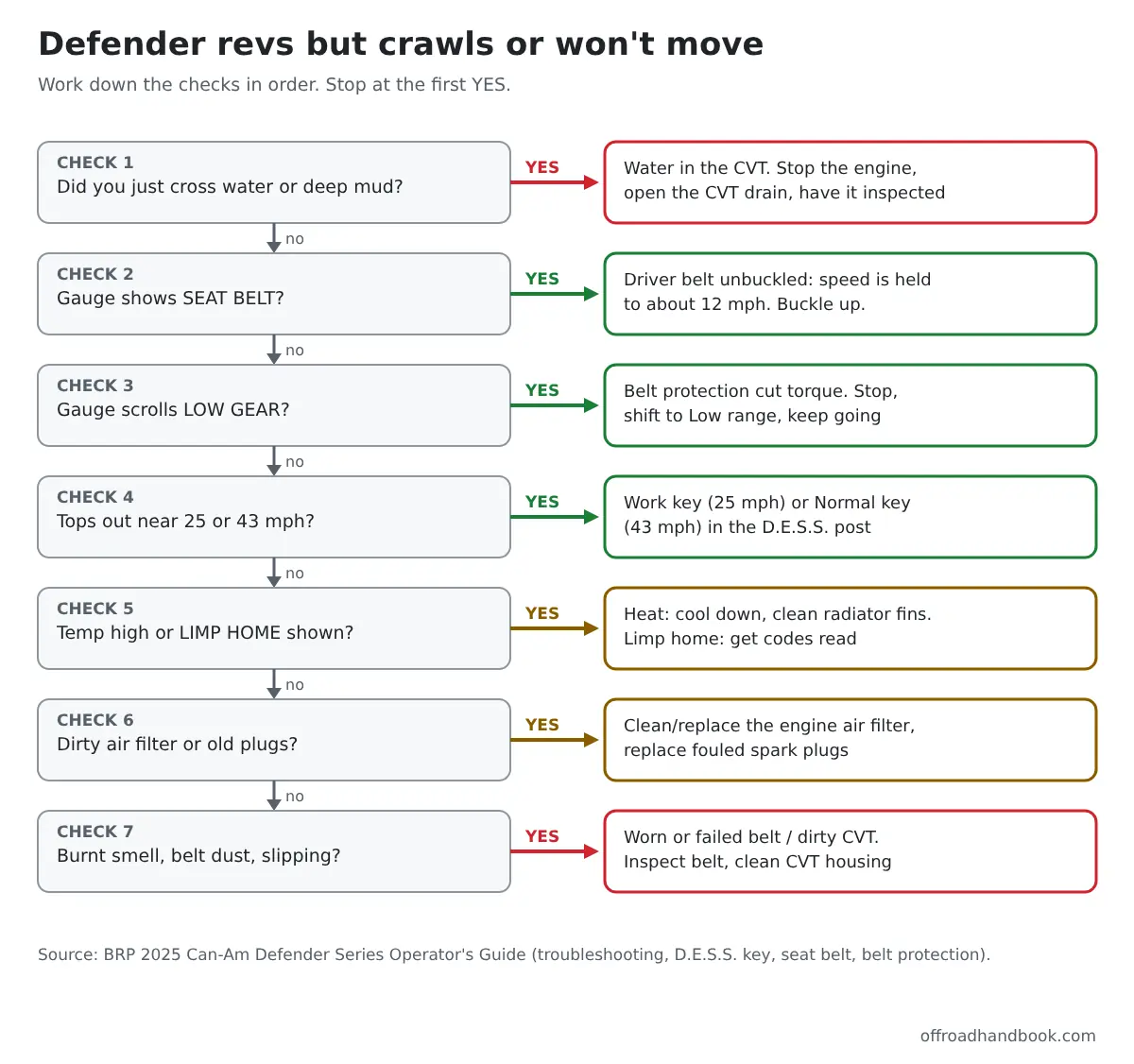
BRP lists two causes for "RPM increases but the vehicle does not move": water in the CVT, or a dirty, worn or failed belt. Water is the first suspect after any creek crossing or deep mud hole. The engine spins up, but the wet belt can't grip the pulleys.
The fix is to stop the engine and drain the CVT. On the 2025 Defender the drain sits on the left side of the vehicle, under the cargo box. BRP's notice is blunt: stop and drain the water to avoid damage to the CVT, then have the CVT inspected and cleaned.
If you didn't hit water, think about how you were driving. BRP says the main reason the belt slips is running in High range when you should be in Low.
2. Drive belt slipping, glazing or breaking
The CVT belt is the Defender's main wear item, and BRP says riding style and conditions have a direct impact on how long it lasts. Its guide spells out when to use Low range: pulling, pushing, hauling a load, 4x4 use, mud holes, water holes, crossing obstacles, climbing onto a trailer, hill climbing, and any long stretch under 15 mph.
Heat is the other belt killer. BRP recommends against holding wide-open throttle for more than five minutes in temperatures above 86°F, with heavy loads or passengers, or in high-drag conditions such as soft sand, hill climbs, mud or a track kit. After a few minutes at full throttle, ease off and let the CVT cool.
Those limits matter most in a Southwest summer or on a long uphill sand run. A few more belt rules from the guide:
- Break in every new belt. A new belt needs 30 miles of break-in with no hard acceleration or braking, no towing, and no high-speed cruising.
- Clean up after a failure. If a belt breaks, the CVT, cover and air outlet must be cleaned before the new belt goes on.
- Mind the arrow. The arrow printed on the belt points toward the front of the vehicle (viewed from the top). BRP says correct rotation direction gives maximum belt life.
- Keep the CVT intake clear. In deep snow it can pack shut, which caused a 2021 recall on HD10 Defenders with track kits (see the recall table below).
Some Defenders also have electronic drive-belt protection, which a dealer can activate. When it senses you're in High at too low a speed in those same hard-work situations, it cuts torque and scrolls LOW GEAR on the gauge. BRP says that when it activates, you must shift to Low.
If you need a spare belt for the trail, match the part to your engine (HD7, HD9 or HD10) and model year. You can search Defender drive belts on Amazon and confirm fitment against your VIN or the parts listing before you buy.
3. Overheating and torque limitation
BRP gives three causes for overheating: low coolant, a cooling fan that's jammed or not running (check its fuse), and dirty radiator fins. On a working Defender the fins are usually the problem. Mud, leaves, grass seed and crop husks get packed into the core until no air gets through.
To reach the radiator, pull the lower part of the front grille and slide it down. Check the radiator and hoses for leaks, then rinse the fins with a garden hose. Never clean the radiator with your hands while it's hot. Check the coolant level only once the engine has cooled.
Defenders with torque limitation mode cut engine torque gradually when coolant temperature gets too high, so overheating can feel like a sudden power loss. The fix is the same: stop, let it cool, and clean the radiator before you push on.
4. Defender won't crank
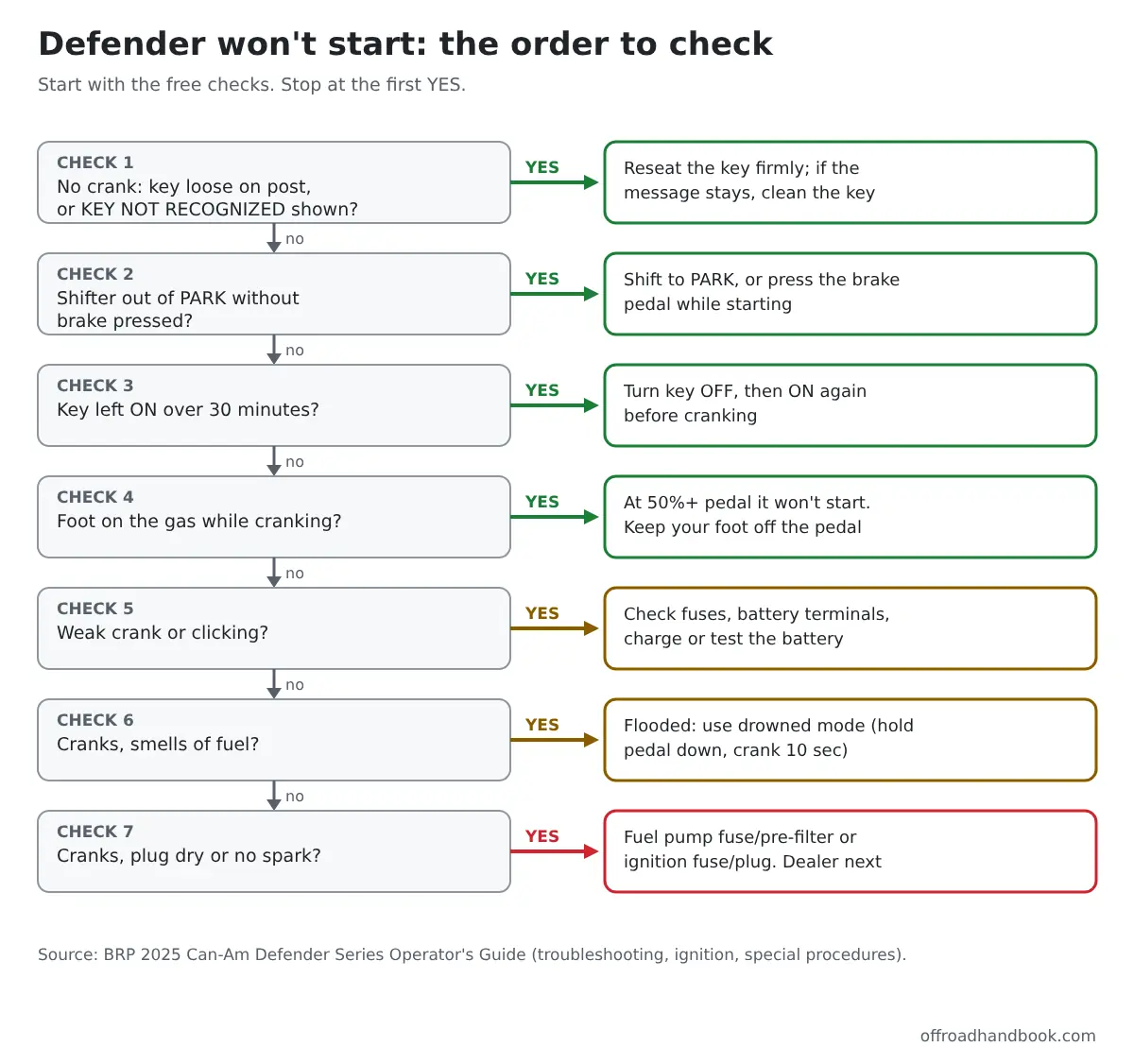
When nothing happens at all, start with the D.E.S.S. key. It has to be seated on its post. If the gauge says KEY NOT RECOGNIZED, BRP says to clean the key, and to see a dealer if the message stays. BAD KEY means it's a key for another vehicle.
Next comes the shifter. If it isn't in PARK or NEUTRAL, you have to press the brake pedal before the engine will start. After that, check the fuses and battery connections.
One no-start that catches a lot of owners is in the ignition section, not the troubleshooting pages. If the key is left ON for more than 30 minutes, the engine won't start until you turn the key OFF and then ON again.
A Defender that sits between hunting seasons can run its battery down. A 12-volt powersports battery maintainer keeps it topped up. If you have to jump it, BRP says to connect the red cable to the battery positive and the black cable to the chassis. Never connect any electrical source to the steering column or anything touching the DPS power steering.
5. Cranks but won't start
First, take your foot off the gas. If the accelerator is pressed 50% or more, the engine won't start. That's by design: holding the pedal down is also how you enter the flood-clearing mode.
If the engine is flooded, use BRP's drowned mode, which cuts injection and ignition while you crank:
- Put the shift lever in PARK.
- Turn the key to ON.
- Press the accelerator all the way down and hold it.
- Turn the key to START and hold it there for 10 seconds.
- Release the key, then release the pedal completely.
- Turn the key to START again to start normally.
If that doesn't work, BRP's next step is to remove the spark plugs, crank the engine several times, then install new plugs (or clean and dry the old ones).
A dry plug after cranking means no fuel is reaching the engine. Check the tank level and fuel pump fuse. After that, the suspects are a clogged pump pre-filter or a failed pump. No spark means checking the ignition fuse, then testing the plug.
Fuel quality matters too. BRP says the engine must not run on gasoline with more than 10% ethanol, so skip E15 at the pump. Water in the fuel causes misfires. The cure is draining the system and refilling with fresh fuel.
6. Speed capped at 12, 25 or 43 mph, or no power
A Defender that "won't go over" a certain speed is usually obeying a limiter, not failing. Match the speed you're stuck at to the table.
| Stuck at about | What's limiting it | Fix |
|---|---|---|
| 12 mph (flat ground) | Driver's seat belt not fastened; gauge shows SEAT BELT | Buckle the driver's belt |
| 25 mph | Work key: full torque, speed capped | Use a Normal or Performance key |
| 43 mph, softer throttle | Normal key: speed capped plus torque reduction | Use the Performance key for full speed and torque |
| Sudden torque cut, LOW GEAR message | Electronic drive belt protection (if activated) | Stop and shift to Low range |
| Power down, CHECK ENGINE lit, LIMP HOME | ECU limp mode after a critical fault | Have the fault codes read |
BRP notes that on hills the vehicle can go faster or slower than these caps. On a steep downhill the Work key's limiter may not stop it from going past 25 mph. Passenger belts don't trigger any light or message, so the driver has to check them.
If no limiter applies, BRP's list for lack of power is a plugged engine air filter (check the housing for deposits too), fouled or damaged spark plugs, water in the CVT, a dirty or worn CVT, or a clogged fuel pump pre-filter.
Dust is the usual reason filters plug early. In sand or dusty conditions, BRP says the CVT air filter needs cleaning before every ride, and more often again when you ride in a group.
Wash it in mild soapy water, rinse, shake it out, and let it air-dry at room temperature. Don't blow compressed air through the paper engine filter, because it damages the fibers.
7. Warning messages: CHECK DPS, PPS FAULT, LIMP HOME
The gauge tells you more than most owners realize. Here's what each message in BRP's display list means and how urgent it is.
| Message | Meaning | What to do |
|---|---|---|
| CHECK ENGINE | Active or past fault; no engine limitation yet | Get codes read soon |
| LIMP HOME | Critical fault; engine limited or behaving differently | Diagnose as soon as possible |
| TPS FAULT | Throttle body fault, usually followed by LIMP HOME | Dealer or shop |
| PPS FAULT | Accelerator pedal sensor fault; partial or no pedal response | Dealer |
| CHECK DPS | Dynamic Power Steering not working properly | Dealer |
| CHECK SMART-LOK | Smart-Lok front differential not working properly | Dealer |
| BRAKE SWITCH FAULT | Brake signal fault | Dealer or shop |
| FUEL SENSOR FAULT | Fuel sender reading out of range | Dealer or shop |
| D.E.S.S. KEY NOT RECOGNIZED / BAD KEY | Dirty key, or a key for another vehicle | Clean the key, or use the right one |
The guide doesn't give a home fix for any of the sensor faults. They need a scan tool, so a dealer or a shop with BRP diagnostics is the next stop.
BRP draws a clear line between the two engine warnings. CHECK ENGINE flags a fault that needs attention, with no engine limitation. LIMP HOME is a critical fault that has already limited the engine and needs diagnosis as soon as possible.
8. 4WD, diff lock and shifter problems
Most Defender drivetrain complaints come from using the controls in a way the guide warns against. The vehicle must be stopped to switch between 2WD and 4WD. BRP warns that mechanical damage may occur if you flip it while moving. Always unlock the front diff before going back to 2WD.
The front diff lock can be engaged on the fly and switches off when the engine stops. It makes steering heavier and slower, and BRP warns never to engage it before entering a turn or while turning. The rear diff lock is different: switch it only when stopped and in gear, not Park.
For the transmission, BRP says to stop completely and apply the brakes before every shift, or the gearbox may be damaged. A "–" on the gear display means the lever is caught between two positions. If seating the lever doesn't clear it, the lever needs adjusting or there's an electrical communication fault. Both are dealer jobs.
Can-Am Defender recalls to check
Some "problems" are recall items that a dealer fixes for free. These are the Defender recalls posted by the U.S. Consumer Product Safety Commission (CPSC).
| Recall date | Defender models | Problem | Remedy |
|---|---|---|---|
| Jan 12, 2017 (17-726) | 2016 Defender, Defender DPS, Defender XT (about 780 units) | Can roll away while in Park | Free dealer repair |
| Jul 22, 2021 (21-767) | 2020–2021 Defender HD10 models used with Apache 360 LT or Apache Backcountry track kits (about 34,400 units) | Stock CVT intake can pack with snow; belt can overheat and break, fire hazard | Stop using track kits in snow; free dealer repair |
| Feb 9, 2023 (23-723) | 2023 Commander, Defender and Maverick Sport/Trail (about 3,310 units in the U.S.) | Defective fuel hose assembly can leak fuel, fire hazard | Free fuel hose replacement |
| Dec 14, 2023 (24-735) | 2022–2023 Defender, Commander and Maverick Trail with HD7 or 700 engines (about 14,555 units in the U.S.) | Operator's guide listed wrong clutch maintenance intervals; clutch can fail and eject fragments | Revised maintenance booklet; follow new intervals |
The 2023 clutch notice matters most for used-Defender buyers. If you own a 2022 or 2023 HD7 model, make sure you're following the revised clutch service interval, not the one in the original guide.
To check a specific machine, give a Can-Am dealer your VIN or call BRP at 888-272-9222. This table covers CPSC postings only. Ask the dealer about any newer campaigns for your year.
After mud or water: the post-ride routine that prevents most of these
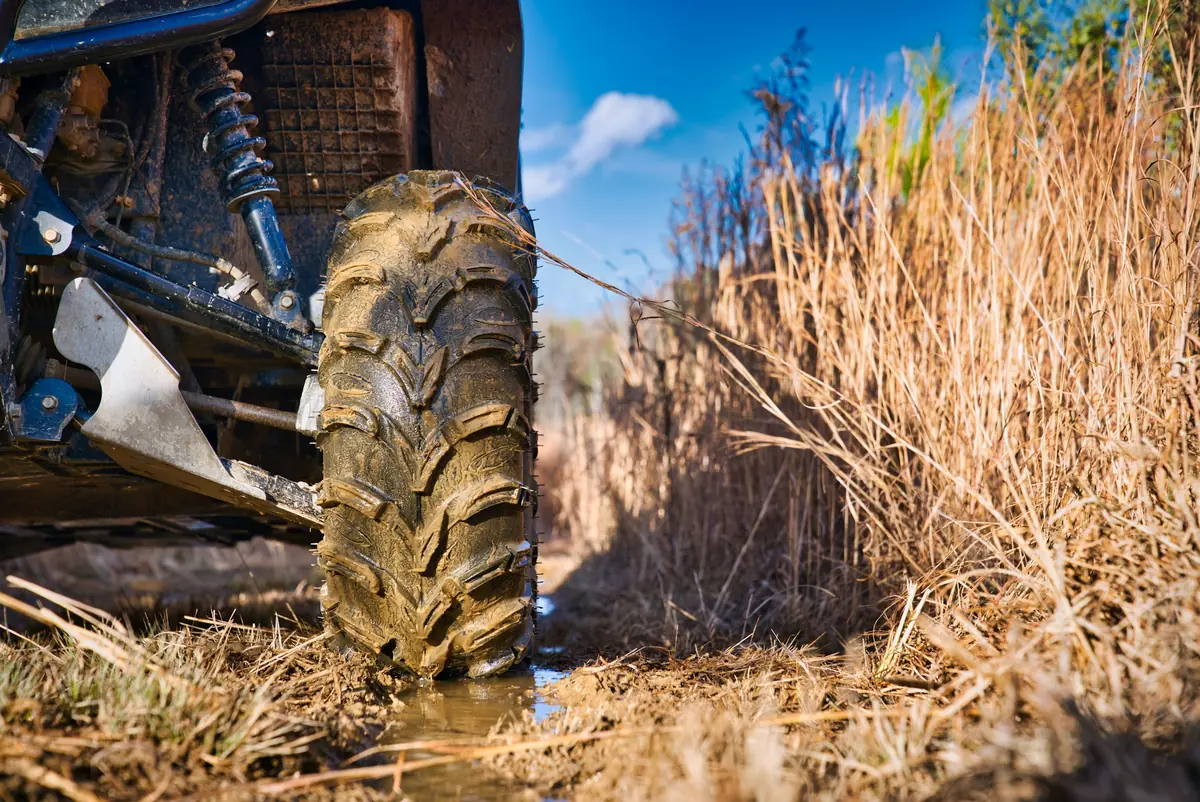
BRP gives Defender owners who ride in deep mud or water a post-ride care list. It also covers several of the problems above before they start:
- Rinse the vehicle and its components with fresh water.
- Clean the CVT air filters, and drain and clean the CVT compartment if you find water or mud.
- Inspect and clean the engine air filter and its housing.
- Clear debris around the exhaust, muffler and spark arrester.
- Clean the radiator.
- Look for water in the vent hoses (fuel tank, gearbox, front differential, rear final drive). If you find any, BRP says to take it to a dealer.
- Clean the shocks, drive shaft bellows and propeller shaft yokes or boots.
Before you cross water, know how deep it is. Our water fording depth calculator and guide explains how to judge a crossing, and the same logic applies to a side-by-side's CVT and air intakes.
Two situations call for no starting at all. If the Defender rolls over, BRP says never start the engine and have it transported to a dealer for inspection. If it was submerged, don't crank it either. Starting an engine that has swallowed water can wreck it if the correct restart procedure isn't followed.
FAQ
Why is my Can-Am Defender limited to 25 mph?
That's the Work key. It allows full engine torque but caps speed at 25 mph. The Normal key caps speed at 43 mph and softens torque, and the Performance key unlocks full speed. An unbuckled driver's seat belt caps it at about 12 mph on flat ground.
Can I keep driving with water in the CVT?
No. BRP says to stop the engine and drain the water to avoid damaging the CVT, then have it inspected and cleaned. A wet belt slips, and slipping is what glazes and burns belts.
Does the 2023 clutch recall cover HD9 and HD10 Defenders?
No. CPSC notice 24-735 covers 2022 and 2023 models with HD7 or 700 engines only. HD10 Defenders appear in the 2021 snow-intake recall, and only for 2020–2021 units used with the listed track kits.
How long should a Defender belt last?
BRP doesn't publish a fixed belt life in the operator's guide, because it depends on use. What extends it, per BRP: Low range for slow, heavy or muddy work, no more than five minutes of wide-open throttle in heat or heavy drag, a 30-mile break-in on every new belt, and a clean CVT intake.
Related guides
- ATV and UTV troubleshooting by symptom
- Can-Am Maverick Sport problems and fixes
- Can-Am Commander problems, fuse chart and recalls
- Polaris Ranger 1000 problems and fixes
- Odes Dominator 800 problems, fault codes and fixes
- Can-Am Outlander 570 problems, recalls and fixes for the ATV with the same CVT basics
- Free off-road calculators

I'm Suryashankar Dasgupta, the founder of Off-Road Handbook. I've been off-roading for years in the USA, including California and Texas, and have ridden mountain and desert terrain abroad. I've also driven a Jeep Compass for more than seven years, so I know the day-to-day side of Jeep ownership first-hand, from the Uconnect screen to the warning lights. Every guide here is researched from manufacturer owner's manuals, NHTSA recall and service-bulletin records and other trusted sources, checked against them before it is published, and corrected when we find a mistake. You can read how we work in our editorial policy: https://offroadhandbook.com/editorial-policy/
Like our off-road guides? Add Off-Road Handbook as a Google Preferred Source so our latest Jeep, ATV, UTV, trail, recovery, and off-road troubleshooting articles can appear more often in your Google Search experience.
Add us as a Preferred Source