How to Use Traction Boards in Snow, Sand and Mud
This post contains Amazon affiliate links. As an Amazon Associate I earn from qualifying purchases, at no extra cost to you.
To use traction boards, stop the moment your tires spin, dig out the side of each tire facing the way you want to go, and jam the board's ramp end hard against the tread. Then clear everyone away and ease on in 4WD low, first gear, so the tires crawl onto the boards instead of spinning.
If they spin, stop, re-wedge and dig more. Once you're moving, keep rolling steadily until you're on firm ground.
That's the short version both big board makers agree on. The details below cover snow, sand and mud, where the boards go with two or four of them, and the situations where boards won't help at all.
How to use traction boards, step by step
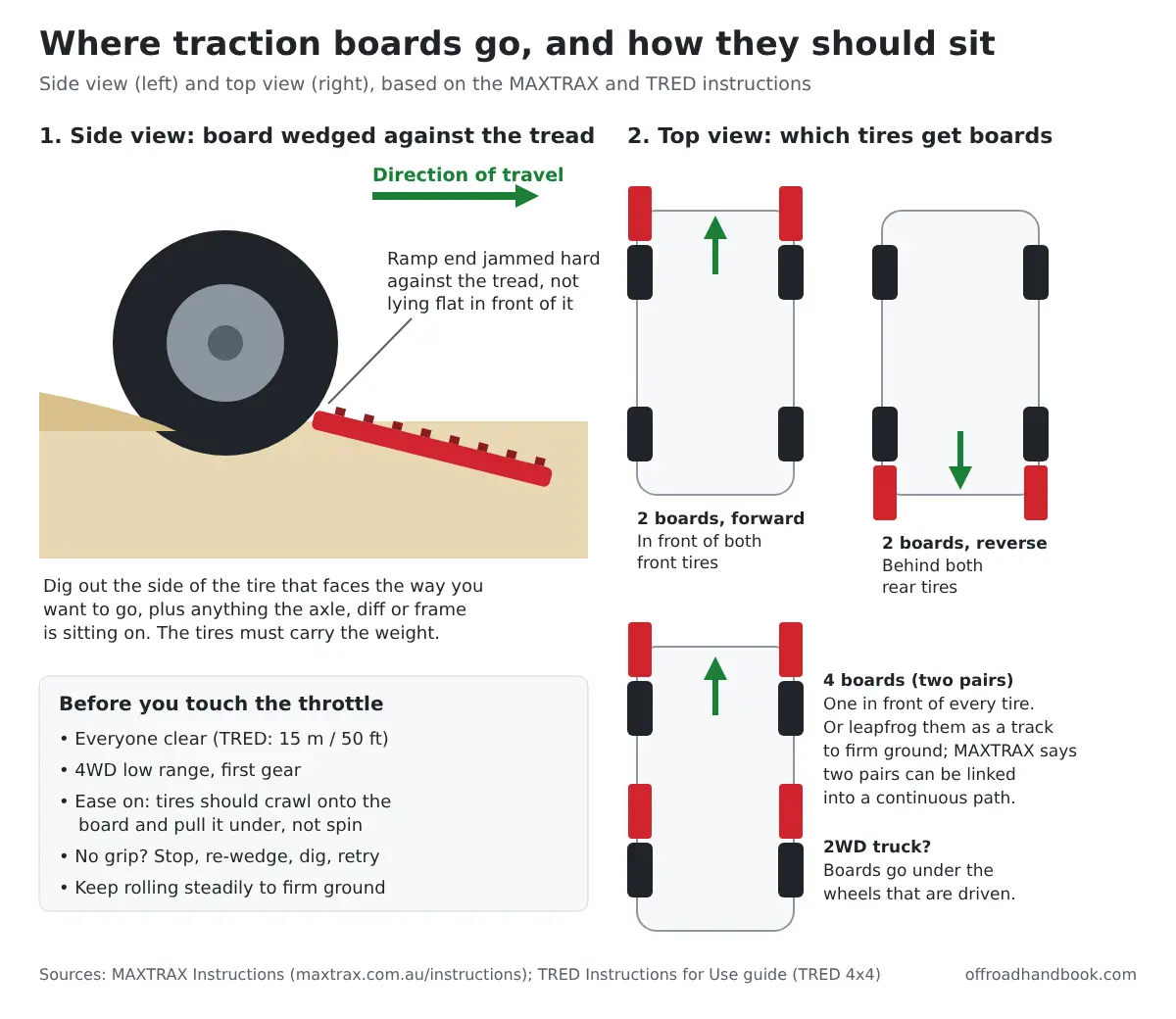
- Stop at the first sign of spin. Spinning tires only bury you deeper. TRED's guide puts it plainly: it's far quicker to slip boards under early than to recover a heavily bogged vehicle.
- Turn on your hazard lights if there's any traffic around. TRED's instructions say not to attempt a recovery at all while there's a risk of being hit by passing vehicles.
- Dig. Clear sand, snow or mud from the face of each tire you'll drive toward, and from under the axles, differential and frame. Both makers stress that the tires have to carry the vehicle's weight. A board under a tire that's hanging off a buried diff does nothing.
- Don't crawl under the vehicle to dig, and watch for hot exhaust parts. Reach in from the side with the shovel.
- Wedge the boards. Push the ramp end firmly against the tread so the board sticks up at an angle rather than lying flat. Going forward, that's in front of both front tires. Reversing, it's behind both rear tires. With four boards, one goes at every tire.
- Air down if you haven't already. Lower pressure helps the tread grab the board's lugs.
- Clear the area. Everyone stands well back (TRED says at least 15 meters, about 50 feet). Never place or adjust boards while the engine is running or the vehicle is in gear.
- Low range, first gear, gentle throttle. The tires should turn slowly enough to grip the lugs and draw the boards underneath.
- No grip? Stop. Reposition the boards so they're tight against the tread, clear whatever is in the way, and try again.
- Keep moving once you have traction. Hold steady momentum until you reach firm ground, then walk back for the boards. The leashes make buried boards easier to find.
If the vehicle bogs down again a few feet later, repeat the process. With two pairs you can leapfrog the boards ahead as a short track to solid ground.
Not sure your situation is a board job at all? The checker below asks the questions that decide it.
Traction Board Go/No-Go Checker
Pick your surface, what's touching the ground, your drivetrain and your rig's loaded weight. The checker tells you whether boards alone should do it, what to dig first, and when to plan for a pull instead.
How the checker decides: the hard-ground, weight and cold limits come straight from the MAXTRAX instructions (5,000 kg is 11,023 lb; −20°C is −4°F).
The 15–18 psi, 50-foot and "combine methods" advice comes from TRED's printed guide. Other brands publish their own limits, so treat the result as a starting plan, not a rating for your specific boards.
For a tire-specific pressure, run your size and weight through the air-down PSI calculator for sand, mud and snow before you head out. A stiff Load Range E tire on a heavy truck won't behave like a light-duty tire at the same number.
What the board makers actually say (and where most guides go wrong)
Most traction board articles are written by retailers, and they don't agree with each other. One popular guide says to stand the boards up at about 45 degrees. A brand blog says 15 to 20 degrees. Neither number appears in the instructions from MAXTRAX or TRED.
What both makers do say is to wedge the board firmly so the tread is in solid contact with the ramp end. MAXTRAX adds that the board should protrude at an angle, not lie flat.
The angle you end up with depends on how deep the tire sits, so don't dig to hit a number. Dig until the board is jammed tight against rubber.
| Topic | MAXTRAX instructions | TRED Instructions for Use |
|---|---|---|
| When to start | Stop as soon as the vehicle stalls; spinning buries it deeper | Stop as soon as traction is lost; boards early beat a heavy bog |
| Digging | Clear tires, diffs, axles and side steps; wheels must carry the weight | Clear only the side of the tire facing your direction; vehicle must not rest on axles or diff |
| Placement | Wedge firmly against the tread, pointing the way you'll travel; at an angle, not flat | Wedge firmly so the tread is in firm contact with the ramp end |
| Tire pressure | Lowering pressure improves traction (no number given) | 15–18 psi, off-road only |
| Gear and throttle | Low range, first gear, gentle; no wheelspin | Low-range 4WD, slowly accelerate; avoid wheelspin |
| If tires don't grip | Stop, reposition, clear more debris, retry | Stop, remove debris, reposition, retry |
| Still stuck | Repeat; link pairs into a track | Rock the vehicle with a board on each side of the same axle; combine with straps or a winch |
| Bystanders | Clear everyone from the area | Everyone at least 15 m (about 50 ft) away |
| Don't use on | Hard or rocky surfaces | Hard or rocky ground |
| Not designed as | A bridge or ramp | A ramp, a lift for repairs, a gap bridge or a loading ramp |
| Vehicle weight limit | 5,000 kg (11,023 lb) | Not stated in the guide; check your model's rating |
| Cold limit | Not below −20°C (−4°F) | Not stated in the guide |
I put this table together from those two documents only, the MAXTRAX instructions page and TRED's printed guide. Where one maker gives a number and the other doesn't, the cell says "not stated" instead of borrowing a figure from a retailer listing.
Notice how much they agree. Both makers warn against wheelspin, digging too little, and using boards on hard ground or as ramps. Those are the habits that kill boards and leave you stuck.
How to use traction boards in snow
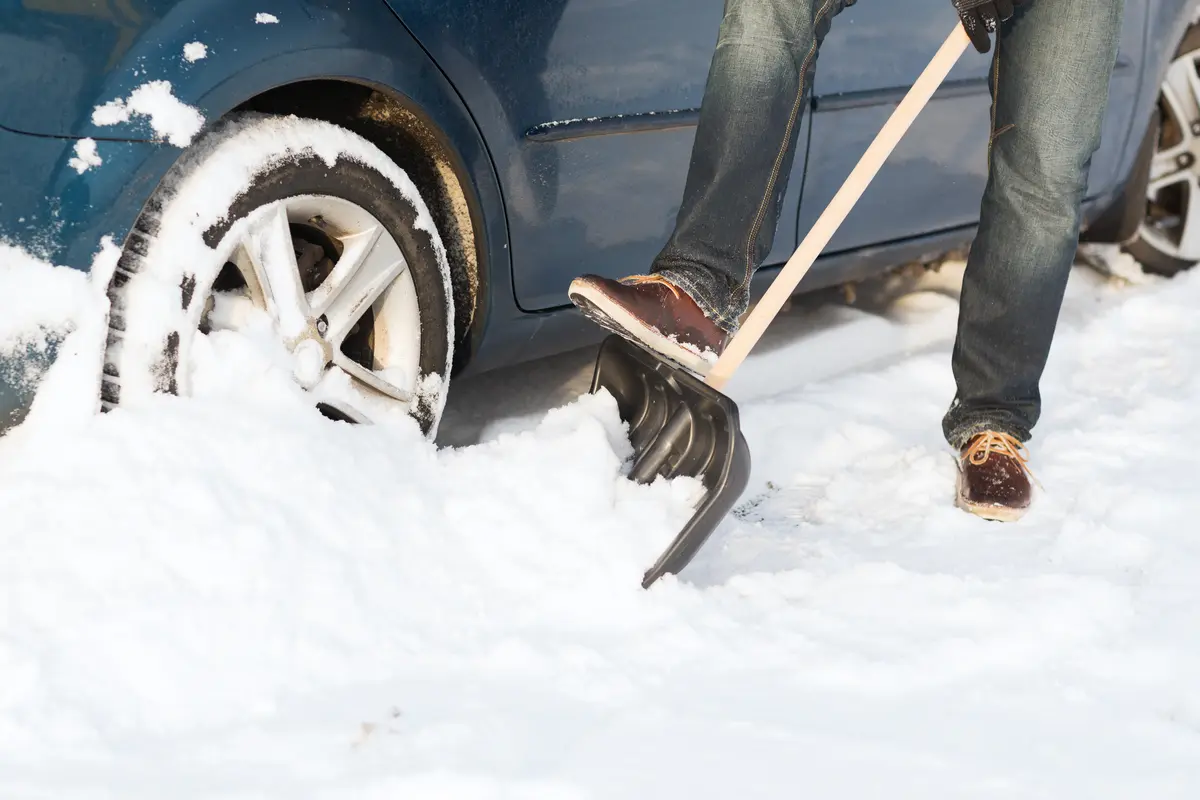
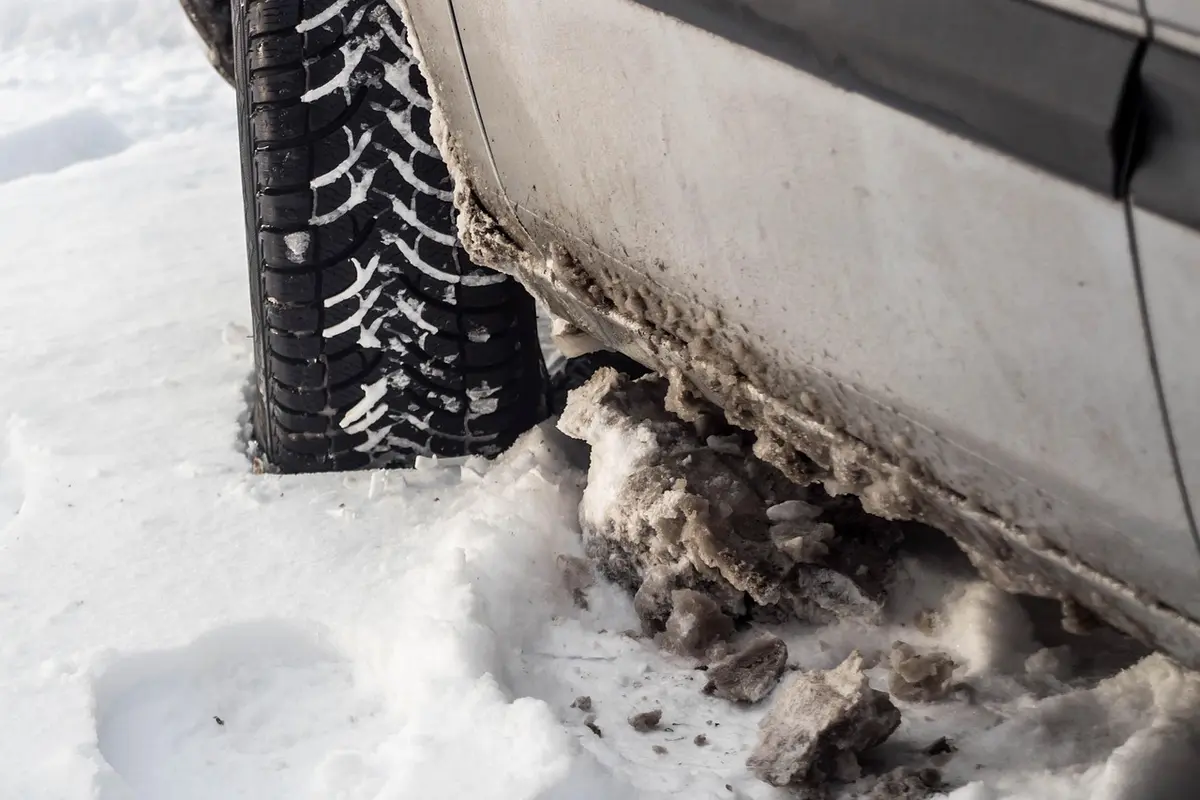
Snow is where a lot of first-timers learn that boards need a shovel. Snow packs up in front of the tire like a wall. Shovel that wall out first, and dig under the frame if you've plowed a drift with the bumper.
Get the board under the tire as far as it will go. If you can dig down to packed snow or dirt, the board has something firm to sit on.
Watch the temperature on real cold-weather trips. MAXTRAX says not to use its boards below −4°F.
If you run into glare ice on a hard road, boards are the wrong tool; that's a hard surface, and chains are the answer. Our guide to 4WD chain rules in California, Colorado, Oregon, Washington and Utah covers when you need them.
How to use traction boards in sand
Sand is the surface boards were made for, and airing down does a lot of the work. Drop pressure before you hit soft sand and you may never need the boards.
Dig a gentle ramp in front of each tire so it doesn't have to climb a vertical lip. If you nosed into a soft bowl, dig out the front axle or skid plate too.
Once you're rolling, don't stop on a soft upslope to grab the boards. Drive to firm or flat ground, park, and walk back. Our sand dune driving guide covers starting pressures, flags and the throttle habits that keep you from needing boards again.
How to use traction boards in mud
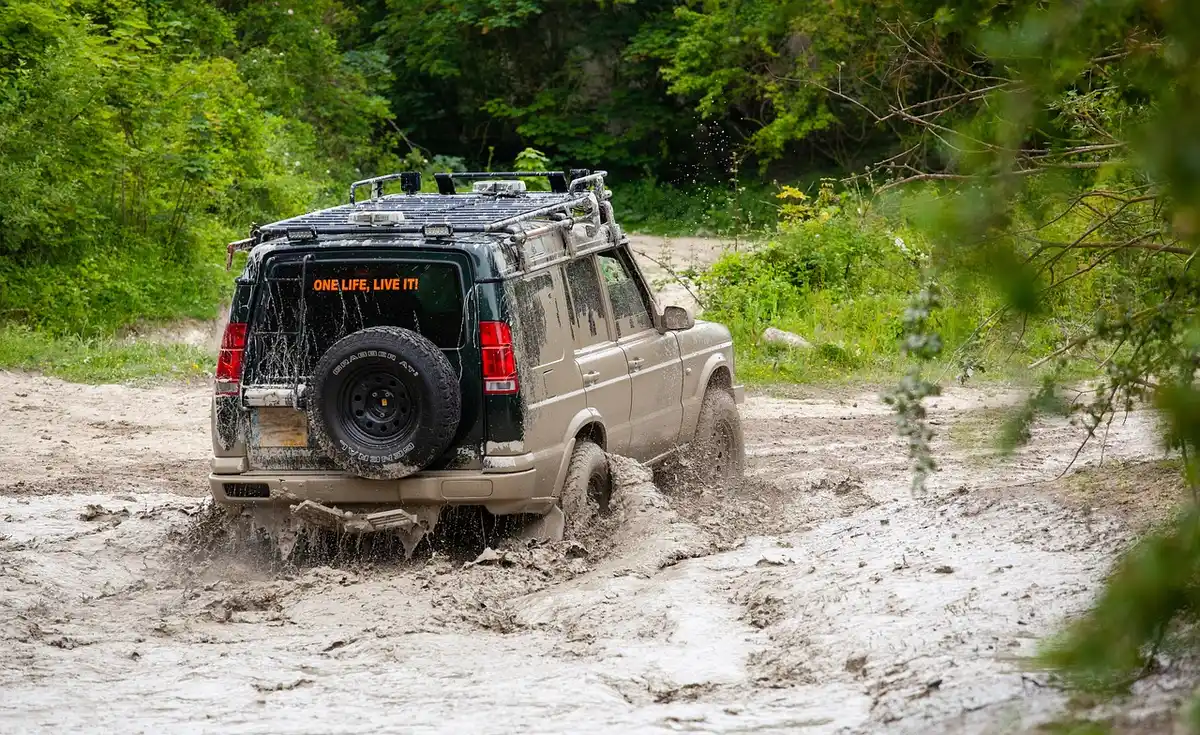
Mud is the hardest of the three for boards. Packed-in tread can't bite the lugs, and deep ruts often leave the differentials sitting on the crown between them.
Dig the crown down until the tires carry the weight again. If the tires smear across the board instead of grabbing it, stop. Clear the mud off the board face and from in front of the tire, re-wedge it, and try again slowly.
If forward won't go, try TRED's rocking trick: a board on each side of the same axle, then ease forward and back to build a short packed path. In a truly deep bog, TRED says to combine boards with a strap or winch. The boards cut the force the pull needs.
Mistakes that chew up boards and dig you deeper
- Spinning the tires on the board. MAXTRAX says wheelspin generates enough heat to melt the material and burn off the teeth, and it doesn't cover that damage under warranty.
- Skipping the dig. If the diff or frame is carrying the weight, the tire has nothing to push with.
- Laying the board flat in front of the tire. The tire just pushes it forward. Jam it into the tread.
- Standing nearby during the attempt. TRED wants everyone at least 15 meters (about 50 feet) back while the driver tries.
- Using boards as ramps or lift blocks. Both makers say they aren't designed as ramps, and TRED says not to use them to raise a vehicle for repairs or to bridge gaps.
- Driving off without them. Buried boards are easy to leave behind. The leashes are there so you can find and pull them out.
When traction boards won't get you out
Boards are a solo, slow-speed tool. They're great when the problem is traction. They can't help when the problem is something else.
- You're high-centered on a rock, a stump or the frame, and digging can't put the weight back on the tires.
- The surface is hard: rock, hardpack or ice. Both makers say not to use boards there.
- You're over the board's weight rating. MAXTRAX lists 11,023 lb; heavy-duty trucks with campers can go over that.
- You need to go uphill out of a hole and the tires still won't grip after two or three honest tries.
That's when you need a pull. If you have a buddy rig, read our comparison of kinetic ropes, snatch straps and tow straps to pick the right one. If you wheel alone, use the winch size calculator to check the line pull your rig needs.
Keep the boards under the tires during the pull. The tires get some drive while the rope or winch does the rest, and that lowers the load on everything.
Traction boards vs a winch, a strap or chains
These aren't really rivals. Each one solves a different problem:
- Traction boards: soft ground, no second vehicle and nothing to anchor to. Slow and low-stress, but they need digging.
- Kinetic rope or snatch strap: needs a second vehicle and rated recovery points. Fast, but it puts big loads on the gear.
- Winch: works solo if there's a solid anchor such as a tree or a buried spare. Handles high-centered and uphill recoveries that boards can't.
- Chains: traction on snow and ice while driving, and legally required on some mountain passes. They're not a stuck-in-a-drift tool.
A common starting kit is a pair of boards plus a strap and rated shackles, with a winch added if you often travel alone.
Choosing and carrying traction boards
The two brands whose instructions this guide follows are easy to find in the US. The MAXTRAX MKII recovery boards were the first modern nylon recovery board, launched in 2005; the safety-orange color is easy to spot when one's half-buried.
The ARB TRED Pro recovery boards are the current TRED design, sold through ARB. Check the current price on Amazon; both are sold as pairs.
Whatever you buy, look up that model's own vehicle-weight and temperature limits. Budget boards often list a big "load capacity" number, and that isn't the same thing as a rating for a vehicle driving across them.
Carry them where you can reach them without unloading the truck: a rack, a tailgate or spare-tire mount, or a bed rail. Lock them if they ride outside. Add a long-handled shovel; both makers mention the board's built-in shovel end, but a real shovel moves far more snow and sand.
Traction board FAQ
Are traction boards worth it?
For sand, snow and mud trips, yes, especially if you sometimes travel with just one vehicle. They're the one recovery tool that works with no anchor and no second vehicle. They're less useful if you mostly drive rocky trails, where the makers say not to use them.
Do traction boards work in snow?
Yes, in soft or packed snow, as long as you dig out the snow packed in front of the tires and get the board seated firmly. They don't help on glare ice over pavement, which counts as a hard surface. MAXTRAX also sets a cold limit of −4°F for its boards.
How many traction boards do I need?
One pair handles most stuck situations on a 4x4: in front of both front tires going forward, or behind both rears in reverse. Two pairs let you board every tire or leapfrog them into a track, which helps in long stretches of soft sand or deep snow.
At what angle should a traction board sit?
Neither MAXTRAX nor TRED gives a degree figure. Both say to wedge the board firmly against the tread so it angles up instead of lying flat. Aim for tight contact between tread and ramp end, not a specific number.
Can I use traction boards as ramps or leveling blocks?
Not as ramps. MAXTRAX says not to use its boards as a bridge or ramp, and TRED says its boards aren't designed as a ramp, to raise a vehicle for repairs, to bridge gaps or to load vehicles or ATVs. Check your own brand's instructions before using them for anything but recovery.
Sources
- MAXTRAX Instructions (steps, wheelspin warning, hard-ground, ramp, 5,000 kg and −20°C limits)
- TRED Instructions for Use guide (PDF) (steps, 15–18 psi, 15 m clearance, rocking recovery, ramp and repair warnings)
- ARB: TRED Pro recovery boards product page (current TRED Pro design and materials)
- 4X4 Australia: How to use traction boards (MAXTRAX history; the 45-degree claim discussed above)
- Rhino USA: How to use traction boards in any terrain (the 15–20 degree claim discussed above)

I'm Suryashankar Dasgupta, the founder of Off-Road Handbook. I've been off-roading for years on mountain and desert terrain. I've also driven a Jeep Compass for more than seven years, so I know the day-to-day side of Jeep ownership first-hand, from the Uconnect screen to the warning lights. Every guide here is researched from manufacturer owner's manuals, NHTSA recall and service-bulletin records and other trusted sources, checked against them before it is published, and corrected when we find a mistake. You can read how we work in our editorial policy: https://offroadhandbook.com/editorial-policy/
Like our off-road guides? Add Off-Road Handbook as a Google Preferred Source so our latest Jeep, ATV, UTV, trail, recovery, and off-road troubleshooting articles can appear more often in your Google Search experience.
Add us as a Preferred Source